
Glossary
Documentation Specialist
 ChatGPT
 Perplexity
 Gemini
 Claude
What is a documentation specialist?
A documentation specialist creates, organizes, maintains, and improves documentation so people can use it reliably. In business operations, the role often sits between subject matter experts, managers, support teams, training teams, and the employees who need clear instructions to do the work.
The role is bigger than writing. A good documentation specialist turns scattered know-how into usable content, keeps the system consistent, and reduces the amount of critical knowledge trapped in meetings, chat threads, or one experienced employee's head. Knowledge-retention research for public agencies points to documenting experienced employees' knowledge through interviews, videos, and knowledge-sharing platforms as a practical strategy for reducing knowledge loss. 1
What a documentation specialist does
A documentation specialist usually works on practical, repeatable information: SOPs, help articles, process guides, onboarding materials, internal knowledge base pages, product documentation, policy explanations, templates, and training references. The Bureau of Labor Statistics describes technical writers as preparing instruction manuals, how-to guides, and other supporting documents that make complex information easier to understand, which overlaps with much of this practical documentation work. 2
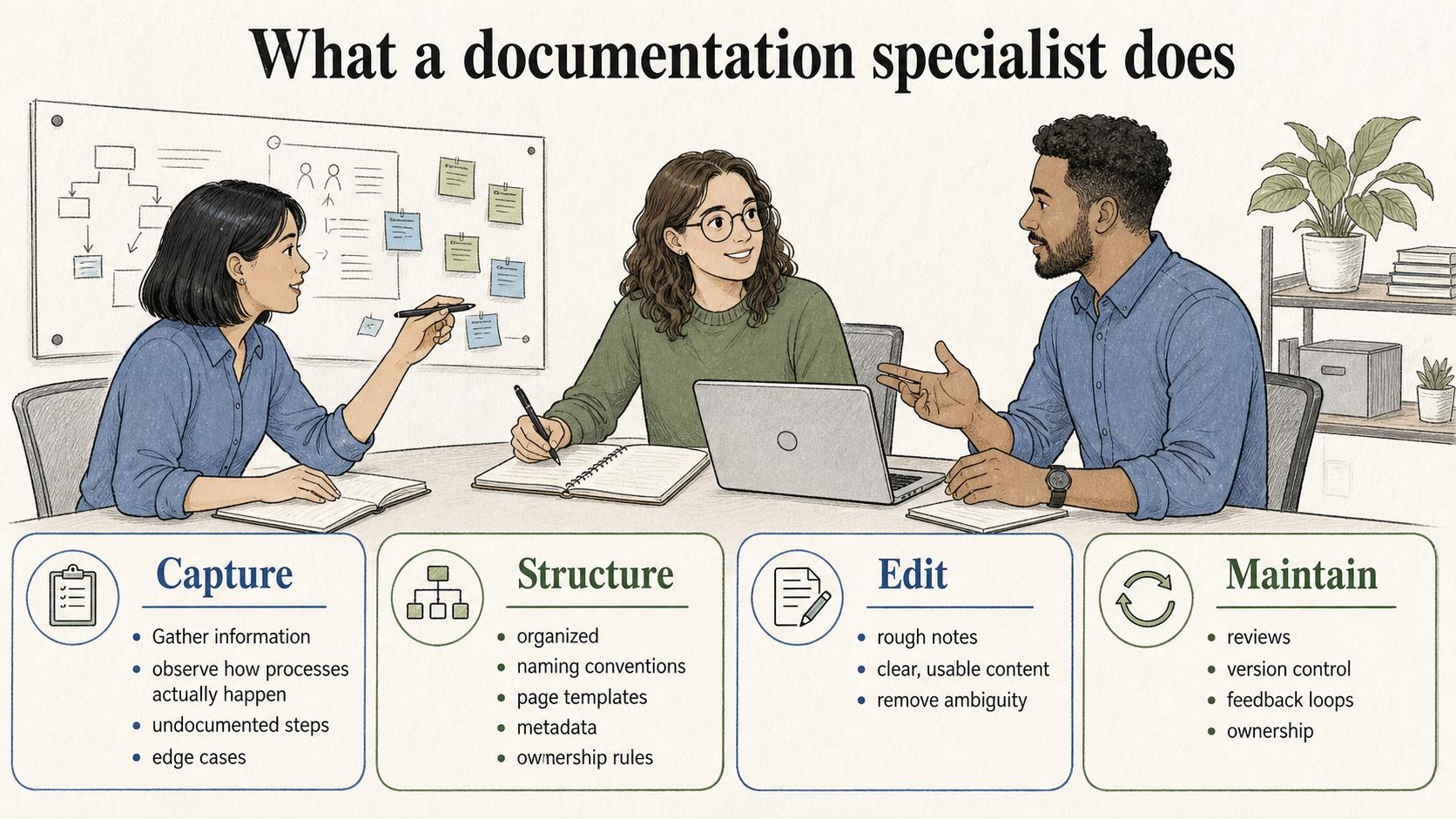
The exact responsibilities depend on the company, but the work tends to include four layers:
- Capture. Gather information from people who know the work, observe how processes actually happen, review existing materials, and identify undocumented steps or edge cases.
- Structure. Decide how documentation should be organized so a reader can find the right answer quickly. This may include naming conventions, page templates, information architecture, metadata, ownership rules, and related links.
- Edit. Turn rough notes, recordings, drafts, and expert explanations into clear, usable content. The strongest documentation specialists remove ambiguity without flattening the expert judgment that makes the process work.
- Maintain. Keep documentation current through reviews, version control, feedback loops, and ownership. APQC's process-knowledge research treats managing the content lifecycle as a core part of process knowledge, so maintenance belongs in the role instead of being left as an afterthought. 3
When a team needs a documentation specialist
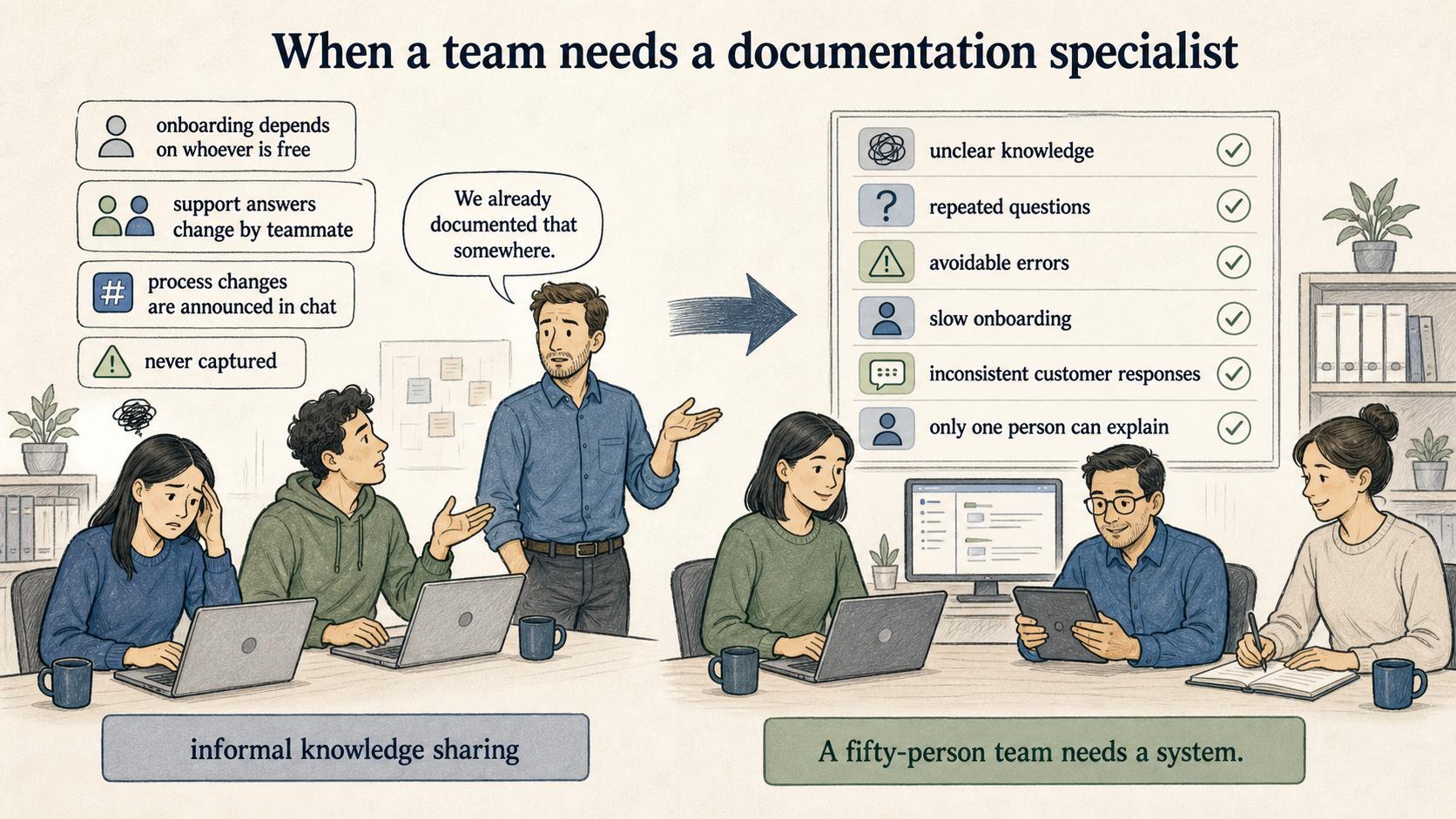
Teams usually feel the need before they name the role. The signs are familiar: onboarding depends on whoever is free, support answers change by teammate, process changes are announced in chat but never captured, and managers keep saying, "We already documented that somewhere."
A documentation specialist becomes valuable when unclear knowledge is more expensive than maintaining it. That cost shows up as repeated questions, avoidable errors, slow onboarding, inconsistent customer responses, or process work that only one person can explain.
The role is especially useful when a company is growing past informal knowledge sharing. A five-person team can remember how work gets done. A fifty-person team needs a system.
What makes a documentation specialist effective
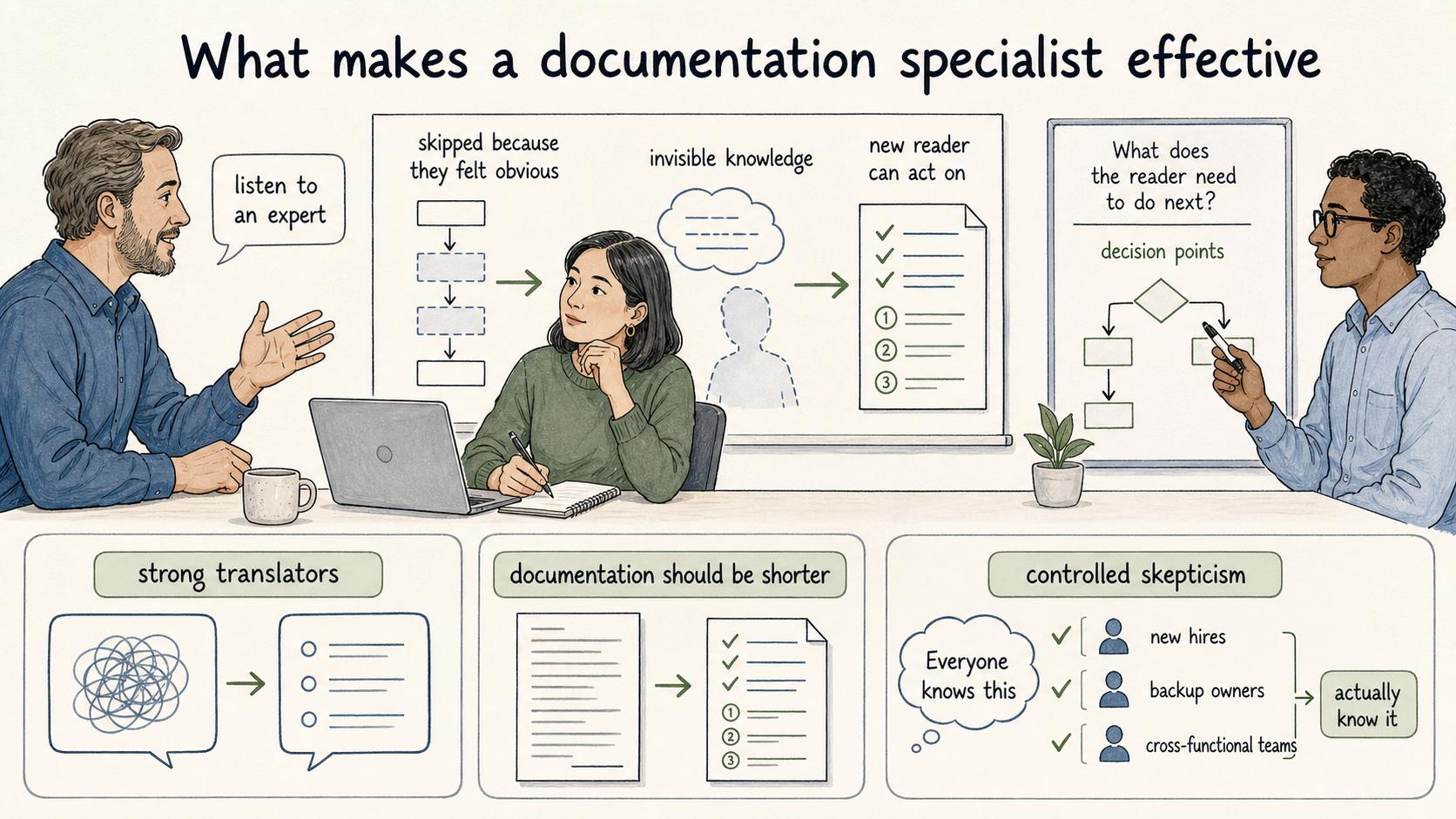
The best documentation specialists are strong translators. They can listen to an expert, notice the parts the expert skipped because they felt obvious, and turn that invisible knowledge into something a new reader can act on.
They also know when documentation should be shorter. More detail can make a page harder to use if it buries the decision points. A good documentation specialist asks, "What does the reader need to do next?" and shapes the page around that job.
Another important skill is controlled skepticism. If a process owner says, "Everyone knows this," the documentation specialist checks whether new hires, backup owners, and cross-functional teams actually know it. That polite friction is part of the job.
Practical role brief template
Use this prompt to define the role for your team before hiring, assigning, or scoping documentation work.
## Documentation Specialist Role Brief

**Glossary term:** documentation specialist
**Source:** Trails Glossary — trails.so/glossary/documentation-specialist

---

### 01. Create a practical role brief

"Create a documentation specialist role brief for [team/company].
The documentation problems we need to solve are: [problems].
The main audiences are: [audiences].
Include:
- Types of documentation this role owns
- Subject matter experts and teams they will work with
- Quality standards for a good page or guide
- Review and maintenance responsibilities
- Tools and workflows they need to use
- Success signals after 30, 60, and 90 days
- Work this role should not own
Write it as a practical operating role, not a generic job description."
Documentation takeaway
A documentation specialist gives documentation an owner and a method. Without that ownership, teams often produce useful fragments that slowly drift out of date. With it, documentation becomes part of how work is transferred, improved, and repeated.
The role works best when it has access to real workflows, not just after-the-fact notes. A documentation specialist needs to see where people hesitate, what exceptions come up, and what decisions are usually made from memory.
How Trails helps
Trails helps documentation specialists capture workflows directly from the people doing the work, then turn those captures into polished step-by-step guides. That gives the specialist a clearer starting point than a blank page or a rushed SME interview. Trails can also create AI-narrated video versions for training and sharing.
Sources
- 1
Wyoming Department of Transportation. Knowledge retention research report. www.dot.state.wy.us/files/live/sites/wydot/files/shared/Planning/Research/RS03225_Knowledge_Retention.pdf.
- 2
Bureau of Labor Statistics. Technical writers profile. www.bls.gov/ooh/media-and-communication/technical-writers.htm.
- 3
APQC. Managing Process Knowledge collection. www.apqc.org/resource-library/resource-collection/managing-process-knowledge.