
Glossary
Technical Writer
 ChatGPT
 Perplexity
 Gemini
 Claude
What is a technical writer?
A technical writer is a documentation professional who turns complex information into clear, usable content. The U.S. Bureau of Labor Statistics describes technical writers as professionals who prepare instruction manuals, how-to guides, journal articles, and other supporting documents to communicate complex technical information more easily.1
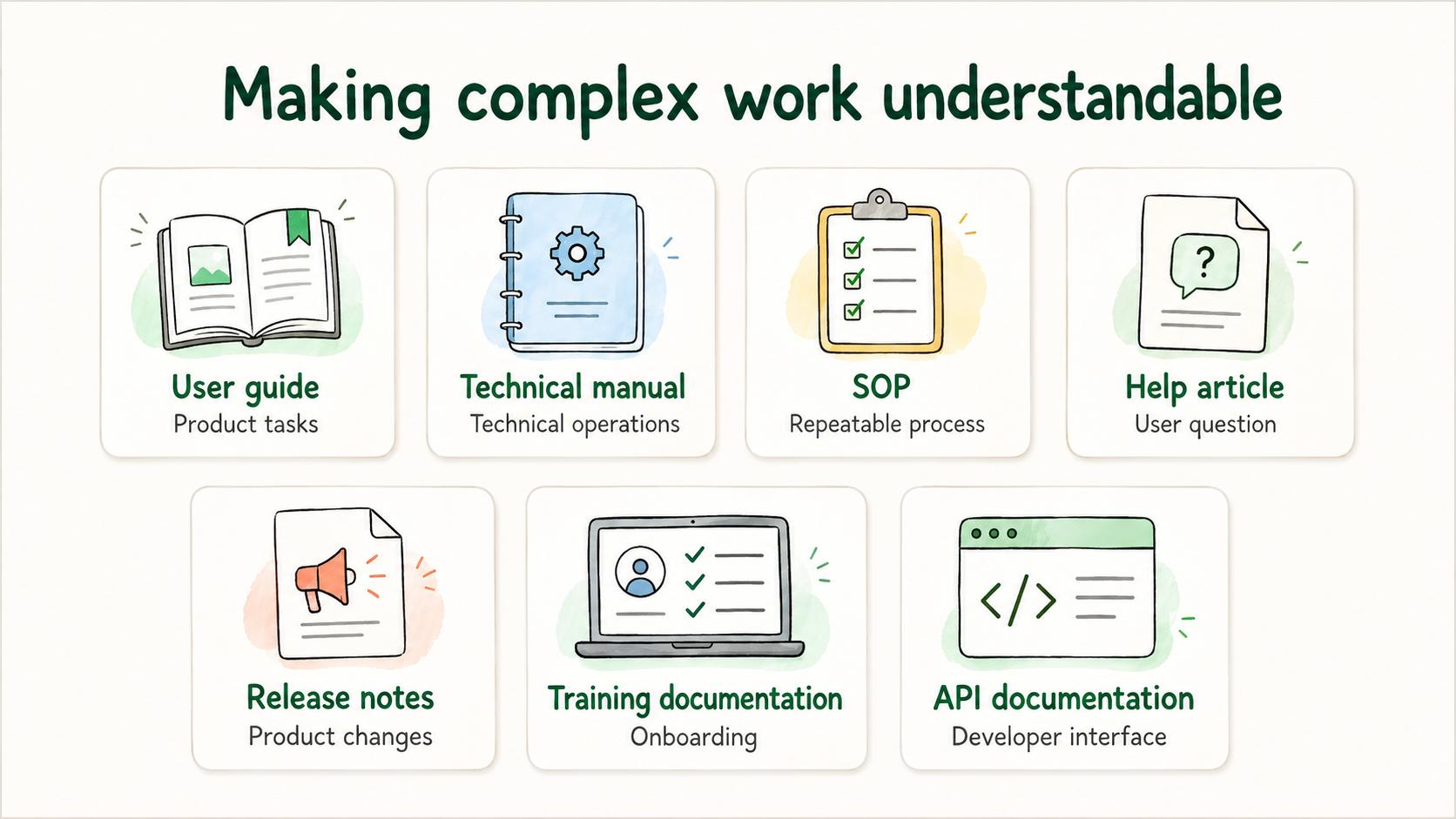
Technical writers create materials such as user guides, technical manuals, help articles, SOPs, API documentation, training guides, release notes, and internal process documentation. The role is not just "writing things down." A strong technical writer investigates how something works, identifies what readers need to do, structures information around that task, and keeps the documentation current as products or processes change.
What a technical writer does
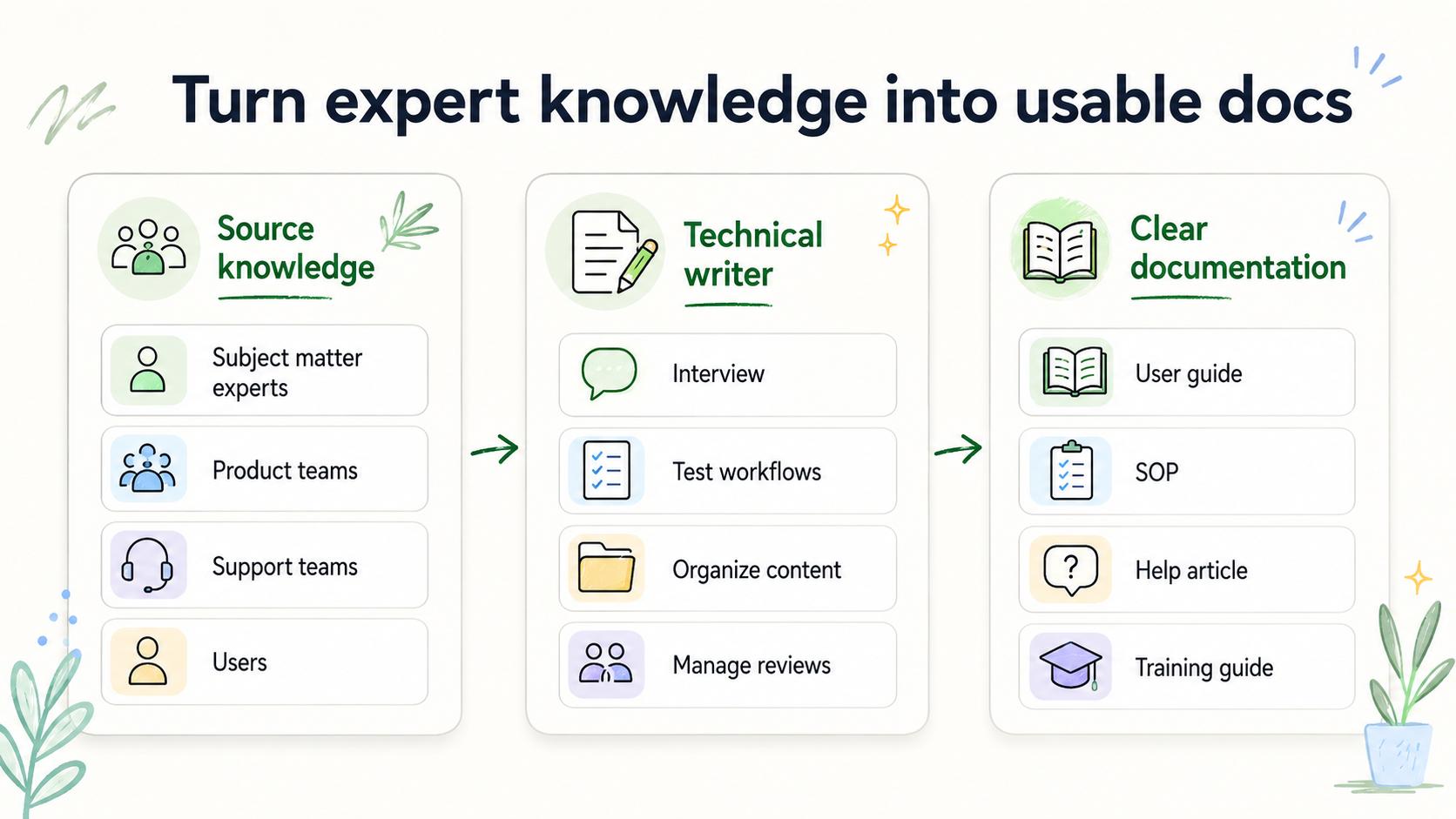
Technical writers sit between experts and readers. They gather information from subject matter experts, product teams, engineers, support teams, operations leaders, trainers, and users. Then they turn that information into documentation people can use without needing the expert in the room.
That work often includes interviewing experts, testing workflows, organizing content, writing procedures, editing drafts, creating templates, managing reviews, updating knowledge bases, and checking whether documentation matches the real product or process. O*NET similarly lists technical-writing work around technical materials, operating instructions, and documentation support.2
The best technical writers are part interviewer, part editor, part systems thinker. They are curious enough to ask basic questions and disciplined enough to turn the answers into reliable guidance.
Common outputs from technical writers
Technical writers may work on public product documentation, internal operations documentation, or both.
| Output | What it helps with | Example |
|---|---|---|
| User guide | Helps users complete product tasks | How to configure account settings |
| Technical manual | Explains equipment, systems, or technical operations | Service manual for a device or platform |
| SOP | Standardizes a repeatable internal process | How to process a refund request |
| Help article | Answers a specific user question | Troubleshooting login errors |
| Release notes | Communicates product changes | New workflow automation feature summary |
| Training documentation | Supports onboarding or enablement | New support agent training guide |
| API documentation | Helps developers use an interface | Authentication and endpoint reference |
The format changes, but the job is the same: make complex work understandable enough that the reader can act.
What makes a technical writer effective
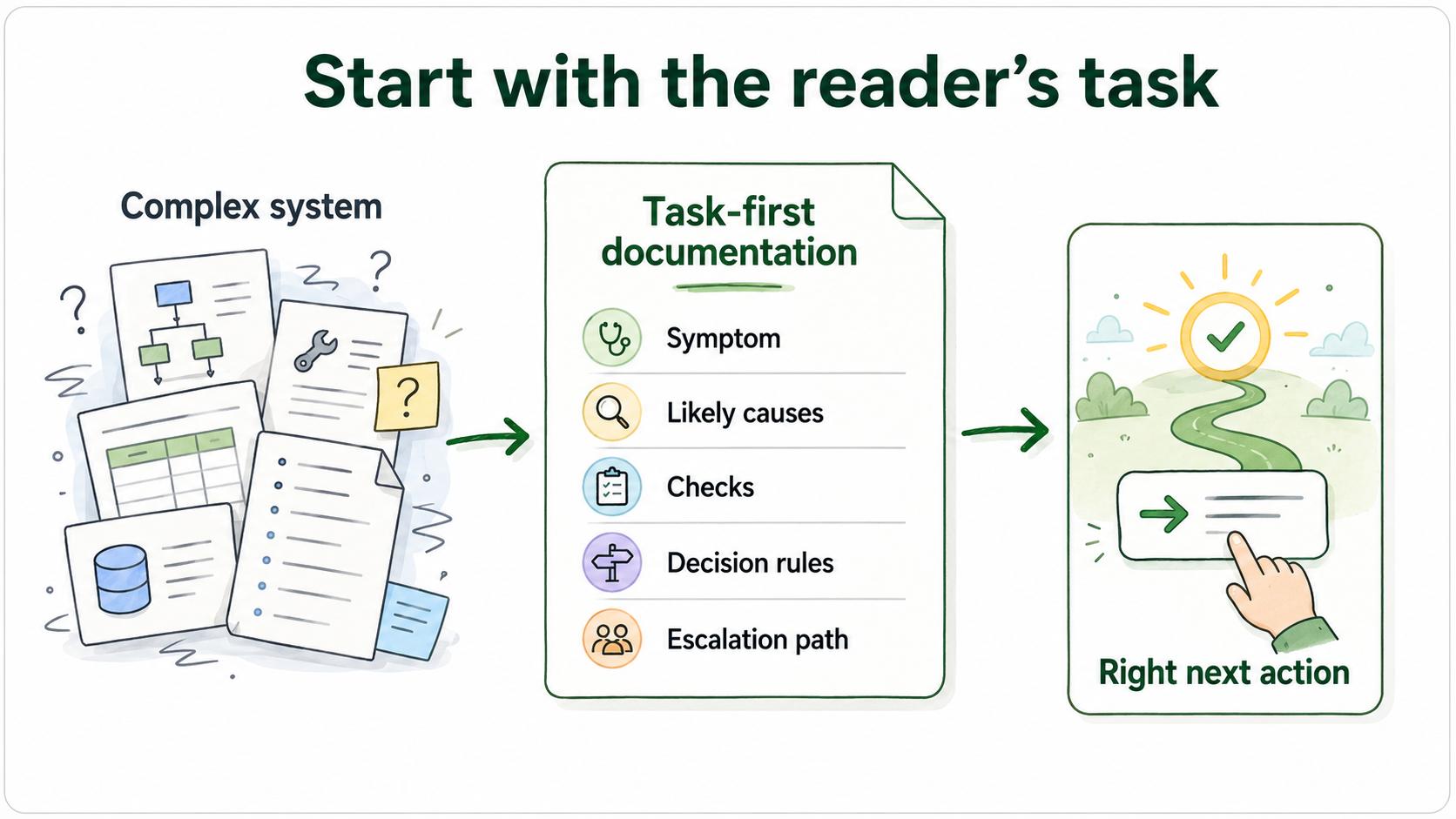
A good technical writer starts with the reader's task. The Diataxis documentation framework separates tutorials, how-to guides, reference, and explanation based on the user's need, which reinforces why technical documentation should be structured around what the reader is trying to accomplish.3
That task-first mindset changes the document. A billing troubleshooting article should not begin with internal system architecture. It should begin with the symptom, likely causes, checks to run, decision rules, and escalation path. A new-hire provisioning SOP should not hide the owner of each step. It should show the handoffs clearly enough that HR, IT, and the manager can coordinate.
The underrated skill is cutting. Experts often want to include every caveat. Readers usually need the right next action. A technical writer has to preserve accuracy without burying the answer.
When a team needs a technical writer
A team usually needs technical writing help when knowledge is trapped in experts' heads, support questions repeat, training depends on shadowing, product changes outpace help content, or internal processes vary by person.
Another sign is review friction. If every documentation draft requires heavy correction from experts, the team may not have a writing problem. It may have a discovery problem, an information architecture problem, or no clear owner for documentation quality.
A technical writer can also expose process gaps. When the writer cannot explain the workflow clearly, the workflow may not be clear yet. That is useful feedback, not a failure.
Technical writing brief template
Use this prompt to scope a technical writing project:
## Technical Writing Brief Template

**Glossary term:** Technical Writer
**Source:** Trails Glossary — trails.so/glossary/technical-writer

---

### 01. Scope a technical writing project

"Documentation project: [guide, manual, SOP, help article, training doc]
Audience: [who will read it]
Reader goal: [what they need to do]
Current problem: [confusion, repeated questions, inconsistent work, missing docs]
Subject matter experts: [people to interview or review]
Source material: [tickets, recordings, process notes, product screens, policies]
Required output: [format and length]
Accuracy risks: [areas needing expert/legal/security review]
Maintenance owner: [who updates it after publication]
Success signal: [fewer questions, faster onboarding, fewer errors, adoption]"
The maintenance owner is not an afterthought. Documentation without ownership decays quickly, especially in fast-changing products or operations.
Common mistakes
The first mistake is bringing the technical writer in too late. If documentation starts after launch, the writer may discover unclear workflows when the team has little time to fix them.
The second mistake is treating technical writing as formatting. Layout matters, but the harder work is understanding, structuring, validating, and maintaining information.
The third mistake is relying only on expert review. Experts confirm accuracy, but readers reveal usability problems. Nielsen Norman Group's usability-testing guidance recommends testing with realistic activities that users would perform in real life.4 When possible, test important documentation with someone close to the actual audience.
Documentation takeaway
Technical writers help teams turn fragile knowledge into reusable assets. For process-heavy teams, they can standardize how workflows are documented, how examples are captured, how review cycles work, and how updates happen when the process changes.
The role is valuable because good documentation is not just content. It is operational infrastructure.
How Trails helps
Trails helps technical writers and subject matter experts capture workflows as they happen. A team member can record a process, and Trails turns it into a polished step-by-step guide with an optional AI-narrated video version.
That gives technical writers a better starting point. Instead of reconstructing every step from memory and interviews, they can refine a captured workflow into accurate, reader-friendly documentation.
- Technical documentation
- Technical manual
- Technical documentation software
- Software documentation
- Subject matter expert
- Documentation manager
- Instructional designer
Sources
- 1
U.S. Bureau of Labor Statistics. Technical Writers. Occupational Outlook Handbook. www.bls.gov/ooh/media-and-communication/technical-writers.htm. Accessed July 2, 2026.
- 2
O*NET Online. Technical Writers. National Center for O*NET Development. www.onetonline.org/link/summary/27-3042.00. Accessed July 2, 2026.
- 3
Daniele Procida. Diataxis Documentation Framework. Diataxis. diataxis.fr/. Accessed July 2, 2026.
- 4
Nielsen Norman Group. Usability Testing 101. Nielsen Norman Group. www.nngroup.com/articles/usability-testing-101/. Accessed July 2, 2026.