
Glossary
Process Reengineering
 ChatGPT
 Perplexity
 Gemini
 Claude
What is process reengineering?
Process reengineering is the redesign of a business process to produce a major improvement in performance, cost, speed, quality, control, or customer experience.1 It fits situations where the process is structurally wrong for the work the organization now needs to do.
The phrase is closely tied to business process reengineering, or BPR.2 In practical terms, reengineering asks a harder question than ordinary improvement work: if the team designed this process today, what would it stop doing, combine, delegate, automate, or rebuild?
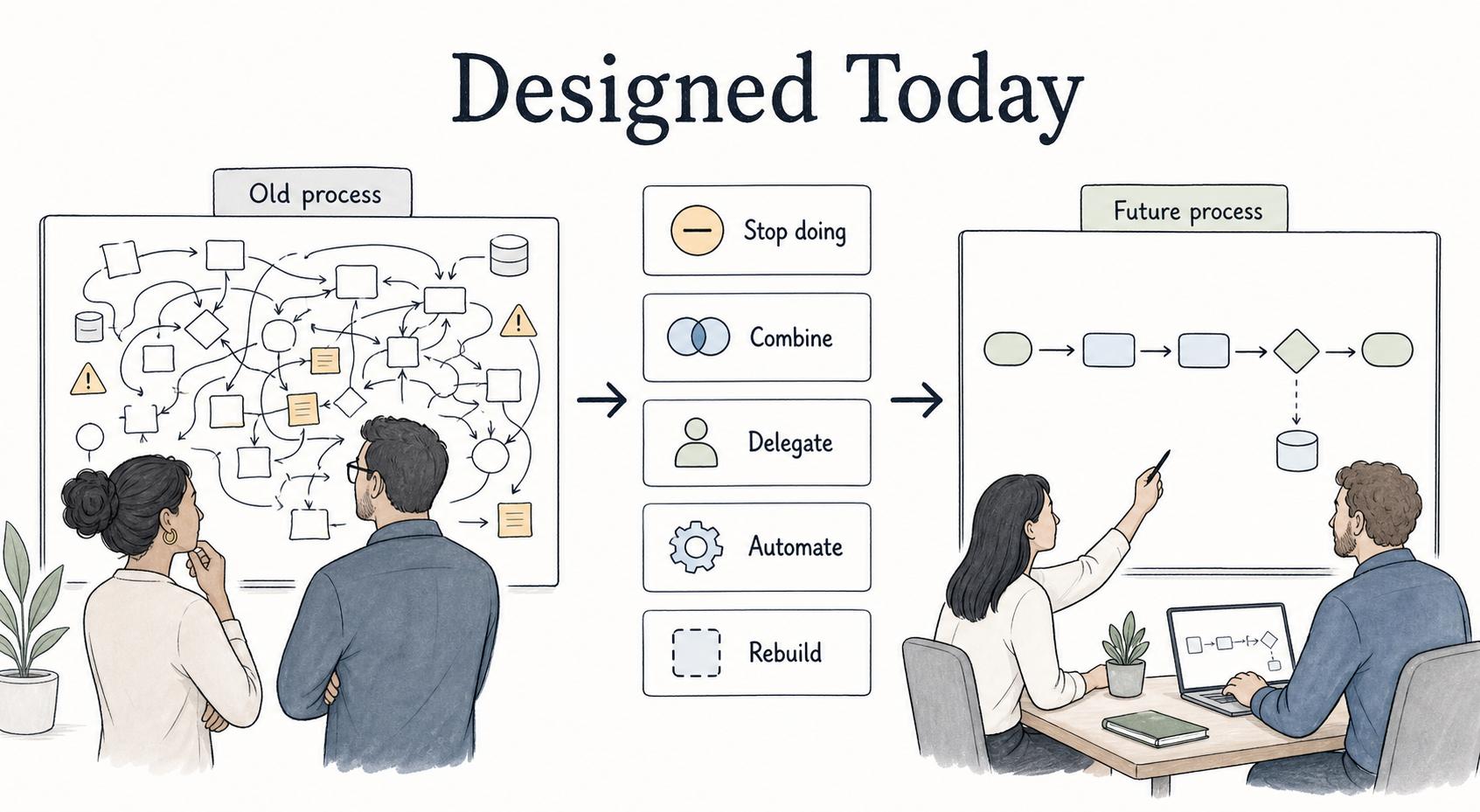
When process reengineering makes sense
Process reengineering is heavier than everyday process improvement. Use it when the process problem crosses teams, systems, handoffs, decision rights, or customer experience.
Good triggers include:
- Cycle time, quality, or customer-delay problems that one team can't fix alone
- Too many approvals, duplicate reviews, manual checks, or hidden workarounds
- Compliance, audit, or control gaps caused by the way work moves
- Growth, acquisitions, product changes, or new operating models that broke the old workflow
- New technology that makes the old process design unnecessary or obsolete
The practical test is whether the process needs a new design. If the underlying flow is sound, reengineering may create more disruption than value. If the flow is wrong, small fixes can become a way to postpone the real decision.
Process reengineering vs. process improvement
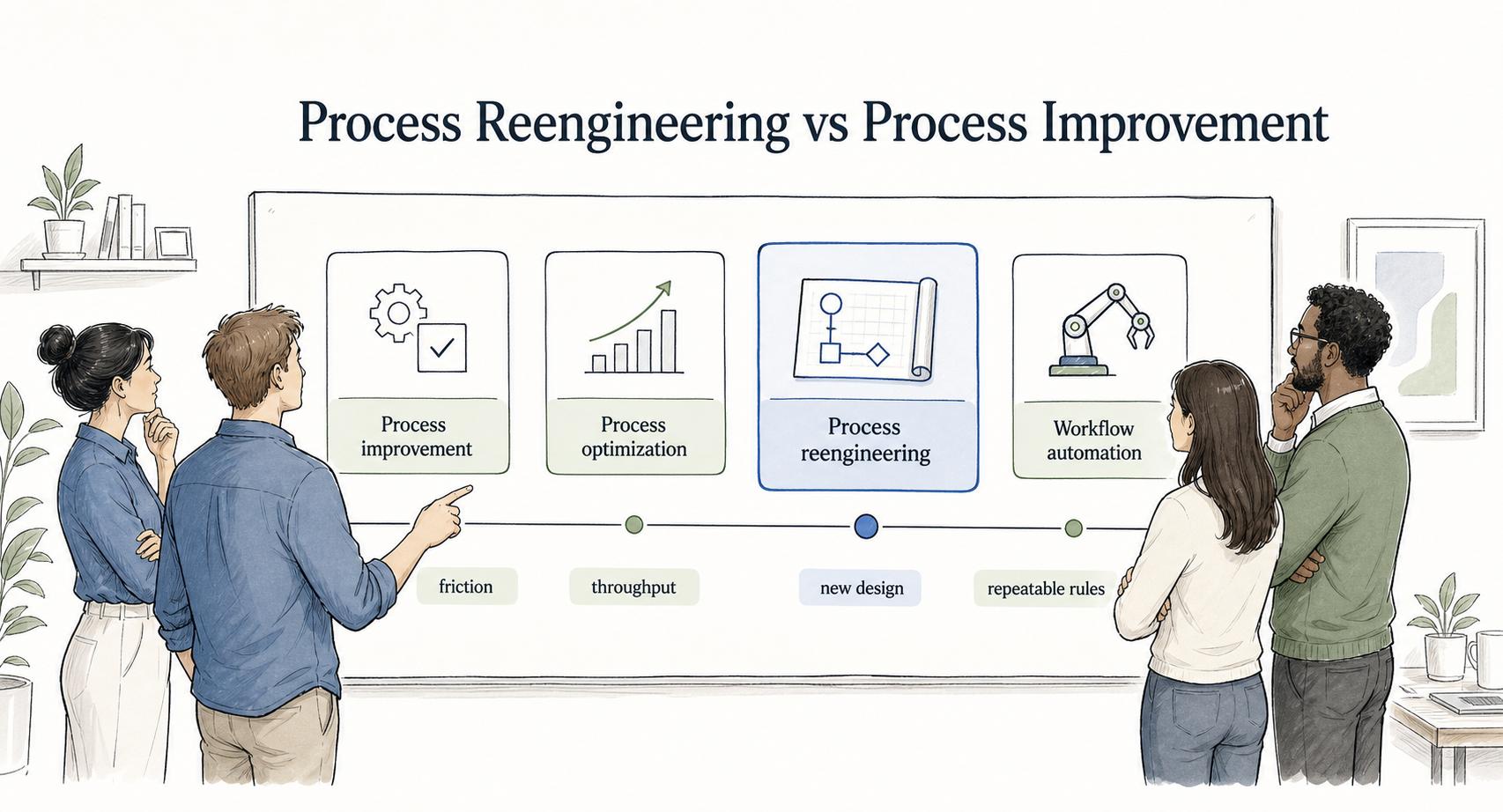
These approaches sit on a spectrum. Choosing the wrong one creates waste in either direction: too much change for a small problem, or too little change for a broken system.
| Approach | Best fit | Typical change |
|---|---|---|
| Process improvement | A process mostly works but has friction, waste, or inconsistency | Refine steps, remove a bottleneck, clarify ownership |
| Process optimization | A working process needs better speed, cost, quality, or throughput | Tune rules, reduce rework, improve routing or templates |
| Process reengineering | The process design no longer fits the business need | Redesign roles, handoffs, systems, approvals, and controls |
| Workflow automation | A clear process has repeatable rules software can execute | Automate routing, reminders, data entry, or status updates |
Automation is not the same as reengineering. Automating a confusing process can make the confusion move faster.3 Reengineering should define the better process before the team decides what software should execute.
How process reengineering works
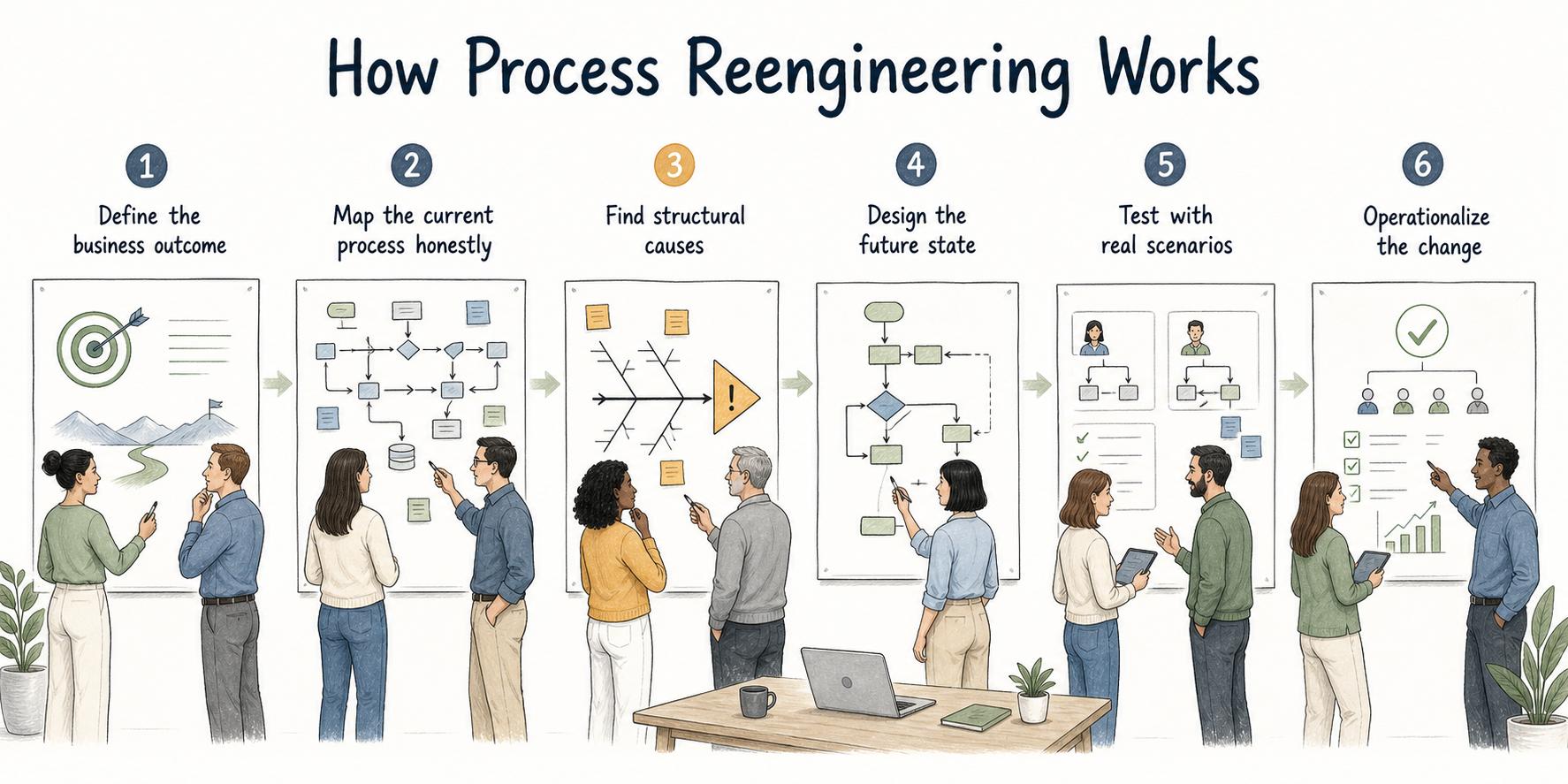
Most reengineering efforts move through a few practical stages.
Define the business outcome. Start with the result the process must create: faster onboarding, fewer billing errors, lower fulfillment cost, stronger compliance, better customer visibility, or less rework. Without a target outcome, the team will redesign around opinions.
Map the current process honestly. Include informal workarounds, duplicate entry, manual checks, approval loops, and places where people leave the system to get work done. The unofficial process is often the real process.
Find structural causes. Look for issues that one checklist can't fix: split ownership, unnecessary handoffs, unclear decision rights, conflicting metrics, tool gaps, poor intake, and controls that happen too late.
Design the future state. Redesign the process around the outcome, not the old org chart. This may change roles, data flow, approvals, automation, customer communication, or handoffs between teams.
Test with real scenarios. Use messy cases before rollout. A future-state map that works only for the cleanest case will fail during launch.
Operationalize the change. Create SOPs, work instructions, training, ownership, metrics, and a review cadence. A redesigned process that exists only in a diagram is not operational yet.4
What to document during process reengineering
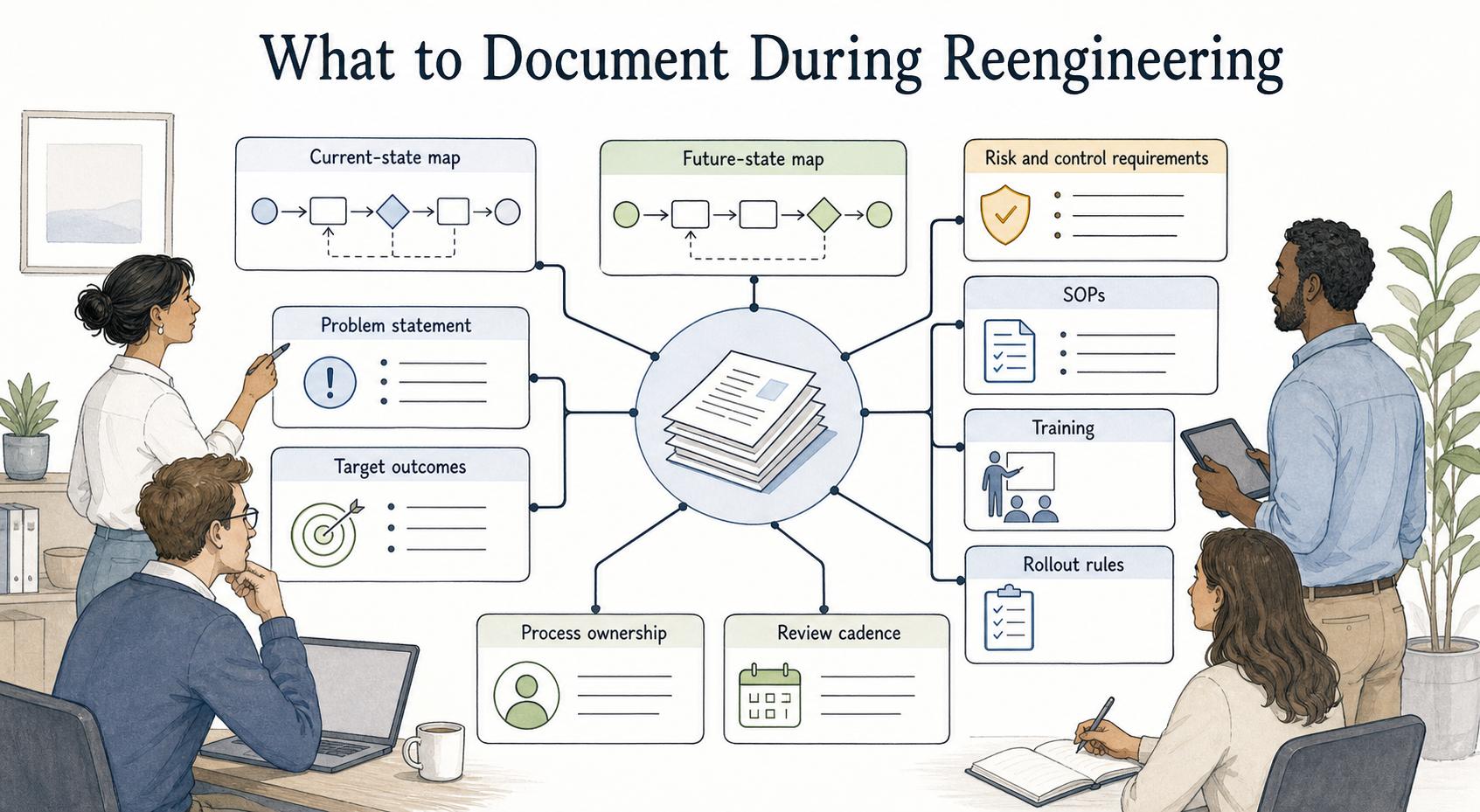
Documentation is how the team proves what changed and gives people a practical path to work the new way.
Useful artifacts include:
- A current-state map with baseline metrics, pain points, and failure modes
- A problem statement and target outcomes that define what the redesign must improve
- A future-state map with role, handoff, decision, approval, and system changes
- Risk, control, compliance, exception, and automation requirements
- SOPs, work instructions, job aids, training, and communication plans
- Rollout rules, cutover support, process ownership, and review cadence
The current-state map explains why change is needed. The future-state map explains what will change. The SOPs and training make the change usable after the project team leaves the room.
Example of process reengineering
Imagine a customer onboarding process split across sales, finance, implementation, support, and customer success. Each team has its own spreadsheet, customers repeat information, kickoff dates slip, and no one owns the full experience.
A process improvement effort might clean up the handoff checklist. A process reengineering effort would change how onboarding works:
- Create one intake path for new customers
- Define one end-to-end onboarding owner
- Remove duplicate data entry across tools
- Standardize approval and readiness criteria
- Replace scattered status updates with one source of truth
- Redesign handoffs between sales, implementation, and success
- Automate task routing after the new process is defined
- Create role-specific SOPs and training for the redesigned workflow
That is reengineering because the operating model changes. The team is changing how work moves, not polishing one step.
Common mistakes
One mistake is calling every improvement project reengineering. The label raises expectations and can create unnecessary resistance. Use it when the process needs meaningful redesign.
Another mistake is designing only with managers. Frontline employees often know where the real delays, side channels, duplicate work, and exception paths live.
A third mistake is ending with a future-state diagram but no enablement. People need updated documentation, system guidance, training, and support while the new process becomes normal.
How Trails helps
Trails helps teams capture current workflows and turn redesigned workflows into step-by-step guides. During process reengineering, teams can document how work is actually performed today, then create clear guides and AI-narrated videos for the future-state process.
That helps the redesign survive rollout. A better process only matters if people know the new steps, handoffs, tools, and decision rules.
Frequently asked questions
Is process reengineering the same as business process reengineering?
They are often used similarly. Business process reengineering usually refers to larger, cross-functional redesign of core business processes. Process reengineering can also describe a narrower redesign effort within a team or department.
Is process reengineering always disruptive?
It usually creates more change than ordinary process improvement because it may alter roles, systems, handoffs, approvals, or controls. The disruption should be intentional and tied to a clear business outcome.
Should teams automate before or after reengineering?
Usually after. First define the better process and decision rules. Then automate the parts that are stable, repeatable, and worth moving into software.
Sources
- 1
IBM. What Is Business Process Reengineering?. www.ibm.com/think/topics/business-process-reengineering.
- 2
MDPI. Business Process Re-Engineering: A Literature Review-Based Analysis. www.mdpi.com/2078-2489/13/4/185.
- 3
Michael Hammer. Reengineering Work: Don't Automate, Obliterate. Harvard Business Review. hbr.org/1990/07/reengineering-work-dont-automate-obliterate.
- 4
SAP Signavio. Business Process Management Lifecycle. www.signavio.com/wiki/bpm/business-process-management-lifecycle/.