
Glossary
Regulatory Compliance
 ChatGPT
 Perplexity
 Gemini
 Claude
What is regulatory compliance?
Regulatory compliance is the practice of meeting the laws, regulations, licenses, standards, and official requirements that apply to an organization. The exact requirements depend on the business model, location, industry, employees, data, customers, vendors, and markets involved.
This page focuses on the operational and documentation side of regulatory compliance. It isn't legal advice. Actual obligations should be identified and reviewed by qualified legal, compliance, security, finance, HR, safety, privacy, or regulatory owners.
Why regulatory compliance matters
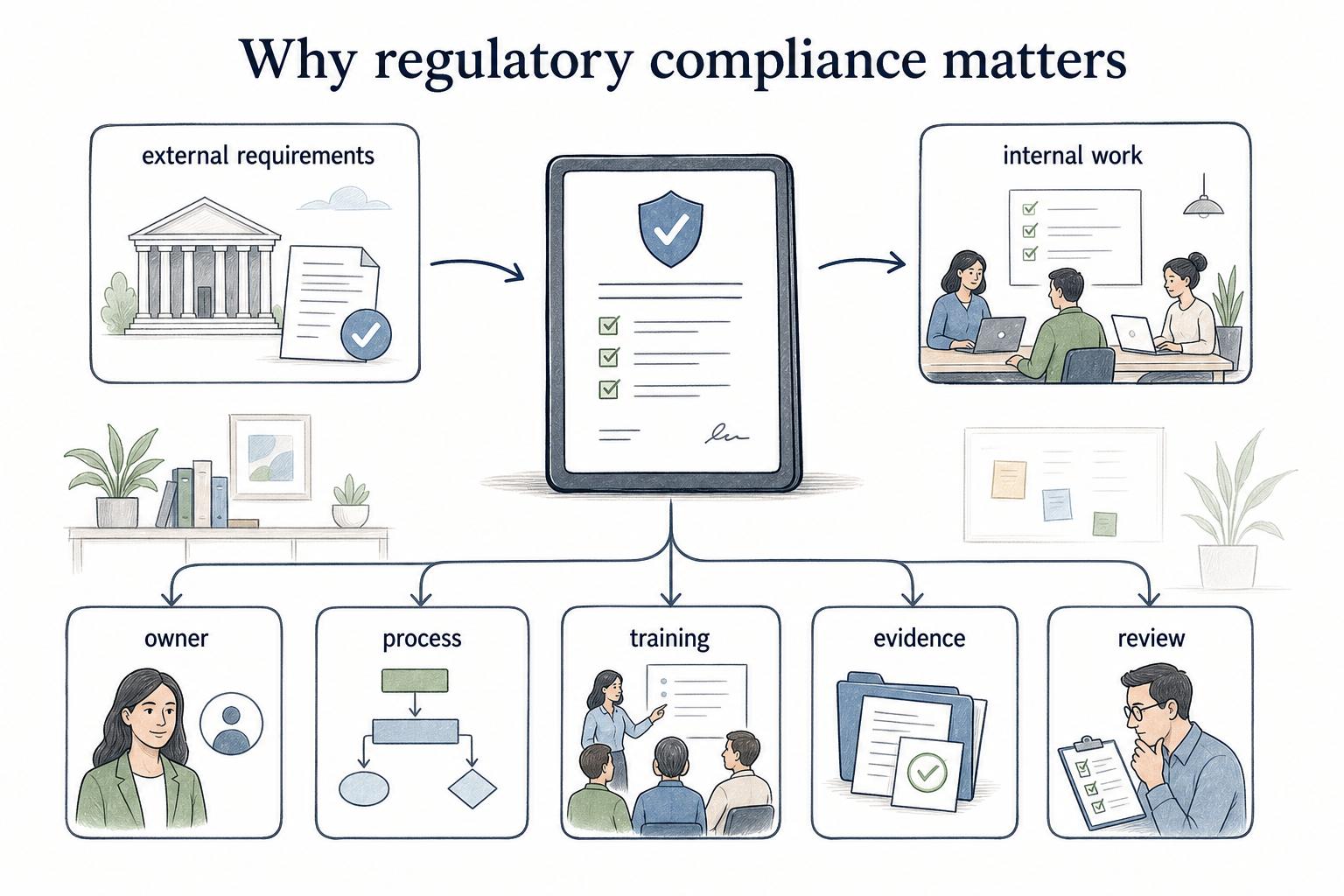
Regulatory compliance turns external requirements into internal work. A rule does not become manageable because someone knows it exists. The organization still has to assign an owner, define the process, train the right people, keep evidence, and review whether the process still works.
The U.S. Small Business Administration notes that legal responsibilities depend on the business and location.1 That is why generic compliance checklists are risky. Two companies in the same industry may have different products, states, customers, vendors, data practices, licenses, and employment obligations.
For operators, the useful question is not only "What applies to us?" It is "How does the business reliably do the work that keeps us compliant?"
Regulations, obligations, controls, and evidence
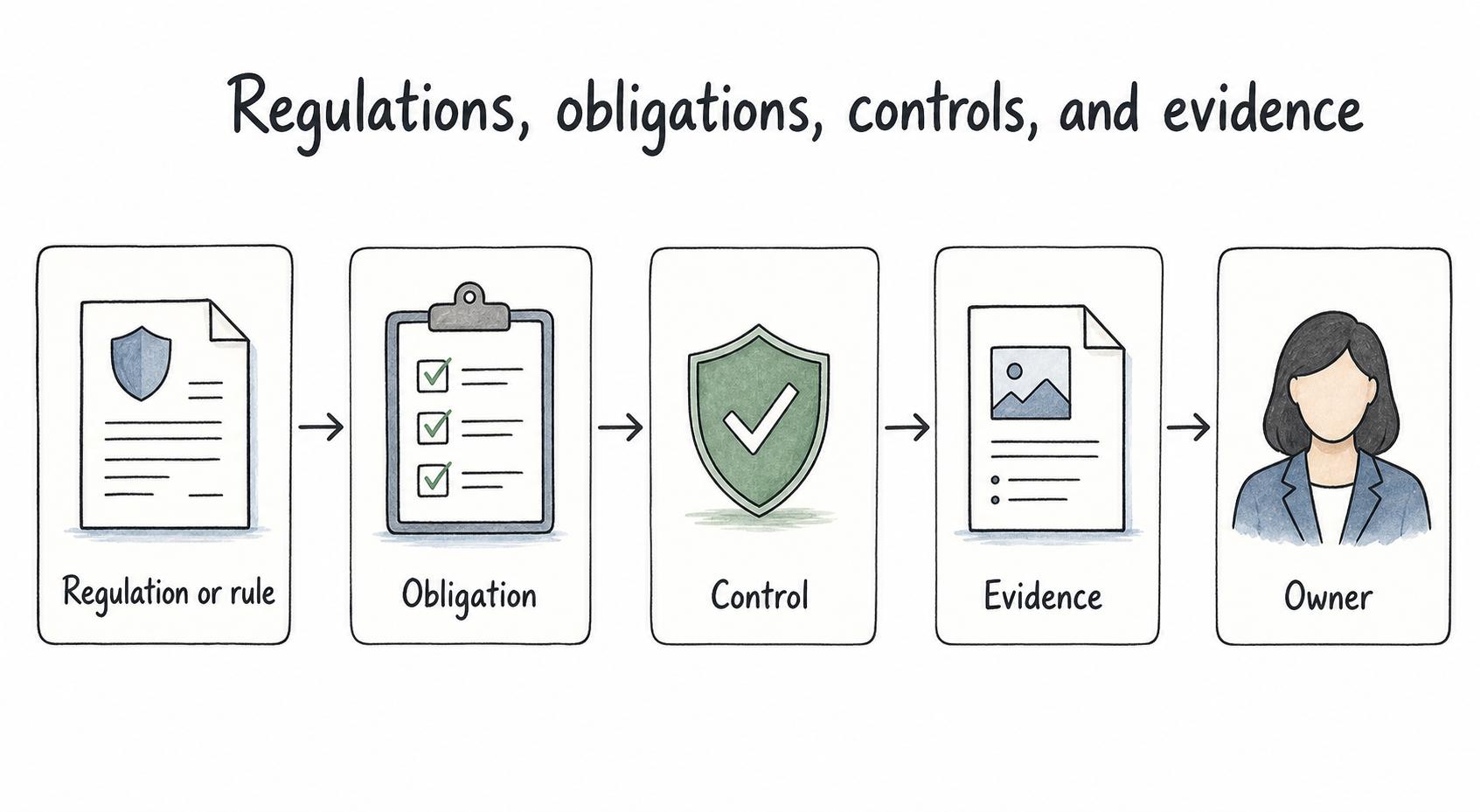
Compliance is easier to manage when the team separates the requirement from the internal process used to meet it.
| Concept | What it means | Example |
|---|---|---|
| Regulation or rule | An external requirement issued through an official legal or regulatory process | A rule that requires certain disclosures, records, controls, or practices |
| Obligation | The specific duty the organization has under a rule, contract, license, or standard | Keep a required record for a defined period |
| Control | The internal activity that helps meet the obligation | Monthly review, approval workflow, access check, training requirement |
| Evidence | The proof that the control happened | Completed log, ticket, signed acknowledgement, audit trail, exported report |
| Owner | The role accountable for maintaining the control | Compliance lead, HR manager, security owner, finance controller |
The Federal Register and Regulations.gov describe rulemaking as the process federal agencies use to develop and issue rules.2 Once a rule applies, the internal work becomes more practical: who does what, when, in which system, and with what proof.
Examples of regulatory compliance work
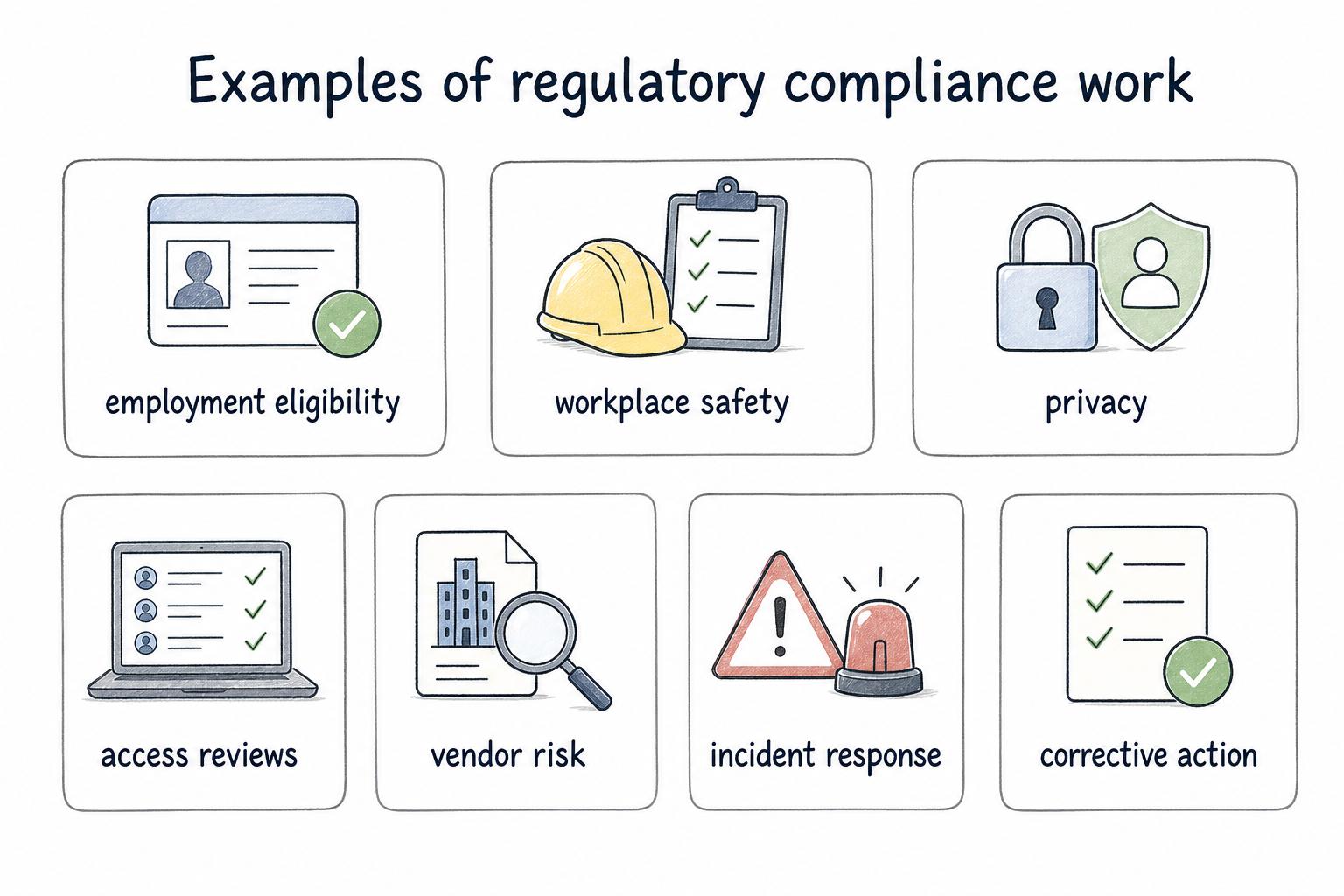
Regulatory compliance shows up in ordinary team workflows, not only in policies. Common examples include employment eligibility, payroll and leave requirements, workplace safety procedures, privacy and data protection practices, access reviews, financial recordkeeping, licensing renewals, advertising claim review, vendor risk checks, incident response, and corrective action.
The mistake is treating these as documents only. Compliance usually lives in repeatable work: a manager approves something, an employee completes training, a system logs access, a vendor is reviewed, a report is checked, or an exception is escalated.
What to document for regulatory compliance
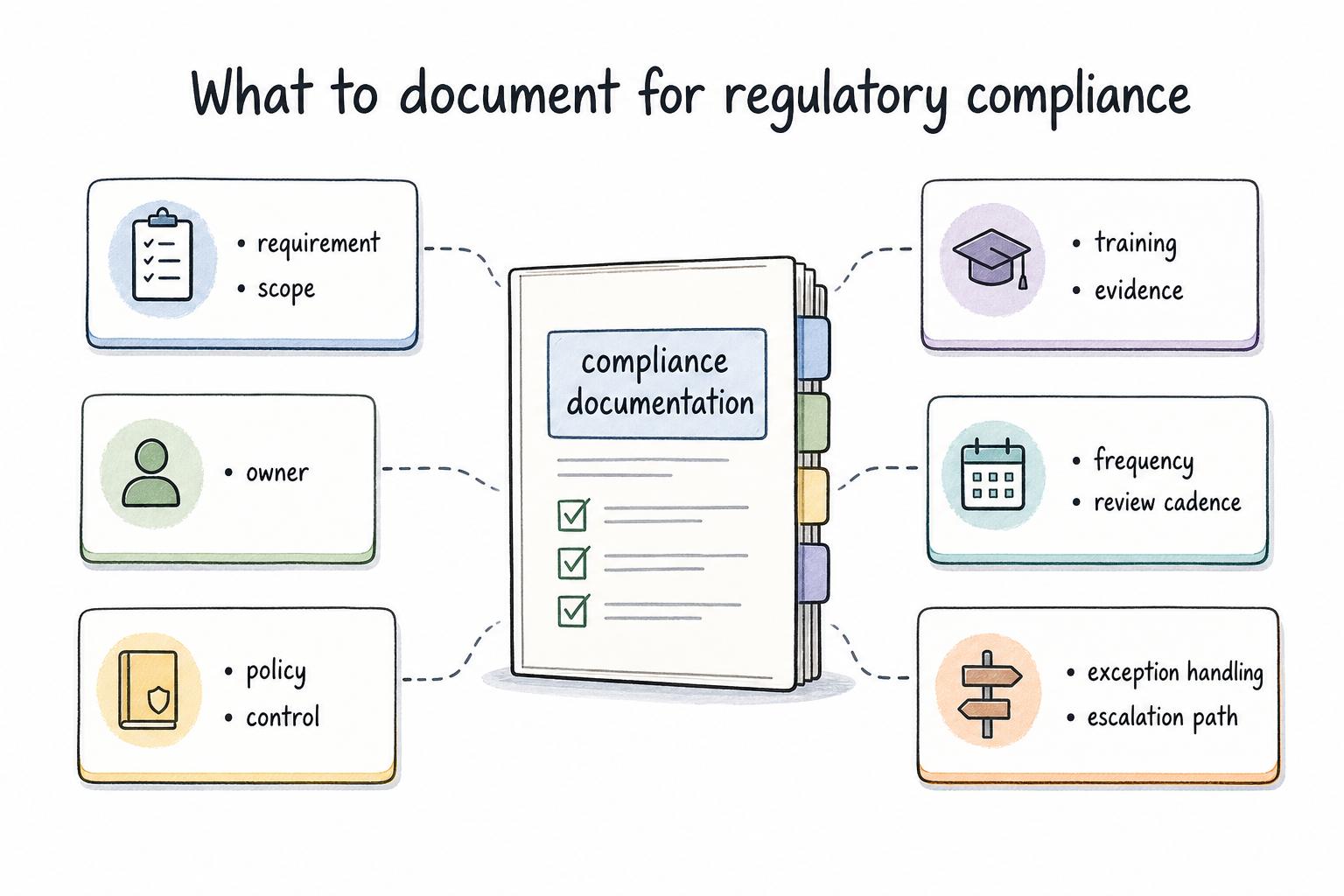
Compliance documentation should make an obligation traceable from requirement to action. A useful compliance page, SOP, or register should answer:
- What requirement applies, and which part of the business is in scope?
- Who owns the requirement and who backs them up?
- Which policy, procedure, control, or training satisfies it?
- What evidence proves the work happened, and where is that evidence stored?
- How often does the control run, and what happens when it fails?
- Who reviews changes in the law, rule, business process, vendor, or system?
Use this prompt to draft the first version of a compliance documentation entry:
## Compliance documentation entry template

**Glossary term:** regulatory compliance
**Source:** Trails Glossary — trails.so/glossary/regulatory-compliance

---

### 01. Create a compliance documentation entry

"Create a compliance documentation entry for [requirement or topic].
Include:
- plain-language requirement summary
- scope by team, location, system, data, product, vendor, or role
- accountable owner and backup owner
- policies, SOPs, controls, and training that satisfy the requirement
- evidence produced by each control
- frequency and review cadence
- exception handling and escalation path
- systems where work and evidence are stored
- open questions for legal, compliance, security, HR, finance, or operations review
Write it for an operations team that needs to follow and maintain the process."
This prompt does not replace legal review. It helps turn an identified requirement into work people can perform, maintain, and test.
Common mistakes
One mistake is treating compliance as a static binder. Requirements, systems, vendors, products, markets, and org structures change. If the documentation has no owner or review trigger, it will drift.
Another mistake is documenting the obligation but not the workflow. "Comply with privacy requirements" is not a usable instruction. The team still needs procedures for access, deletion, vendor review, consent, incident response, retention, training, and evidence.
A third mistake is collecting evidence after the fact. Evidence should be produced as part of the workflow whenever possible. The SBA also emphasizes keeping records that document compliance with internal requirements.3 If teams have to reconstruct proof later, the process is more fragile than it looks.
A fourth mistake is over-centralizing ownership. Legal or compliance may interpret obligations, but many controls are run by HR, finance, IT, security, operations, support, sales, or managers. The owner model should match how the work actually happens.
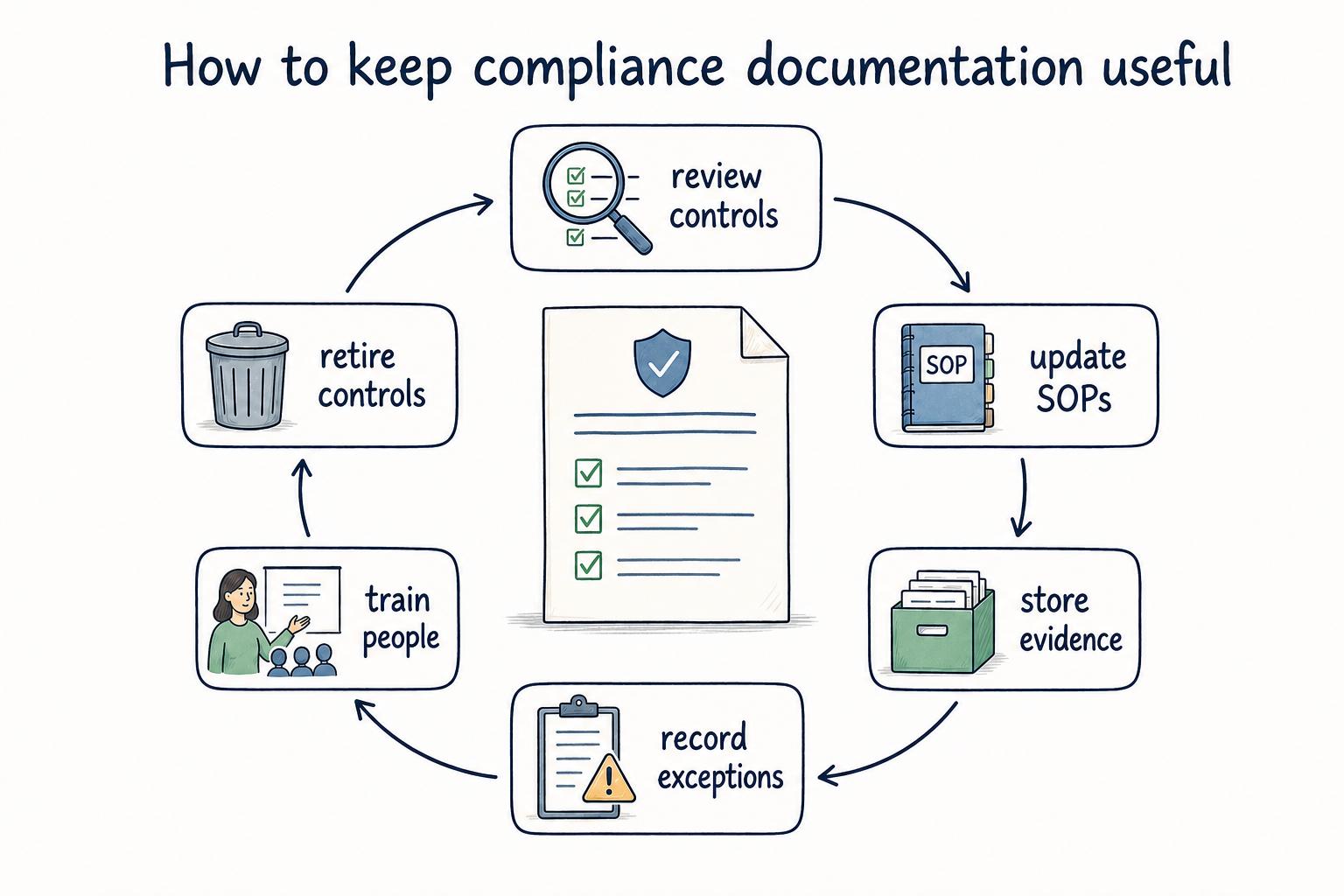
How to keep compliance documentation useful
The most useful compliance documentation is plain enough for the people doing the work and specific enough for reviewers to test. It should name the system, role, record, cadence, and exception path. Avoid vague verbs like "ensure" unless the document also says how.
A simple maintenance rhythm helps:
- Review high-risk controls on a set cadence.
- Update SOPs when tools, vendors, teams, or laws change.
- Store evidence where the owner and reviewer can find it.
- Record exceptions and corrective actions.
- Train people on the workflow, not only the policy statement.
- Retire controls that no longer match a real obligation or risk.
The DOJ's corporate compliance program guidance emphasizes context, effectiveness, testing, and improvement.4 The operational version is straightforward: documentation should reflect how the business prevents, detects, and corrects problems in practice.
Documentation takeaway
Regulatory compliance is the operating system around applicable requirements: owners, procedures, training, controls, evidence, exceptions, and review.
Good compliance documentation helps teams do the right work consistently and show that the work happened. It also gives legal, compliance, and operational leaders a clearer way to find gaps before they become expensive surprises.
How Trails helps
Trails helps teams capture repeatable workflows and turn them into step-by-step guides. For compliance-related work, that can help document access reviews, policy acknowledgments, evidence collection, training workflows, reporting procedures, vendor reviews, and corrective-action processes.
Compliance-critical guides should still be reviewed by the appropriate legal, compliance, security, HR, finance, or regulatory owner before they become official guidance.
Sources
- 1
U.S. Small Business Administration. Stay legally compliant. U.S. Small Business Administration. www.sba.gov/business-guide/manage-your-business/stay-legally-compliant. Accessed July 13, 2026.
- 2
Federal Register. A Guide to the Rulemaking Process. Federal Register. uploads.federalregister.gov/uploads/2013/09/The-Rulemaking-Process.pdf. Accessed July 13, 2026.
- 3
U.S. Small Business Administration. Stay legally compliant. U.S. Small Business Administration. www.sba.gov/business-guide/manage-your-business/stay-legally-compliant. Accessed July 13, 2026.
- 4
U.S. Department of Justice. Evaluation of Corporate Compliance Programs. U.S. Department of Justice. www.justice.gov/criminal/criminal-fraud/page/file/937501. Accessed July 13, 2026.