
Glossary
Poka Yoke
 ChatGPT
 Perplexity
 Gemini
 Claude
What is poka yoke?
Poka yoke is a Lean quality concept for mistake-proofing work so errors are prevented, caught earlier, or made easier to correct. It changes the process, tool, or environment so the right action is easier and the wrong action is harder.
The useful assumption is that good people still get interrupted, rush, forget details, misread signals, and operate inside imperfect systems. Poka yoke designs repeatable work around that reality.
Where the term poka yoke comes from
Poka yoke comes from Japanese. Poka refers to an inadvertent error or careless mistake, while yokeru means to avoid or prevent. Together, the term is commonly translated as "mistake-proofing" or "error prevention."
The method was first called baka-yoke, or "fool-proofing." Shigeo Shingo adopted poka-yoke as a more respectful name, shifting the focus away from blaming the person and toward designing the process to prevent errors.
What poka yoke does
Poka yoke reduces predictable errors by building quality into the work instead of inspecting for problems only at the end. A good mistake-proofing control prevents an error, detects it before it travels downstream, or makes the correct next step obvious.
A physical example is a part that only fits in one orientation. A digital example is a form that cannot be submitted until required fields are complete. A service example is an escalation template that asks for customer impact, reproduction steps, screenshots, and priority before a ticket reaches engineering.
Each example shifts the burden away from memory. The process itself starts carrying more of the quality load.
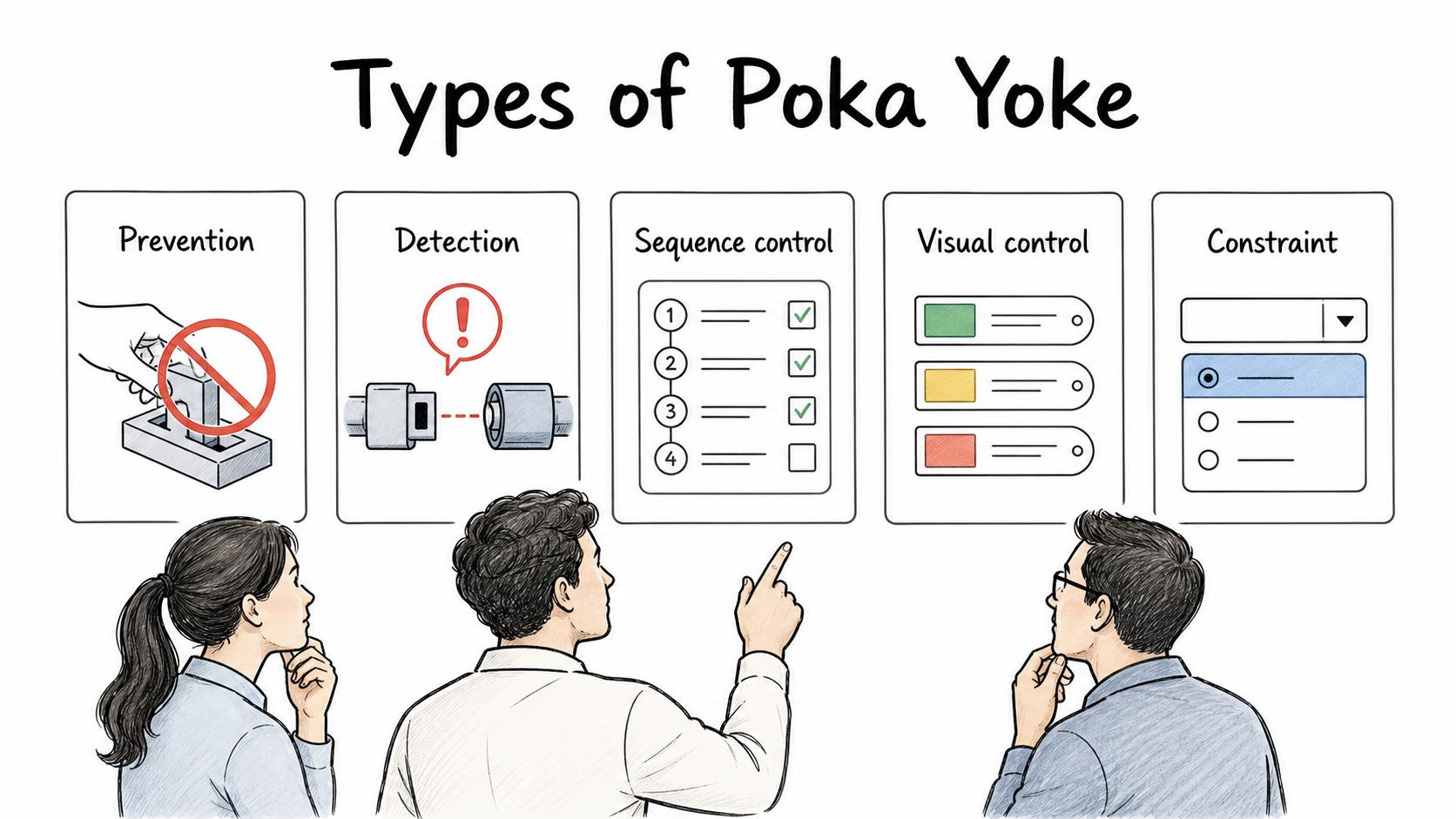
Types of poka yoke
Poka yoke can show up in different forms, depending on the failure the team is trying to prevent.
| Pattern | What it does | Example |
|---|---|---|
| Prevention | Makes the wrong action impossible or hard to complete | A required approval before a purchase order can be sent |
| Detection | Flags an error before it moves downstream | A mismatch alert when entered data does not match the source record |
| Sequence control | Keeps steps from happening out of order | A closing checklist that must be completed before the shift can be marked done |
| Visual control | Makes the correct action easy to see | Color-coded labels for materials, statuses, or priority levels |
| Constraint | Limits choices to valid options | Dropdown values instead of free-text categories |
The best control is usually the smallest one that prevents a meaningful failure. A poka yoke solution should reduce confusion rather than wrap low-risk work in a maze of approvals.
Poka yoke examples outside manufacturing
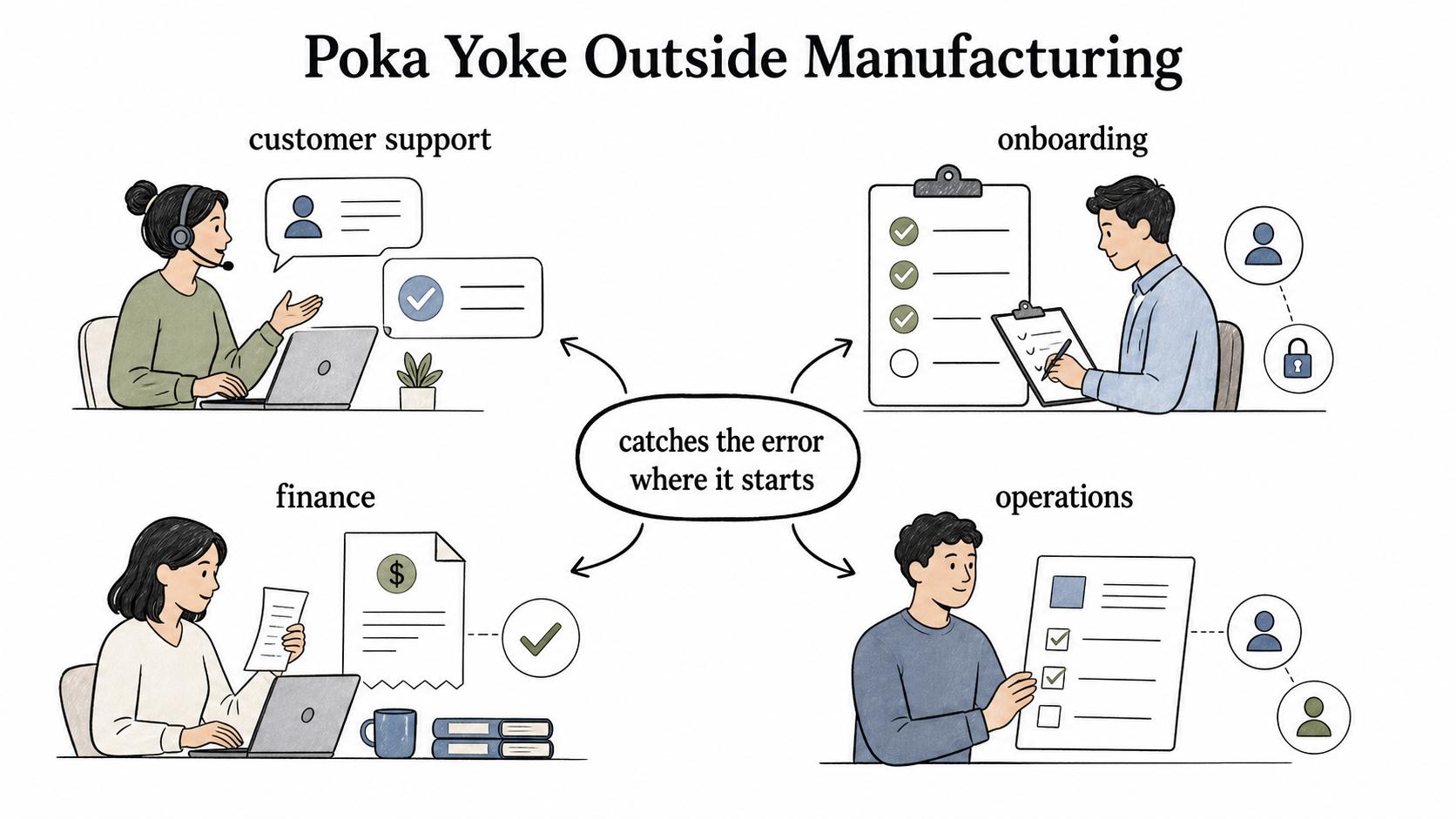
Although poka yoke is strongly associated with Lean manufacturing, the idea applies anywhere repeatable work can fail in predictable ways.
In customer support, an intake form can require account ID, screenshots, browser details, and reproduction steps before a bug escalation is submitted. That prevents engineering from receiving incomplete reports that have to be sent back.
In onboarding, a new-hire checklist can block system access until required paperwork, manager approval, and security training are complete. That reduces skipped setup steps without relying on one coordinator's memory.
In finance, an expense workflow can require receipts for certain categories and route exceptions to the right approver. That makes the policy easier to follow at the moment of submission.
In operations, a handoff template can require the outgoing shift to document unresolved issues, open risks, and next actions before the incoming team takes over.
The tool matters less than the placement of the control. The strongest poka yoke catches the error where it starts.
How to apply poka yoke
Start with a specific defect. Poka yoke works best when the team can name the repeated error, where it enters the workflow, and what happens when it is missed.
Ask these diagnostic questions:
- What mistake keeps happening, and where does it first become possible?
- Is the cause missing information, unclear sequence, confusing labels, weak handoff, too many choices, or tool friction?
- Can the process prevent the error instead of reminding people to avoid it?
- If prevention is too heavy, can the process detect the error earlier?
- What is the simplest control that would help without slowing normal work too much?
That last question matters. Over-control creates workarounds, bad data, and frustration. The control should be proportional to the risk.
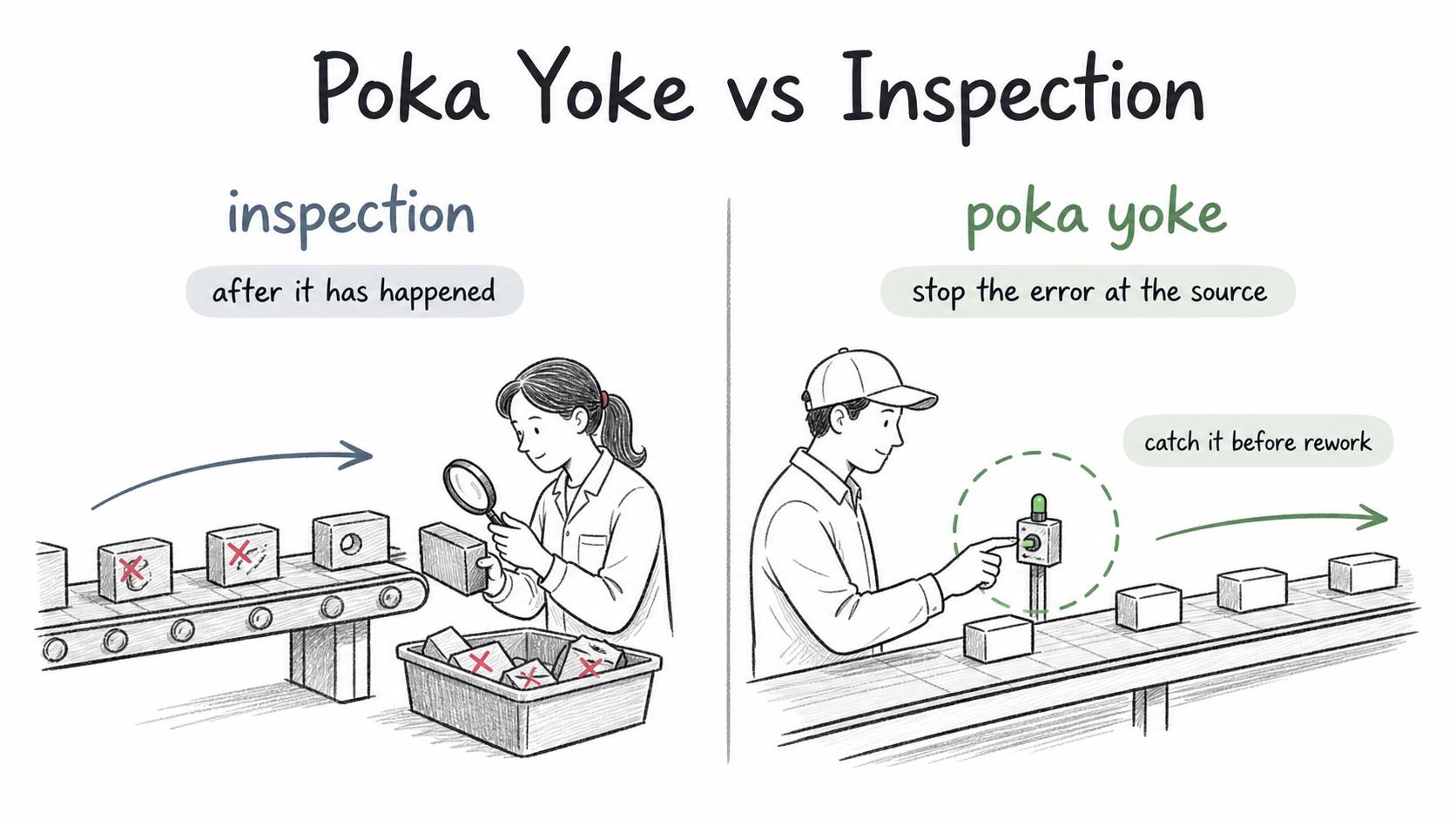
Poka yoke vs inspection
Inspection checks the work after it has happened. Poka yoke tries to stop the error at the source or catch it before it creates rework.
Inspection still has a place, especially when risk is high or the output needs review. But inspection alone often finds defects after someone has already spent time creating them. Poka yoke moves quality earlier by improving the process conditions that produced the mistake.
A useful rule: if the same defect keeps appearing in inspection, look upstream for a mistake-proofing opportunity.
Common mistakes
One mistake is treating reminders as poka yoke. A reminder can help, but a stronger control changes the workflow so the mistake is less likely in the first place.
Another mistake is adding required fields without understanding the work. If people do not know the answer, they may enter placeholder text just to continue. That creates the appearance of control without improving quality.
A third mistake is failing to update documentation. When the process changes, the SOP, work instruction, checklist, and training material should explain the new control and what people should do when it triggers.
Documentation takeaway
Poka yoke is process design, but documentation keeps the design understandable. When a team adds a validation rule, required checklist, revised handoff, or new approval gate, the related documentation should explain what changed, why the control exists, and how to handle exceptions.
Strong SOPs list the steps and show where errors commonly occur, how the process prevents them, and what to do when the control triggers.
How Trails helps
Trails helps teams document the workflow around mistake-proofing controls. When a team adds a new checklist, intake rule, handoff, or exception path, Trails can capture the updated workflow as someone performs it and turn it into a polished step-by-step guide. Teams can also create an AI-narrated video version for training or sharing.
That makes the new control easier to explain and easier to adopt.
FAQ
What does poka yoke mean in simple terms?
Poka yoke means mistake-proofing. It is a way to design work so common errors are prevented, caught earlier, or easier to correct.
Is poka yoke only for manufacturing?
No. It is common in manufacturing, but the same idea applies to service work, software workflows, onboarding, finance, support, operations, and any repeatable process with predictable errors.
Is a checklist poka yoke?
It can be, but only if it changes behavior at the point where the mistake happens. A checklist that people ignore is just documentation. A checklist embedded into the workflow, reviewed at the right time, or required before the next step can function as mistake-proofing.