
Glossary
Playbook
 ChatGPT
 Perplexity
 Gemini
 Claude
What is a playbook?
A playbook is a practical guide for handling a repeatable business situation. It combines principles, workflows, decision rules, examples, templates, scripts, and links to deeper procedures so a team can respond consistently without pretending every case is identical.
The useful unit is the play: a recommended move for a real situation. A strong playbook helps someone decide how to qualify a lead, onboard a customer, respond to an incident, launch a campaign, handle an escalation, or run a manager check-in. It captures the judgment behind good work, including when to apply the advice and when to escalate.
When a playbook is the right format
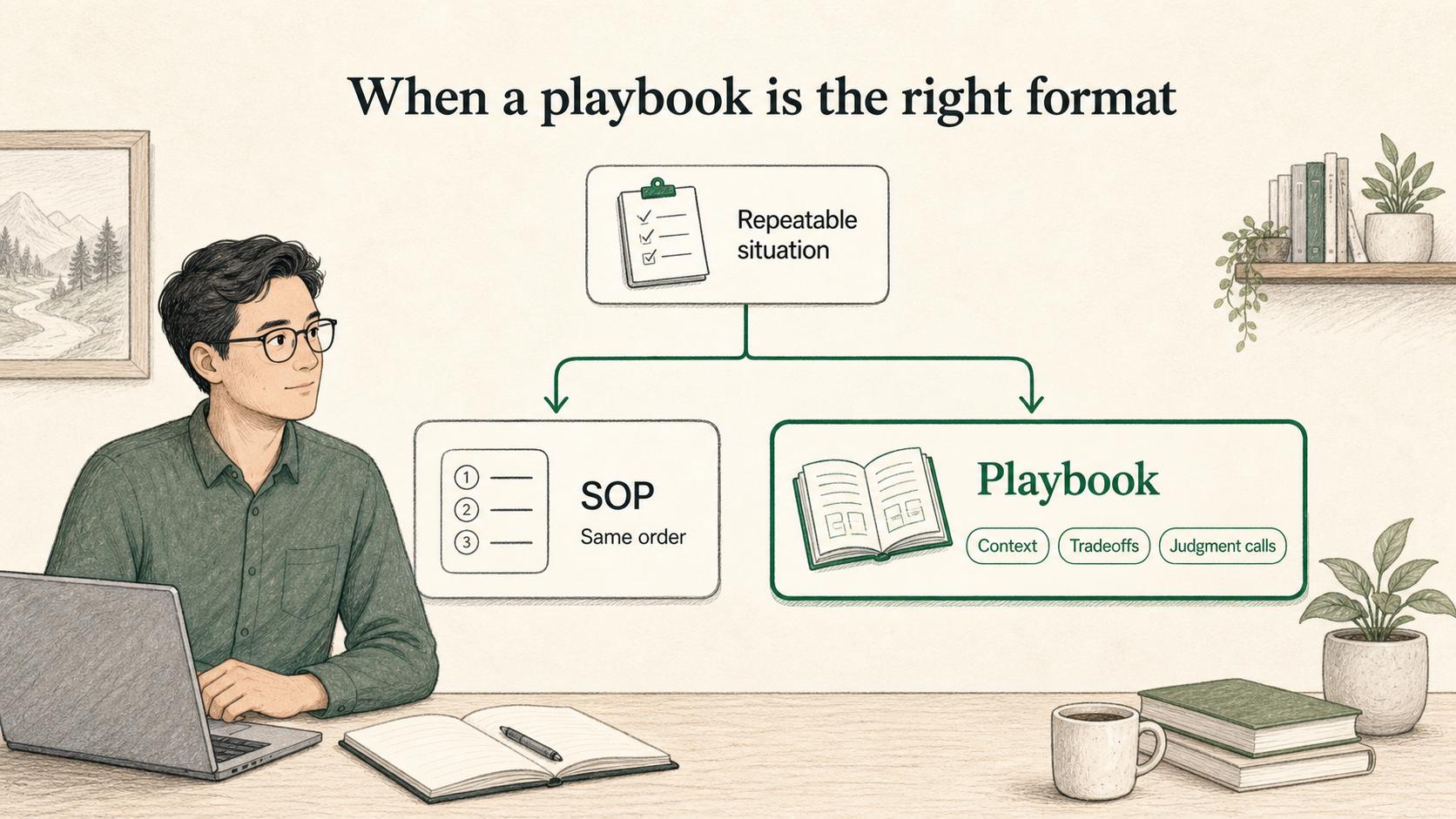
Use a playbook when the work has recognizable patterns but still requires context. If every step must happen in the same order, an SOP is usually better. If the work involves tradeoffs, customer differences, risk signals, or judgment calls, a playbook gives people a way to act consistently without forcing a false script.
A customer support escalation playbook, for example, may avoid exact reply scripts and instead explain which signals make an issue urgent, when to bring in engineering, what information to collect before escalating, and how to communicate with the customer while the team investigates. The playbook gives the support rep enough structure to avoid improvising from scratch.
What a useful playbook includes
A playbook should make expected behavior visible. The most useful sections help someone make a decision during work.
Strong playbooks usually include:
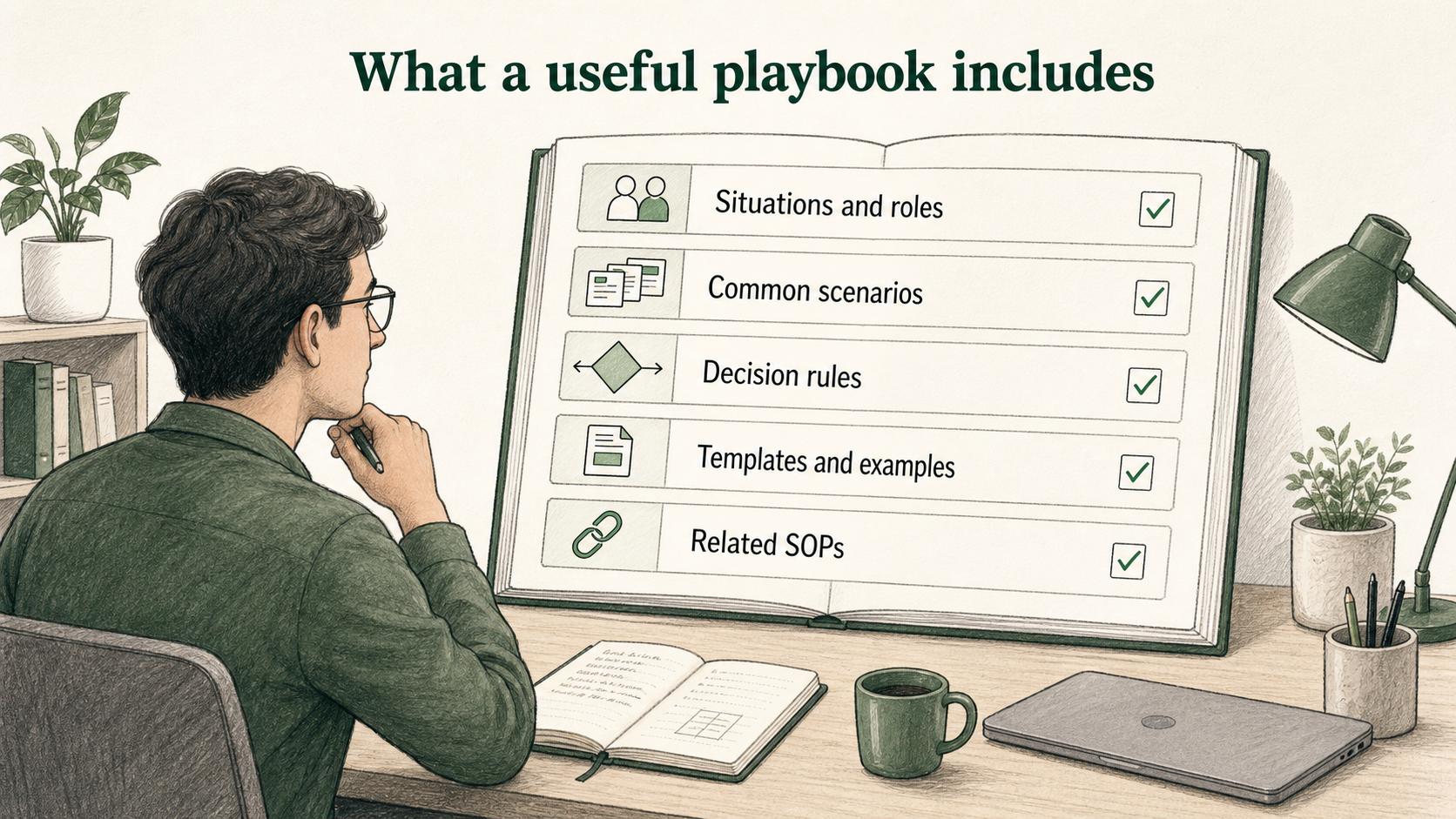
- The situations the playbook covers and the roles using it
- Common scenarios or plays, each with a trigger and recommended action
- Decision rules, escalation thresholds, and success criteria
- Templates, scripts, examples, or screenshots that show the standard in practice
- Links to related SOPs, work instructions, tools, and source systems
The exact mix depends on the job. A sales playbook needs talk tracks and qualification rules. An incident response playbook needs severity criteria, communication paths, and handoff expectations. A hiring playbook needs interview stages, calibration guidance, and candidate communication rules.
Use one test: could a capable person use the playbook during real work? If the answer is no, the document is probably only a reference.
Playbook vs. SOP vs. manual
These formats overlap, but they solve different problems.
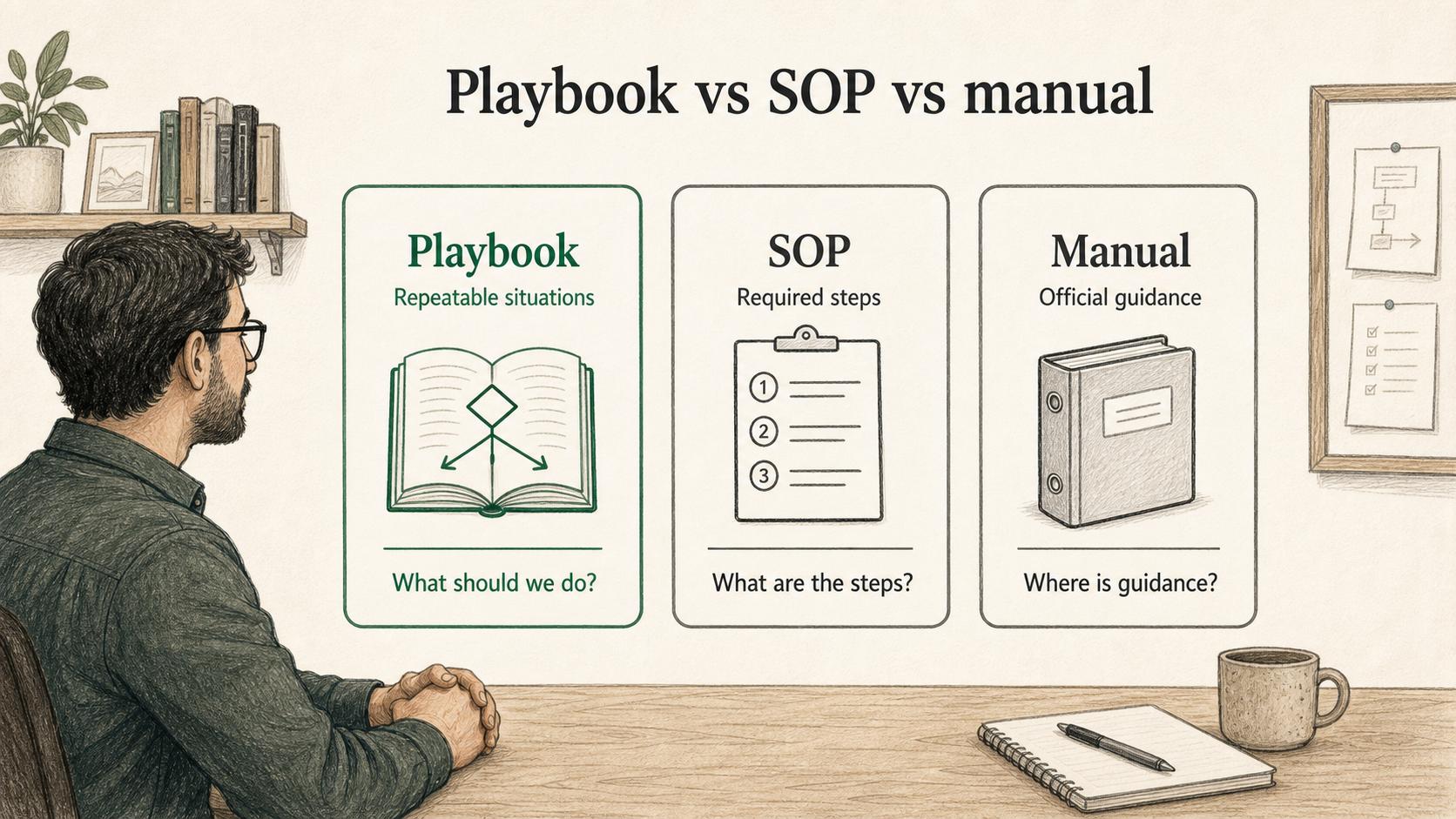
| Format | Best for | What it should answer |
|---|---|---|
| Playbook | Repeatable situations that need judgment | What should we do when this kind of situation appears? |
| SOP | A specific process that needs consistent execution | What are the required steps, in what order? |
| Manual | A broader collection of policies, procedures, or reference material | Where can someone find the official guidance? |
A playbook can point to SOPs, and a manual can contain playbooks. The distinction matters because teams often make playbooks too procedural or SOPs too vague. If the work depends on judgment, name the decision rules. If the work depends on precision, document the steps.
How to build a playbook from real work
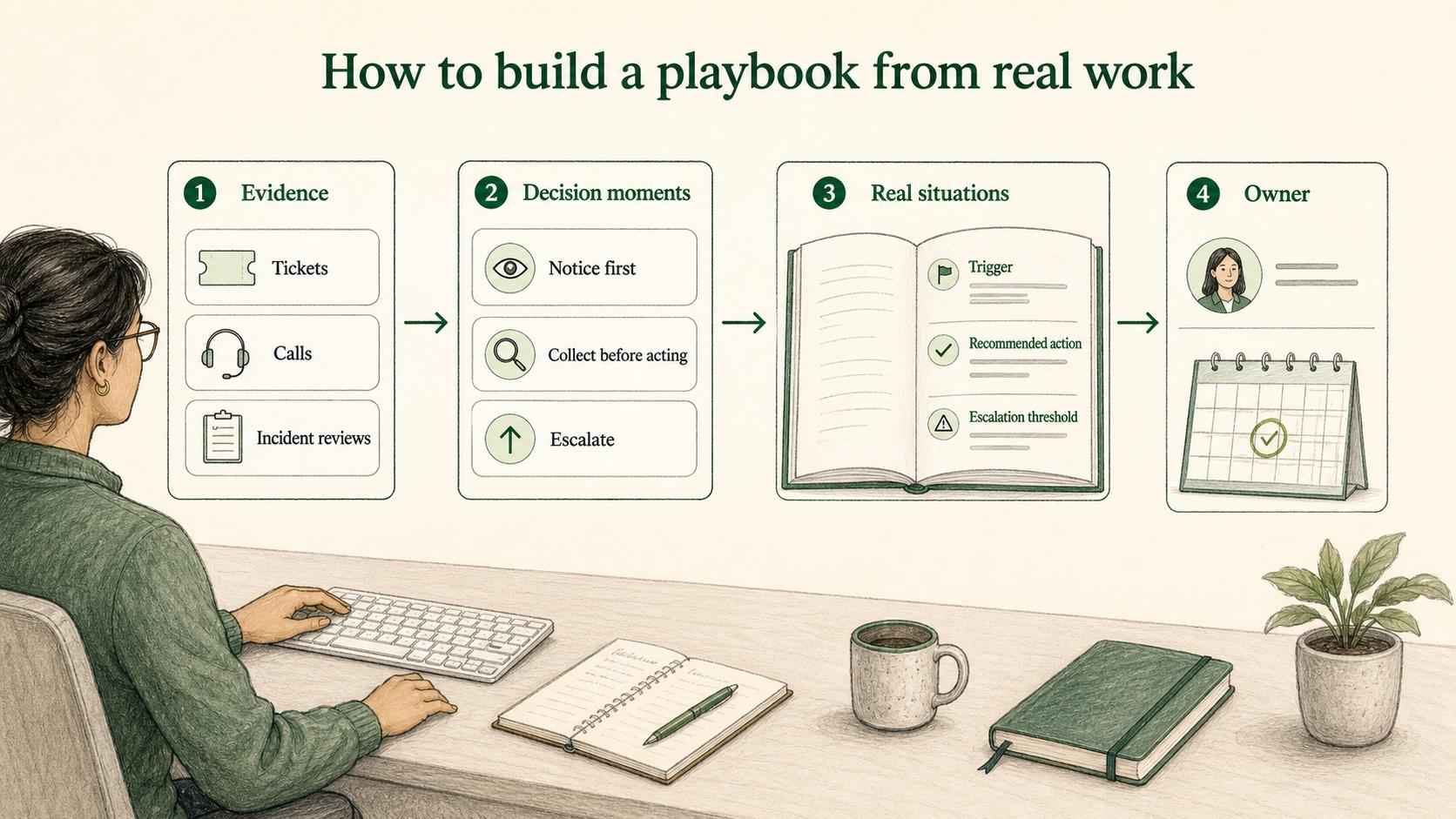
The fastest way to make a playbook generic is to start from a blank outline. Start with evidence instead: recordings, completed tickets, sales calls, onboarding projects, incident reviews, handoff notes, or examples from strong performers.
Look for moments where good people make decisions that are hard for new people to see. What do they notice first? What information do they collect before acting? What do they avoid doing too early? Where do they escalate? What artifact proves the work is complete?
Then organize the playbook around real situations. A support playbook might have plays for billing confusion, product defects, angry customers, security questions, and feature requests. Each play should include the trigger, recommended action, useful language, required context, and escalation threshold.
The maintenance rule is just as important: assign an owner. Playbooks age quietly. The first sign is usually that experienced teammates stop linking to them.
AI-ready playbook prompt
Use this prompt to turn team knowledge into a first draft, then validate it with the people who do the work well.
## Playbook Draft Prompt

**Glossary term:** Playbook
**Source:** Trails Glossary — trails.so/glossary/playbook

---

### 01. Create a playbook

"Create a playbook for [team] handling [scenario]. The audience is [role or team]. Include: purpose, when to use it, common situations, decision rules, recommended plays, examples, templates or scripts, escalation paths, success criteria, and related SOPs or work instructions. Make the guidance practical enough to use during live work, and call out judgment calls that experienced teammates usually make implicitly."
The prompt is a starting point. The important pass comes afterward, when the team replaces generic advice with real examples, wording, screenshots, thresholds, and exceptions.
Common mistakes
The most common mistake is documenting ideals instead of behavior. "Communicate clearly" is not a play. "If the customer is blocked and the bug has no workaround, tag support leadership before the next customer update" is closer to usable guidance.
Another mistake is hiding the playbook from the moment of work. A playbook that only lives in a long knowledge base page may be technically documented but operationally invisible. Link it from onboarding, ticket macros, CRM stages, internal tools, or the checklist where people actually need it.
A subtler mistake is letting the playbook compete with SOPs. If a play requires a precise workflow, link to the SOP instead of duplicating steps. Duplication makes the playbook feel complete at first, then makes it harder to keep accurate.
How Trails helps
Trails helps teams turn real workflows into reusable playbook material. A teammate can capture a process as they perform it, turn it into a polished step-by-step guide, and create an AI-narrated video version for training or sharing. That makes it easier to fill playbooks with examples of how work actually happens.