
Glossary
Training SOP
 ChatGPT
 Perplexity
 Gemini
 Claude
What is a training SOP?
A training SOP is a standard operating procedure written to teach someone how to perform a repeatable task the approved way. It combines the control of an SOP with the context, examples, and checks a learner needs during training.1
Many SOPs are technically correct but hard to learn from. They assume the reader already understands the system, vocabulary, edge cases, and quality bar. A training SOP fills those gaps without turning the procedure into a full training manual.
When a training SOP is useful
Use a training SOP when a task is repeatable, important, and teachable. It works especially well for customer support workflows, back-office operations, onboarding tasks, compliance-sensitive steps, field service work, and internal software processes.
A training SOP is a good fit when:
- New hires need to perform the task without constant shadowing.
- Different employees complete the same work in different ways.
- Mistakes create rework, customer confusion, safety risk, or quality problems.2
- The process has decision points that are easy to miss.
- Managers need a consistent way to judge whether someone is ready to work independently.
Keep the scope narrow. If the SOP tries to explain an entire department, it becomes too heavy for training. Anchor it to one job or one workflow.
What a training SOP should include
A strong training SOP uses the same backbone as a normal procedure, then adds learner support where the task usually breaks down.
Include the basics: purpose, scope, audience, tools, access, prerequisites, and the approved step-by-step procedure. Then add the pieces that make it useful for training:
- Decision points: where the learner has to choose, escalate, or slow down.
- Examples: what a correct result looks like in the real system or workflow.
- Common mistakes: the misses that create rework or bad handoffs.
- Practice activity: a realistic scenario the learner can complete.
- Readiness check: how a trainer, manager, or peer confirms competence.
- Owner and review trigger: who keeps the SOP current and when it should be updated.
The readiness check is often the most useful section. A training SOP should not end with "read this page." It should make clear what the learner needs to demonstrate.3
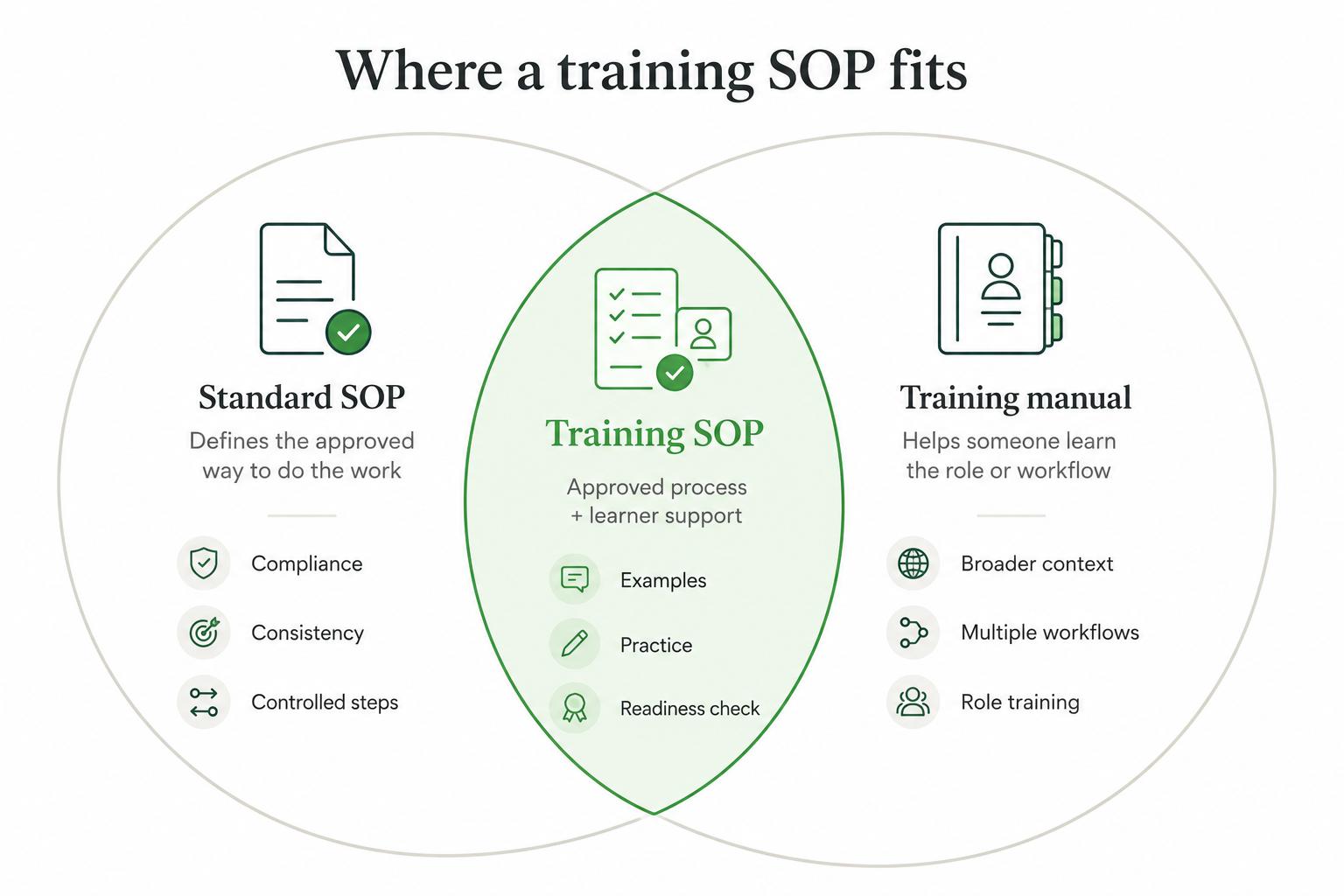
Training SOP vs training manual
A training SOP is narrower than a training manual. A training manual may cover a role, department, or onboarding program. A training SOP covers one repeatable procedure inside that larger training system.
For example, a support training manual might explain the team's tools, tone, escalation model, and quality expectations. A training SOP inside that manual might teach the specific workflow for refund requests, account access issues, or post-call notes.
That narrow scope is the advantage. A training SOP can stay close to the work, include screenshots or video where useful, and be updated when the procedure changes.
Training SOP vs SOP training
A training SOP is the document that teaches one procedure. SOP training is the broader activity of teaching employees how to use SOPs correctly.
A team may run SOP training for all new hires, then use individual training SOPs for specific workflows. The first builds the habit of following standard procedures. The second teaches the exact work.
Training SOP template
Use this prompt-style template to draft from a real workflow:
## Training SOP Template

**Glossary term:** Training SOP
**Source:** Trails Glossary — trails.so/glossary/training-sop

---

### 01. Draft a training SOP from a workflow

"Create a training SOP for [task or workflow].

Audience: [role or team]
Purpose: [why the task matters]
Trigger: [when the learner should use this process]
Prerequisites: [tools, access, materials, prior knowledge]
Approved procedure: [step-by-step workflow]
Decision points: [common branches or exceptions]
Common mistakes: [what learners often miss]
Practice scenario: [realistic example]
Readiness check: [how a trainer confirms competence]
Owner and review trigger: [who maintains it and when it changes]"
After drafting, test the SOP with someone who has not done the task before. If they can complete the practice scenario and explain the key decision points, the SOP is probably working. If they can only follow it while a trainer narrates every step, the document is still too thin.
Common mistakes
The most common mistake is writing a training SOP from memory instead of from the actual workflow. That misses small but important details: which button appears after a status changes, what to do when a field is blank, or how to recognize a bad input.
Another mistake is confusing completion with competence. A learner can click through a process once and still not understand when to escalate, how to spot exceptions, or why the work matters. Build those checks into the SOP instead of assuming they will happen informally.4
A third mistake is leaving the training SOP unowned. Training procedures age quickly when tools, policies, roles, or quality standards change. Assign an owner and a review trigger so the SOP does not quietly become outdated.
How Trails helps
Trails helps teams turn real workflows into training SOPs without starting from a blank page. A subject matter expert can capture the process as they perform it, and Trails turns the workflow into a polished step-by-step guide. Trails can also create an AI-narrated video version for training or sharing.
That matters for training SOPs because the details learners need are often the same details experts forget to write down. Capturing the work directly makes the SOP easier to create, review, and keep aligned with the way the process actually runs.
FAQ
Is a training SOP the same as a regular SOP?
No. A regular SOP defines the approved procedure. A training SOP teaches that procedure with learner context, examples, practice guidance, and readiness checks.
Who should own a training SOP?
Usually the process owner and training owner share responsibility. The process owner keeps the procedure accurate; the training owner keeps it teachable.
Should a training SOP include video?
Use video when the task is visual, timing-sensitive, or hard to understand from text alone. Pair it with written steps so learners can search and reference the procedure later.
Sources
- 1
National Institute of Standards and Technology. Training Within Industry. NIST MEP. www.nist.gov/mep/training-within-industry-twi. Accessed June 25, 2026.
- 2
Occupational Safety and Health Administration. Education and Training. OSHA. www.osha.gov/safety-management/education-training. Accessed June 25, 2026.
- 3
Dunlosky et al.. Improving Students' Learning With Effective Learning Techniques. Psychological Science in the Public Interest. www.psychologicalscience.org/publications/journals/pspi/learning-techniques.html. Accessed June 25, 2026.
- 4
ERIC. Transfer of Training. ERIC. eric.ed.gov/?id=ED551825. Accessed June 25, 2026.