
Glossary
L&D Manager
 ChatGPT
 Perplexity
 Gemini
 Claude
What does an L&D manager do?
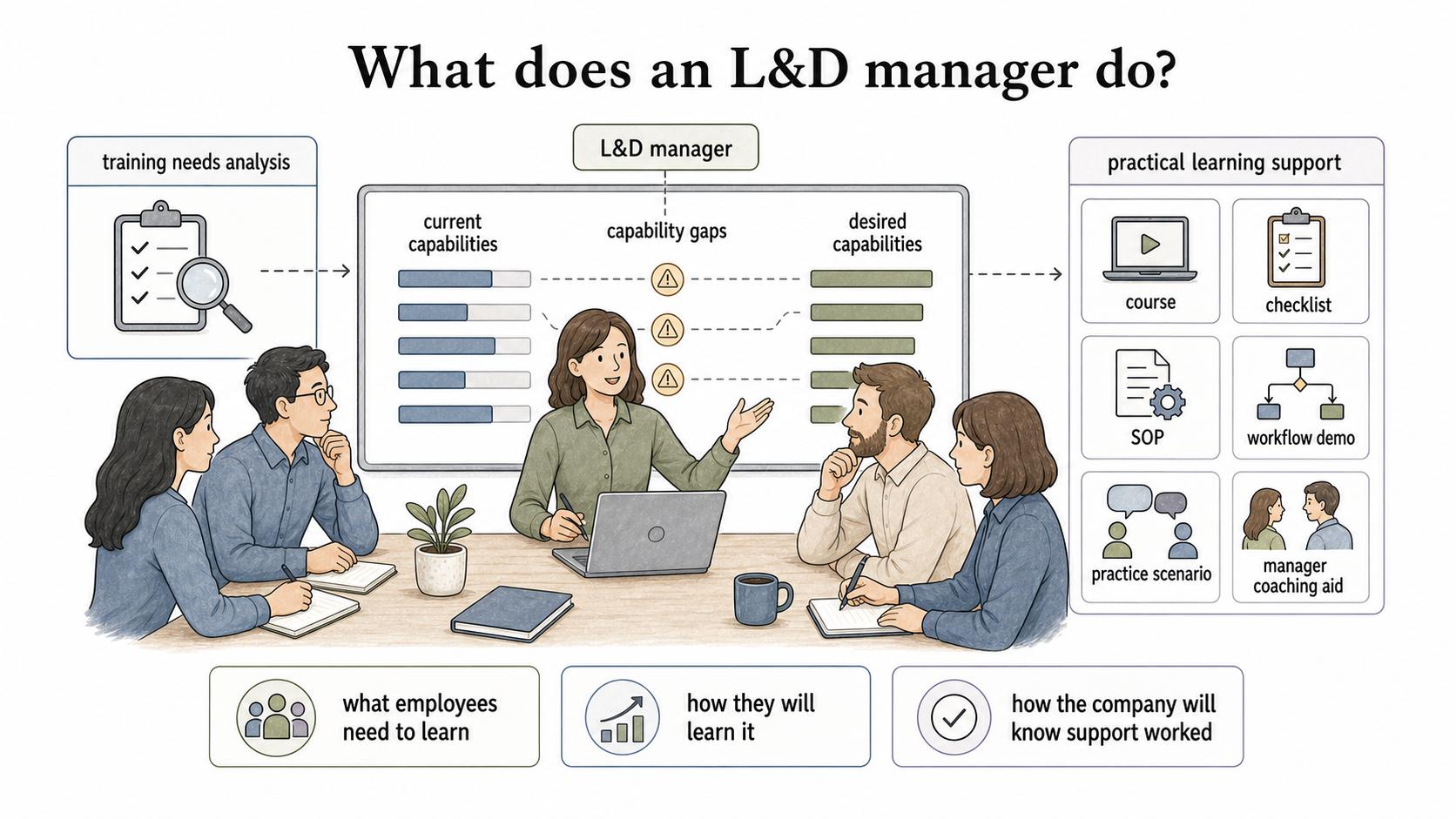
An L&D manager, or learning and development manager, owns how employees learn the work. The role can include onboarding, role training, manager development, compliance training, skill building, learning systems, and the documentation that keeps those programs usable.
The job is less about scheduling courses and more about turning business needs into learning support people can use.
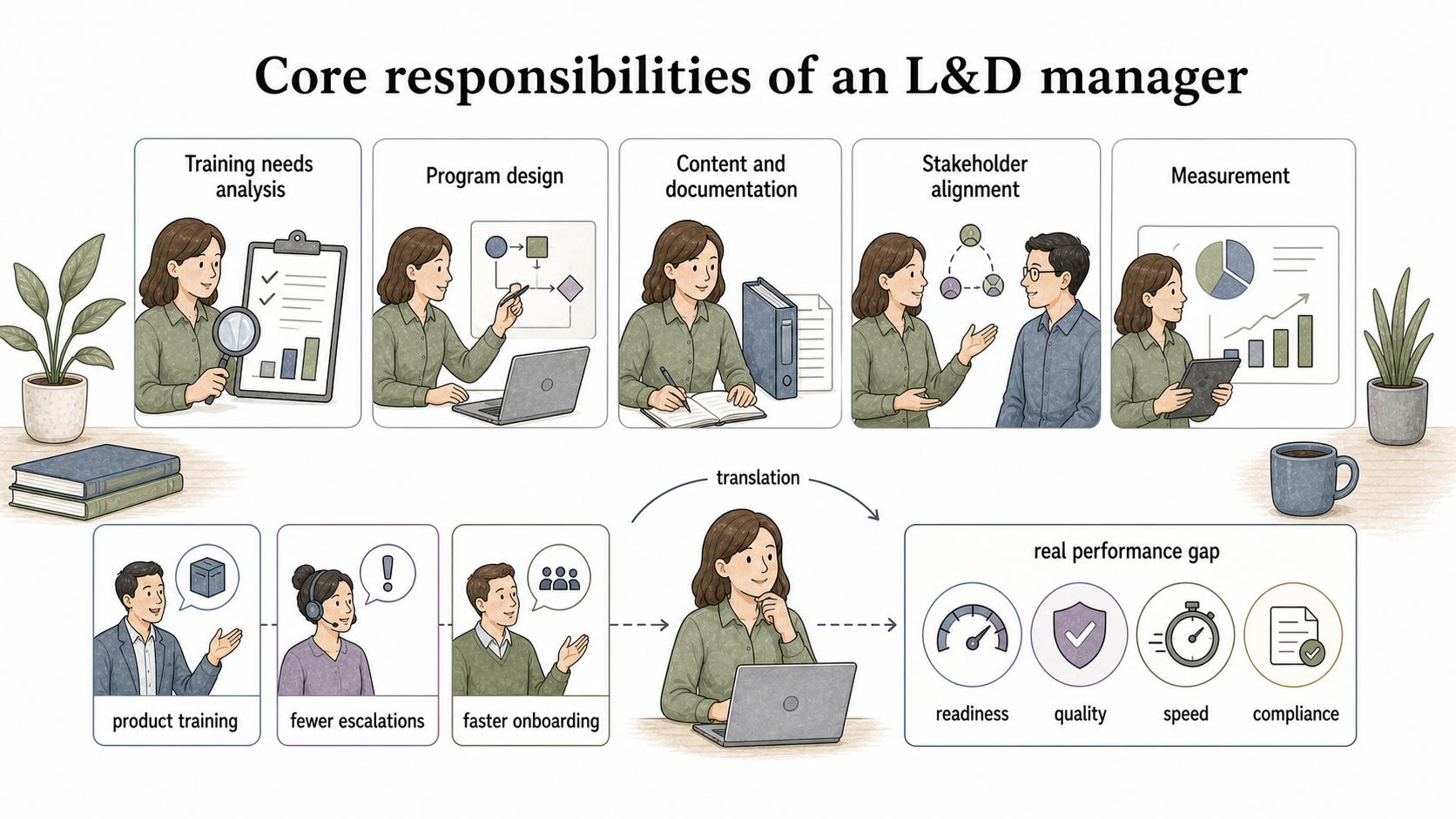
Core responsibilities of an L&D manager
| Responsibility | What it means in practice | What often gets missed |
|---|---|---|
| Training needs analysis | Identify gaps in knowledge, confidence, or process clarity | Treating every performance issue as a course request |
| Program design | Create learning paths, workshops, job aids, or self-serve resources | Designing around content instead of real work |
| Content and documentation | Maintain guides, SOPs, videos, checklists, and manager materials | Letting training drift after change |
| Measurement | Track readiness, quality, speed, or compliance | Measuring completion while ignoring behavior |
The hidden part of the job is translation: turning requests for product training, fewer escalations, or faster onboarding into support for the real performance gap.
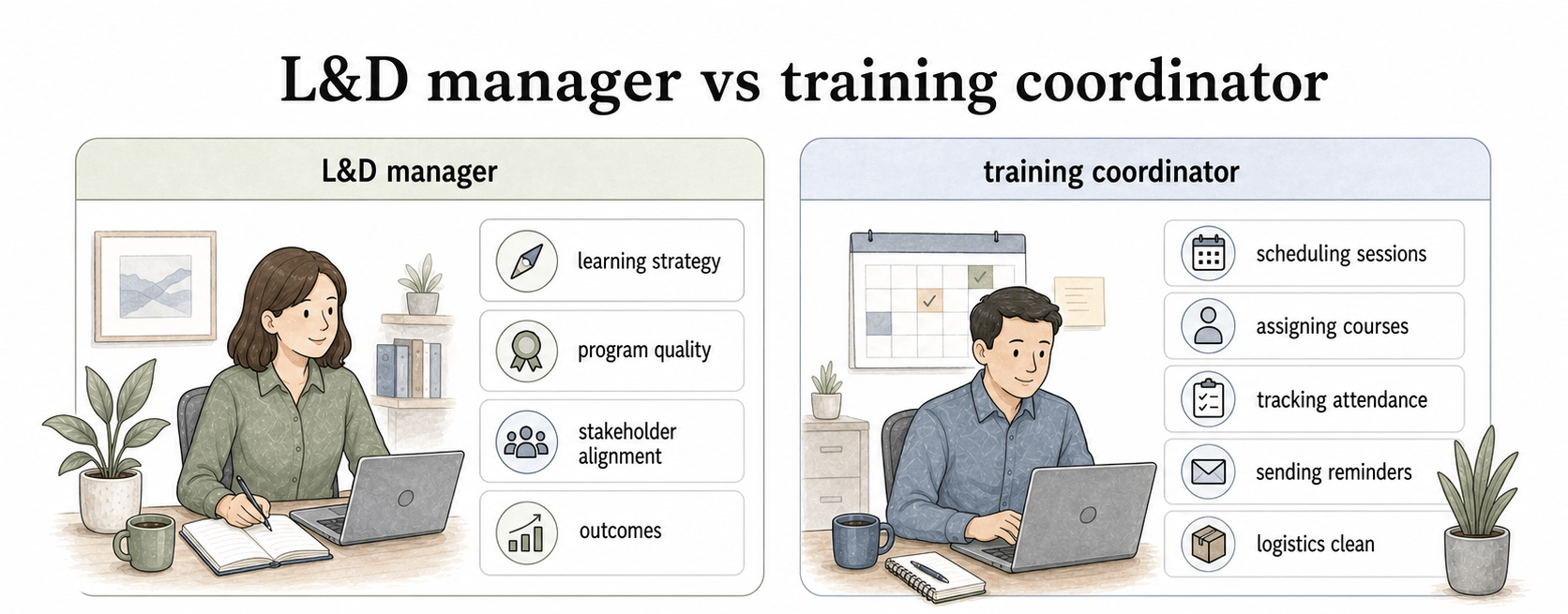
L&D manager vs. training coordinator
An L&D manager usually owns learning strategy, program quality, stakeholder alignment, and outcomes. A training coordinator usually owns scheduling, assignments, attendance, reminders, and logistics. In lean teams those roles can overlap, but someone still needs to own learning architecture.
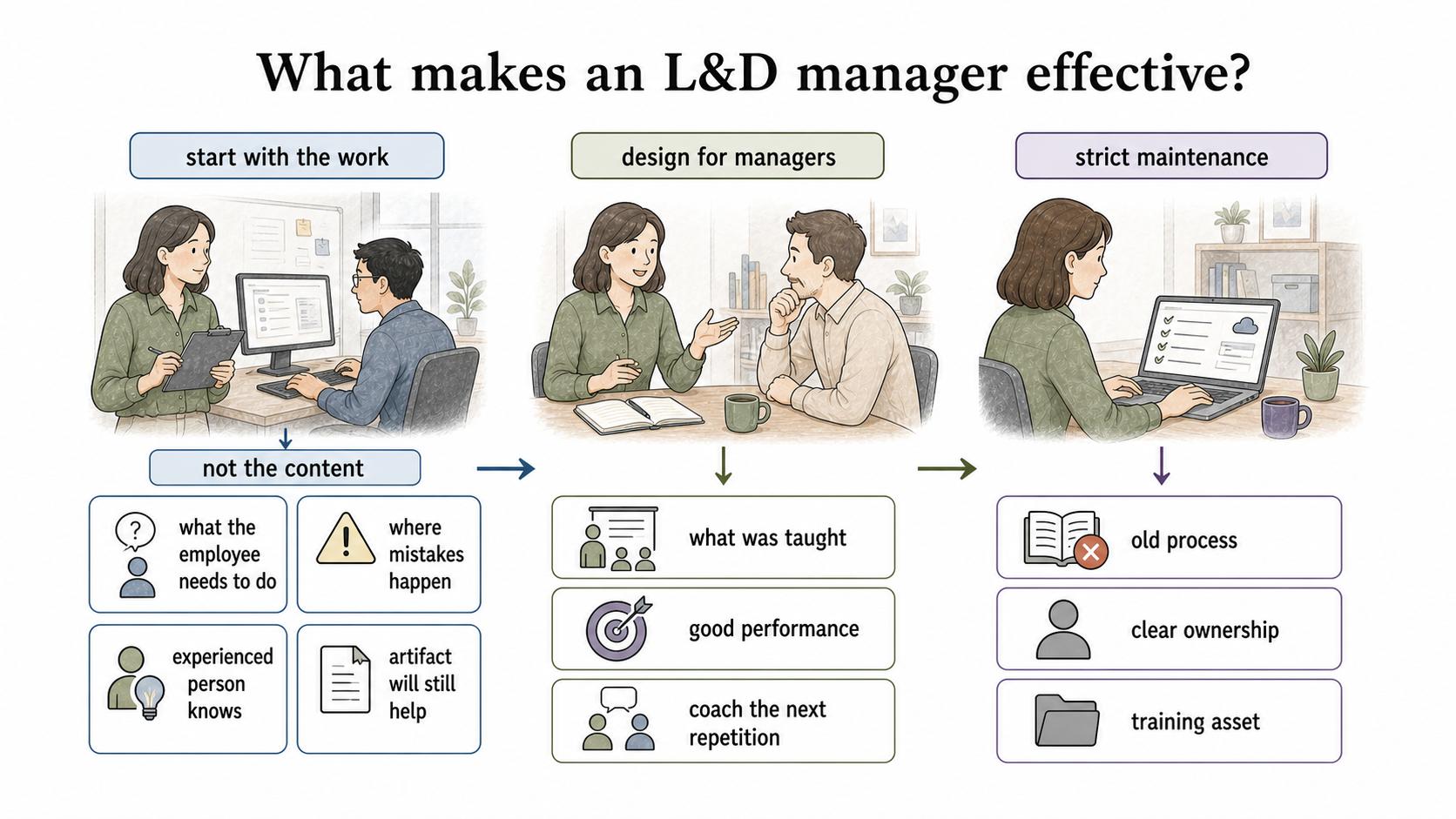
What makes an L&D manager effective?
Strong L&D managers start with the work, not the content. They ask what employees need to do, where mistakes happen, what experienced people know, and which artifact will still help after the session ends.
They design for manager reinforcement and maintain assets as tools, processes, and expectations change.
A practical prompt for planning an L&D program
## L&D Program Planning

**Glossary term:** L&D Manager
**Source:** Trails Glossary — trails.so/glossary/ld-manager

---

### 01. Plan a learning response

"You are helping an L&D manager plan a training response for [team] on [topic/process].
Audience: [role or group]
Business problem: [what is going wrong or changing]
Current state: [what employees do today]
Desired behavior: [what employees should do after support]
Known constraints: [time, tools, compliance needs, manager availability]
Existing materials: [docs, SOPs, videos, examples]

Recommend the best learning support format, the core sections to include, what managers should reinforce afterward, and how we should measure whether the training worked. Avoid recommending a full course if a job aid, checklist, SOP, or short walkthrough would solve the problem better."
Many workplace learning problems are better solved with a short guide, workflow demo, practice scenario, or manager coaching aid than with a full course.
Documentation an L&D manager should own or influence
Important assets include onboarding checklists, role-based learning paths, training documentation, SOPs, knowledge-transfer notes, process walkthroughs, facilitator guides, manager guides, and assessment rubrics. Each needs an owner, a review trigger, and a connection to the source process.
How Trails helps
Trails helps L&D managers turn real workflows into reusable learning material. Teams can capture a process, turn it into a polished guide, and create an AI-narrated video for onboarding, tool training, support processes, and knowledge transfer.
Sources
- 1
ATD. 2024 State of the Industry release. Association for Talent Development, 2024. www.td.org/content/press-release/atd-research-l-and-d-professionals-are-optimistic-about-td-s-value-within-organizations.
- 2
OpenLearn. Training needs analysis. The Open University. www.open.edu/openlearn/money-business/workplace-learning-coaching-and-mentoring/content-section-1.1.
- 3
Saks and Belcourt. An investigation of training activities and transfer of training in organizations. www.researchgate.net/publication/227701783_An_investigation_of_training_activities_and_transfer_of_training_in_organizations.