
Glossary
Just in Time (JIT)
 ChatGPT
 Perplexity
 Gemini
 Claude
What is just in time?
Just in time (JIT) is an operations approach where materials, information, or work arrive when they are needed. Instead of carrying large buffers, teams use demand signals to reduce waste, limit idle inventory or work-in-progress, and expose problems earlier. 1
Why just in time matters
JIT is best known from lean manufacturing, but the same logic shows up in warehouses, support operations, IT provisioning, and documentation work. 2
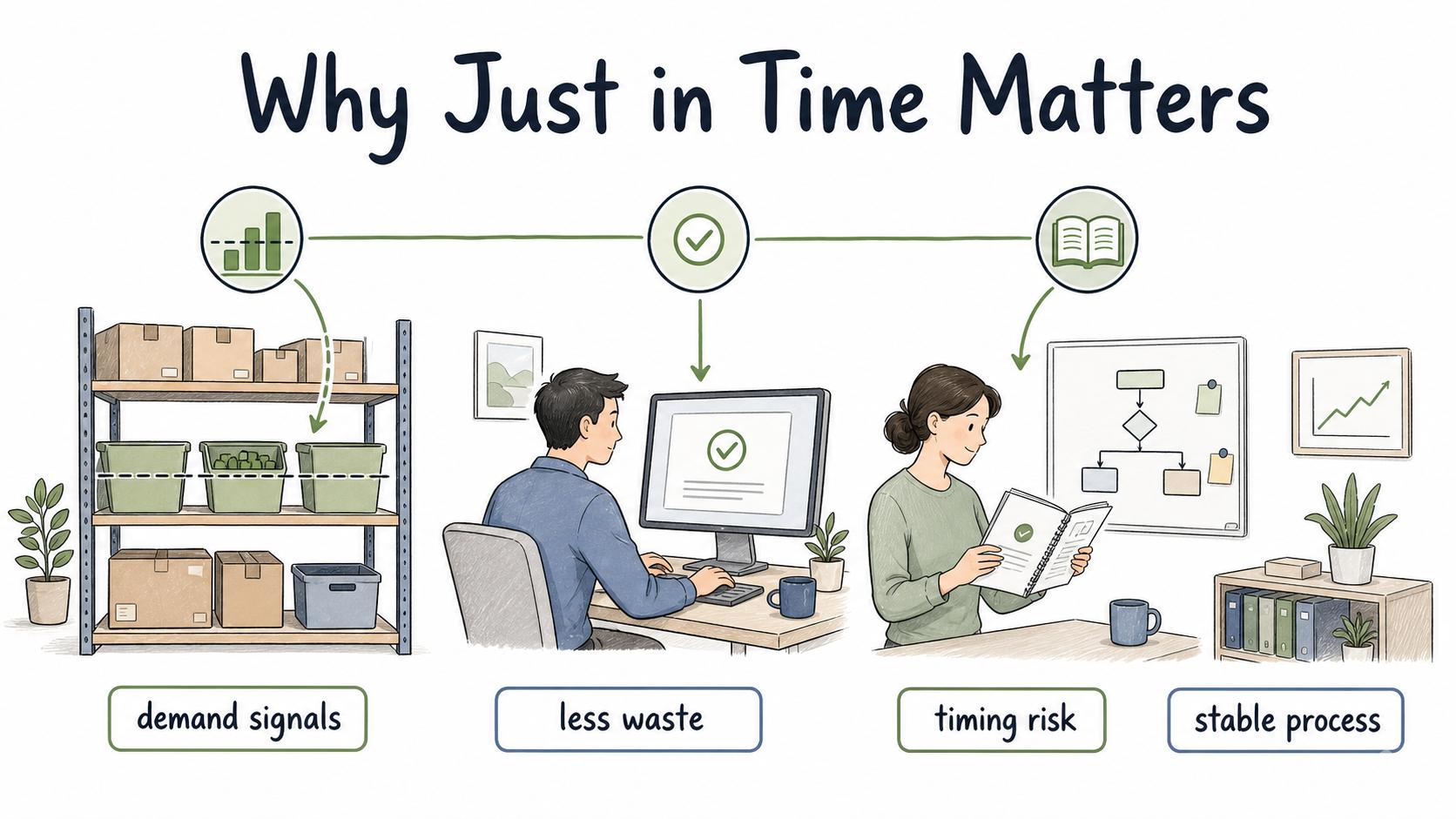
The upside is less stale inventory, fewer unused assets, and less work created before anyone needs it. The risk is timing: a late approval, vague owner, missing work instruction, or broken supplier handoff can stop the flow. 3
JIT sharpens operations only when the underlying process is stable enough to run with less slack.
How just in time works
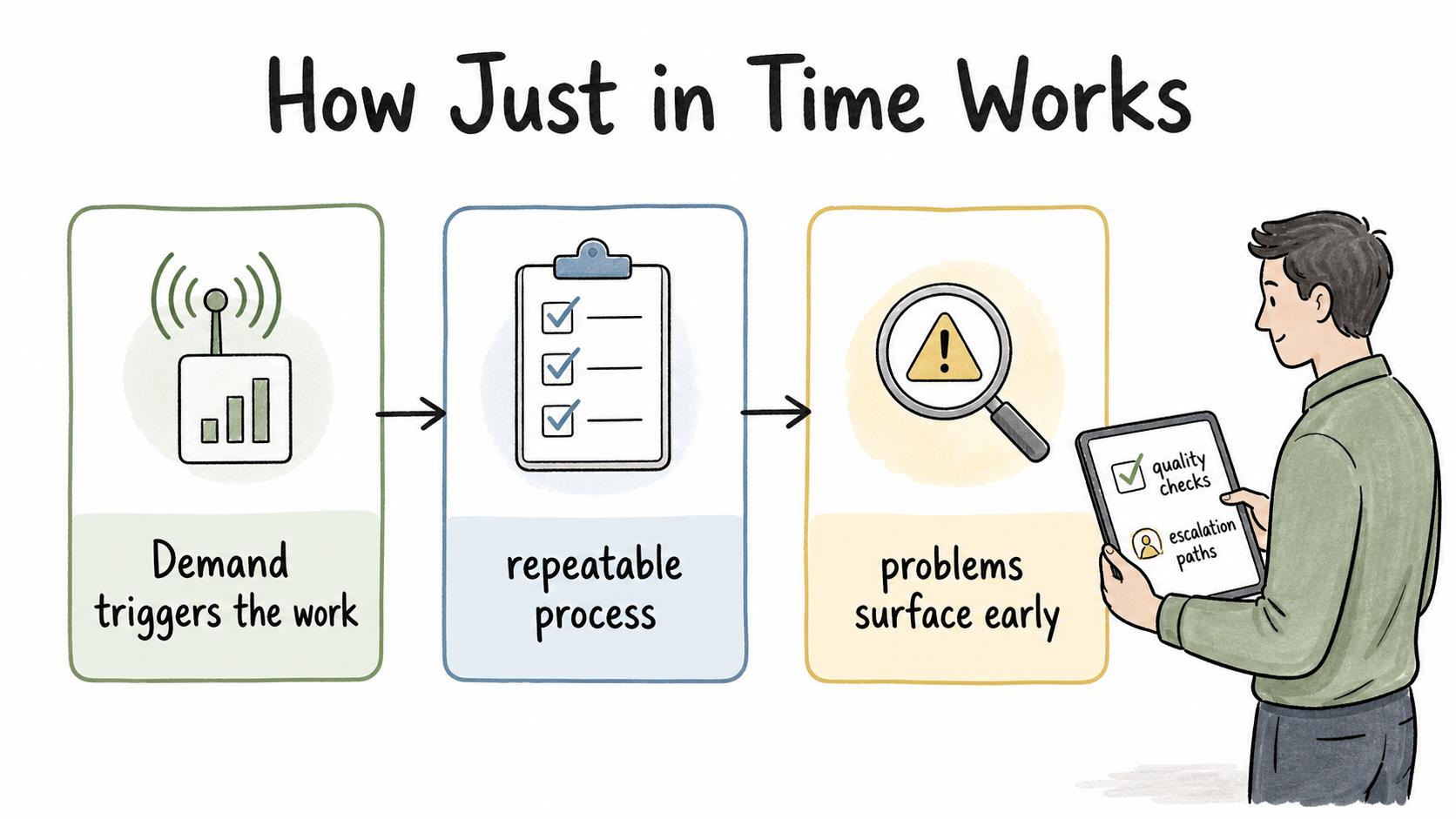
- Demand triggers the work: define the signal that starts the next step, such as a kanban card, inventory threshold, customer request, ticket status, or scheduled service window.
- The process is repeatable: establish clear steps, dependencies, quality checks, and escalation paths before reducing buffers.
- Problems surface early: make missing inputs, late approvals, unclear tasks, or quality issues visible while there is still time to fix the flow.
Just in time vs just in case
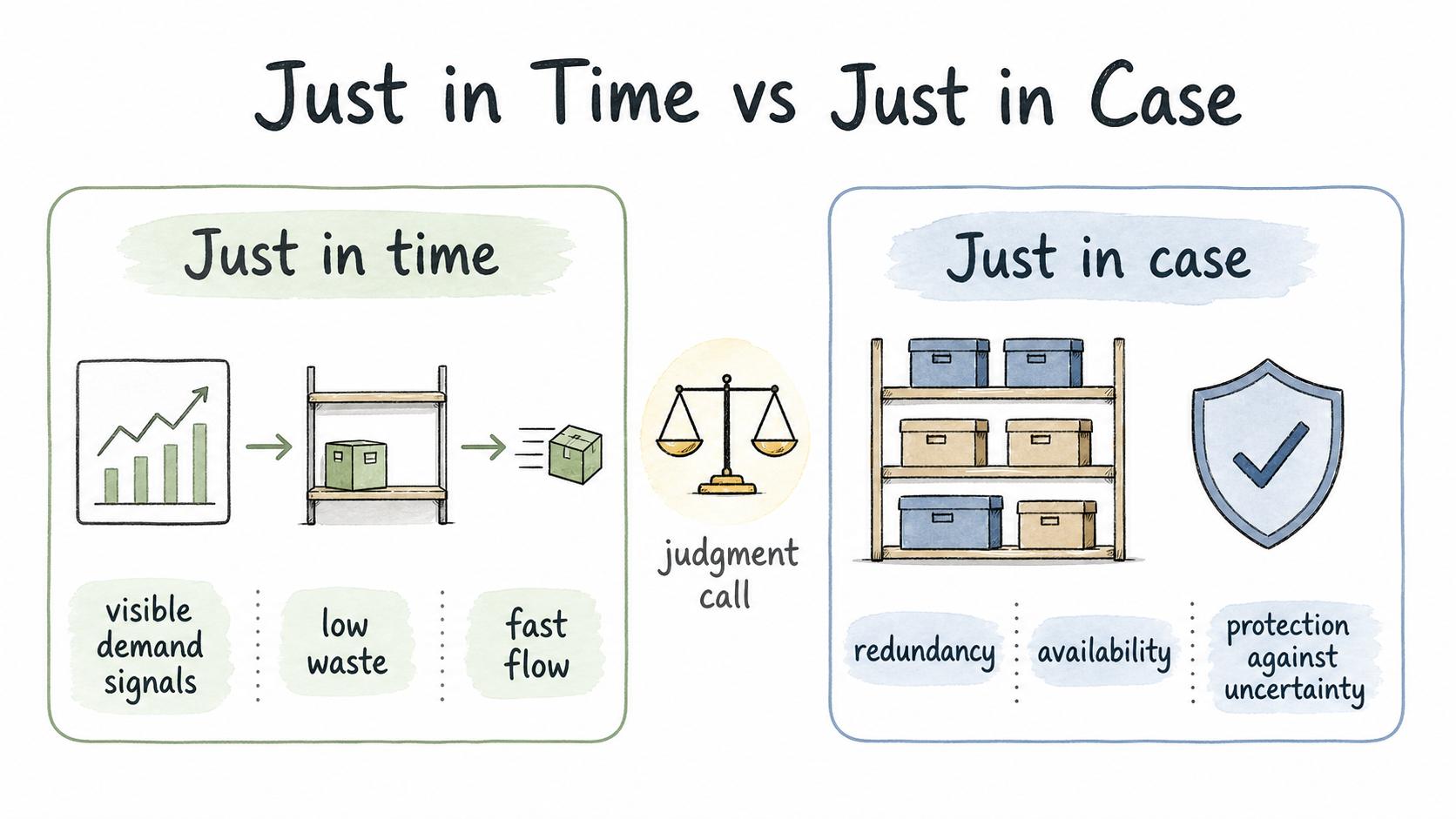
The better comparison is between two risk strategies:
| Approach | What it optimizes for | Main risk | When it fits |
|---|---|---|---|
| Just in time | Low waste, fast flow, less idle inventory or prep work | Breakdowns when timing, quality, or ownership is unclear | Stable processes with visible demand signals and dependable handoffs |
| Just in case | Redundancy, availability, and protection against uncertainty | Excess cost, outdated materials, hidden process problems | Volatile demand, fragile supply chains, high-risk work, or low tolerance for downtime |
The judgment call is where a buffer protects the business and where it hides poor process design.
Where JIT breaks down
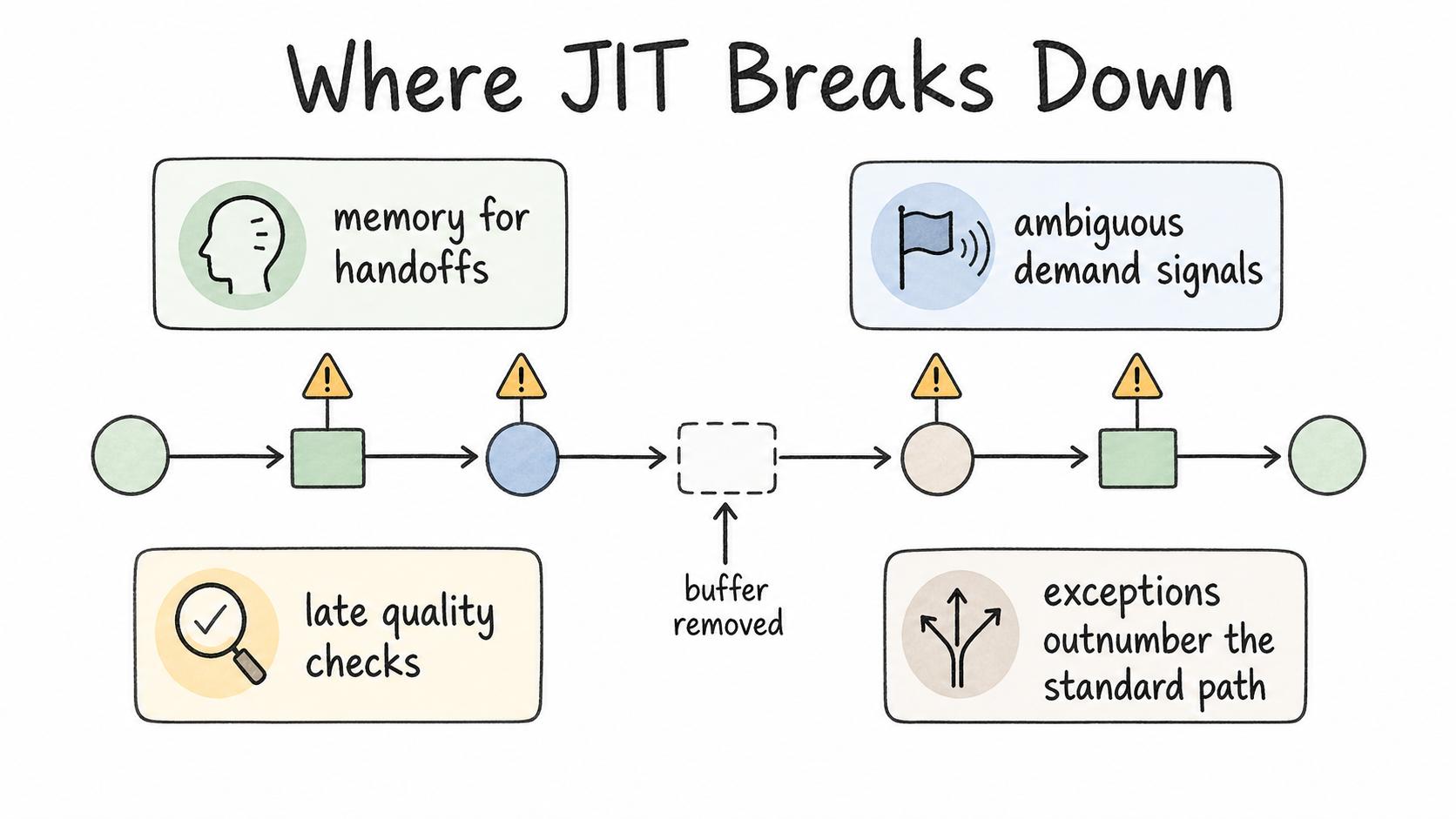
JIT fails when a team treats it as a cost-cutting slogan before the work is predictable. Removing inventory, people, time, or documentation without tightening the process creates more fire drills, not better flow.
- People rely on memory for critical handoffs: JIT exposes undocumented knowledge quickly because there is no cushion when the expert is unavailable.
- Demand signals are ambiguous: work piles up too early or arrives too late.
- Quality checks happen after the handoff: late inspection creates rework at the worst possible moment.
- Exceptions outnumber the standard path: the system is not ready for tight timing.
How to apply JIT thinking to team workflows
For non-manufacturing teams, JIT often means reducing unnecessary work-in-progress. A customer success team might wait to build custom training docs until a customer confirms its rollout plan. A support operations team might create troubleshooting guides around issues agents actually see. An IT team might standardize access requests so provisioning happens quickly after approval instead of being batched days later.
Documentation needs to stay close to the work. A stale, broad, or hard-to-follow guide creates extra meetings, duplicate reviews, shadow spreadsheets, or manual reminders—buffers that can show the process is not trusted.
Documentation takeaway
JIT systems need lightweight documentation because timing depends on repeatability. Document the points where delay, ambiguity, or quality problems would interrupt flow. A useful JIT workflow guide names the demand signal, trigger for action, next-step owner, quality check before handoff, and escalation path when timing slips. 4
FAQ
Is just in time only for manufacturing?
No. JIT started as a major lean manufacturing concept, but the broader idea applies to services, support, IT, operations, and documentation work whenever demand should trigger action instead of preparation far in advance.
Does JIT mean having no backup plan?
No. A good JIT system still uses buffers where the risk is real. The difference is that buffers are intentional, not a default response to unclear processes.
Sources
- 1
Toyota. Toyota Production System overview. www.toyota-europe.com/about-us/toyota-vision-and-philosophy/toyota-production-system.
- 2
EPA. Lean Thinking and Methods: JIT/Kanban. www.epa.gov/sustainability/lean-thinking-and-methods-jitkanban.
- 3
NIST MEP. When your lean supply chains feel out of control, focus on what you can. www.nist.gov/blogs/manufacturing-innovation-blog/when-your-lean-supply-chains-feel-out-control-focus-what-you-can.
- 4
Lean Enterprise Institute. Standardized work. www.lean.org/lexicon-terms/standardized-work/.