
Glossary
Instruction Manual
 ChatGPT
 Perplexity
 Gemini
 Claude
What is an instruction manual?
An instruction manual is a document that explains how to use, assemble, operate, maintain, or troubleshoot something. It gives the reader enough context and step-by-step direction to complete a task correctly without someone standing beside them.
Instruction manuals are common for products, equipment, internal tools, software workflows, and repeatable business processes. Standards for software user information emphasize user needs, clear presentation, and lifecycle maintenance, so a manual should be treated as a maintained product rather than a one-time writing task. 1
A useful manual makes the order of work obvious, flags where the reader may get stuck, and explains what to do when the real situation does not match the ideal path.
What an instruction manual includes
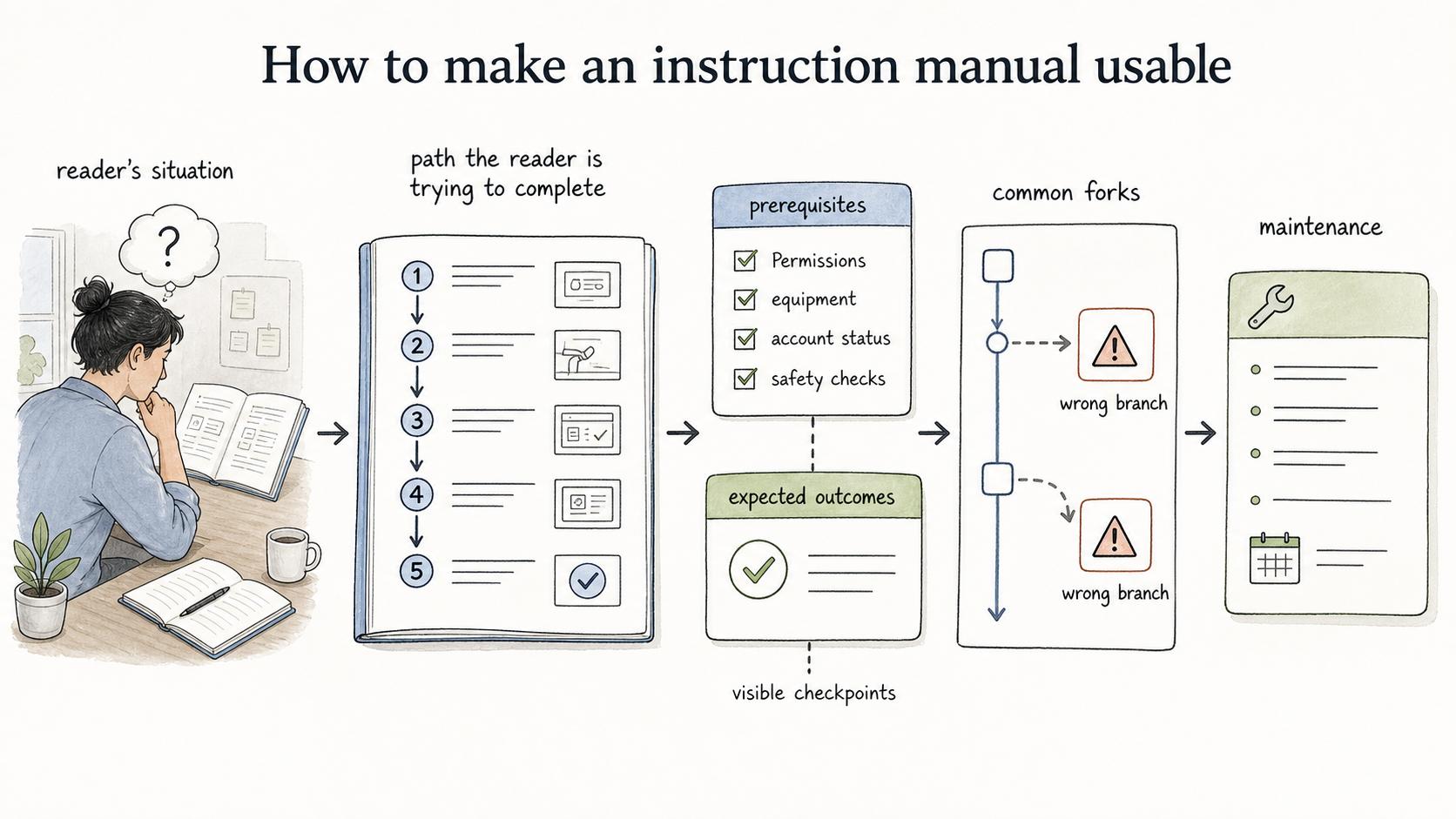
A practical instruction manual answers four questions: what the task is for, what the reader needs before starting, what to do in order, and how to confirm the result is correct.
The best manuals also name forks in the path. They tell the reader when to continue, when to stop, and when to escalate—turning a list of directions into a working support asset.
When an instruction manual is the right format
Use one when a reader needs to perform a task with limited supervision—especially when it is repeatable, has multiple screens or physical steps, creates downstream risk if done wrong, or is performed infrequently. OSHA’s lockout/tagout standard is one example of why written procedures and periodic checks matter. 2
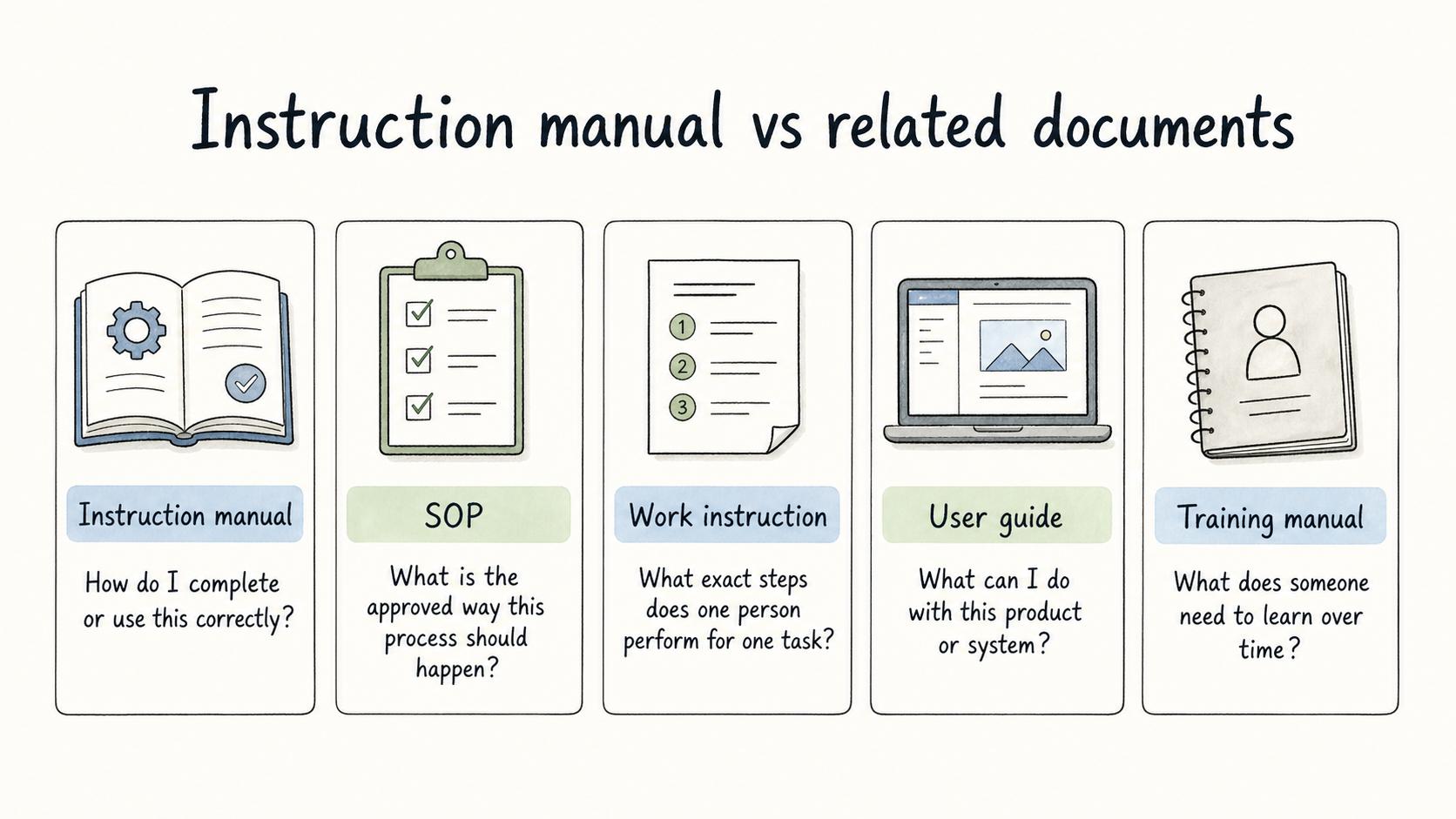
A manual is weaker when the real problem is judgment, policy, or ownership. In those cases the team may need an SOP or policy first.
How to make an instruction manual usable
- Start with the reader’s situation, not the system’s structure.
- Put prerequisites near the top.
- Show expected outcomes, not just actions.
- Name common forks caused by role, plan, location, or data quality.
- Write with maintenance in mind by anchoring fast-changing interfaces around stable intent and checkpoints.
Federal plain-language guidance supports reader-specific writing and testing for understanding; visible outcomes also reduce how much a reader must remember while performing work. 3 4
Common mistakes
The most common mistake is documenting what an expert remembers rather than what a first-time reader needs. Other mistakes are creating polished manuals that cannot be maintained and mixing instruction with policy. Link to policy or SOP where needed, then keep the manual focused on completing the task.
Instruction manual examples
How Trails helps
Trails helps teams create instruction manuals by capturing a workflow as someone performs it, then turning it into a polished step-by-step guide and AI-narrated video for training or handoff.
Sources
- 1
IEEE/ISO/IEC. 26514-2021. IEEE. standards.ieee.org/ieee/26514/7467/.
- 2
OSHA. 29 CFR 1910.147 lockout/tagout standard. OSHA. www.osha.gov/laws-regs/regulations/standardnumber/1910/1910.147.
- 3
Digital.gov. Federal plain language guide series. Digital.gov. digital.gov/guides/plain-language.
- 4
Nielsen Norman Group. Ten usability heuristics. Nielsen Norman Group. www.nngroup.com/articles/ten-usability-heuristics/.