
Glossary
Gap analysis
 ChatGPT
 Perplexity
 Gemini
 Claude
What is gap analysis?
Gap analysis is the practice of comparing where something is today with where it needs to be, then naming the difference clearly enough to act on it. In operations, that usually means looking at a process, team, system, or performance metric and asking what is missing, weak, delayed, undocumented, or under-resourced.
A good gap analysis turns a vague complaint into a concrete decision: which gap matters enough to close, what closed would look like, and what work has to change to get there.
Why gap analysis matters
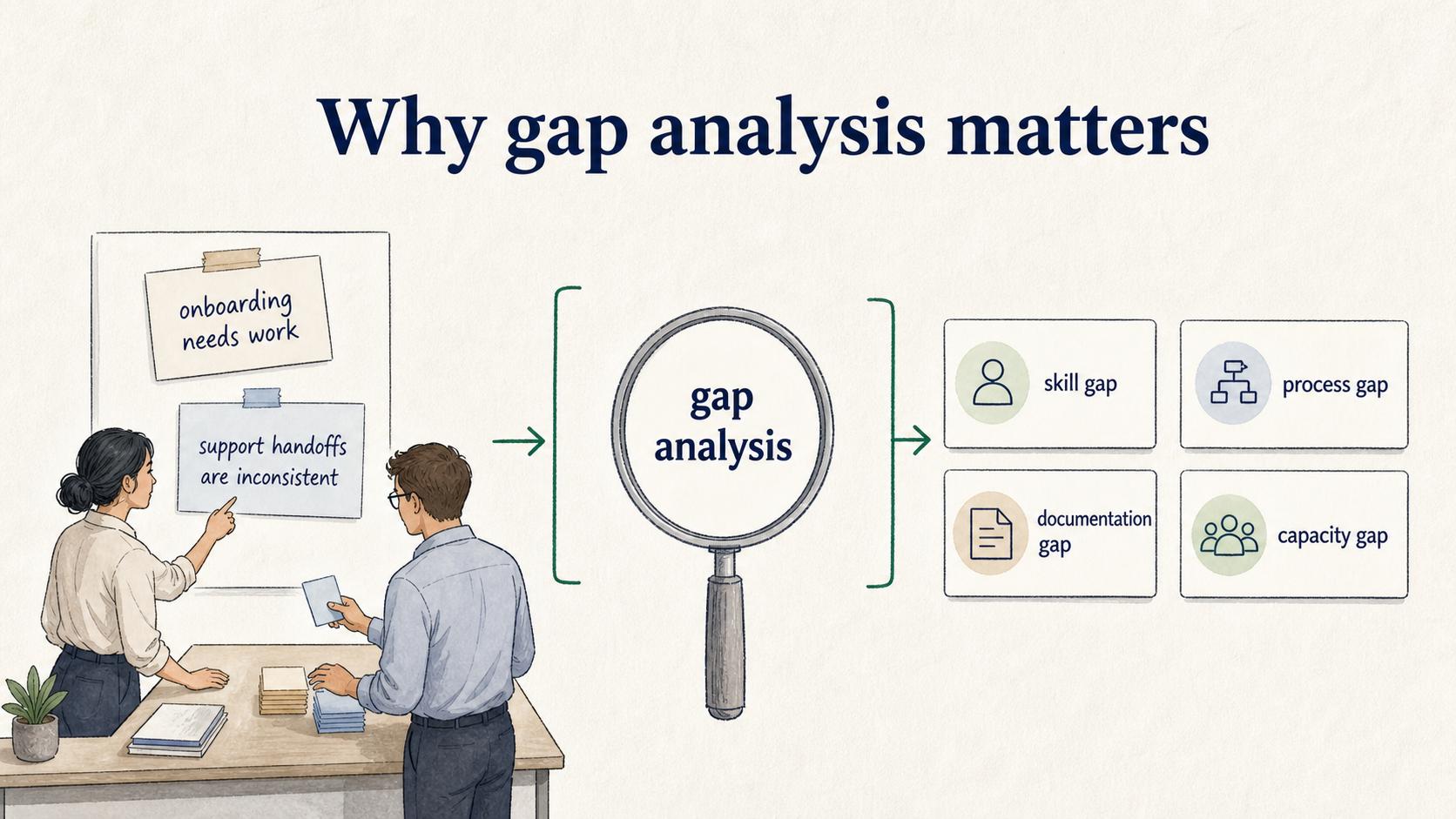
Gap analysis gives teams a structured way to avoid vague improvement work. Structured assessment can identify disparities and focus improvement efforts. 1
A skill gap may need training. A process gap may need a clearer workflow. A documentation gap may need a guide, checklist, or example. A capacity gap may need staffing or prioritization. Treating all of them as the same problem usually creates busywork.
How gap analysis works
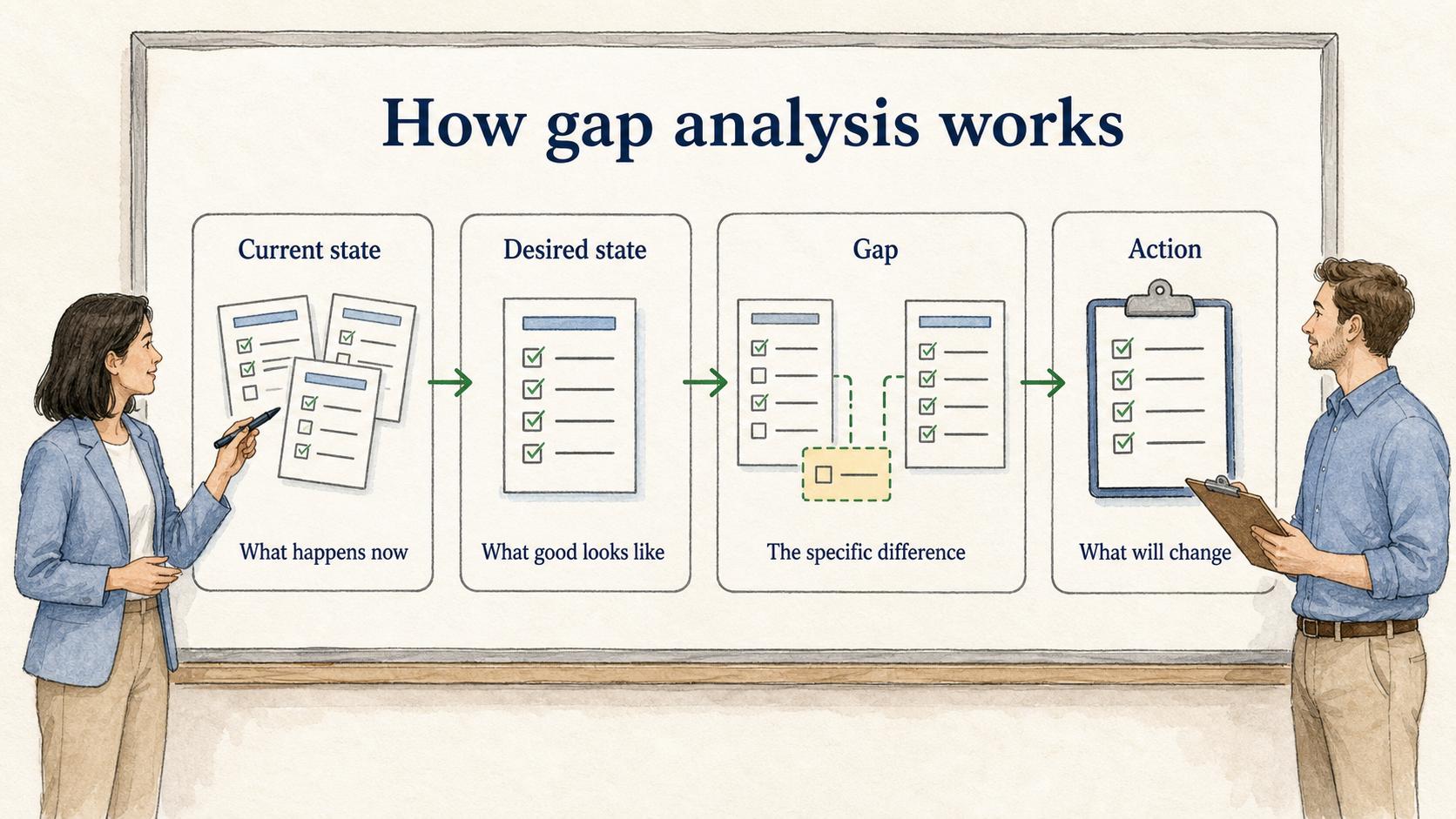
A useful gap analysis has four parts: current state, desired state, gap, and action. The common failure is making the desired state too abstract. Better documentation is not a target; a clear, observable standard is.
| Part | What to define | Weak version | Stronger version |
|---|---|---|---|
| Current state | What happens now | People do it differently | Three teams use three different intake checklists |
| Desired state | What good looks like | More consistency | One checklist is used before every handoff |
| Gap | The specific difference | Process is unclear | Required customer context is missing in 40% of handoffs |
| Action | What will change | Improve the workflow | Add a required handoff template and review examples weekly |
Ground the analysis in examples, artifacts, data, or observed work; CDC guidance similarly emphasizes using data and benchmarks to understand and improve performance. 2
Example of gap analysis
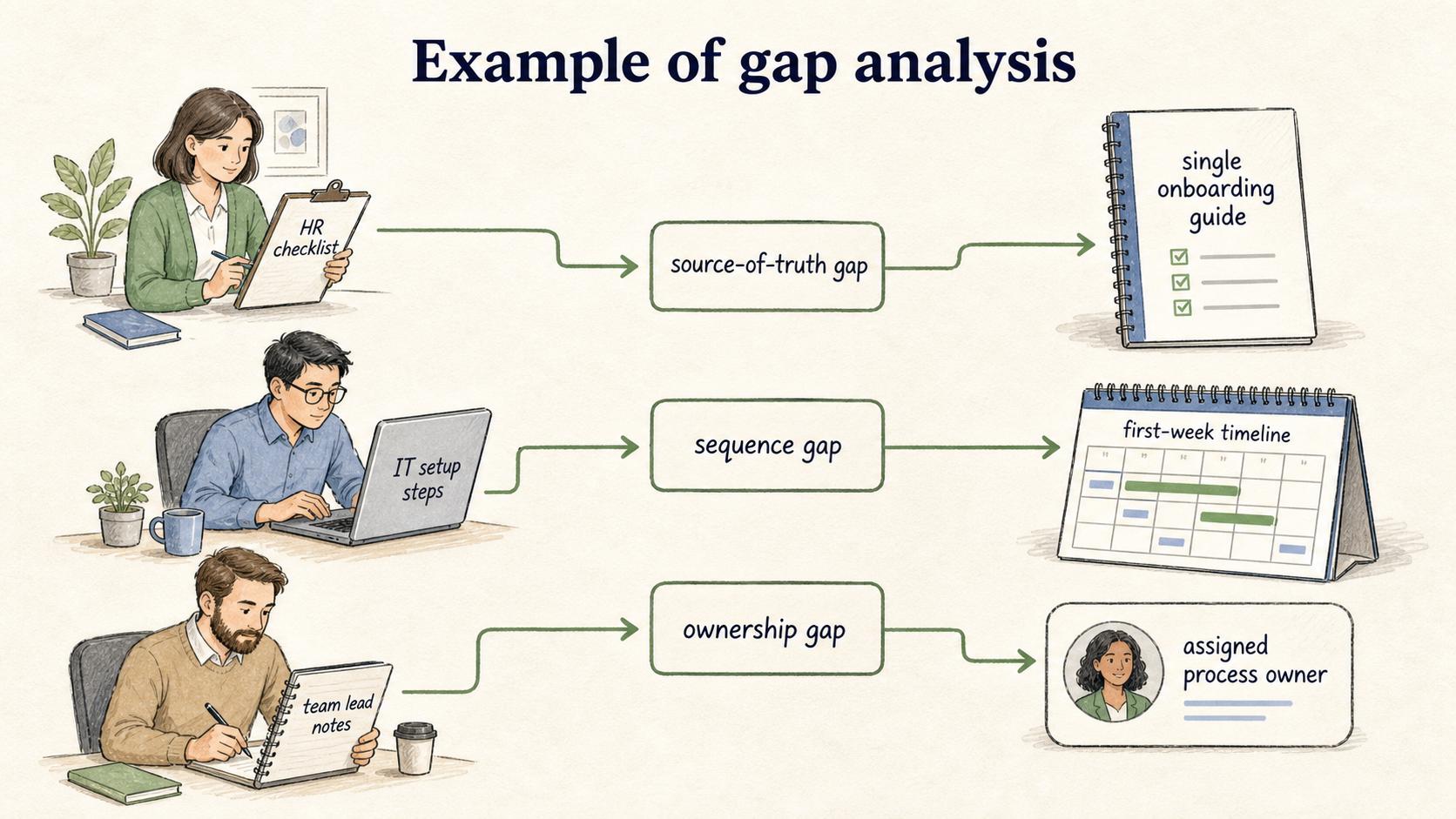
Imagine an operations manager reviewing new-hire onboarding. The target is that every new employee can complete first-week setup without asking a manager for repeated instructions. The current state is scattered: HR has one checklist, IT sends separate setup steps, and team leads keep their own notes.
- The source-of-truth gap: no one knows which checklist is current.
- The sequence gap: employees receive some steps before they have the right account access.
- The ownership gap: no one is accountable for updating the process after tools change.
Those gaps point to different actions. A single onboarding guide may solve the source-of-truth issue, a first-week timeline the sequence issue, and an assigned process owner the maintenance issue.
Common mistakes
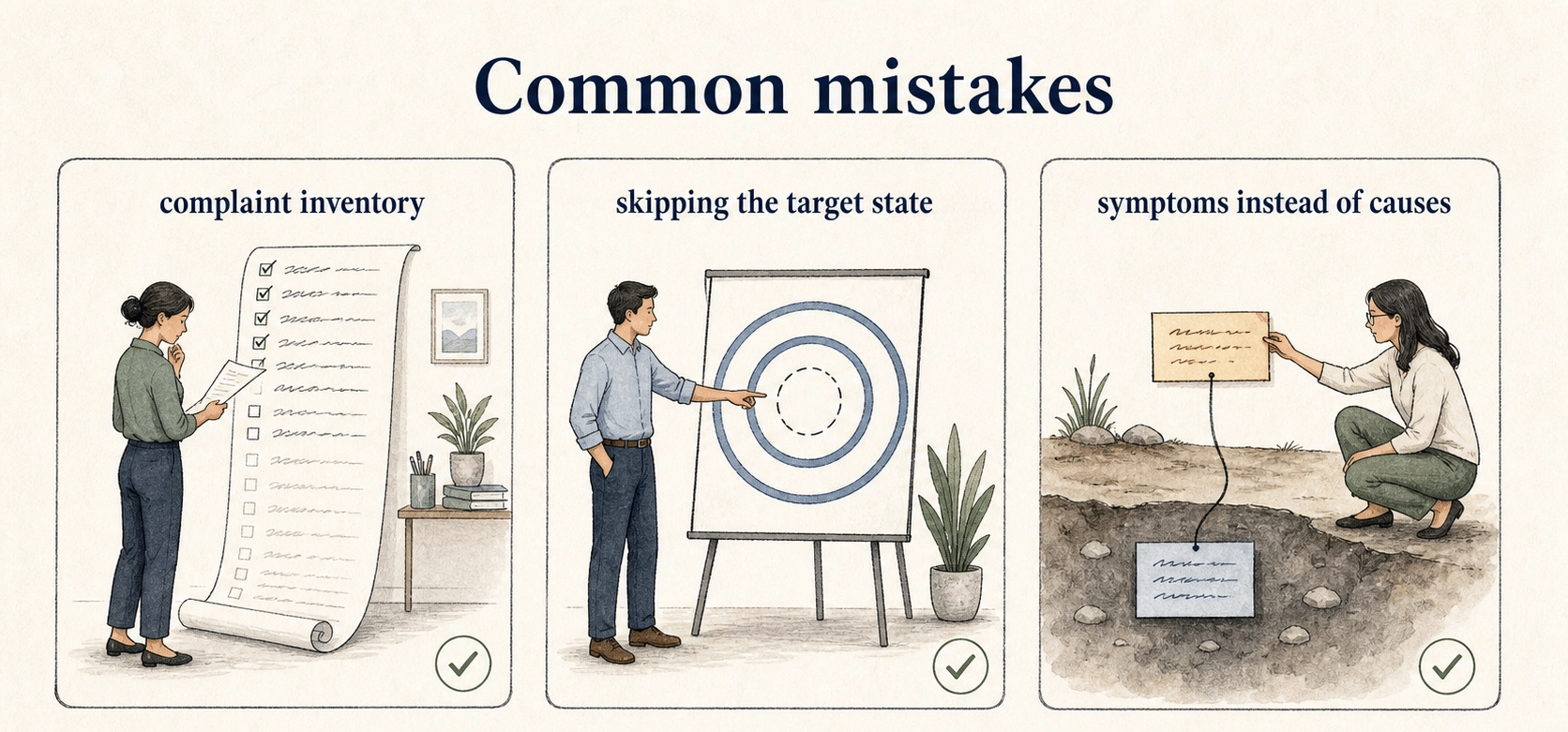
Do not turn gap analysis into a complaint inventory: rank gaps by consequence, frequency, and fixability, and judge improvement strategies against evidence and local context. 3
Other common mistakes are skipping the target state and naming symptoms instead of causes. Too many support questions may be a symptom; the underlying gap may be missing setup steps, unclear product language, or help written for the wrong audience.
How to apply gap analysis in documentation
Pick one workflow, define what a competent person should be able to do after reading the documentation, then compare that target against the current materials. If the evidence is weak, the next step is observation, not rewriting everything.
## Gap analysis diagnostic

**Glossary term:** Gap analysis
**Source:** Trails Glossary — trails.so/glossary/gap-analysis

---

### 01. Prompt

"For [process], the current documentation helps [audience] do [task]. The target state is that they can do [task] without [avoidable dependency or failure]. Today, the biggest gap is [missing information, unclear sequence, outdated step, owner ambiguity, or exception path]. Evidence: [example, ticket, audit result, repeated question, or observed handoff]. The smallest useful fix is [specific documentation or workflow change]."
How Trails helps
Trails is useful when the gap is caused by unclear, inconsistent, or stale process documentation. A team can capture a workflow as someone performs it, turn it into a polished step-by-step guide, and create an AI-narrated video version for training or sharing.
FAQ
What is the purpose of gap analysis?
It defines the difference between the current and desired state so a team can choose the right improvement work.
Is gap analysis only used for business strategy?
No. It can be used for strategy, operations, training, documentation, compliance readiness, customer support, or any situation with a target state.
Sources
- 1
PMC. Gap analysis needs assessment tool study. pmc.ncbi.nlm.nih.gov/articles/PMC6214354/.
- 2
CDC. Performance management and quality improvement data benchmarks. www.cdc.gov/public-health-gateway/php/our-work/performance-management-quality-improvement-data-benchmarks.html.
- 3
AHRQ. Closing the Quality Gap summary. www.ncbi.nlm.nih.gov/books/NBK43909/.