
Glossary
Framework
 ChatGPT
 Perplexity
 Gemini
 Claude
What is a framework?
A framework is a structured way to think about a problem, make a decision, or organize work. It gives people a shared set of concepts, categories, questions, or principles without spelling out every exact step.
In business operations, a framework is useful when teams need consistent judgment, not just consistent execution. It helps people approach similar situations through the same lens while leaving room for context.
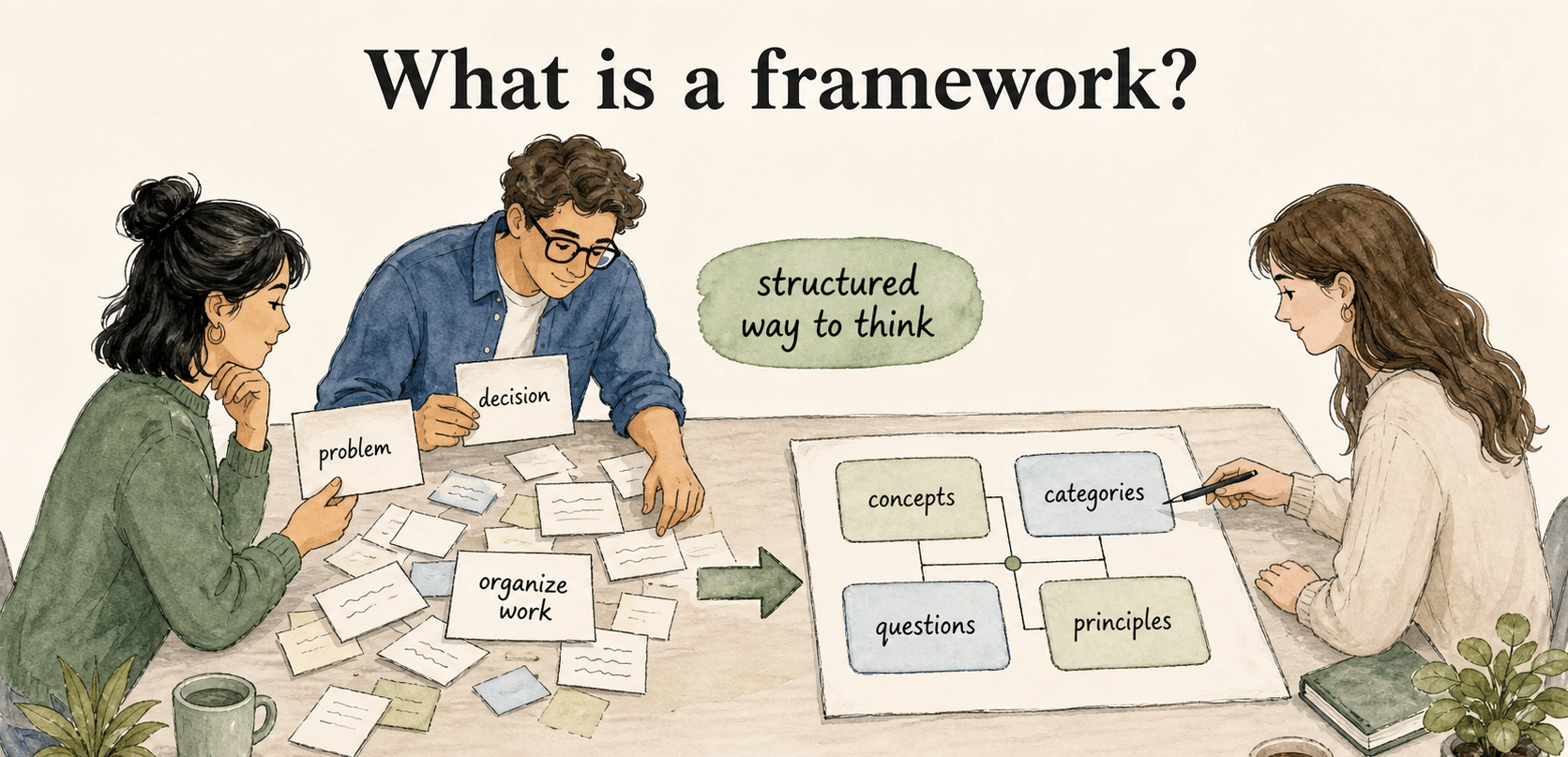
What a framework does
A good framework narrows the field of judgment: it identifies the dimensions, tradeoffs, and answer people are trying to produce. NIST describes its Cybersecurity Framework as a way to prioritize risk actions and communicate through a common language. 1
A customer success team might use a renewal-risk framework covering product adoption, executive sponsorship, support experience, commercial fit, and account health. It does not prescribe every customer interaction; it helps the team assess accounts consistently and decide what to do next.
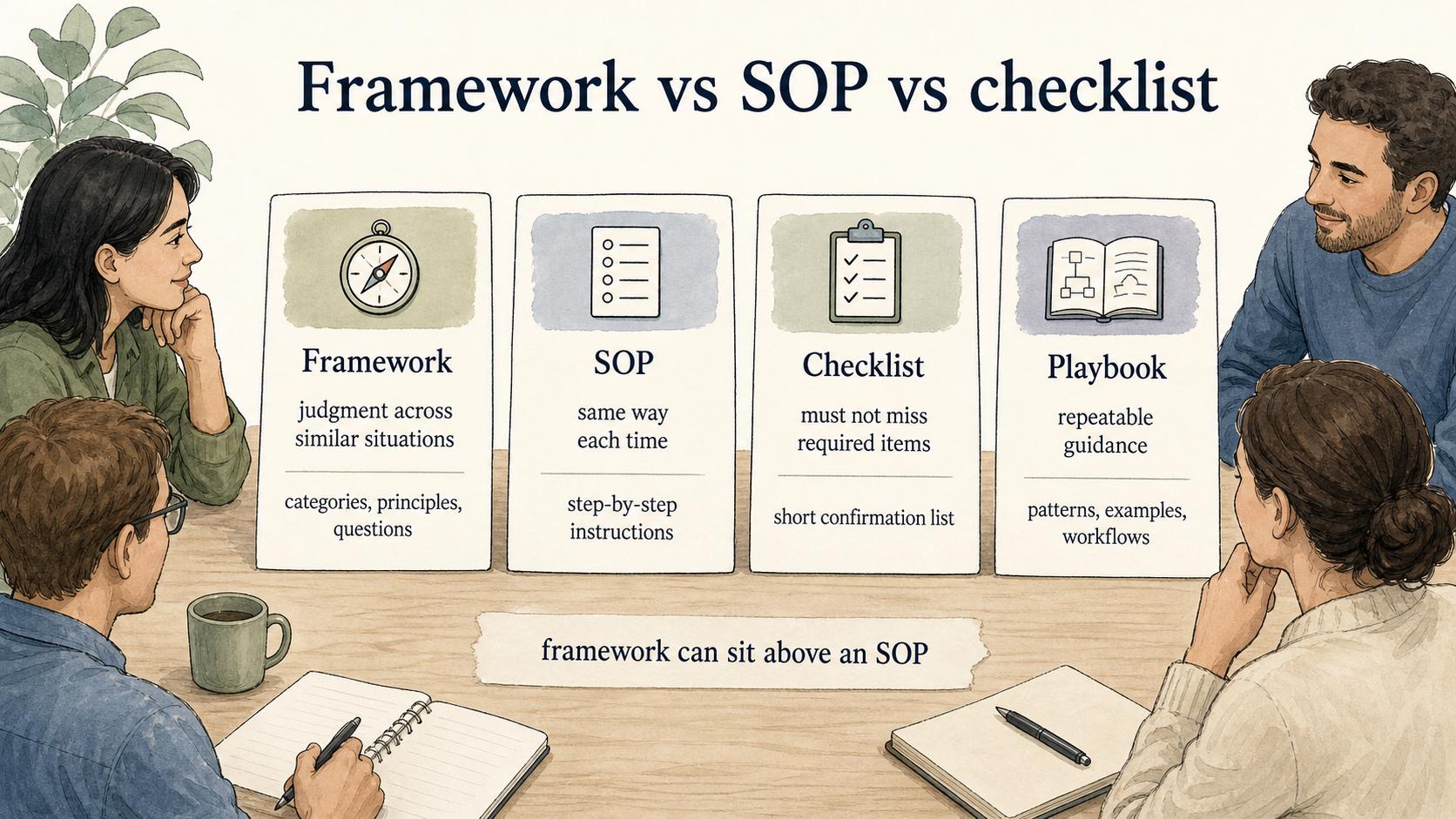
Framework vs SOP vs checklist
Teams often confuse frameworks with other operating documents. The difference is the amount of judgment required.
| Tool | Best used when | What it provides | Common failure mode |
|---|---|---|---|
| Framework | Work requires judgment across similar situations | Categories, principles, questions, or criteria | Too abstract to change behavior |
| SOP | Work should be performed the same way | Steps and ownership | Too rigid for edge cases |
| Checklist | Required items must not be missed | Short confirmation list | Substitutes for training or context |
| Playbook | A team needs repeatable scenario guidance | Patterns, examples, scripts, workflows | Becomes too large to maintain |
A framework can sit above an SOP: it explains how to judge the situation, while the SOP explains how to execute a known process. ISO 31000 similarly pairs principles, a framework, and a process. 2
Examples of frameworks
Frameworks help teams make repeatable decisions without pretending every case is identical. A support team may classify issues as urgent, high priority, or routine; a product team may compare impact, effort, strategic fit, and customer pain; a finance team may use an approval framework.
- A clear purpose: the decision, analysis, or conversation it supports.
- A small set of dimensions: the categories that matter most.
- A judgment rule: how to interpret dimensions when they conflict.
- Examples and boundaries: when to use it and when not to.
How to make a framework useful
Start with a repeated decision or conversation, not with a diagram. Make the real disagreement explicit—such as speed, risk, and customer experience—then test the framework against recent examples. If it cannot explain how the team should have handled three real cases, it is probably too theoretical.
Documentation takeaway
Frameworks need examples more than polish. Document the input, judgment, tradeoff, and final decision. USGS describes structured decision making in the same spirit: an organized approach with helpful steps, not a rigidly prescribed method. 3
## Framework documentation template

**Glossary term:** Framework
**Source:** Trails Glossary — trails.so/glossary/framework

---

### 01. Prompt

"Framework name: [name]
Use this when: [decision or situation]
Do not use this when: [boundary]
Key dimensions: [3-5 criteria]
Decision rule: [how to weigh the criteria]
Example: [realistic scenario]
What good looks like: [output, decision, or next action]"
How Trails helps
Trails helps a framework become part of day-to-day workflow by capturing how an experienced person applies it during real work, turning that into a guide and AI-narrated video for training or sharing.
FAQ
Is a framework the same as a process?
No. A process describes how work moves from step to step. A framework describes how to think, decide, or evaluate within a type of situation.
When should a team not use a framework?
Avoid one when work is already highly procedural and low-judgment; an SOP or checklist will usually be clearer.
Sources
- 1
NIST. Cybersecurity Framework 2.0. nvlpubs.nist.gov/nistpubs/CSWP/NIST.CSWP.29.pdf.
- 2
ISO. ISO 31000 risk management guidelines. www.iso.org/standard/65694.html.
- 3
USGS. Structured decision making overview. www.usgs.gov/centers/eesc/science/structured-decision-making.