
Glossary
Documentation Manager
 ChatGPT
 Perplexity
 Gemini
 Claude
What is a documentation manager?
A documentation manager is responsible for improving how a team creates, organizes, governs, and maintains documentation. The role is less about writing every guide personally and more about making the documentation system work: the right people contribute, content follows a useful standard, and important pages stay findable and current.
In smaller companies, a documentation manager may also be a writer, editor, trainer, operations lead, or knowledge manager. In larger teams, the role often becomes a program owner for documentation quality, tooling, workflows, and governance.
What a documentation manager manages
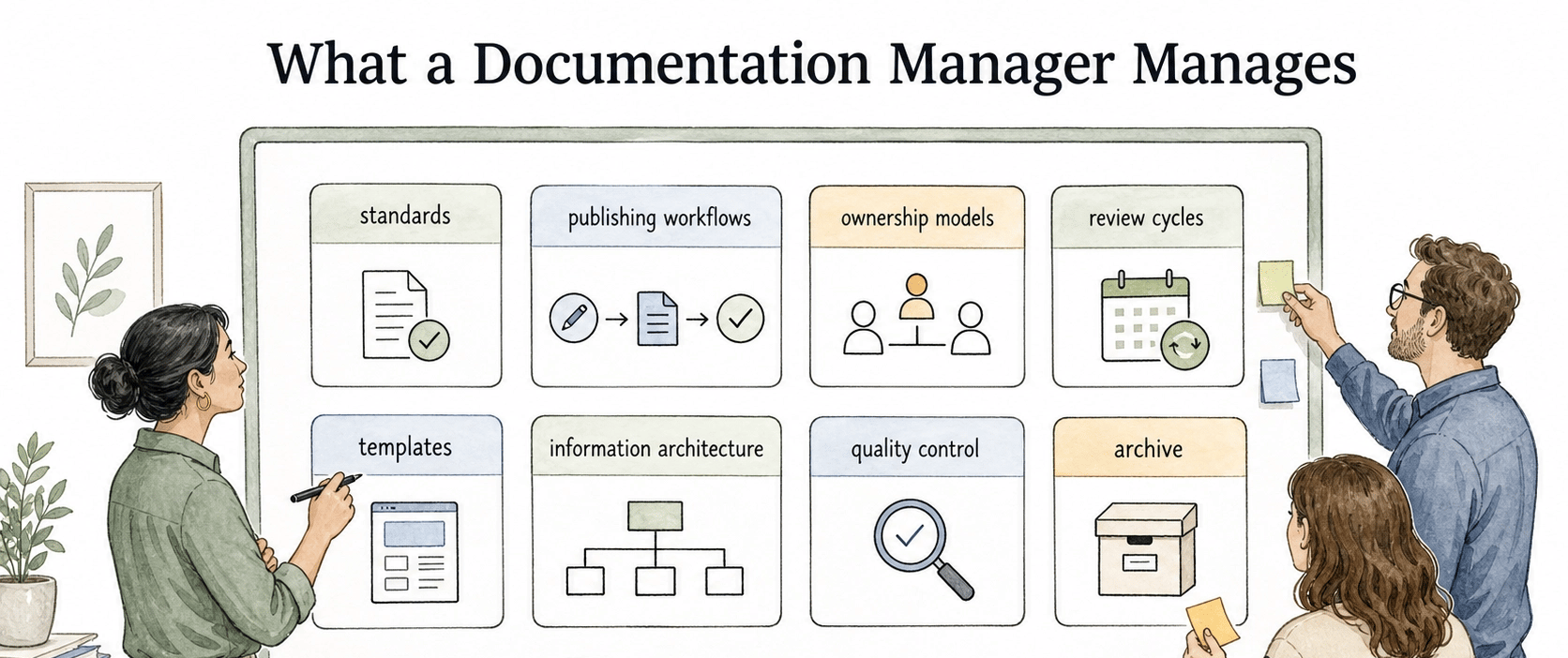
A documentation manager usually manages the system around the docs: standards, publishing workflows, ownership models, review cycles, templates, information architecture, and quality control. They may manage writers or coordinate subject matter experts, but the deeper value is operational. They reduce the randomness that makes documentation hard to trust.
ISO's knowledge-management guidance frames this as a managed system that has to be established, maintained, reviewed, and improved over time. 1
For example, a support organization may have hundreds of macros, troubleshooting guides, escalation procedures, and onboarding docs. A documentation manager helps decide how those materials should be structured, who owns them, how changes get reviewed, and when outdated content should be archived.
The best documentation managers translate how work happens into knowledge people can find and use later.
Why documentation managers matter
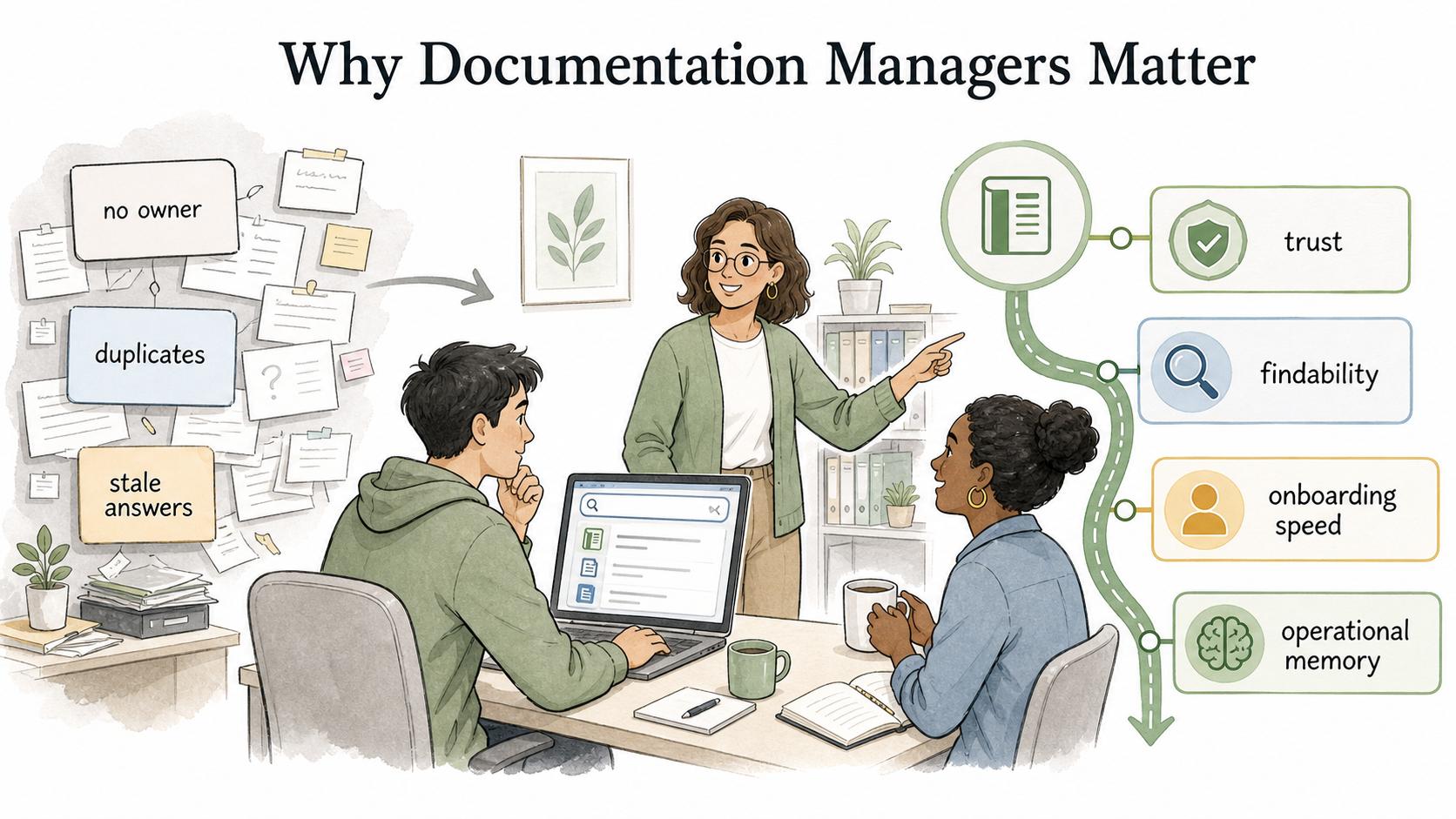
Most documentation systems fail for organizational reasons before they fail for writing reasons. Pages have no owner. Review cycles are unclear. The same process exists in three places. New hires search the wiki and still ask a senior teammate because the answer looks stale.
A documentation manager addresses those problems at the system level. They make documentation easier to contribute to, easier to maintain, and easier to trust. That matters because documentation quality affects onboarding speed, support consistency, compliance readiness, customer handoffs, and day-to-day operational memory. McKinsey's research on knowledge workers also shows why findability matters: a large share of the workday can disappear into searching and gathering information. 2
The non-obvious part of the job is knowing when more documentation is the wrong answer. Sometimes the fix is to delete duplicate pages, tighten a template, move a guide closer to the workflow, or clarify ownership before asking anyone to write more.
Core responsibilities
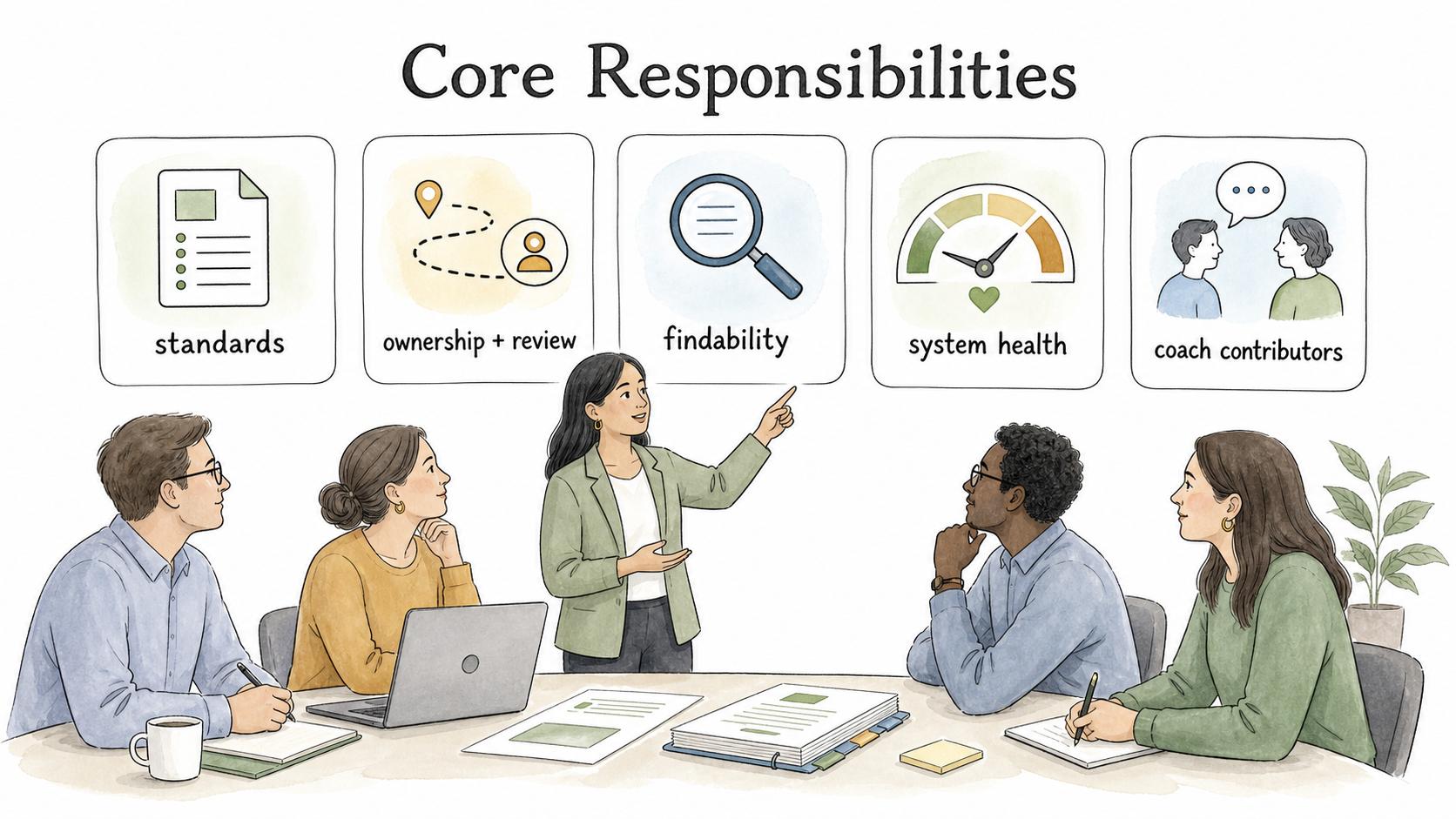
A documentation manager's responsibilities usually fall into a few practical buckets.
Set standards that people can actually follow. Templates, tone guidance, naming conventions, and content types should reduce friction. If the standard is too heavy, people avoid documenting. If it's too loose, readers can't tell which pages are reliable.
Create ownership and review paths. The manager doesn't need to approve every update, but they should make sure high-value content has owners, reviewers, and a review cadence that matches its risk.
Improve findability. Documentation that can't be found might as well not exist. This includes navigation, search terms, metadata, links between related pages, and removing duplicate or abandoned material.
Manage the health of the system. Documentation managers should track stale pages, repeated support questions, onboarding friction, broken links, and content gaps. The point isn't a dashboard for its own sake. It's to notice where the documentation system is failing the work.
Coach contributors. Subject matter experts often know the process but don't know how to turn it into usable documentation. A documentation manager helps them capture the important decisions, edge cases, and examples without turning every page into a long manual. Deloitte's knowledge-management research makes the same organizational point: knowledge sharing has to be treated as a culture and transfer problem, not only a tooling problem. 3
A practical documentation-manager diagnostic
If you are deciding whether your team needs a documentation manager, look for these signals:
- Important processes depend on a few people's memory
- New hires ask the same questions after reading the docs
- Teams disagree about which page is the source of truth
- Documentation exists, but no one knows who can change it
- Tooling debates happen more often than content-quality decisions
- Stale pages are easier to create than to retire
One or two of these problems can be handled by better ownership. When several show up together, the team likely needs someone managing documentation as a system.
AI-ready documentation audit prompt
Use this prompt to scope the role before hiring or assigning a documentation manager:
## Documentation Management Audit

**Glossary term:** Documentation Manager
**Source:** Trails Glossary — trails.so/glossary/documentation-manager

---

### 01. Audit a documentation system

"You are auditing the documentation system for [team/company]. Identify the biggest documentation-management problems, not just writing gaps.

Context:
- Team size and functions: [details]
- Current documentation tools: [tools]
- Main audiences: [new hires/support/customers/operations/etc.]
- Known pain points: [pain points]

Review the following document inventory or notes:
[paste list or examples]

Return: top 5 system issues, likely root cause, recommended owner, first 30-day fix, and what not to spend time on yet."
How Trails helps
Trails helps documentation managers create better source material for process documentation. A team member can capture a workflow while performing it, then Trails turns that workflow into a polished step-by-step guide and can create an AI-narrated video version for training or sharing. That makes it easier for the documentation manager to standardize repeatable processes without asking every subject matter expert to start from a blank page.
The process documentation software comparison can help you evaluate capture and editing tools before standardizing the team's documentation workflow.
FAQ
Does a documentation manager need to be a technical writer?
Not always. Writing skill helps, but the role also requires systems thinking, editorial judgment, stakeholder coordination, and an understanding of how teams use documentation in real work.
When should a startup hire a documentation manager?
Usually when documentation debt starts slowing onboarding, support, operations, or compliance work. Before hiring, many startups assign the responsibility to an operations, enablement, or support leader.
What should a documentation manager measure?
Useful signals include content freshness, ownership coverage, repeated unanswered questions, onboarding friction, support deflection quality, and whether teams can find the source of truth quickly.
Sources
- 1
ISO. ISO 30401 knowledge management systems overview. www.iso.org/obp/ui/.
- 2
McKinsey. Capturing business value with social technologies. www.mckinsey.com/industries/technology-media-and-telecommunications/our-insights/capturing-business-value-with-social-technologies.
- 3
Deloitte. Organizational knowledge management. www.deloitte.com/us/en/insights/topics/talent/organizational-knowledge-management.html.