
Glossary
Documentation Culture
 ChatGPT
 Perplexity
 Gemini
 Claude
What is documentation culture?
Documentation culture is the set of habits, expectations, and incentives that determine whether a team documents important work as part of normal operations. A strong documentation culture makes useful knowledge easy to create, update, find, and trust. A weak one leaves process knowledge trapped in people's heads, chat threads, old tickets, or one-off meetings.
Documentation culture shows up in daily behavior: whether the team treats documentation as part of doing the work, or as cleanup that happens after the real work is over.
What documentation culture looks like
A healthy documentation culture shows up in small behaviors. People update the guide when the process changes. Managers ask, "Where is this documented?" before scaling a new workflow. New hires are pointed to current materials instead of a chain of people to ask. Subject matter experts know how to contribute without becoming full-time writers.
For example, a support team with a strong documentation culture does not wait until onboarding breaks to update its escalation guide. When a new escalation path is agreed on, the owner updates the guide, links it from the support workspace, and tells the team what changed. The documentation becomes part of the operating system.
A weak documentation culture often has plenty of pages. The problem is that no one knows which ones matter, whether they are current, or who owns them.
Why documentation culture matters
Documentation culture matters because tools and templates cannot compensate for a team that does not trust or maintain its knowledge. You can buy a better wiki, create a cleaner template, or run a documentation cleanup week. If the underlying habits do not change, the system drifts back into the same shape. Deloitte makes the same point in its knowledge-management research: organizations need to champion a knowledge-sharing culture as much as the tools and platforms themselves. 1
The hidden failure mode is performative documentation. Teams create pages to prove that something was documented, but the pages do not help anyone make a better decision or complete a task. A healthy culture values usefulness over volume. The sharper question is: "Can the next person use this without asking the same questions again?"
Good documentation culture also protects continuity. When people change roles, take time off, or leave the company, the team does not lose the process along with them. ISO 30401 frames knowledge management as a system for establishing, maintaining, reviewing, and improving how organizational knowledge is managed. 2
Signs of strong and weak documentation culture
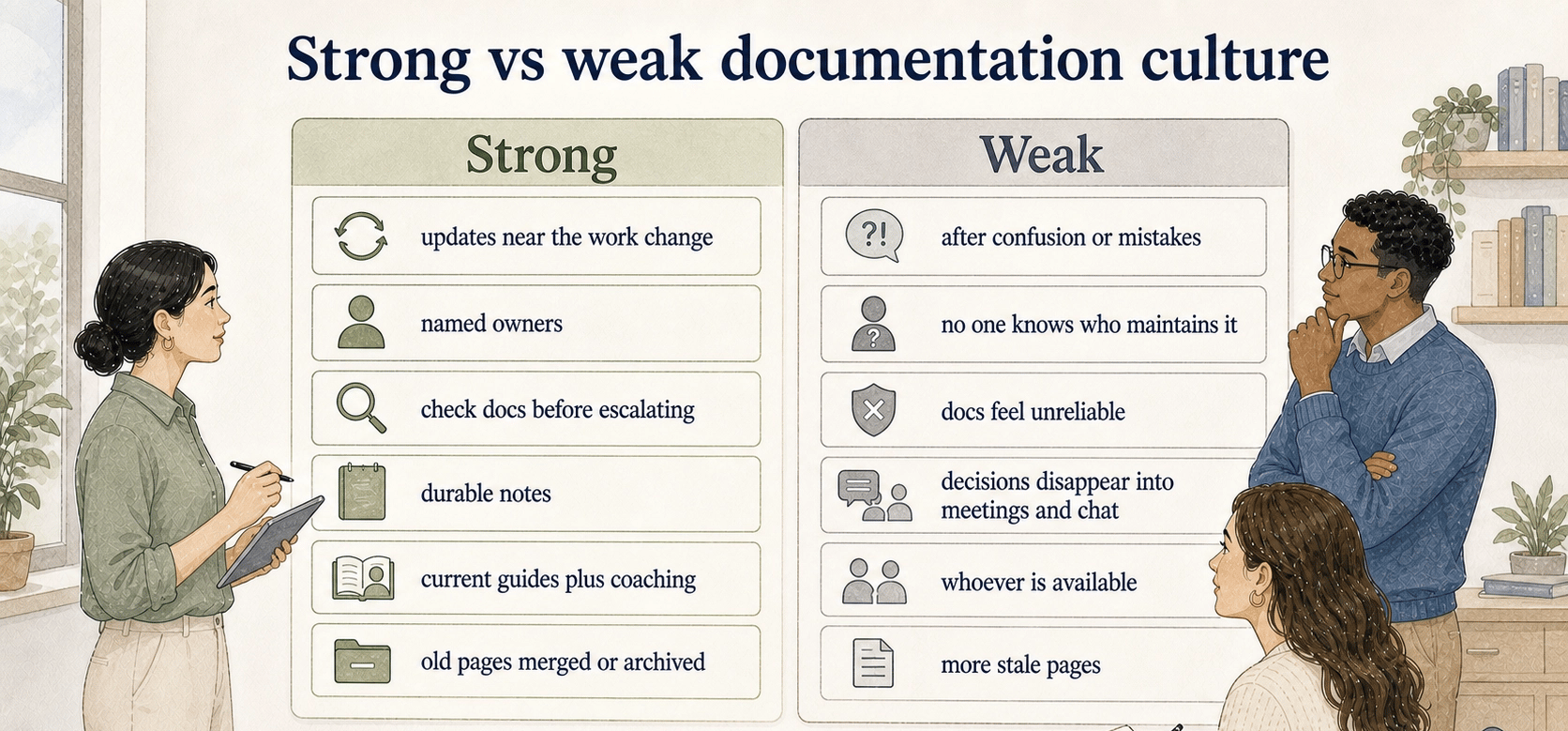
Use these signals to diagnose whether the issue is content volume, content quality, or team behavior.
| Signal | Strong documentation culture | Weak documentation culture |
|---|---|---|
| Process changes | Updates are made near the time the work changes | Updates happen only after confusion or mistakes |
| Ownership | Important pages have named owners | Pages exist, but no one knows who maintains them |
| Search behavior | People check docs before escalating routine questions | People skip search because the docs feel unreliable |
| Meetings | Decisions create or update durable notes | Decisions disappear into meetings and chat |
| Onboarding | New hires learn from current guides plus coaching | New hires depend mostly on whoever is available |
| Cleanup | Old pages are merged or archived | More pages are created to work around stale ones |
The strongest signal is whether people behave as if documentation is trustworthy enough to use.
How to improve documentation culture
Improving documentation culture is mostly about lowering friction and changing expectations. A team does not become documentation-driven because someone asks everyone to "document more." It improves when the easiest path is also the durable path.
Tie documentation to real moments of change. The best update trigger is not a quarterly cleanup. It is when the process changes, a customer issue reveals a gap, a new hire gets stuck, or a teammate asks the same question twice. Documentation should follow the work while the context is still fresh.
Make ownership visible. If an important guide has no owner, people hesitate to edit it. If it has an owner, reviewer, and update path, the team knows where to send corrections and who can resolve conflicts.
Reward useful maintenance. A team that celebrates only new docs will accumulate clutter. Give equal credit to merging duplicates, archiving stale pages, tightening a confusing guide, or turning a messy explanation into a repeatable workflow.
Use templates lightly. Templates help when they reduce blank-page friction. They hurt when they force every topic into the same shape. A quick troubleshooting note, a process guide, and a policy explanation do not need identical structure.
Keep documentation close to use. If a guide supports a workflow, link it from the place people perform that workflow. Documentation culture weakens when the only path to knowledge is remembering which folder might contain it. McKinsey's research on knowledge workers found that searching and gathering information can consume a large share of working time, which is why findability belongs in the culture conversation. 3
Common misconceptions
One misconception is that documentation culture means everyone should write constantly. In practice, most teams need better capture and maintenance habits, not more writing volume. A short, current guide beats a long abandoned one.
Another misconception is that documentation culture belongs to the documentation team. A documentation manager can build the system and standards, but the culture lives in how product, support, operations, customer success, HR, and leadership behave when knowledge changes.
A third misconception is that culture is too soft to manage. It becomes concrete when you define ownership, review triggers, contribution paths, and expectations around where decisions should live.
Practical diagnostic questions
Ask these questions when a team says, "Our docs are a mess":
- Which three recurring questions should no longer require a person to answer?
- Which documents do people trust, and why?
- Which pages look official but are no longer safe to follow?
- What process changes happened recently without a documentation update?
- Who can archive stale documentation without asking five people?
- Where do new decisions currently go to become durable knowledge?
These questions move the conversation from vague frustration to fixable operating problems.
How Trails helps
Trails supports documentation culture by making process capture easier at the moment work happens. A teammate can perform a workflow, capture it, and turn it into a polished step-by-step guide with an optional AI-narrated video version. That lowers the friction of creating useful process documentation, which is often the difference between a documentation culture people talk about and one they actually practice.
FAQ
Is documentation culture the same as knowledge management?
No. Knowledge management is the broader discipline of capturing, organizing, sharing, and reusing knowledge. Documentation culture is the day-to-day behavior that makes documented knowledge actually happen and stay useful.
Can documentation culture exist without a documentation manager?
Yes, especially in small teams. But as the organization grows, a documentation manager or clear ownership model helps keep the culture from depending on a few motivated individuals.
What is the fastest way to improve documentation culture?
Start with one high-friction workflow, assign an owner, update the guide when the work changes, and route repeated questions back into that guide. A visible working loop beats a broad announcement.
Sources
- 1
Deloitte. Deloitte on organizational knowledge management. www.deloitte.com/us/en/insights/topics/talent/organizational-knowledge-management.html.
- 2
ISO. ISO 30401 knowledge management systems overview. www.iso.org/obp/ui/.
- 3
McKinsey. McKinsey on knowledge-worker search time. www.mckinsey.com/industries/technology-media-and-telecommunications/our-insights/capturing-business-value-with-social-technologies.