
Glossary
Cycle Time
 ChatGPT
 Perplexity
 Gemini
 Claude
What is cycle time?
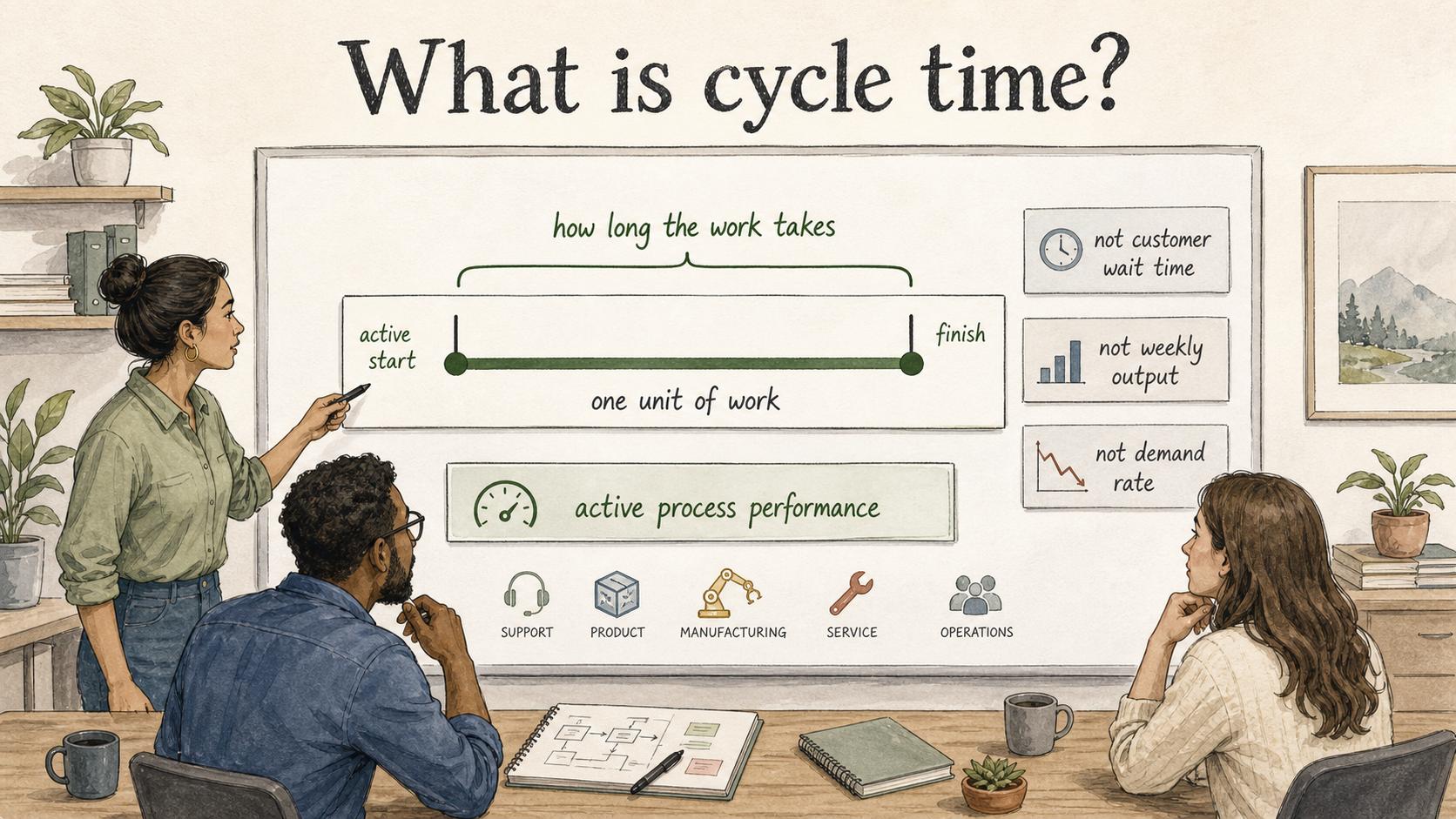
Cycle time measures how long one unit of work takes from active start to finish. 1 In operations, support, product, manufacturing, and service teams, it shows how quickly a process moves after someone begins the work.
The phrase sounds simple, so teams misuse it. Cycle time is not customer wait time, weekly output, or demand rate. It is a narrower measurement of active process performance.
Why cycle time matters
Cycle time matters because it turns process improvement into something observable. If a support team says, "refund requests take too long," cycle time separates active work from the waiting around it. A four-minute review that sits in a two-day queue needs a different fix than a review step that reliably takes two hours.
Good cycle time analysis moves the conversation from blame to diagnosis. The team can ask where work slows down after someone starts it, which steps create rework, and which handoffs interrupt flow.
The hidden trap is measuring only the easy timestamp. If teams ignore side work, manual checks, approvals, or rework loops, cycle time becomes a comforting number rather than a useful one. Kanban flow metrics make the same point by separating started work, finished work, work item age, and throughput. 3
Cycle time vs lead time vs takt time
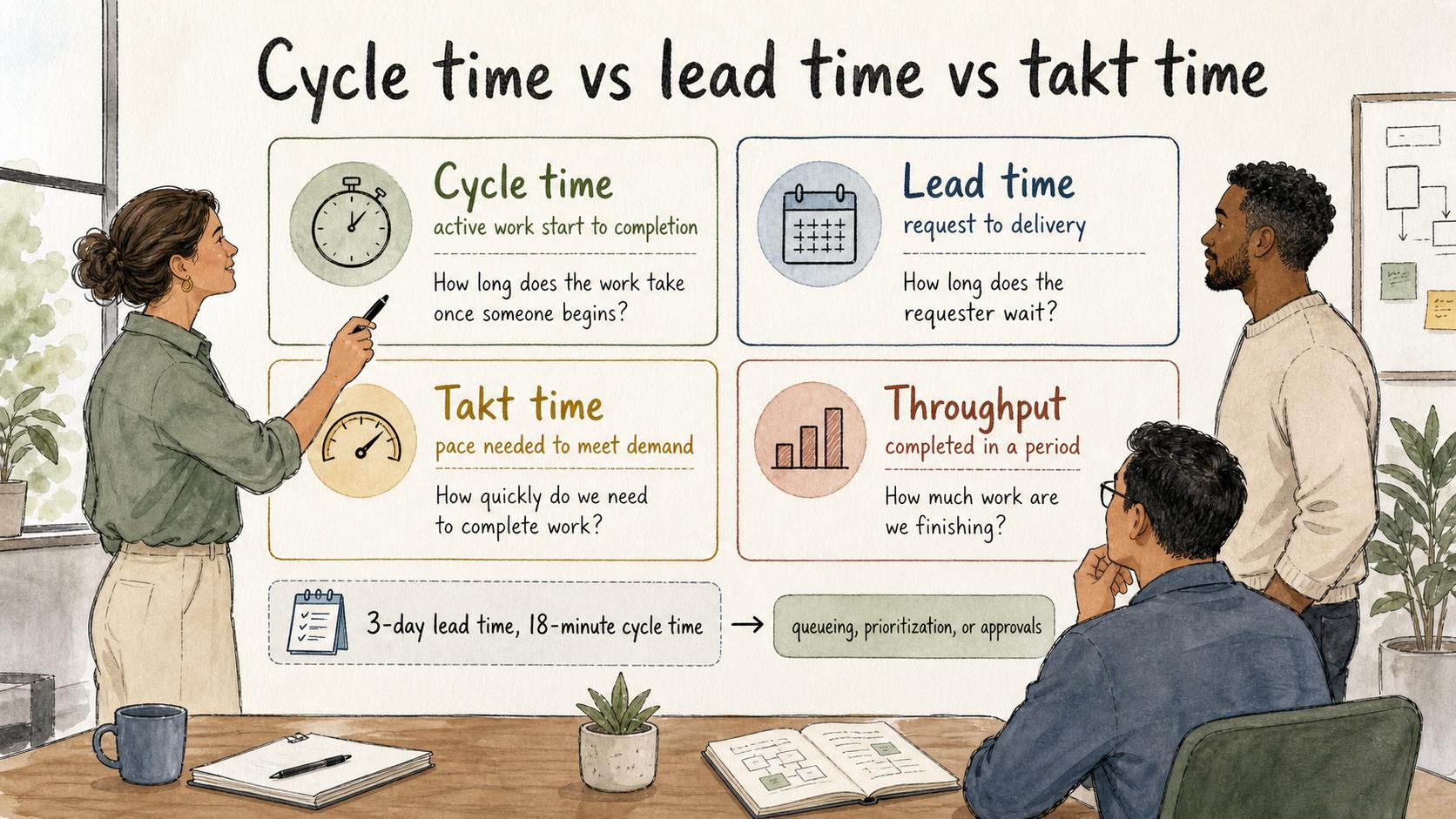
Cycle time is easiest to understand when compared with nearby metrics. 2 The boundaries matter because each metric answers a different operational question.
| Metric | What it measures | Best question it answers |
|---|---|---|
| Cycle time | Time from active work start to completion | How long does the work take once someone begins? |
| Lead time | Time from request or demand to delivery | How long does the customer or requester wait? |
| Takt time | The pace needed to meet demand | How quickly do we need to produce or complete work? |
| Throughput | Amount completed in a period | How much work are we finishing? |
For example, a customer service team may have a three-business-day lead time for a billing correction but an 18-minute cycle time. That points to queueing, prioritization, or approvals rather than the correction task itself.
How to measure cycle time without fooling yourself
Start by defining the unit of work. A "ticket," "order," "claim," or "content request" may include very different effort depending on complexity. If the unit is too broad, the average will hide the real pattern. If it is too narrow, the metric may encourage local optimization that does not help the full process.
Then define the start and stop points. The start should be the moment active work begins, not when the request first arrives. The stop point should be when the work is complete according to the process, not when someone marks it complete to clear a queue. In knowledge work, that boundary needs extra care: a draft may be done for the writer but not done for the requester.
Finally, inspect outliers instead of only watching the average. A stable average can hide a painful tail: most requests finish quickly, while a few sit in rework for days. Those outliers often expose missing decision rules, unclear ownership, overloaded reviewers, or undocumented exception paths.
Example: cycle time in a support workflow
Imagine a support team handles account access requests. The process has four active steps: verify identity, check account status, apply the access change, and send confirmation. The team initially reports that these requests take two days.
After mapping the work, they learn the active cycle time is usually 12 minutes. The long delay comes from a queue before identity verification and a manager approval that happens only once per day. Useful fixes would clarify approval criteria, route urgent cases differently, and remove avoidable rework when the first request lacks required information.
That is the value of cycle time: it helps teams locate real friction inside the work instead of treating every delay as a productivity issue.
How to improve cycle time
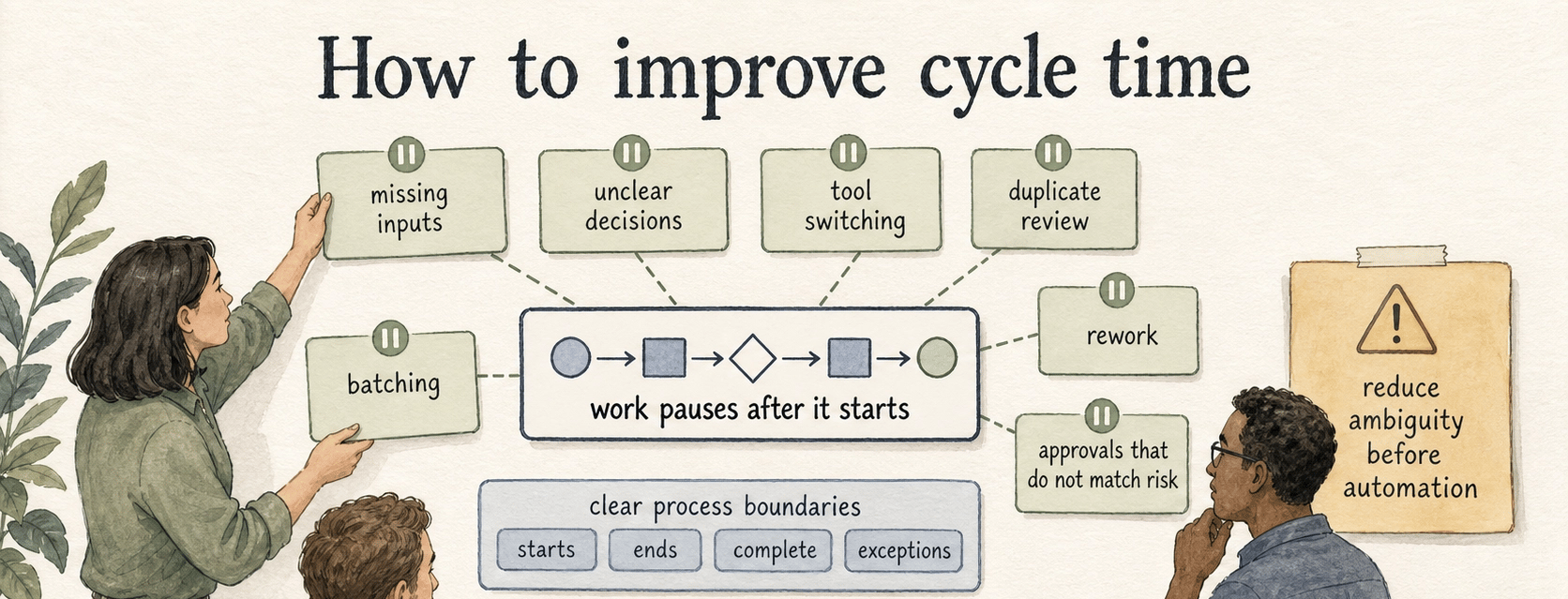
To improve cycle time, look for the points where work pauses after it starts: missing inputs, unclear decisions, tool switching, duplicate review, batching, rework, or approvals that do not match risk.
Reduce ambiguity before automation. If the team does not agree on when a task starts, when it ends, what counts as complete, or who owns exceptions, automation may only make the confusion faster. Clear process boundaries are the foundation for useful cycle time measurement.
Documentation matters because private shortcuts create inconsistent cycle times. Capturing the exact workflow, decision checks, and exception handling gives everyone the same baseline before the team starts optimizing.
Documentation takeaway
Cycle time is a process metric, but it depends on clear process documentation. To measure it well, document the unit of work, start point, stop point, required inputs, exception paths, and handoffs. Without those boundaries, cycle time reports tend to drift into opinion.
When updating an SOP, include the measurement rule directly in the workflow: "Cycle time starts when an agent opens the verified request and ends when confirmation is sent." That single sentence prevents future teams from comparing numbers that were measured in different ways.
AI-ready template for a cycle time review
## Cycle Time Review

**Glossary term:** Cycle Time
**Source:** Trails Glossary — trails.so/glossary/cycle-time

---

### 01. Review cycle time

"Review the cycle time for [workflow/process]. Define the unit of work, active start point, completion point, and required inputs. Separate active work from waiting, approvals, queues, and rework. Identify the main sources of variation, the most important outliers, and one process or documentation change that could improve cycle time without reducing quality."
How Trails helps
Trails helps teams see the real workflow behind cycle time. It captures a workflow as someone performs it, turns it into a polished step-by-step guide, and can create an AI-narrated video version for training or sharing. That gives teams a concrete baseline to improve and a guide they can update when the better workflow becomes the new standard.
FAQ
Is shorter cycle time always better?
Not always. Shorter cycle time is useful when quality, safety, and customer outcomes stay intact. If speed creates rework or risky shortcuts, the process is not actually healthier.
What is a good cycle time?
A good cycle time depends on the work, demand, risk, and customer expectation. The better question is whether cycle time is stable, understood, and improving for the right reasons.
Should teams measure average or median cycle time?
Use both when possible. The median shows the typical experience, while the average can reveal whether a few very slow cases are dragging the process down.
Can cycle time apply to knowledge work?
Yes, but the boundaries need extra care. Define when active work starts, what counts as completion, and how to handle review, waiting, and rework.
Sources
- 1
Lean Enterprise Institute. Cycle Time. www.lean.org/lexicon-terms/cycle-time/.
- 2
Lean Enterprise Institute. Takt Time. www.lean.org/lexicon-terms/takt-time/.
- 3
ProKanban. The Basic Metrics of Flow. www.prokanban.org/blog/https-prokanban-org-blog-the-kanban-pocket-guide-chapter-6-the-basic-metrics-of-flow.