
Glossary
Takt Time
 ChatGPT
 Perplexity
 Gemini
 Claude
What is takt time?
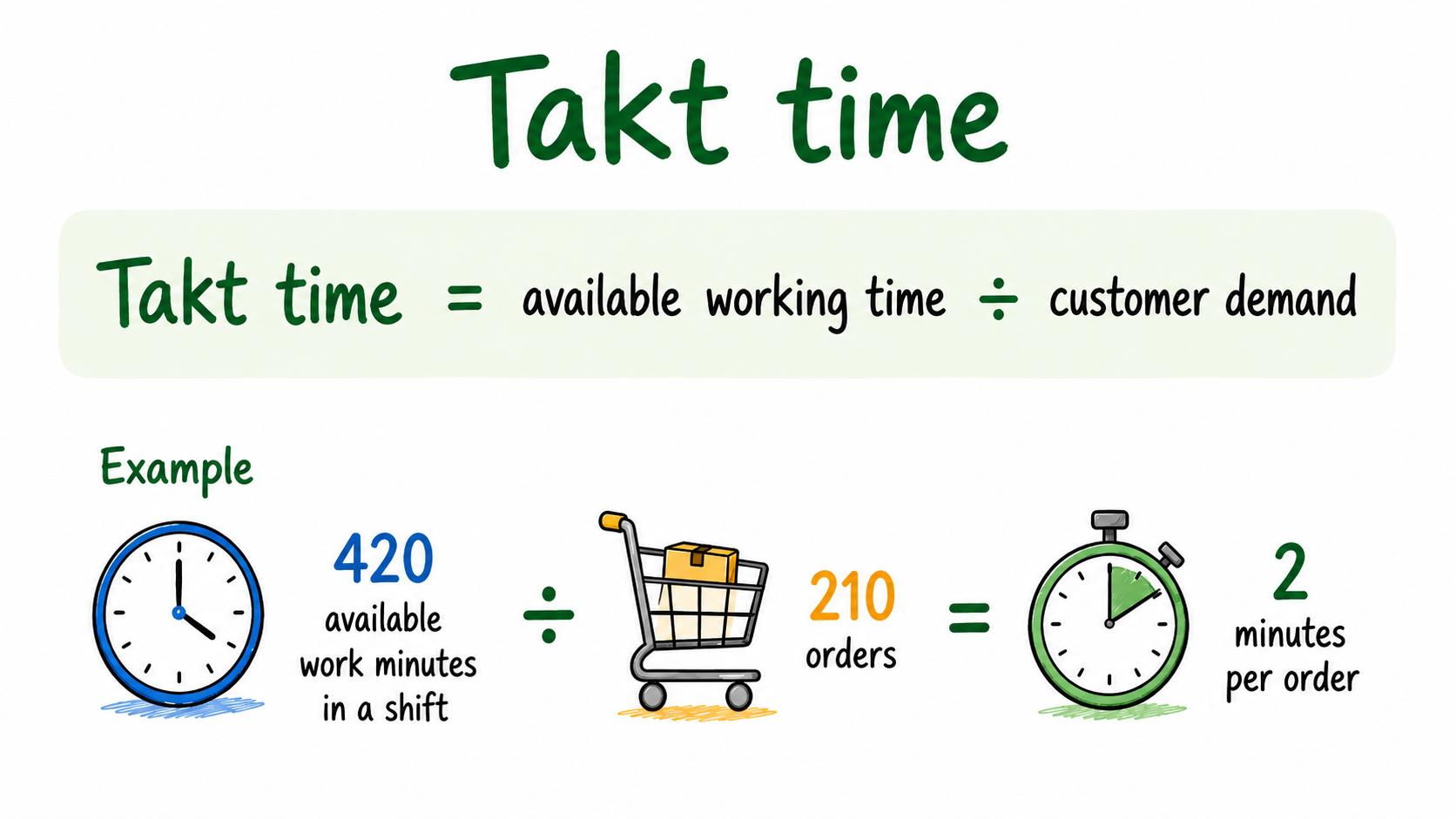
Takt time is the pace at which work needs to be completed to meet customer demand. It is calculated by dividing available working time by customer demand for the same period.1
Takt time = available working time / customer demand
If a team has 420 available work minutes in a shift and needs to complete 210 orders, the takt time is 2 minutes per order. That does not mean every person should rush. It means the overall process needs to produce completed work at roughly that rhythm to keep up with demand.
Why takt time matters
Takt time gives teams a demand-based rhythm. Instead of asking, "How fast can we work?" it asks, "What pace does demand require?"
That question is useful for staffing, capacity planning, standard work, queue management, and process improvement. In manufacturing, takt time can help balance a production line. In service and operations teams, it can explain why backlog grows even when people feel busy.
For example, a customer support team may receive 120 routine requests per day. If the team has 360 focused work minutes available for those requests, the implied takt time is 3 minutes per request. If the actual process usually takes 8 minutes, "work faster" is the wrong diagnosis. The team may need clearer triage rules, better templates, fewer handoffs, more capacity, or a separate path for complex requests.
Takt time vs. cycle time vs. lead time
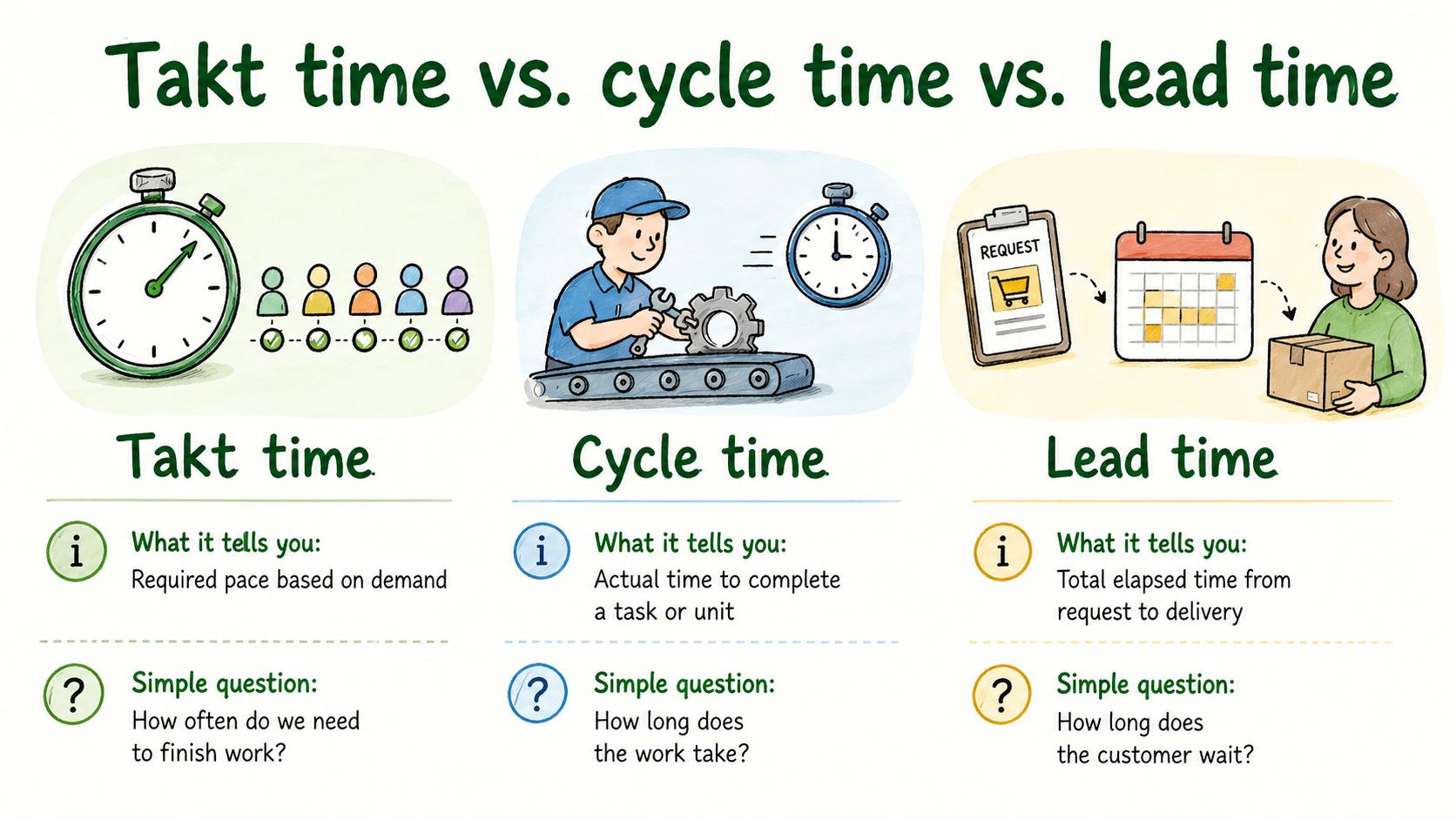
Takt time is often confused with other time-based process measures.
| Term | What it tells you | Simple question |
|---|---|---|
| Takt time | Required pace based on demand | How often do we need to finish work? |
| Cycle time | Actual time to complete a task or unit | How long does the work take? |
| Lead time | Total elapsed time from request to delivery | How long does the customer wait? |
The comparison matters. If cycle time is longer than takt time, the process cannot keep up without backlog, overtime, added capacity, or lower quality. If cycle time is much shorter than takt time, the team may be overproducing, waiting, or using capacity unevenly.2
Takt time is the target pace. Cycle time is actual performance. Lead time is the customer's wait.
How to calculate takt time
Use the same period for both parts of the formula. Do not divide daily available time by weekly demand or weekly time by daily demand.
A practical calculation looks like this:
- Choose the period, such as one shift, one day, or one week.
- Calculate available working time for that period.
- Remove planned breaks, meetings, maintenance, setup, or other unavailable time.
- Count demand for the same period.
- Divide available working time by demand.
- Compare takt time with actual cycle time and backlog behavior.
The common trap is using full clock time instead of available working time. An eight-hour shift is not 480 minutes of productive capacity if the team has breaks, huddles, system downtime, setup, and administrative work.
Example of takt time in operations
Imagine an onboarding team needs to complete 30 customer account setups per day. The team has 300 minutes of focused setup time after meetings and planned breaks.
300 available minutes / 30 account setups = 10 minutes per setup
The takt time is 10 minutes per setup. If the actual setup workflow takes 6 minutes for simple accounts and 25 minutes for complex accounts, the average alone may hide the real issue. The team might need separate paths: one standard setup flow, one complex setup flow, and clearer routing criteria.
That is where takt time becomes useful. It points to the mismatch between demand, capacity, and workflow design.
What takt time can and cannot tell you
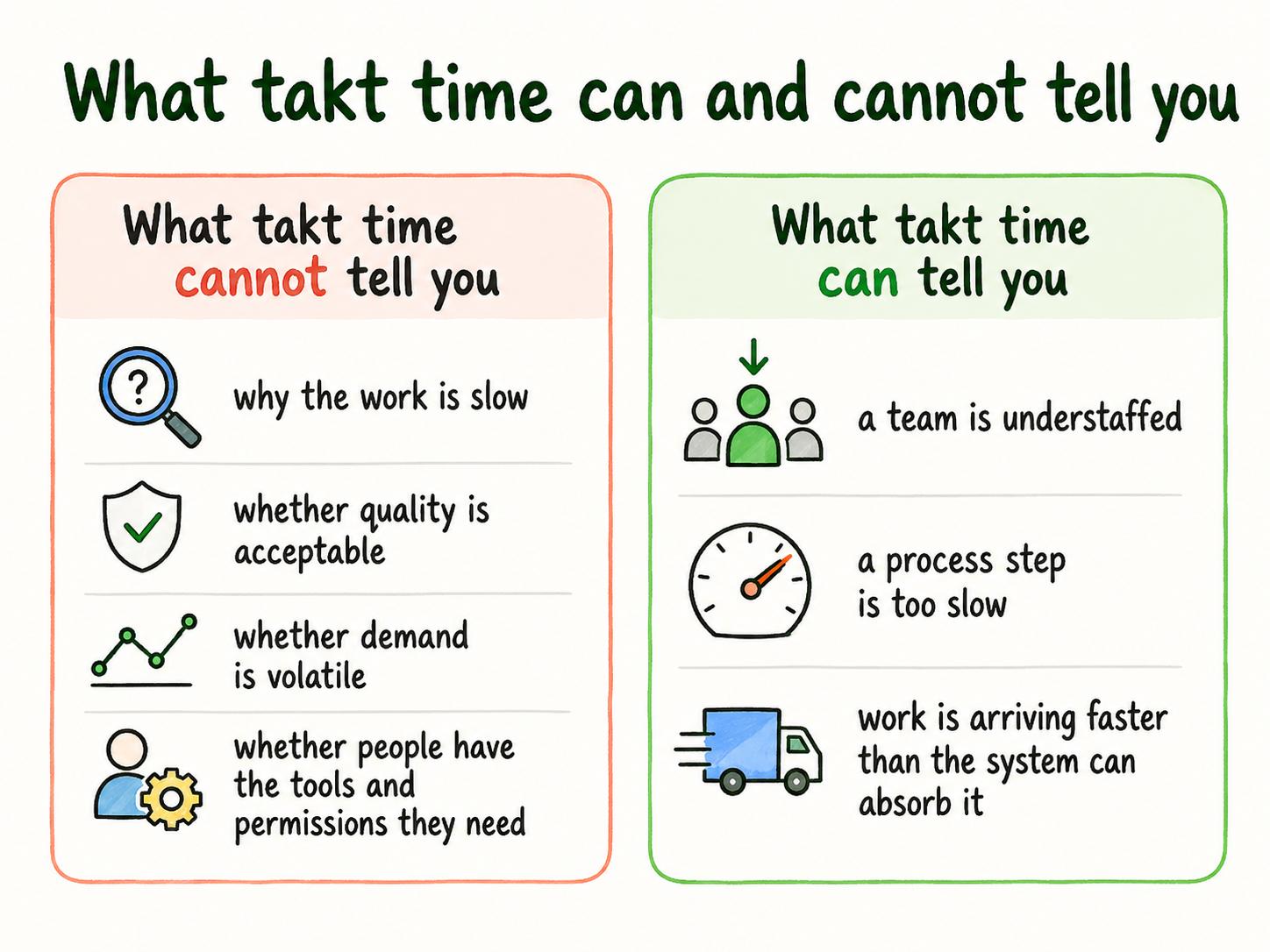
Takt time is useful because it makes demand visible. It can show that a team is understaffed, that a process step is too slow, or that work is arriving faster than the system can absorb it.3
But takt time is not a complete operating plan. It does not explain why the work is slow, whether quality is acceptable, whether demand is volatile, or whether people have the tools and permissions they need. It works best for repeatable work. When every request is highly custom, one takt time can hide too much variation.
Use takt time as a signal, then study the workflow:
- Where does work wait?
- Which step varies most?
- Which handoff creates rework?
- Which exception consumes capacity?
- Which queue grows first?
Takt time prompt
Use this prompt to apply takt time to a repeatable workflow:
## Takt Time Prompt

**Glossary term:** Takt Time
**Source:** Trails Glossary — trails.so/glossary/takt-time

---

### 01. Apply takt time to a workflow

"Workflow: [process name]
Period to analyze: [shift, day, week]
Available working time: [minutes or hours after planned downtime]
Customer demand for same period: [number of units, requests, orders, tickets]
Calculated takt time: [available time / demand]
Actual cycle time: [average and range if known]
Backlog behavior: [growing, stable, shrinking]
Main sources of variation: [complex cases, rework, handoffs, tooling, approvals]
Process changes to test: [routing, templates, automation, staffing, clearer steps]"
The prompt is strongest when the team includes both numbers and observations. Takt time without workflow context can turn into pressure instead of improvement.
Documentation takeaway
Takt time becomes useful when the process behind it is visible. If the required pace is clear but the work steps are vague, the team cannot tell whether the problem is capacity, training, tooling, handoffs, or demand planning.
Document the workflow that supports the expected pace: inputs, steps, roles, quality checks, handoffs, exceptions, and escalation paths. Then the team can compare the process as written with the process as performed.
How Trails helps
Trails helps teams capture repeatable workflows and turn them into polished step-by-step guides. Teams can also create AI-narrated video versions for training or sharing.
When a team is trying to improve takt time, that documentation gives people a shared view of how the work actually happens. The team can capture the current workflow, identify where work slows down, update the guide when the process changes, and train people on the improved process.
- Standard work
- Lead time
- To-be process
- Total quality management
- Leader standard work
- Cycle time
- Throughput
Sources
- 1
Lean Enterprise Institute. Takt Time. Lean Enterprise Institute. www.lean.org/lexicon-terms/takt-time/. Accessed July 2, 2026.
- 2
TWI Institute. Takt Time. TWI Institute. www.twi-institute.com/takt-time/. Accessed July 2, 2026.
- 3
Toyota North America. TPS Series: Takt Time. LinkedIn. www.linkedin.com/posts/toyota-north-america_tps-tpsseries-startyourimpossible-activity-7378495037787213824-sPZK. Accessed July 2, 2026.