
Glossary
Continuous Flow
 ChatGPT
 Perplexity
 Gemini
 Claude
What is continuous flow?
Continuous flow is a lean process improvement principle where work moves steadily from one step to the next with as little waiting, batching, rework, or interruption as possible. It designs the workflow so an item, request, customer, document, or unit of work does not sit idle between steps. 1
In practice, continuous flow asks what must be true for the work to move forward in the right order, at the right quality level, without piling up between teams.
Why continuous flow matters
Most process problems do not come from one dramatic failure. They come from small delays that become normal: a request waits for review, a batch sits in a queue, a document needs rework because instructions were unclear, or a handoff depends on one busy person. Each delay may look harmless, but together they lengthen lead time and make the process harder to manage. 2
Continuous flow exposes those delays. Instead of asking whether each department is busy, it asks whether the work itself is moving. That distinction matters because a team can be fully utilized while the customer, order, ticket, or internal request is still waiting.
The common mistake is treating every pause as waste. Some pauses protect the business: approvals, safety checks, quality review, customer confirmation, and legal review may all be necessary. The problem is unmanaged waiting. Healthy flow makes necessary pauses visible and intentional.
How continuous flow works
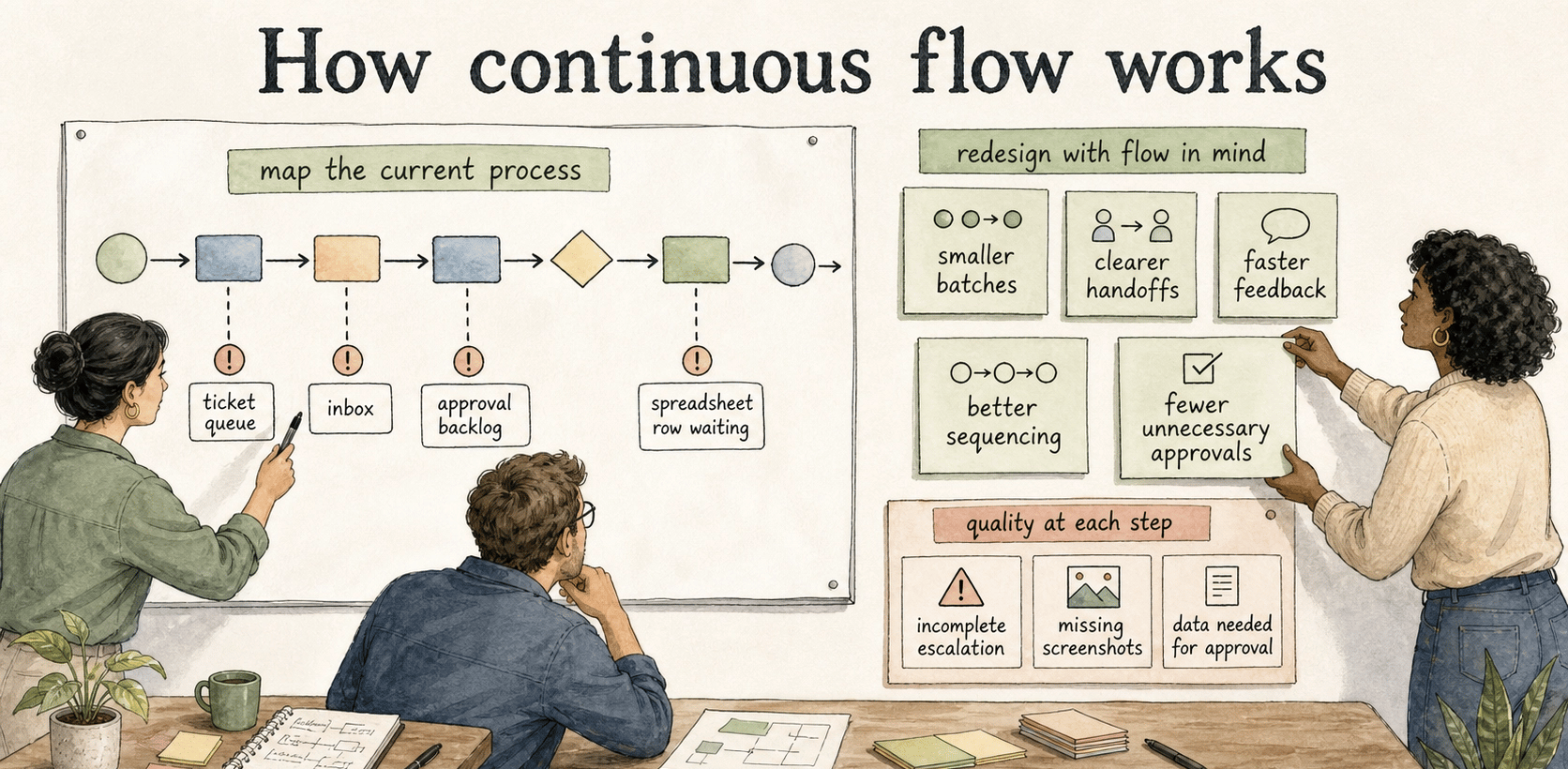
Continuous flow usually starts by mapping the current process and finding where work stops. The stop might be physical, like inventory between production steps. It might be digital, like a ticket queue, inbox, approval backlog, or spreadsheet row waiting for someone to notice it.
Once the waits are visible, the team can redesign the process around smaller batches, clearer handoffs, faster feedback, better sequencing, and fewer unnecessary approvals. The best improvement is often modest. A team may not be able to rebuild the whole workflow, but it can reduce one queue, clarify one owner, or prevent one recurring rework loop.
Continuous flow also depends on quality at each step. If work moves quickly but carries defects forward, the process only hides delay until later. In support, that might mean an incomplete escalation. In publishing, it might mean a draft that reaches final review without required screenshots. In operations, it might mean a request that advances without the data needed for approval.
Continuous flow vs batch processing
Batch processing groups work together and moves it through the process in chunks. Continuous flow moves smaller units forward as soon as they are ready. Neither approach is always right. 3
| Approach | Best when | Watch out for |
|---|---|---|
| Continuous flow | Work is repeatable, handoffs are clear, and delay is costly | Over-optimizing speed before quality and ownership are stable |
| Batch processing | Setup time is high, review needs comparison, or grouping creates efficiency | Work waits too long before the batch is large enough to move |
| Hybrid flow | Some steps need batching, but others can move continuously | Letting the batched step become an excuse for delays everywhere |
The practical question is where batching creates useful efficiency and where it creates avoidable waiting.
How to recognize broken flow
Broken flow often shows up as work-in-progress that nobody fully owns. The work is assigned somewhere, but the next action is unclear. People say "it's with legal," "it's waiting on ops," or "it should be in review" without knowing what must happen next.
Walk one item through the process and ask:
- Where does this item wait?
- Who knows it is waiting?
- What signal tells the next person to act?
- What information is missing at handoff?
- Which step sends the most work backward?
- What rule separates normal work from exceptions?
If the answers depend on individual memory instead of a shared process, the flow is fragile. The team may still complete the work, but only through constant checking, reminders, and informal rescue.
How to document continuous flow
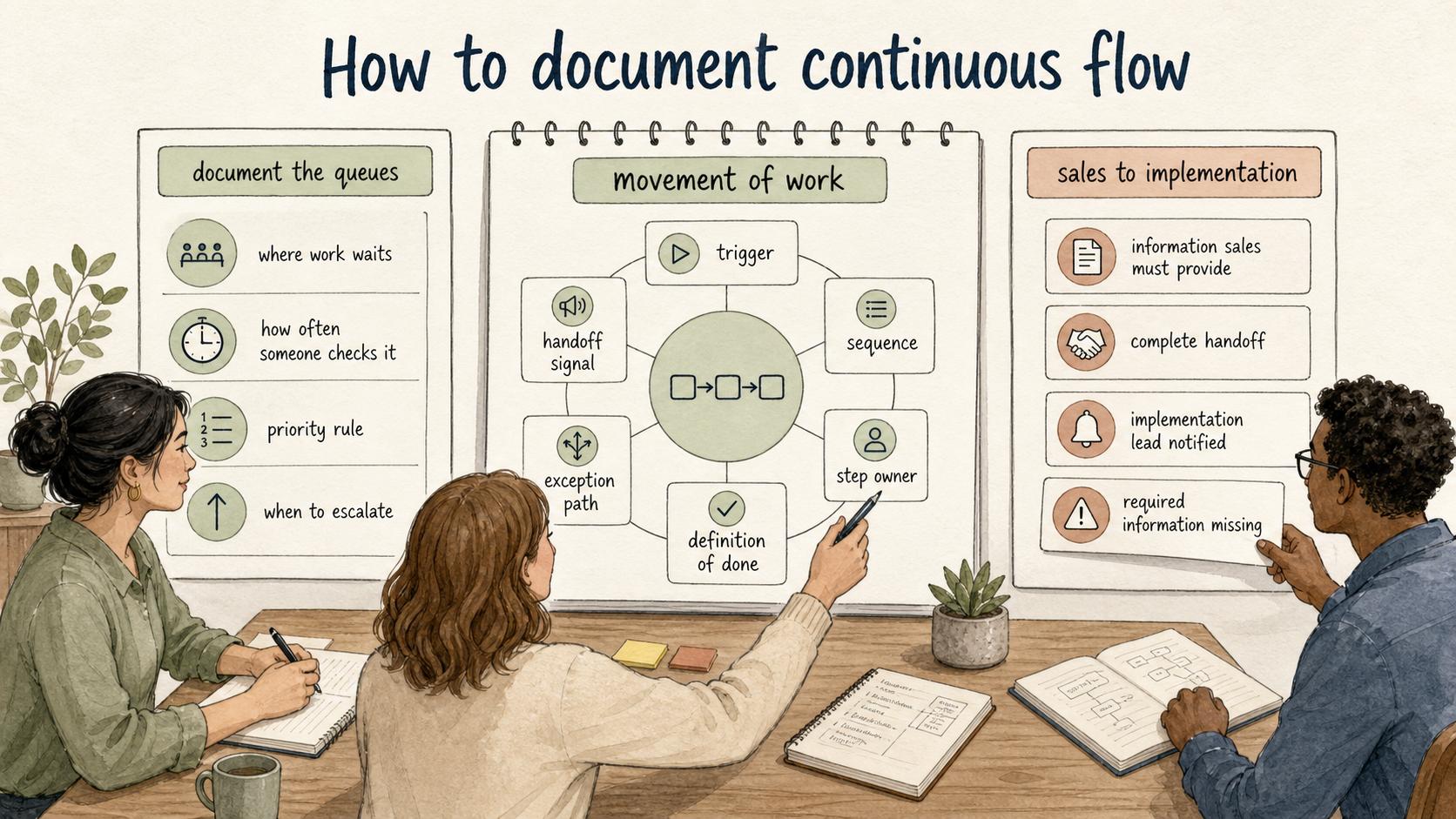
Documentation helps continuous flow when it captures the movement of work, not just isolated task instructions. A useful process guide should show the trigger, sequence, step owner, handoff signal, definition of done, and exception path. 4
Document the queues too. Teams often write instructions for active work and skip the waiting states, even though those waiting states are the flow problem. A good process document should make them explicit: where work waits, how often someone checks it, what priority rule applies, and when an item should be escalated.
For example, a customer onboarding handoff from sales to implementation should not only say "create the onboarding project." It should specify what information sales must provide, what counts as a complete handoff, how the implementation lead is notified, what happens when required information is missing, and how long a new account can sit before it becomes an escalation.
How Trails helps
Trails can help teams document continuous flow by capturing a workflow as someone performs it and turning that capture into a polished step-by-step guide. That makes the real sequence, handoff points, and shared instructions easier to see.
For training or rollout, Trails can also create an AI-narrated video version of the workflow. That is useful when a process improvement only works if several people understand the new flow, not just the person who redesigned it.
FAQ
Is continuous flow only for manufacturing?
No. Continuous flow comes from lean and manufacturing contexts, but the idea applies to service, support, operations, content, onboarding, and other knowledge-work processes. The unit of work changes, but the principle is the same: reduce avoidable waiting and rework.
What is the difference between continuous flow and a process flow?
A process flow describes the sequence of steps in a workflow. Continuous flow describes the quality of that movement: whether work progresses smoothly through those steps without unnecessary queues, handoff delays, or rework.
Can continuous flow create problems?
Yes. If a team focuses only on speed, it can push low-quality work downstream faster. Continuous flow works best when each step has clear quality criteria, ownership, and escalation rules.
Sources
- 1
Lean Enterprise Institute. Continuous flow. www.lean.org/lexicon-terms/continuous-flow/.
- 2
Project Production Institute. Little's Law: A Practical Approach to Understanding Production System Performance. projectproduction.org/journal/littles-law-a-practical-approach-to-understanding-production-system-performance/.
- 3
Lean Enterprise Institute. Batch-and-queue. www.lean.org/lexicon-terms/batch-and-queue/.
- 4
Lean Enterprise Institute. Lean continuous improvement as culture. www.lean.org/the-lean-post/articles/lean-continuous-improvement-as-culture/.