
Glossary
Compliance Training
 ChatGPT
 Perplexity
 Gemini
 Claude
What is compliance training?
Compliance training is employee education that teaches people how laws, policies, risks, and expected behaviors apply to their work. Good training turns compliance requirements into practical judgment: what to do, what to avoid, and when to ask for help.
Weak compliance training stops at annual acknowledgement. Strong training gives employees realistic situations, clear escalation paths, and enough context to recognize risk before it becomes an incident. DOJ guidance asks whether a compliance program is disseminated to, and understood by, employees in practice, and it treats training, communications, reporting channels, investigations, and program improvement as connected signals. 1
Why compliance training matters
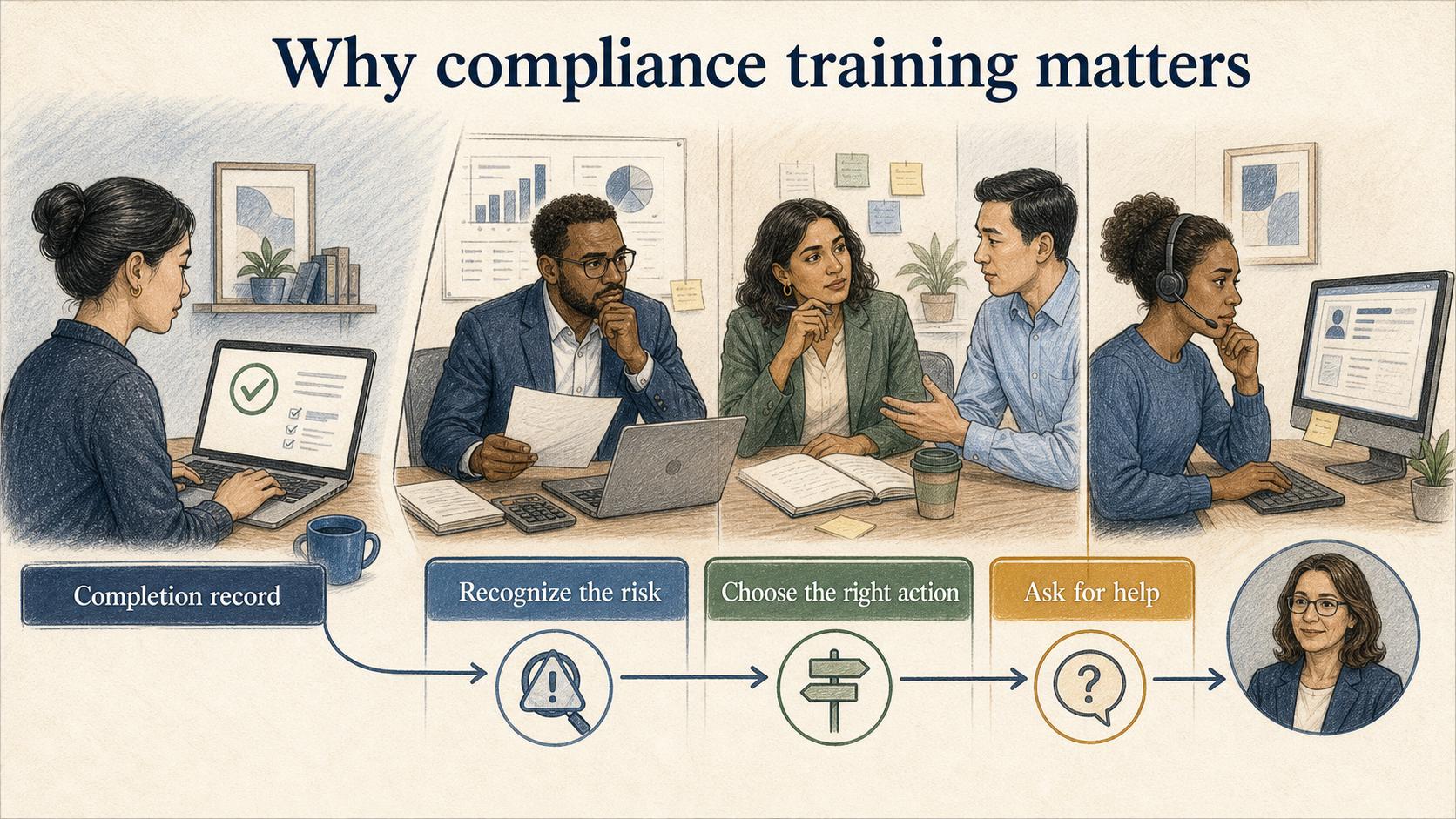
Compliance failures rarely happen because no policy exists. They happen because people don't recognize the risk, don't believe the rule applies to their situation, feel pressure to work around it, or don't know where to raise a concern.
Training gives the organization a way to close that gap. A finance employee needs to know how expense approvals, anti-bribery rules, and documentation requirements apply to real transactions. A manager needs to understand how to respond to harassment complaints. A support team needs to know which customer data can be shared, recorded, exported, or deleted.
The useful test is behavior at the moment of decision. If employees can pass a quiz but still can't spot the risky scenario in their day-to-day work, the training is mainly a completion record.
What compliance training should cover
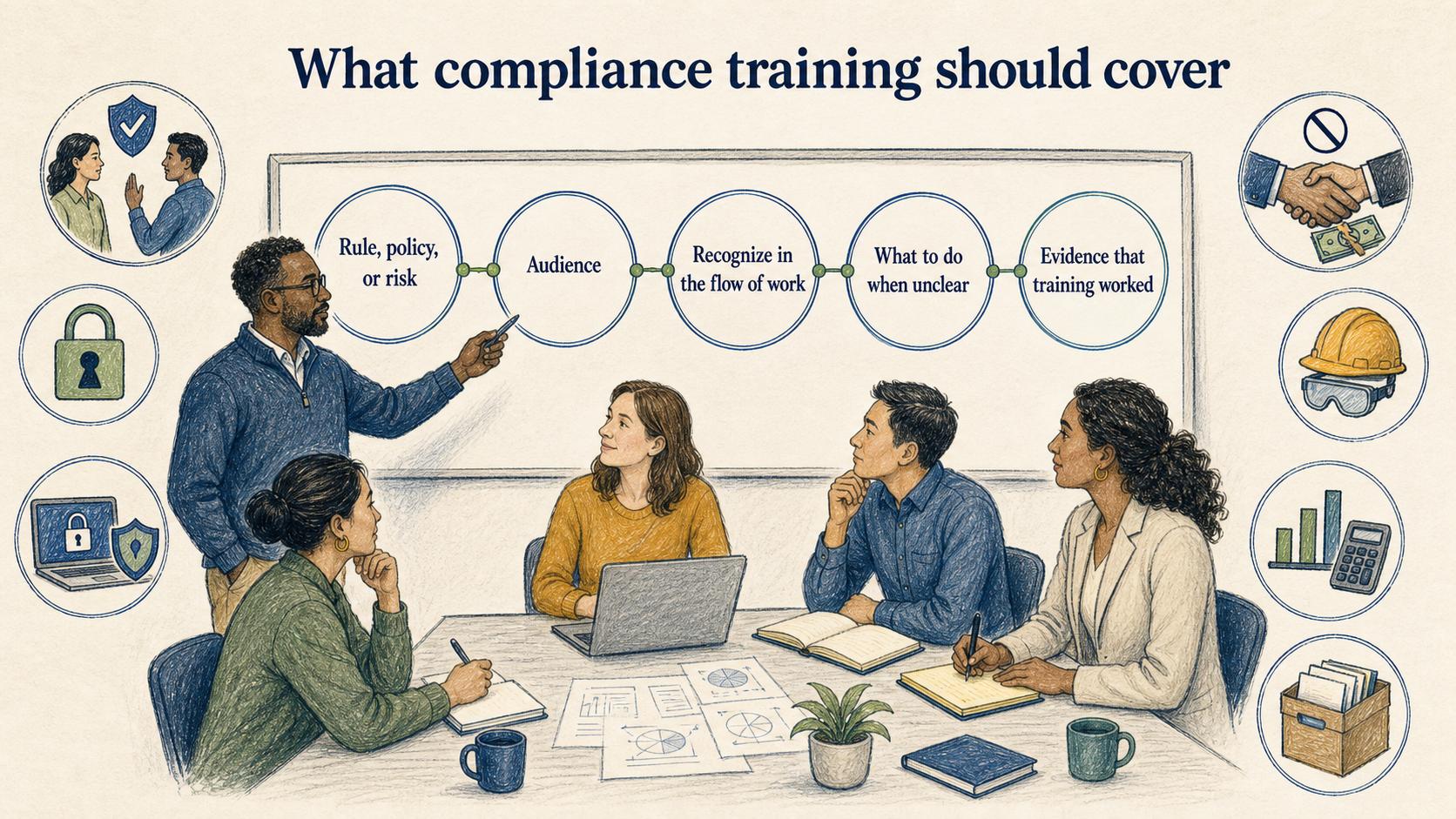
The right topics depend on the company's industry, locations, risk profile, workforce, and regulatory obligations. Common areas include anti-harassment, data privacy, cybersecurity, anti-bribery, conflicts of interest, workplace safety, financial controls, records retention, and industry-specific requirements.
A useful compliance training program answers five questions:
- What rule, policy, or risk does this training address?
- Who needs the training, and why does this audience face the risk?
- What should the employee recognize in the flow of work?
- What should they do when the scenario is unclear?
- What records or signals will show whether the training worked?
That last question matters more than teams expect. Completion records are useful, but they are not the whole story. Strong programs also track whether employees understood the material, whether managers reinforced it, and whether reports, audits, or incidents show that the training missed something. DOJ's evaluation questions specifically look at whether training is risk-based, tailored to high-risk roles, and measured for effectiveness. 2
Compliance training examples
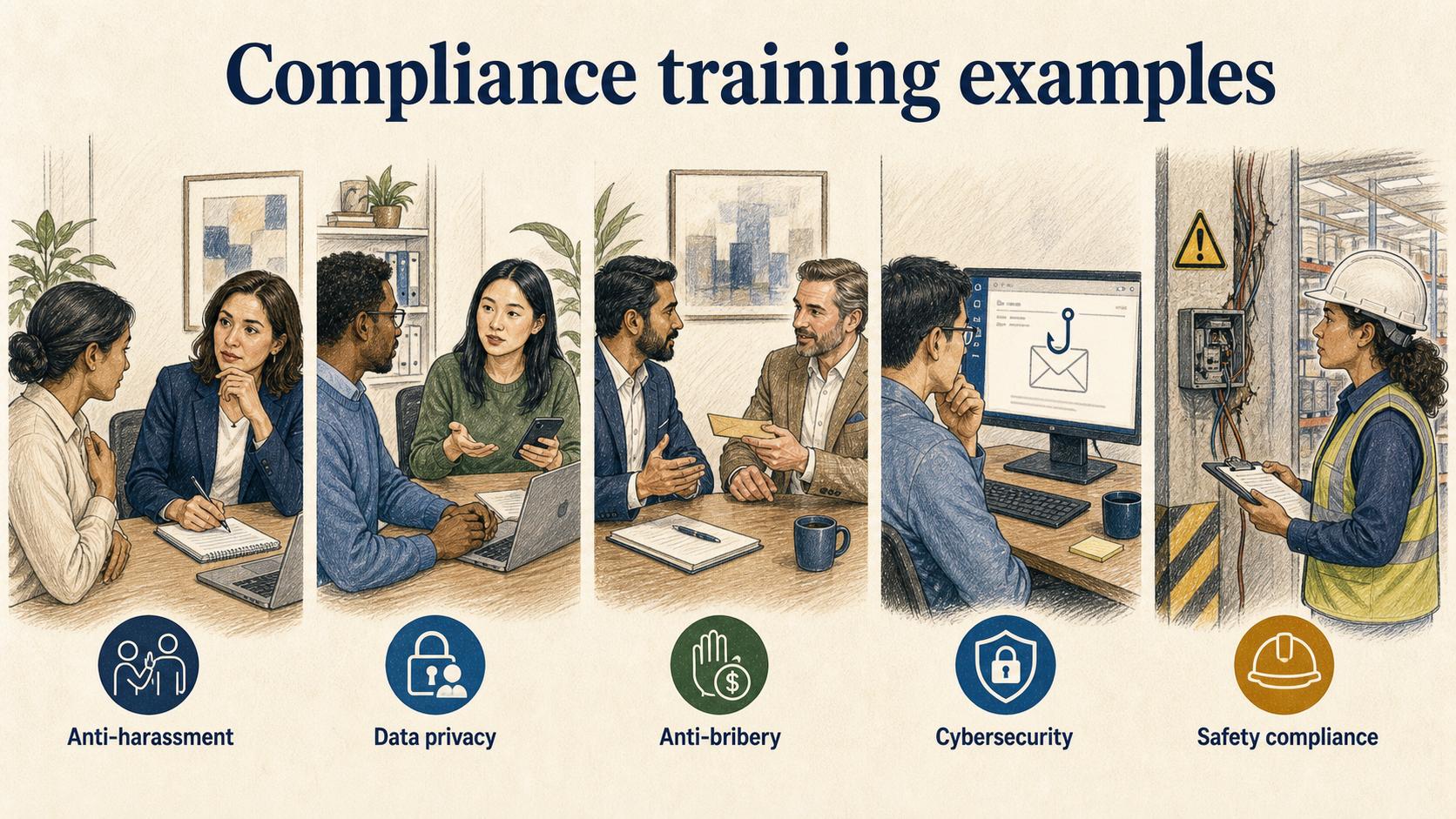
| Training type | What it teaches | Practical scenario to include |
|---|---|---|
| Anti-harassment | Expected workplace conduct, reporting options, and manager responsibilities | A manager hears a complaint informally and needs to respond correctly. |
| Data privacy | How personal data is collected, shared, retained, and deleted | A customer asks for an export or deletion request. |
| Anti-bribery | Gifts, entertainment, third-party risk, and government interactions | A reseller requests an unusual discount near a public-sector deal. |
| Cybersecurity | Phishing, passwords, device security, and incident reporting | An employee receives a believable vendor invoice email. |
| Safety compliance | Required procedures, hazard reporting, and stop-work expectations | A worker sees a changed condition that makes the original plan unsafe. |
The strongest examples feel close to the employee's real work. Generic warnings like “follow all laws and policies” rarely help someone make the right call under deadline pressure.
What makes compliance training effective
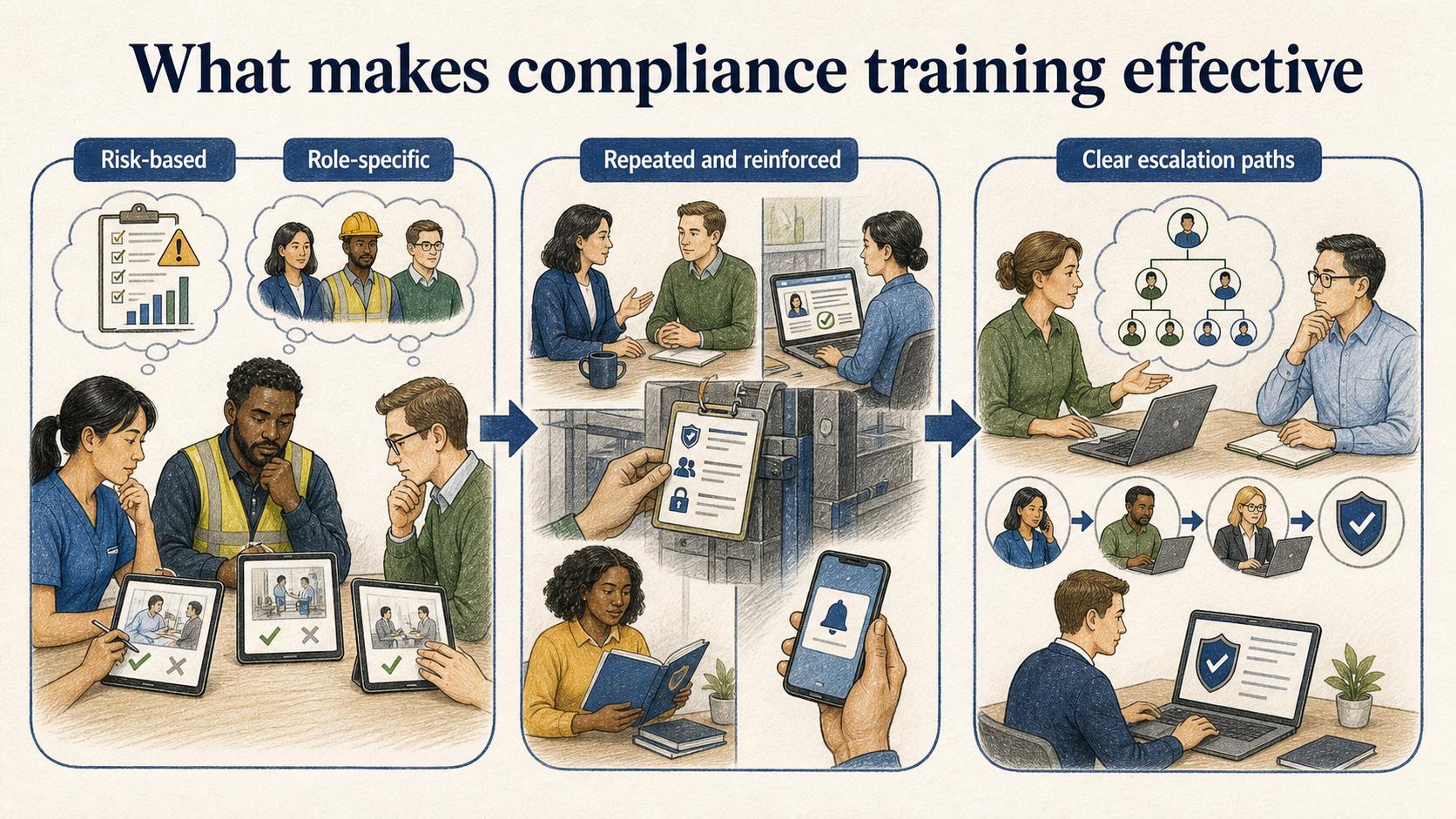
Effective compliance training is risk-based. People should spend more time on the risks they are likely to face and the decisions they are expected to make. The Federal Sentencing Guidelines frame an effective compliance and ethics program around communicating standards and procedures through training and other practical methods. 3 A salesperson, warehouse supervisor, engineer, and payroll manager may all need compliance training, but they don't need identical examples.
It is also repeated and reinforced. Annual training can introduce or refresh expectations, but short manager discussions, onboarding modules, job aids, policy updates, and scenario reminders often do more to keep behavior alive.
Finally, effective training makes escalation feel normal. Employees should leave knowing who to contact, which channels are available, what happens after a report, and why raising a concern is part of doing the job well. HHS OIG's general compliance guidance similarly treats effective lines of communication, disclosure programs, and training as core compliance program infrastructure. 4
AI-ready compliance training prompt
Use this prompt to turn a policy into a practical training outline:
## AI-ready compliance training prompt

**Glossary term:** Compliance Training
**Source:** Trails Glossary — trails.so/glossary/compliance-training

---

### 01. Create a compliance training outline

"Create a compliance training outline for [audience] on [policy/risk area].

Include:
- The decisions this audience needs to make in real work
- 3 realistic scenarios, including one gray-area case
- What employees should do, avoid, and escalate
- Manager responsibilities, if different from employee responsibilities
- A short knowledge check that tests judgment, not memorization
- The records we should keep to show the training was completed
Use plain language and avoid legal advice beyond the policy text provided."
This prompt works best when paired with the actual company policy, role expectations, and examples from recent questions, audits, or incidents.
Compliance training vs policy acknowledgment
A policy acknowledgment proves that someone received or accepted a policy. Compliance training should help them apply it. Both can matter, but they serve different jobs.
If the risk is low and the rule is simple, an acknowledgment may be enough. If employees need to recognize gray areas, make judgment calls, or respond to complaints, incidents, or customer requests, they need scenarios and escalation paths.
Documentation takeaway
Compliance training depends on clear source material: policies, SOPs, reporting steps, manager guides, investigation procedures, and role-specific examples. If those materials are scattered or outdated, training is harder to trust.
Trails can help teams capture repeatable compliance workflows, turn them into step-by-step guides, and create AI-narrated video versions for onboarding or refresher training. That's most useful for process-heavy topics where employees need to see how a request, report, review, or approval should move through the team.
FAQ
Is compliance training legally required?
Sometimes. Requirements vary by topic, industry, jurisdiction, and employee role. Teams should confirm specific obligations with legal counsel or the responsible compliance owner.
How often should compliance training happen?
The answer depends on risk. High-risk topics, new regulations, employee role changes, policy updates, incidents, or audit findings may justify more frequent reinforcement than a single annual course.
What is the biggest mistake in compliance training?
Treating completion as the goal. Completion matters, but the real test is whether employees can recognize the risk, choose the right action, and escalate when the answer is unclear.
Sources
- 1
U.S. Department of Justice. Evaluation of Corporate Compliance Programs. www.justice.gov/criminal/criminal-fraud/page/file/937501/dl?inline=.
- 2
U.S. Department of Justice. Guidance on risk-based compliance training. www.justice.gov/criminal/criminal-fraud/page/file/937501/dl?inline=.
- 3
U.S. Sentencing Commission. U.S. Sentencing Guidelines §8B2.1. guidelines.ussc.gov/apex/r/ussc_apex/guidelinesapp/guidelines?app_gl_id=%C2%A78B2.1.
- 4
HHS Office of Inspector General. General Compliance Program Guidance. oig.hhs.gov/compliance/general-compliance-program-guidance/.