
Glossary
Compliance SOP
 ChatGPT
 Perplexity
 Gemini
 Claude
What is a compliance SOP?
A compliance SOP is a standard operating procedure for carrying out a compliance-related process. It translates a law, regulation, policy, or control requirement into the steps people should follow in daily work.
A compliance SOP is not the rule itself. It is the operating method for following the rule. DOJ compliance-program guidance asks whether policies and procedures are accessible, integrated into operations, and tied to the company's risk profile, which is the gap an SOP is meant to close. 1 For example, a privacy policy may say the company honors deletion requests; the SOP explains who receives the request, how identity is verified, which systems are checked, how completion is recorded, and when legal or security should review the case.
Why compliance SOPs matter
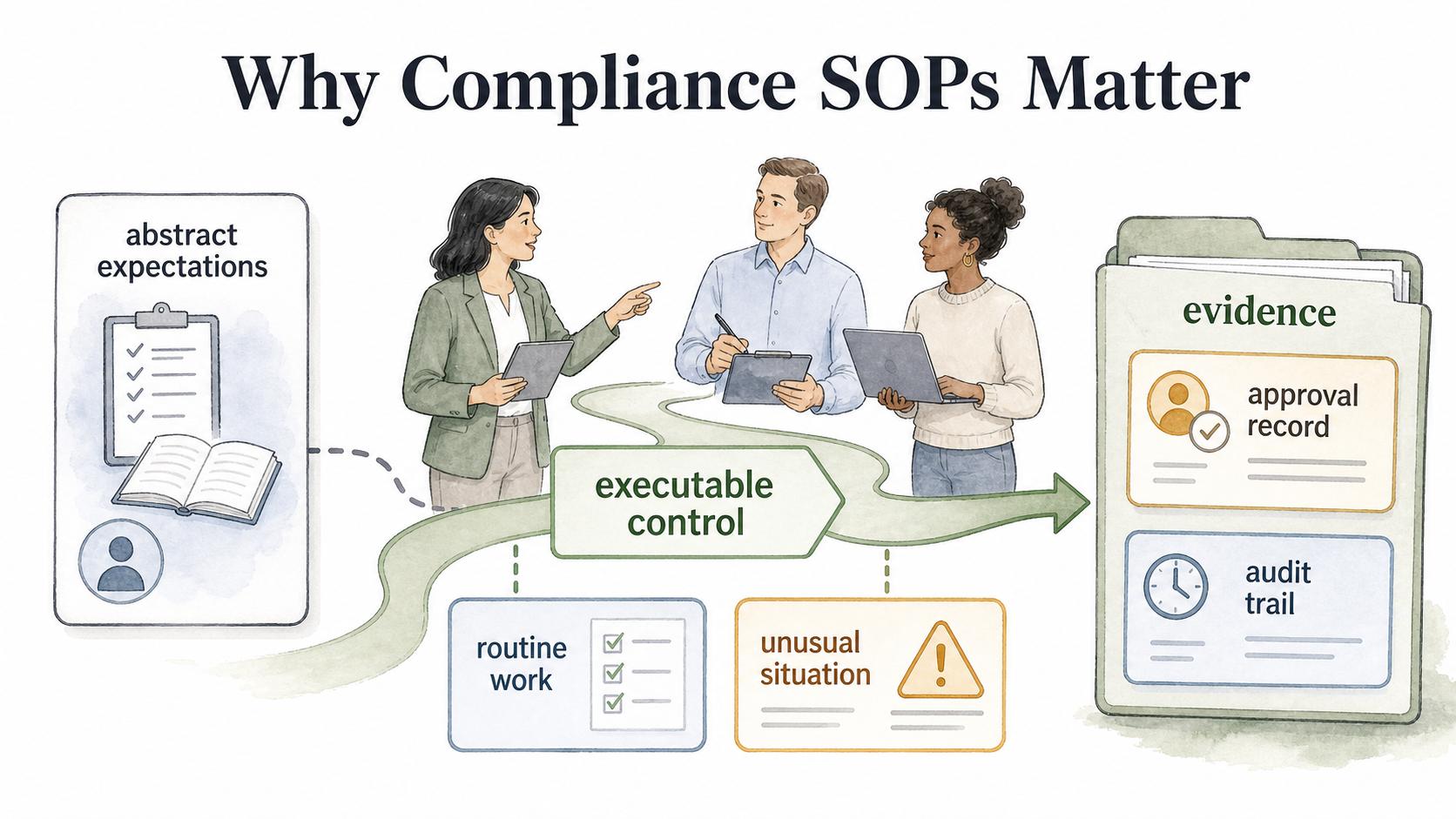
Compliance programs fail when expectations stay abstract. A code of conduct, policy library, or training course may tell employees what the company expects, but someone still needs to handle the refund exception, investigate the complaint, approve the vendor, review the access request, or preserve the record.
A compliance SOP makes the control executable. It tells employees what to do when the work is routine, what to do when the situation is unusual, and what evidence should exist afterward.
That evidence is easy to overlook. Many compliance processes need proof that the right step happened: a signed acknowledgment, approval record, system log, investigation note, audit trail, or completed checklist. The Federal Sentencing Guidelines frame effective programs around standards and procedures, monitoring and auditing, reporting systems, and periodic evaluation. 2 A useful SOP builds that record into the workflow instead of asking people to reconstruct it later.
Compliance SOP vs policy vs compliance manual
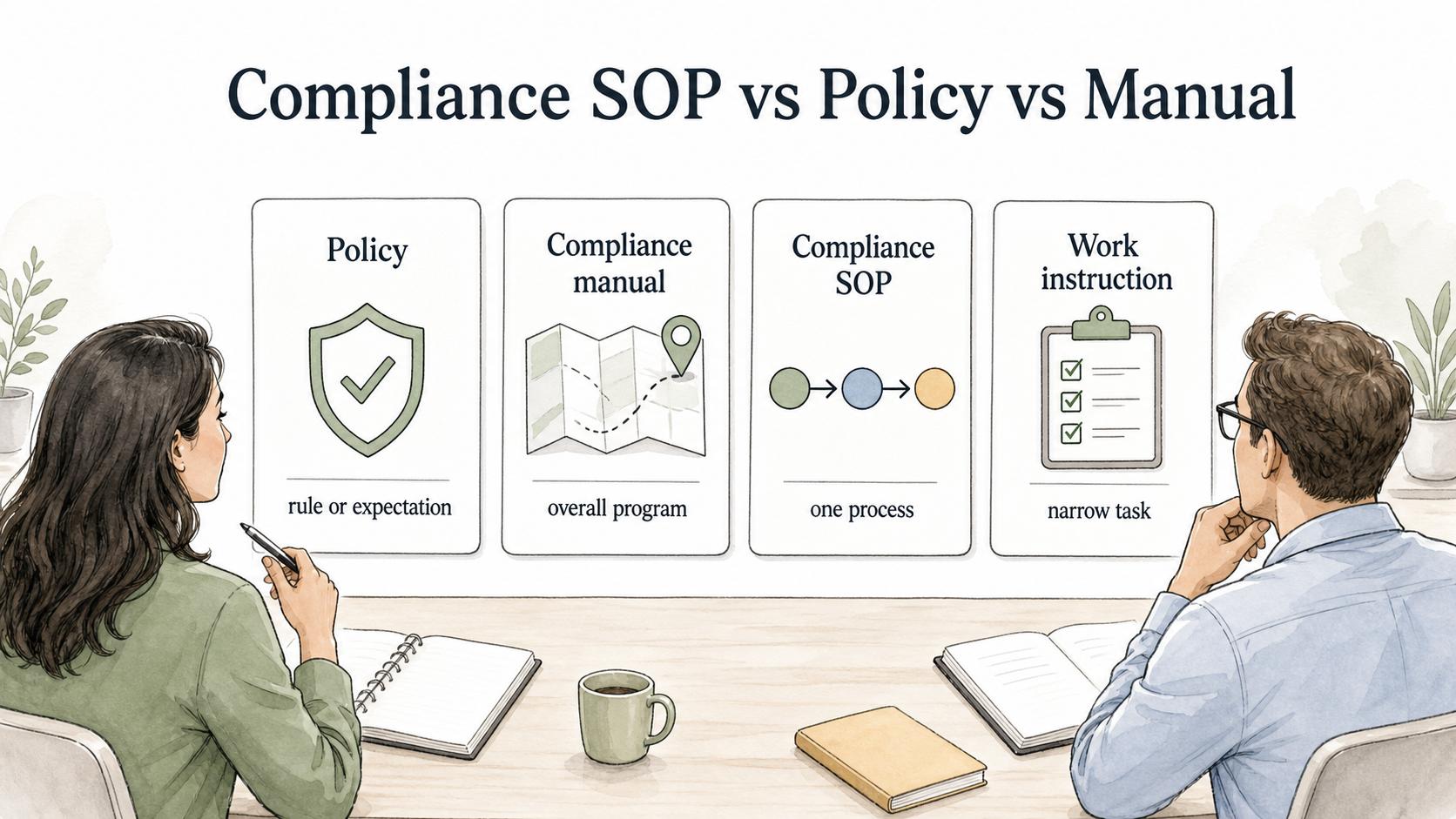
These documents work together, but they answer different questions.
| Document | Main question it answers | Example |
|---|---|---|
| Policy | What is the rule or expectation? | Employees must disclose conflicts of interest. |
| Compliance manual | How does the overall compliance program work? | The company's compliance roles, reporting channels, training, monitoring, and governance. |
| Compliance SOP | How is one compliance process performed? | How employees submit a conflict disclosure and how compliance reviews it. |
| Work instruction | How is one narrow task completed? | How to attach the disclosure record in the case management system. |
The common mistake is making one document do every job. A policy becomes unreadable when it includes every click path. An SOP becomes risky when it restates the law from memory instead of linking back to the approved policy or legal source.
What a compliance SOP should include
A compliance SOP should be specific enough for a trained employee to follow without guessing, but not so brittle that it breaks every time a form or system label changes. HHS OIG's general compliance guidance identifies written policies and procedures, compliance leadership, training, communication, auditing, and corrective action as core compliance program infrastructure. 3
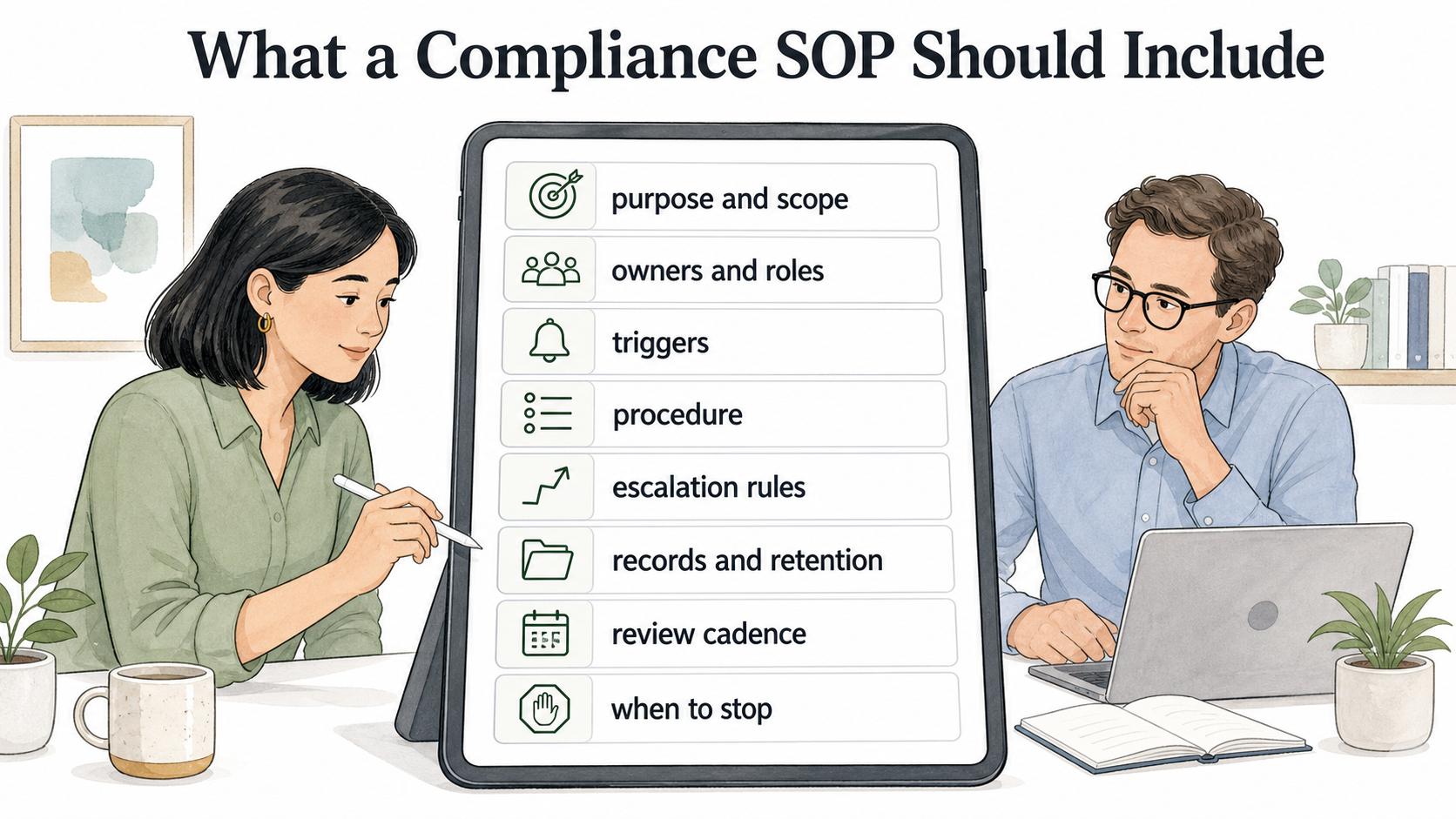
Include only what helps someone perform, review, or prove the work:
- Purpose and scope: The risk, policy, process, team, geography, system, or employee group covered by the SOP.
- Owners and roles: Who performs the work, who reviews it, who approves exceptions, and who owns future updates.
- Triggers: The event that starts the procedure, such as a complaint, request, audit finding, vendor onboarding, policy exception, or regulatory deadline.
- Procedure: The sequence of actions, decision points, approvals, handoffs, and required documentation.
- Escalation rules: Conditions that require legal, compliance, security, HR, finance, or leadership review.
- Records and retention: What proof is created, where it lives, and how long it should be kept according to the relevant policy.
- Review cadence: When the SOP should be reviewed, especially after incidents, audit findings, regulatory changes, or system changes.
The practical test is whether the SOP tells people when to stop. Compliance work often becomes risky when employees push a strange case through the normal path because the procedure never named the exception.
Compliance SOP examples
A company might create compliance SOPs for vendor due diligence, access reviews, conflict-of-interest disclosures, incident reporting, employee complaint intake, anti-bribery gift approvals, policy exception requests, records holds, data subject requests, or required training follow-up.
The best examples are tied to a real control. A vendor due diligence SOP might require the procurement owner to collect business justification, screen the vendor, route high-risk countries or government touchpoints to compliance, document approval, and block onboarding until required checks are complete.
A weak SOP says “make sure the vendor is compliant.” A strong SOP defines what “make sure” means, who decides, what tool is used, and what happens if the answer is not clean.
How to write a compliance SOP
Start with the approved source: the policy, control requirement, regulatory obligation, contract clause, audit finding, or risk assessment. Don't ask a process owner to invent compliance requirements from memory. The SOP should operationalize the source, not reinterpret it.
Next, map the process as it actually happens. Compliance teams often discover that the official path and the real path are different. That gap is the reason to write the SOP. The procedure should make the expected path realistic enough that employees don't need a shadow process to get work done.
Then pressure-test exceptions. Ask, “What would make this case unusual, urgent, high-risk, or outside our authority?” Add escalation points for those conditions. A compliance SOP without escalation rules quietly encourages improvisation.
Finally, define the record. If the organization may need to show that a control operated, the SOP should say what evidence is created at the time of work. NIST SP 800-53 treats control implementation, assessment, accountability, and supporting records as part of making controls inspectable rather than assumed. 4 Screenshots, ticket IDs, approval notes, review dates, and system logs are stronger than after-the-fact explanations.
AI-ready compliance SOP prompt
## AI-ready compliance SOP prompt

**Glossary term:** Compliance SOP
**Source:** Trails Glossary — trails.so/glossary/compliance-sop

---

### 01. Draft a compliance SOP

"Draft a compliance SOP for [process name].
Use the following source policy or requirement: [paste approved source].
Audience: [team or role].
Include purpose, scope, roles, triggers, step-by-step procedure, decision points, escalation rules, required records, and review cadence.
Flag any places where legal, compliance, security, HR, or finance must confirm the requirement instead of guessing.
Keep the SOP practical for daily use and avoid adding obligations not present in the source material."
This prompt is only a starting point. The final SOP should be reviewed by the responsible compliance owner before employees rely on it.
How Trails helps
Compliance SOPs are easier to maintain when they reflect the real workflow. Trails can capture a process as someone performs it, turn that workflow into a polished step-by-step guide, and create an AI-narrated video version for training or sharing. That is useful for repeatable compliance processes where employees need to see the exact sequence, handoffs, and records involved.
FAQ
Is a compliance SOP legally required?
Sometimes a specific procedure may be required by law, regulation, contract, or internal control standard, but many compliance SOPs are created because they help teams operate controls consistently. Confirm specific requirements with legal counsel or the responsible compliance owner.
Who owns a compliance SOP?
Ownership depends on the process. Compliance may own the standard, while operations, HR, finance, security, or procurement may own the day-to-day execution. The SOP should name both execution and review responsibilities.
How often should a compliance SOP be reviewed?
Review it after a legal or policy change, audit finding, incident, system change, role change, or repeated process confusion. Calendar reviews help, but event-triggered reviews catch the issues that matter most.
Sources
- 1
U.S. Department of Justice. Evaluation of Corporate Compliance Programs. www.justice.gov/criminal/criminal-fraud/page/file/937501/dl?inline=.
- 2
U.S. Sentencing Commission. U.S. Sentencing Guidelines §8B2.1. guidelines.ussc.gov/apex/r/ussc_apex/guidelinesapp/guidelines?app_gl_id=%C2%A78B2.1.
- 3
HHS Office of Inspector General. General Compliance Program Guidance. oig.hhs.gov/compliance/general-compliance-program-guidance/.
- 4
NIST. NIST SP 800-53 Rev. 5. csrc.nist.gov/pubs/sp/800/53/r5/upd1/final.