
Glossary
Compliance Officer
 ChatGPT
 Perplexity
 Gemini
 Claude
What is a compliance officer?
A compliance officer is the person responsible for helping an organization manage legal, regulatory, policy, ethics, and internal-control obligations. The role usually includes building or managing the compliance program, advising the business, monitoring risk, supporting training, and making sure concerns can be raised and addressed.
The title changes with industry and company size. In a small organization, compliance officer may be a part-time responsibility assigned to an operations, legal, HR, finance, or security leader. In a regulated enterprise, it may be a dedicated function with staff, reporting lines, audits, investigations, and board visibility. The Federal Sentencing Guidelines assign overall responsibility for an effective compliance and ethics program to specific high-level personnel and day-to-day operational responsibility to delegated individuals. 1
Why the compliance officer role matters
Compliance work needs an owner. Without one, policies scatter, training becomes generic, reports disappear into unclear channels, and teams improvise when a new rule, incident, or audit finding appears.
A compliance officer gives the organization a responsible point of coordination. That doesn't mean the officer personally performs every control or owns every risk. Sales, HR, finance, security, operations, and product teams still own their work. The compliance officer helps define expectations, monitor whether the program is working, and escalate issues when the business needs a stronger answer than “we usually do it this way.”
The role depends on independence of judgment. DOJ guidance asks whether compliance personnel have sufficient seniority, resources, autonomy, data access, and authority to detect and prevent misconduct. 2 HHS OIG guidance similarly emphasizes authority, stature, access, resources, and access to senior leadership and governance channels. 3 A compliance officer who cannot raise uncomfortable concerns, access information, or escalate to leadership is mostly a title.
What a compliance officer does
A compliance officer's responsibilities vary, but most roles include a mix of program design, advisory work, monitoring, reporting, and improvement.
| Responsibility | What it looks like in practice | What can go wrong |
|---|---|---|
| Program governance | Maintaining the compliance plan, calendar, policies, ownership, and reporting rhythm | The program exists, but nobody knows what is current or required. |
| Policy and SOP oversight | Helping teams write, update, approve, and communicate compliance documents | Policies say the right thing, but procedures don't match real work. |
| Training and communication | Making sure employees understand the risks and expected behaviors for their roles | Training is completed but not remembered or applied. |
| Reporting and investigations | Supporting complaint intake, escalation, triage, documentation, and follow-up | Employees don't trust the process or managers mishandle concerns. |
| Monitoring and auditing | Reviewing controls, records, exceptions, and trends | Problems are found only after an external audit or incident. |
| Remediation | Tracking corrective actions after issues, investigations, or audit findings | The same issue repeats because the root cause was never fixed. |
The role is most valuable when it connects these activities. A training issue may reveal a weak policy. A hotline report may reveal an unclear SOP. An audit finding may show that a control exists on paper but not in daily work.
Compliance officer vs compliance manager
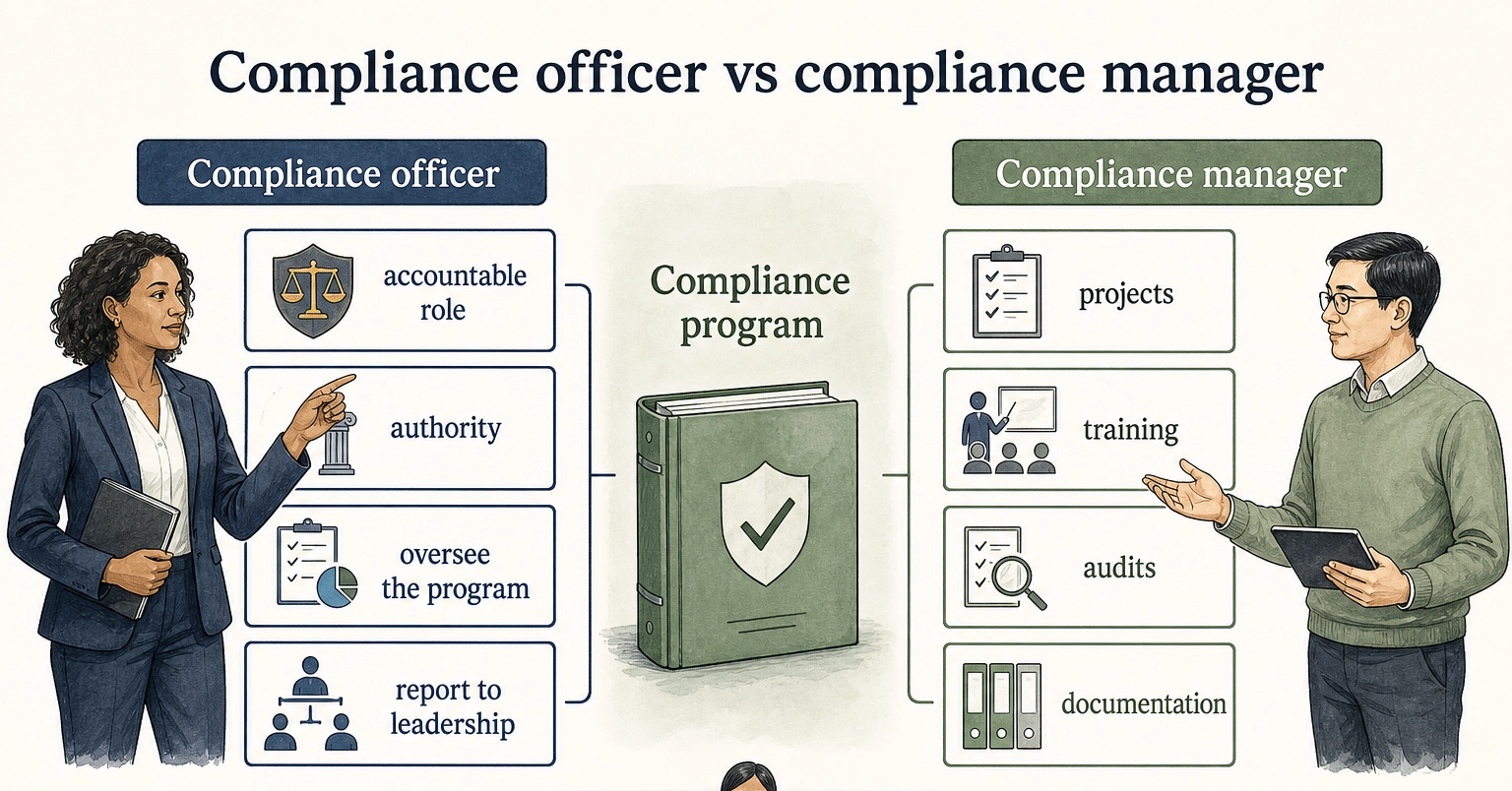
The difference is not always formal. In some companies, “compliance officer” is the accountable role with authority to oversee the program and report to leadership. “Compliance manager” may be a more operational title focused on running projects, training, audits, or documentation.
In smaller teams, one person may do both. The useful question is not the title. It is whether someone has clear responsibility for the compliance program and enough authority to act on what they find.
What makes a compliance officer effective
An effective compliance officer has access to the parts of the business where risk actually lives. They can't manage compliance from a policy folder. ISO 37301 frames compliance management as a system that must be established, developed, implemented, evaluated, maintained, and improved, which reinforces why the role needs contact with real work. 4 The officer needs to understand how sales are approved, how vendors are onboarded, how complaints are handled, how customer data moves, how training is assigned, and how exceptions are documented.
They also need a clear escalation path. If a high-risk issue appears, the compliance officer should know who decides, who must be informed, and what documentation is required. Ambiguous escalation is one of the fastest ways to turn a manageable concern into a larger problem.
Finally, the role needs credibility with both employees and leadership. Employees need to believe that asking a question will not punish them. Leaders need to treat compliance findings as operational signals, not administrative noise.
Practical diagnostic for the role
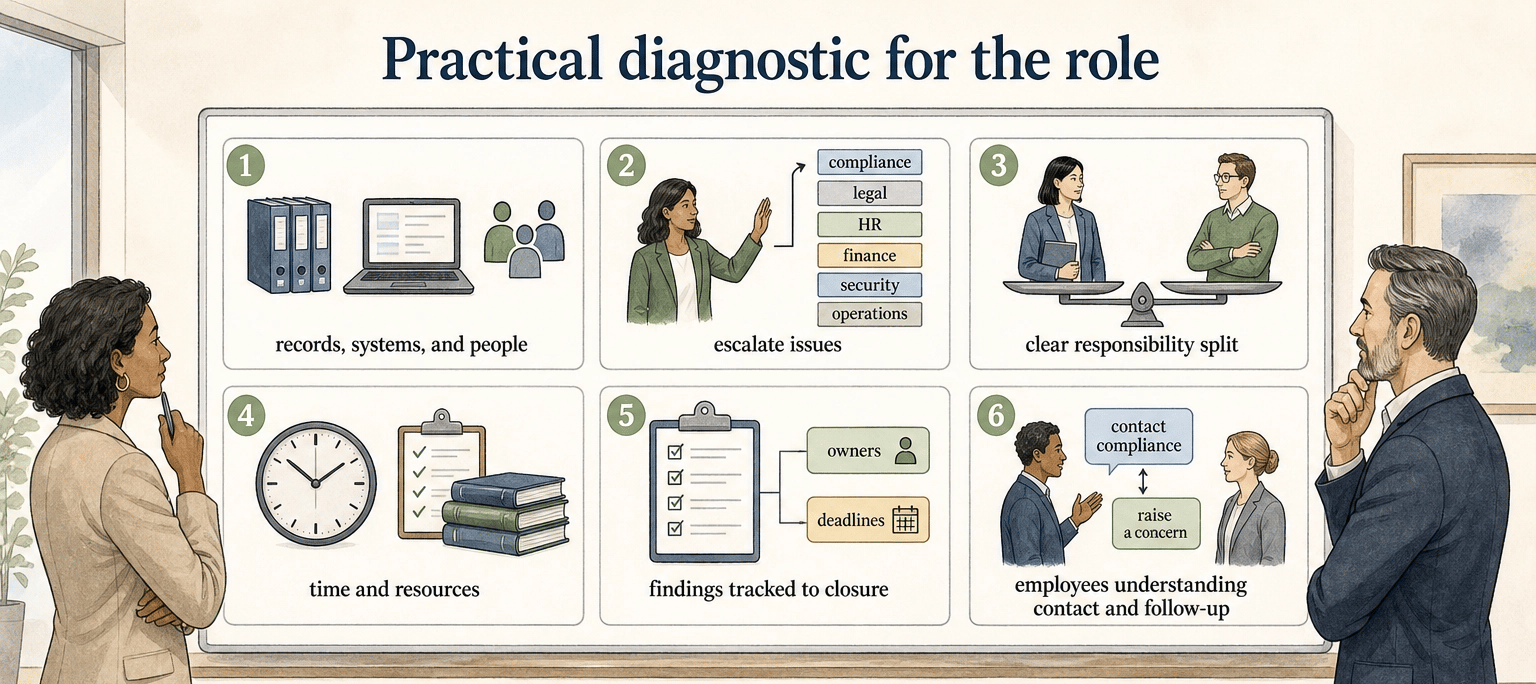
A company can test whether the compliance officer role is strong enough by asking:
- Can the compliance officer access the records, systems, and people needed to evaluate risk?
- Can they escalate issues outside the normal management chain when necessary?
- Are responsibilities split clearly between compliance, legal, HR, finance, security, and operations?
- Does the officer have time and resources to monitor the program, not just react to problems?
- Are findings tracked to closure with owners and deadlines?
- Do employees know how to contact compliance and what happens after they raise a concern?
If several answers are unclear, the company may have a compliance contact but not a durable compliance function.
Documentation takeaway
A compliance officer depends on clear documentation: policies, SOPs, training records, investigation notes, audit trails, corrective action plans, and ownership maps. The documentation should make the program inspectable without forcing the officer to reconstruct every decision from memory.
Trails can help teams capture repeatable compliance workflows as they happen, turn them into step-by-step guides, and create AI-narrated video versions for training or sharing. That is useful when a compliance officer needs process owners to document how a control, review, report, or approval actually works.
FAQ
Does every company need a compliance officer?
Not every company needs a dedicated full-time compliance officer, but every company with meaningful regulatory, legal, security, financial, or workplace conduct risk needs clear compliance ownership. The right structure depends on size, industry, geography, and risk.
Should a compliance officer report to legal?
Sometimes, but the reporting line should preserve independence, access, and escalation. In regulated organizations, the officer may need direct access to senior leadership, a board committee, or another oversight body.
Is a compliance officer responsible for preventing every violation?
No. A compliance officer helps design, operate, monitor, and improve the compliance program. Business leaders and process owners still own day-to-day conduct and controls in their areas.
Sources
- 1
U.S. Sentencing Commission. U.S. Sentencing Guidelines §8B2.1. guidelines.ussc.gov/apex/r/ussc_apex/guidelinesapp/guidelines?app_gl_id=%C2%A78B2.1.
- 2
U.S. Department of Justice. Evaluation of Corporate Compliance Programs. www.justice.gov/criminal/criminal-fraud/page/file/937501/dl?inline=.
- 3
HHS Office of Inspector General. General Compliance Program Guidance. oig.hhs.gov/compliance/general-compliance-program-guidance/.
- 4
ISO. ISO 37301 compliance management systems overview. committee.iso.org/sites/tc309/home/projects/published/iso-37301-compliance-management.html.