
Glossary
Communication SOP
 ChatGPT
 Perplexity
 Gemini
 Claude
What is a communication SOP?
A communication SOP is a standard operating procedure that explains how a team shares important information, chooses the right channel, escalates issues, and documents decisions. It turns “keep people in the loop” into a repeatable process.
A good communication SOP leaves ordinary conversation alone and defines the moments where confusion gets expensive: urgent issues buried in chat, decisions made without context, updates sent to the wrong place, and handoffs that depend on whoever remembers the backstory.
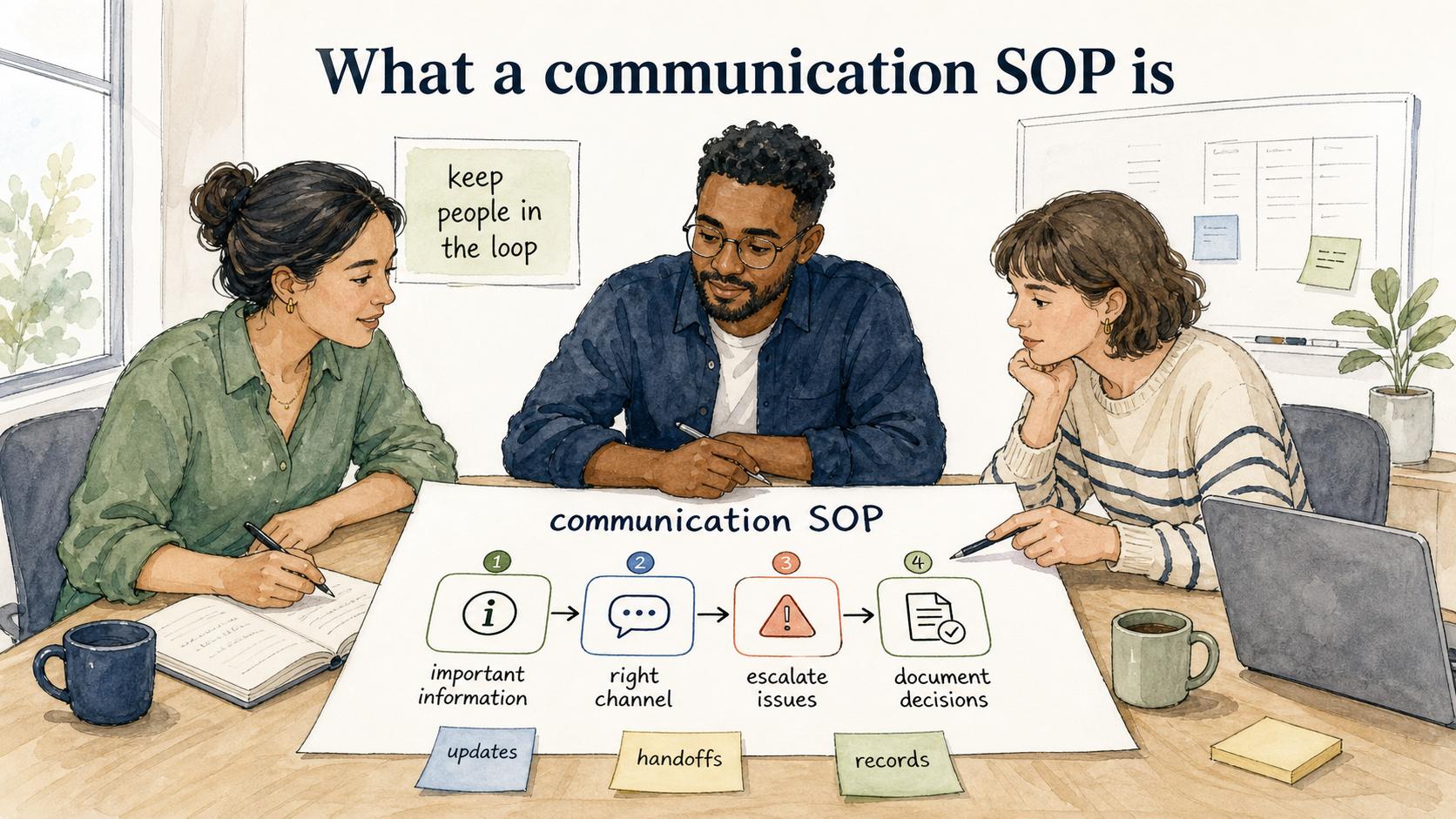
What a communication SOP covers
A communication SOP defines the rules for recurring communication moments. That might include customer escalations, incident updates, shift handoffs, leadership reporting, project status updates, internal approvals, or policy changes. 1
The strongest SOPs answer five questions:
- What information needs to be communicated?
- Who needs to send it, approve it, or receive it?
- Which channel should be used?
- How quickly does it need to happen?
- What record should remain afterward?
That last question is the one teams often miss. If a decision disappears into a private message or a long Slack thread, the communication technically happened, but the organization cannot reliably learn from it or act on it later.
Why communication SOPs matter
Most teams do not struggle because nobody communicates. They struggle because communication is inconsistent. One manager sends urgent customer issues by email, another posts in a chat channel, and a third mentions it in a meeting. Everyone is trying to be helpful, but the receiving team has to monitor too many places and guess what matters.
A communication SOP reduces that guesswork. It gives the team a shared routing system for information, especially when work crosses departments, time zones, tools, or levels of urgency. 2
The hidden benefit is accountability. When the SOP says a severity-one customer issue must be posted in a specific channel, assigned to an owner, and summarized in the customer record, the team can tell whether the process happened. Without that rule, the only proof may be a scattered set of messages.

Communication SOP example
A customer support team might create a communication SOP for product bugs reported by customers. The SOP could say:
- Routine bugs are logged in the ticket and tagged for product review.
- Bugs affecting multiple customers are posted in a support-product channel with a required summary format.
- Bugs that block customer work are escalated to the on-call owner within 15 minutes.
- Customer-facing updates must use approved language from the incident owner.
- The final resolution is added back to the ticket and the internal knowledge base.
This works because it defines the few moments where communication quality changes the outcome.
How to choose the right communication channel
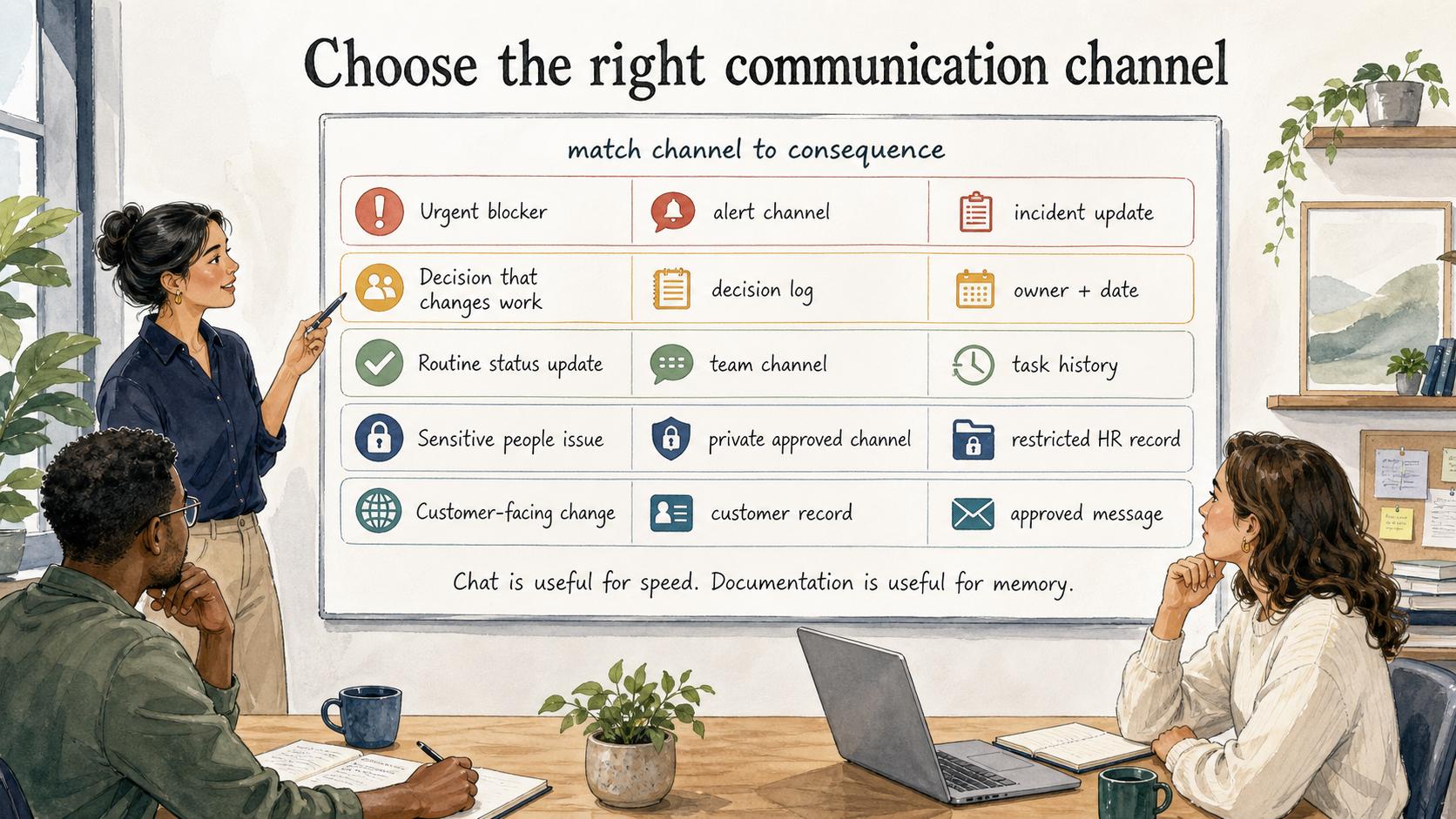
A useful communication SOP includes a simple channel rule: match the channel to the consequence of missing the message. Fast questions can live in chat. Decisions, escalations, and customer-impacting updates need a durable record.
| Situation | Best channel | Record to keep |
|---|---|---|
| Urgent blocker | Alert channel or escalation tool | Incident or ticket update |
| Decision that changes work | Project doc, ticket, or decision log | Decision summary with owner and date |
| Routine status update | Team channel or project tracker | Weekly update or task history |
| Sensitive people issue | Private HR-approved channel | Restricted HR record |
| Customer-facing change | Customer record plus approved message | Final customer note and source context |
The practical rule: if people will need the information later, don't leave it only in chat. Chat is useful for speed. Documentation is useful for memory.
What to include in a communication SOP
A communication SOP should be short enough that people can follow it during real work. Include the trigger, audience, channel, message format, timing, owner, escalation path, and recordkeeping step. 3
The message format matters more than teams expect. A required format such as “summary, impact, owner, next update time, link to source record” can remove a lot of back-and-forth. It also prevents vague updates like “we are looking into it,” which create the feeling of communication without useful information.
AI-ready communication SOP template
## Communication SOP Template

**Glossary term:** Communication SOP
**Source:** Trails Glossary — trails.so/glossary/communication-sop

---

### 01. Create a communication SOP

"Create a communication SOP for [team/process].

Define:
- Trigger events that require communication
- Message owner and backup owner
- Audience for each trigger
- Required channel for urgent, routine, and sensitive updates
- Required message format
- Escalation timing and escalation owner
- Where the final record should be stored
- Example message for one routine update and one urgent update

Context:
- Team: [team]
- Process: [process]
- Tools used: [tools]
- Main failure to prevent: [failure]"
Use the output as a first draft, then test it against a real scenario. If the SOP cannot tell someone what to do under pressure, it is still too abstract.
How Trails helps
Trails helps teams capture communication workflows as they happen, then turn them into step-by-step guides. That is useful when the SOP depends on specific tools, screens, fields, or handoff points.
For example, a manager can record the process for escalating a customer issue, including where to post, which ticket fields to update, and where the final summary belongs. Trails turns that workflow into a polished guide and can create an AI-narrated video version for training or onboarding.
FAQ
Is a communication SOP the same as a communication plan?
No. A communication plan usually describes how information will be shared for a project or initiative. A communication SOP defines a repeatable procedure for communication that happens again and again.
What teams need a communication SOP?
Support, operations, HR, IT, customer success, compliance, and leadership teams all benefit when communication has timing, ownership, and recordkeeping requirements.
How detailed should a communication SOP be?
Detailed enough to remove uncertainty at the moment of action. If the SOP tries to cover every possible message, people will ignore it. Focus on triggers where missed or unclear communication creates risk.
What is the biggest communication SOP mistake?
The biggest mistake is naming channels without defining the record of truth. A team may communicate quickly in chat, but important decisions, escalations, and customer-impacting updates still need a durable record.
- Standard operating procedure
- Email SOP
- Approval workflow
- Escalation procedure
- Customer service SOP
- Change management SOP
- Process documentation
Sources
- 1
AHRQ. TeamSTEPPS handoff tool. Agency for Healthcare Research and Quality. www.ahrq.gov/teamstepps-program/curriculum/communication/tools/handoff.html.
- 2
ACOG. Communication strategies for patient handoffs. American College of Obstetricians and Gynecologists. www.acog.org/clinical/clinical-guidance/committee-opinion/articles/2012/02/communication-strategies-for-patient-handoffs.
- 3
Penn State Extension. SOP writing guide. Penn State Extension. extension.psu.edu/standard-operating-procedures-a-writing-guide/.