
Glossary
Escalation Procedure
 ChatGPT
 Perplexity
 Gemini
 Claude
What is an escalation procedure?
An escalation procedure is a documented process for moving an issue, request, incident, or decision to the next level of ownership when the normal path cannot resolve it. In incident management, Atlassian describes escalation as handing work to a more experienced or specialized employee when the current owner cannot resolve it. 1 The procedure tells people when to escalate, who receives the escalation, what context must travel with it, and what response is expected.
A good escalation procedure works like a decision system. It protects frontline teams from guessing, prevents urgent work from disappearing in informal messages, and gives managers enough context to act quickly.
Why escalation procedures matter
Escalation procedures matter most when hesitation is expensive. In customer support, a delayed escalation can turn a solvable account issue into churn risk. In IT, NIST's incident-response guidance emphasizes preparation and response practices that reduce incident impact and improve detection, response, and recovery. 2 In operations, an exception that sits with the wrong person can block a customer, shipment, invoice, or employee onboarding step.
The common mistake is writing an escalation path that only says "notify a manager." That instruction is too thin. The person escalating still has to decide whether the issue qualifies, which manager to contact, how urgent it is, and what evidence to include.
A useful escalation procedure removes those guesses. It defines triggers, levels, owners, communication channels, expected response times, and closure rules. Support escalation guidance commonly ties escalation criteria to triage, documentation, and service-level expectations. 3
What an escalation procedure should include
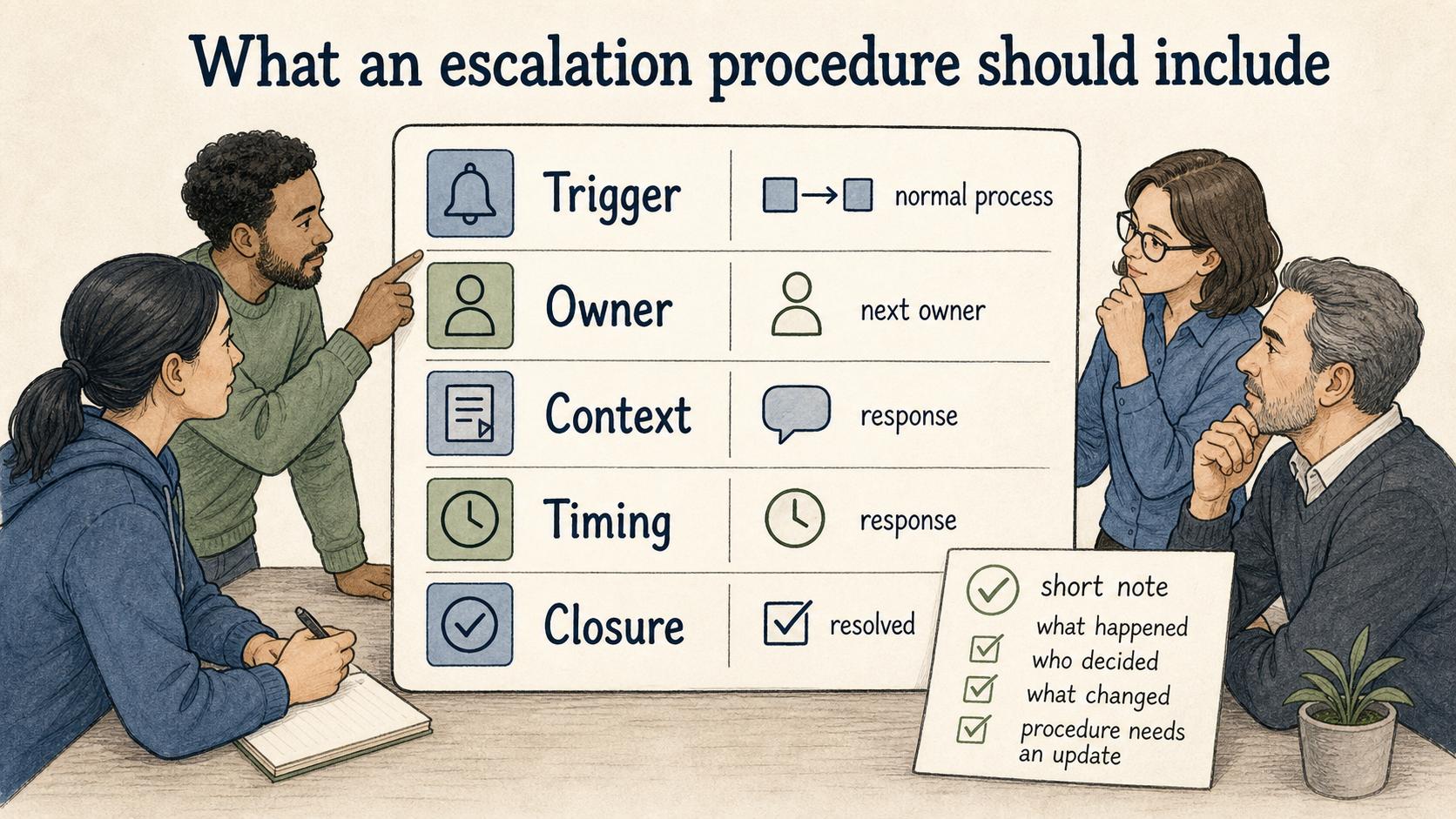
An escalation procedure should answer five practical questions:
- Trigger: What conditions mean the normal process is no longer enough?
- Owner: Who receives the escalation at each level?
- Context: What information must be included so the next owner can act?
- Timing: How quickly should the escalation happen, and how fast should the next owner respond?
- Closure: Who confirms the issue is resolved and updates the record?
The closure rule is easy to overlook. Without it, teams escalate issues but never learn from them. A resolved escalation should usually leave behind a short note: what happened, who decided, what changed, and whether the procedure needs an update.
Escalation levels example
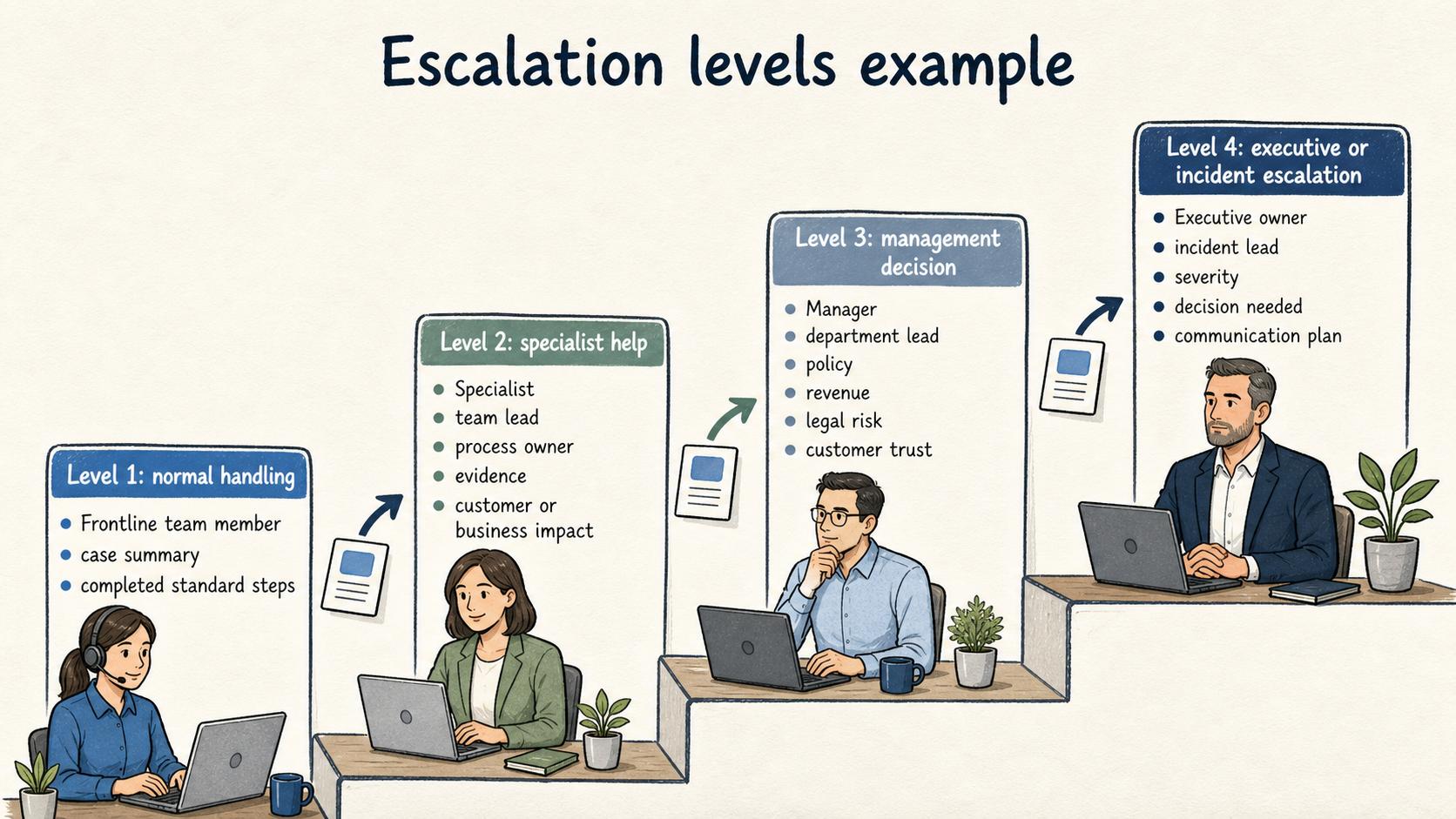
| Level | Use when | Owner | Required context |
|---|---|---|---|
| Level 1: normal handling | The issue fits documented guidance and has no unusual risk | Frontline team member | Case summary and completed standard steps |
| Level 2: specialist help | The issue is technically complex, unclear, or outside normal authority | Specialist, team lead, or process owner | What was tried, evidence, customer or business impact |
| Level 3: management decision | The issue affects policy, revenue, legal risk, customer trust, or cross-team priorities | Manager or department lead | Recommendation, tradeoffs, deadline, impacted stakeholders |
| Level 4: executive or incident escalation | The issue threatens major customer, financial, security, or operational outcomes | Executive owner or incident lead | Current state, severity, decision needed, communication plan |
Customize the levels to the team. A small support team may only need two. A regulated operations team may need more detail around audit trails, approvals, or customer communication.
Escalation procedure vs escalation matrix
An escalation matrix usually shows who should be contacted at each level. An escalation procedure explains the workflow around that contact.
The matrix is useful for quick routing. The procedure prevents weak handoffs. It should say what qualifies for escalation, what information is required, how to communicate urgency, and what happens after the issue is resolved. ITIL-style incident guidance distinguishes functional escalation to specialists from hierarchical escalation to higher authority, which is why routing and decision rights both matter. 4
If a team has only an escalation matrix, people may know who to call but still disagree about when to call them. If a team has only a written procedure with no names or roles, people may understand the concept but lose time finding the right owner. Most teams need both.
How to document an escalation procedure
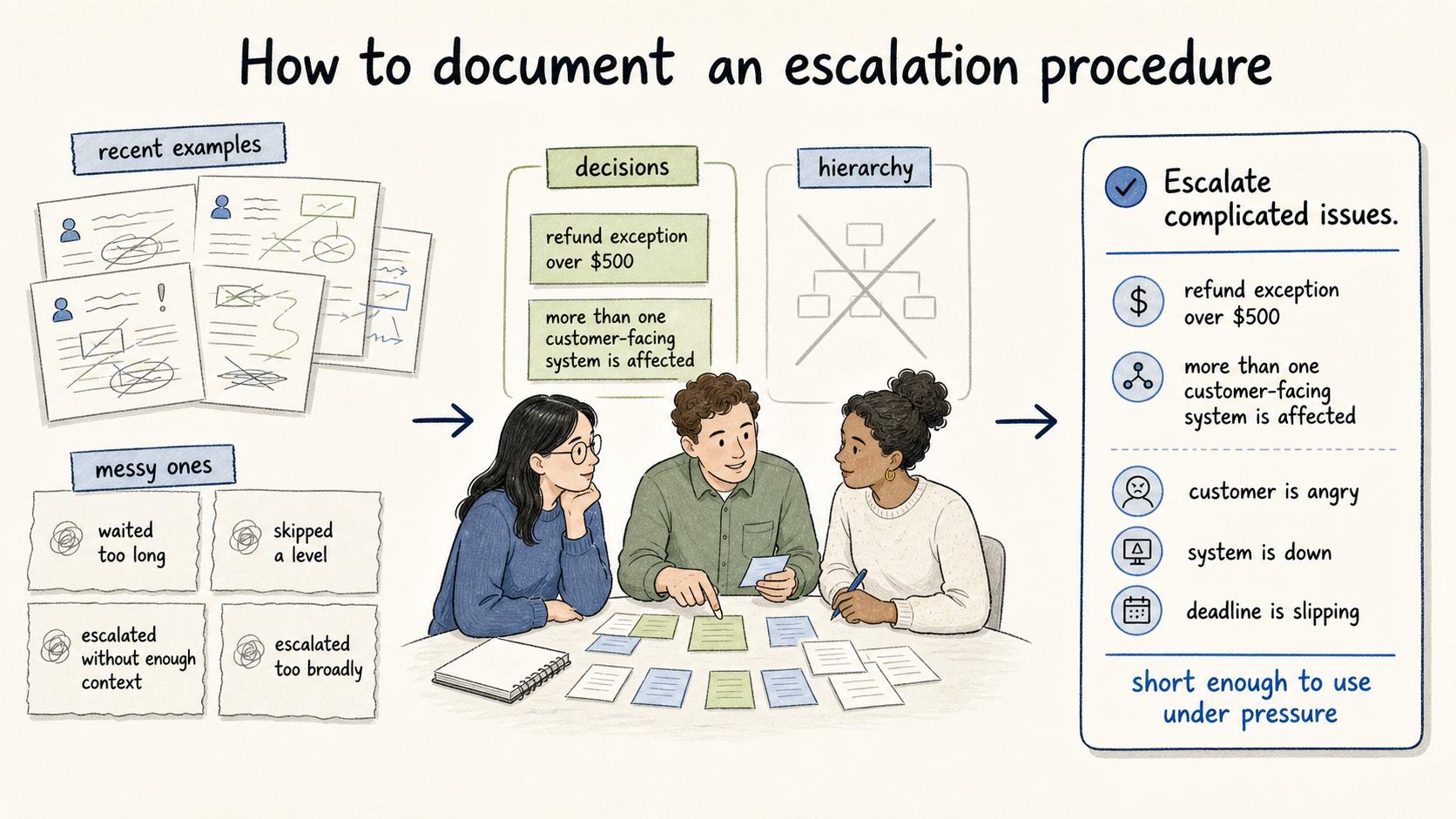
Start with recent examples, especially messy ones. Look for cases where someone waited too long, skipped a level, escalated without enough context, or escalated too broadly. These examples reveal the real trigger points better than a generic brainstorming session.
Then write the procedure around decisions, not hierarchy. A useful trigger sounds like "Escalate to the support lead when the customer asks for a refund exception over $500" or "Escalate to incident command when more than one customer-facing system is affected." A weak trigger sounds like "Escalate complicated issues."
Keep the procedure short enough to use under pressure. Escalation documents often fail because they are written for perfect training conditions, not for the moment when a customer is angry, a system is down, or a deadline is slipping.
Common mistakes
The biggest mistake is making escalation feel like failure. If employees think escalation means they did something wrong, they will delay it. The procedure should make escalation a normal part of responsible ownership.
Another mistake is allowing side-channel escalations to become the real process. Private messages and hallway decisions may solve one problem quickly, but they leave no record for the next person. If urgent issues must start in Slack, email, or a call, the procedure should still require a follow-up note in the system of record.
Finally, avoid escalation paths with no decision rights. If the next owner can only sympathize but cannot approve, reject, prioritize, or assign resources, the escalation will just move frustration to a new person.
How Trails helps
Trails can help teams capture an escalation workflow as someone performs it, then turn that workflow into a polished step-by-step guide. That is useful for procedures that involve multiple systems, screenshots, or decision points.
A documented escalation procedure can also be shared as training material. Trails can create an AI-narrated video version, giving new hires a clearer sense of what to do when the normal process no longer applies.
See how teams document support and escalation workflows, giving agents a guide to the system steps alongside the escalation rules.
FAQ
What is an escalation procedure in customer support?
In customer support, an escalation procedure tells agents when an issue needs a specialist, manager, engineering partner, or leadership decision, and what context must be included in the handoff.
What is the difference between escalation and handoff?
A handoff moves work from one person or team to another. Escalation moves work upward or outward because the normal owner lacks the authority, information, urgency level, or expertise to resolve it.
Who should own an escalation procedure?
The process owner should own the procedure, but the people who use it should help test it. If frontline teams cannot apply the triggers quickly, the procedure needs refinement.
Sources
- 1
Atlassian. Escalation policies for incident management. www.atlassian.com/incident-management/on-call/escalation-policies.
- 2
NIST. SP 800-61 Rev. 3, Incident Response Recommendations and Considerations. csrc.nist.gov/pubs/sp/800/61/r3/final.
- 3
Zendesk. 6 keys to a successful ticket escalation process. www.zendesk.com/blog/customer-service/support/6-keys-ticket-escalation/.
- 4
Matrix42. ITIL incident management terminology. www.matrix42.com/en/incident-management.