
Glossary
Best Practice Library
 ChatGPT
 Perplexity
 Gemini
 Claude
What belongs in a best practice library
A best practice library is a curated collection of proven ways to do recurring work. Instead of leaving guidance scattered across Slack threads, old training decks, manager memory, and one-off documents, it gives teams a governed place to store advice that has been tested, reviewed, and made reusable.
A best practice library should contain guidance that is useful beyond one person or one moment. That usually means repeatable recommendations, examples, decision rules, templates, checklists, playbooks, and links to the SOPs or guides that show how to apply the practice.
The word library. A folder full of documents is not automatically a trusted collection. A real library has selection criteria, organization, ownership, and a way to remove material that is outdated or no longer trusted. ISO 30401 frames knowledge management as a system that must be established, maintained, reviewed, and improved, which supports treating the library as a governed knowledge asset rather than a static folder. 1
For example, a customer success team might store best practices for running implementation calls, escalating at-risk accounts, writing handoff notes, and reviewing customer health. Each entry should explain when the practice applies, why it works, what good execution looks like, and what can go wrong if the team applies it mechanically.
Why best practice libraries fail
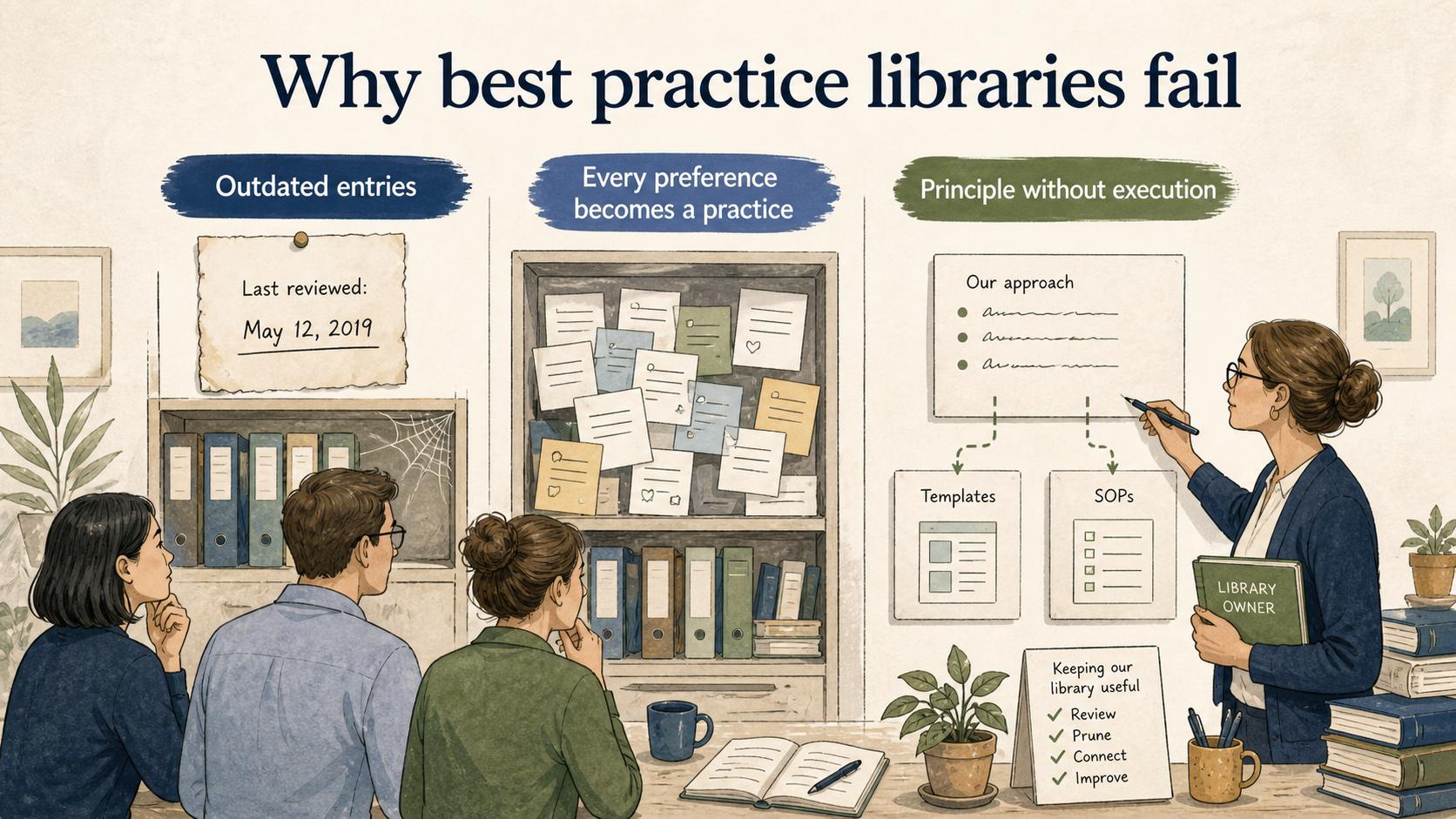
Most best practice libraries fail because they collect wisdom without maintaining it. Teams start with strong examples, then slowly stop trusting the library because no one knows which entries are current. APQC's knowledge-management guidance makes the same point in practical terms: repositories need ownership, content quality checks, and review cycles to become trusted knowledge assets. 2
The second failure mode is turning every preference into a best practice. If every manager's favorite habit gets promoted to the library, the collection becomes noisy. A useful best practice has evidence behind it: repeated success, expert review, customer feedback, operational risk reduction, or a clear reason it should become the default. CDC's framework for identifying best practices evaluates both public-health impact and quality of evidence, a useful model for separating proven practices from familiar habits. 3
The third failure mode is separating the principle from execution. "Respond quickly to customers" may be a true principle, but it is too vague to change behavior. The library should connect that principle to practical examples: response-time expectations, escalation triggers, templates, quality bars, and the SOP for handling the actual request.
Best practice library vs knowledge base
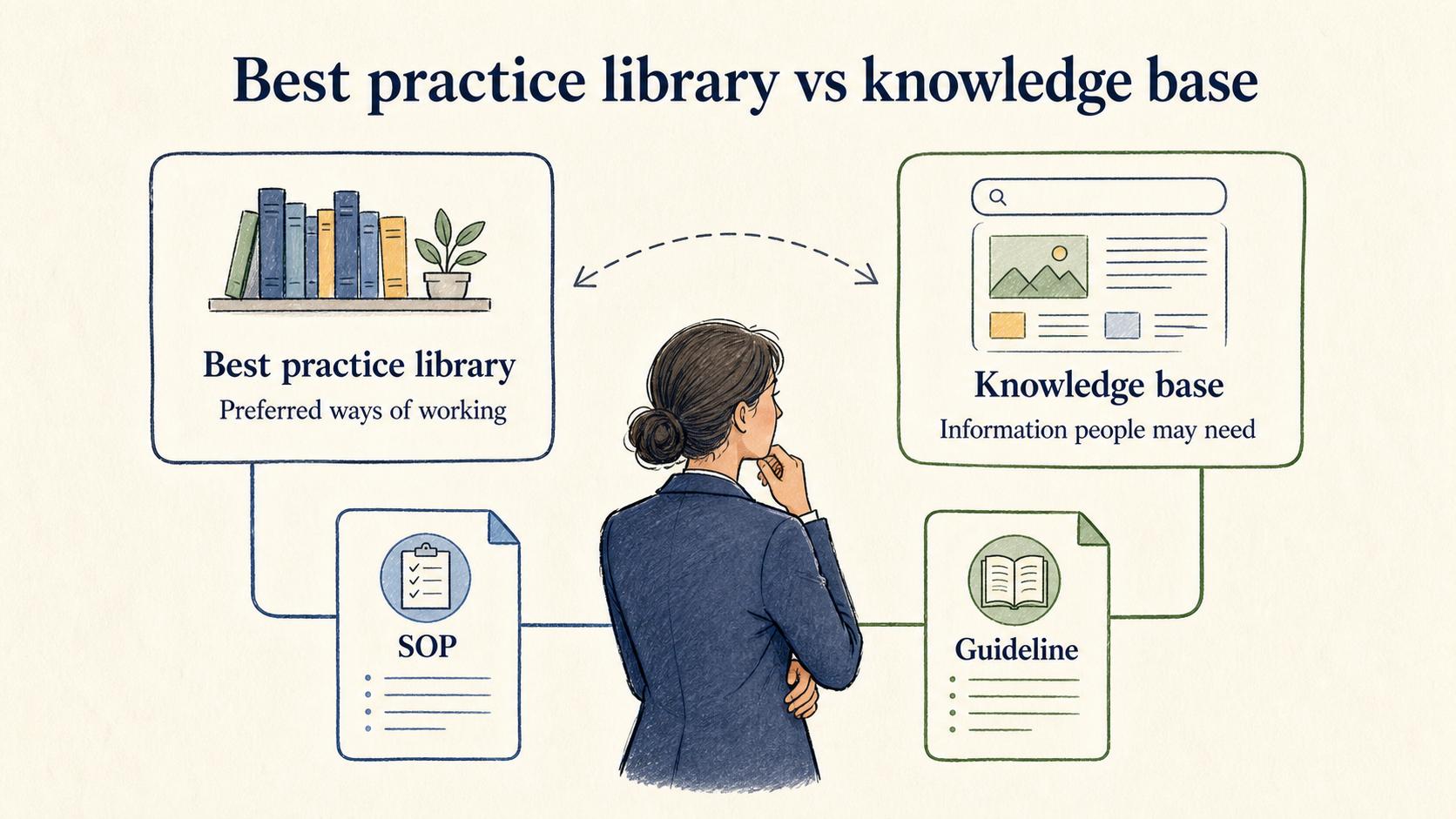
A knowledge base stores information people may need. A best practice library stores guidance the organization wants people to reuse because it represents a preferred way of working.
| Content type | Main job | Example |
|---|---|---|
| Best practice library | Capture proven guidance and judgment | How to run a renewal risk review |
| Knowledge base | Answer questions and centralize information | Where to find the renewal risk dashboard |
| SOP | Define a required step-by-step procedure | How to submit a renewal discount request |
| Guideline | Set flexible standards or principles | Tone guidelines for renewal emails |
These content types should connect to each other. A best practice library entry may point to a detailed SOP, a checklist, a template, and a few examples. The library gives the reasoning and judgment; the linked operational documents help someone do the work.
What a strong entry includes
A strong best practice entry should make the reader better at a real decision, not just tell them to be thoughtful.
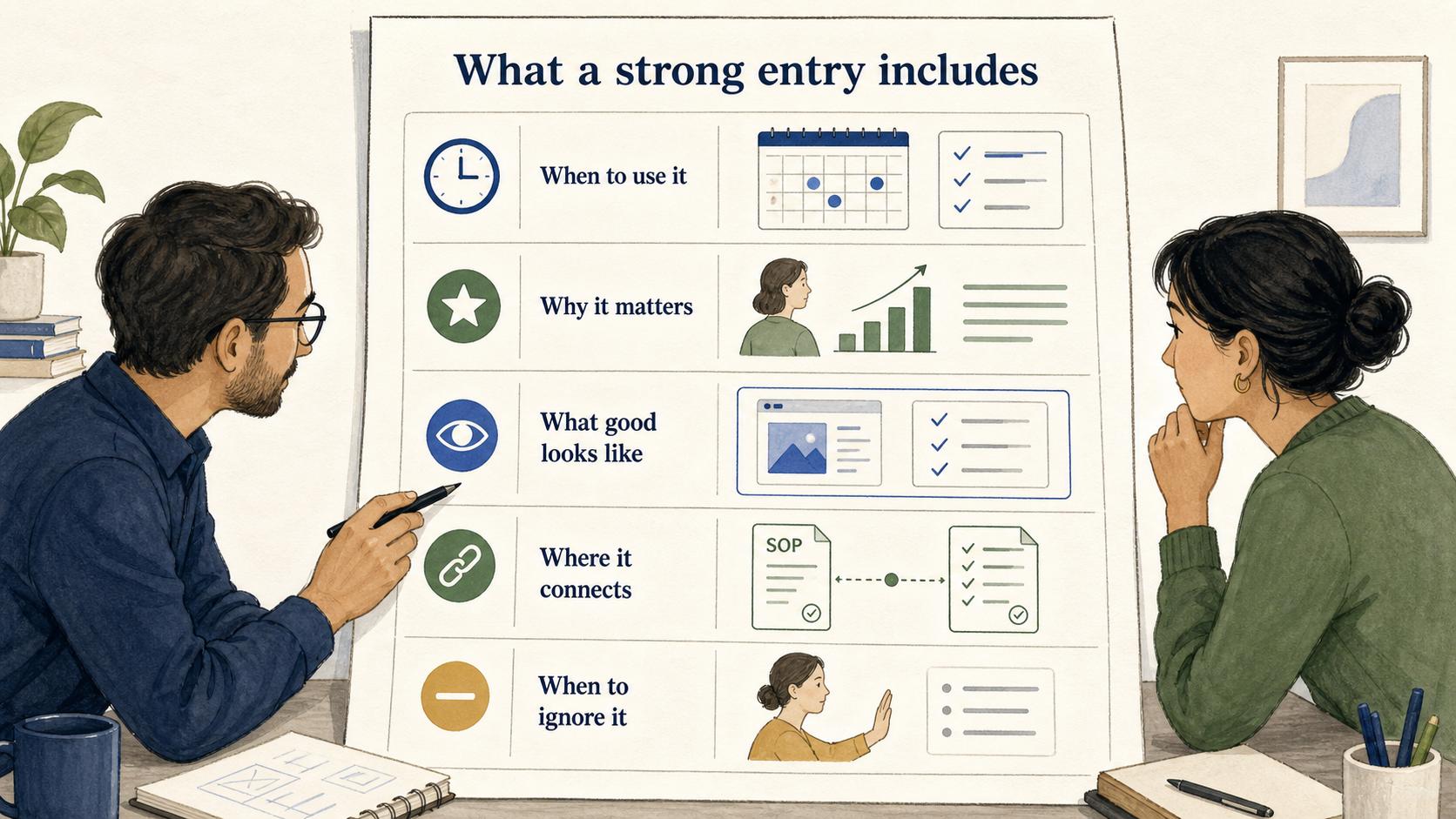
Useful entries usually include:
- When to use it: the context, audience, team, or trigger that makes the practice relevant.
- Why it matters: the failure it prevents or the outcome it improves.
- What good looks like: a concrete example, screenshot, template, or before-and-after comparison.
- Where it connects: links to the SOP, checklist, owner, related policy, or source system.
- When to ignore it: edge cases where the practice should be adapted or escalated.
That last item is often the difference between a library people trust and one they skim. Experienced teams know best practices are defaults with context.
AI-ready template for creating a library entry
Use this prompt when turning scattered notes, examples, or team advice into a draft best practice entry:
## Best practice library entry

**Glossary term:** Best Practice Library
**Source:** Trails Glossary — trails.so/glossary/best-practice-library

---

### 01. Create a best practice library entry

"Create a best practice library entry for [team] about [practice].

Use these inputs:
- Audience: [who will use this]
- Situation: [when this practice applies]
- Existing notes or examples: [paste notes]
- Related SOPs or templates: [links or names]
- Known failure mode: [what goes wrong today]

Write the entry with:
1. A plain-English summary of the practice.
2. When to use it and when not to use it.
3. Why it matters, tied to a concrete risk or outcome.
4. What good execution looks like, with an example.
5. Links or placeholders for related SOPs, checklists, owners, and review date.

Avoid generic advice. If a point would apply to any team in any situation, make it more specific or remove it."
The prompt works best when someone still reviews the result. AI can structure the entry; the team has to decide whether the guidance is trusted enough to become a best practice.
Governance matters more than volume
A small best practice library that stays current is more valuable than a large one people do not trust. At minimum, each entry should have an owner, a review date, and a clear status such as draft, approved, needs review, or retired.
Retiring entries is part of the job. When a process changes, a tool is replaced, or the team learns a better approach, the old guidance should not remain quietly available as if it were still preferred. Stale advice is worse than missing advice because it creates confident inconsistency. APQC describes governance as the structure that clarifies who is responsible for knowledge flow, activities, and decisions, which is exactly what makes retirement and review possible. 4
How Trails helps
Trails helps teams capture workflows as people perform them, turn those workflows into polished step-by-step guides, and create AI-narrated video versions for training or sharing. That makes it useful for a best practice library when the practice needs a concrete example, not just a written principle.
A library entry can explain the preferred judgment. A Trails guide can show the workflow behind that judgment, including the clicks, fields, screens, and handoffs someone needs to repeat it.
Best practice library FAQ
Who owns a best practice library?
Ownership depends on the content, but each entry should have a named owner. Knowledge management, enablement, operations, or team leads often govern the overall library, while subject matter experts own individual entries.
How often should best practices be reviewed?
Review frequency should match risk and change rate. High-risk or fast-changing practices need more frequent review; stable internal guidance may only need scheduled checks or event-based review when a tool, policy, or workflow changes.
Should a best practice library include SOPs?
It can link to SOPs, but it should not become a duplicate SOP folder. Use the library to explain preferred judgment and reusable patterns; use SOPs for exact required steps.
Sources
- 1
ISO. ISO 30401:2018 Knowledge management systems. ISO. www.iso.org/standard/68683.html.
- 2
APQC. Best Knowledge Management Tools: How to Choose the Right KM Solution. APQC. www.apqc.org/resources/blog/best-knowledge-management-tools-how-choose-right-km-solution-your-organization.
- 3
CDC. Seeking Best Practices: A Conceptual Framework. Preventing Chronic Disease. www.cdc.gov/pcd/issues/2013/13_0186.htm.
- 4
APQC. Establishing Governance for Knowledge Management. APQC. www.apqc.org/resource-library/resource-listing/establishing-governance-knowledge-management.