
Glossary
Best Practice
 ChatGPT
 Perplexity
 Gemini
 Claude
What makes something a best practice
A best practice is a recommended way to do work because it has produced reliable results in a specific context. It gives people a strong default, explains when that default applies, and leaves room for judgment when the situation changes.
A best practice earns its name by being tested in real work. It may come from repeated team experience, expert review, customer feedback, process improvement work, or a pattern that consistently prevents mistakes. The key is that the practice has a reason behind it. CDC's best-practice framework evaluates both impact and quality of evidence, which is a useful standard for deciding whether a practice is proven enough to recommend. 1
For example, "always confirm the customer's goal before troubleshooting" can be a best practice for support teams because it prevents agents from solving the wrong problem. The advice becomes useful when the team defines what confirmation looks like, where it happens in the workflow, and what exceptions exist.
A weak best practice sounds good. A useful one changes behavior.
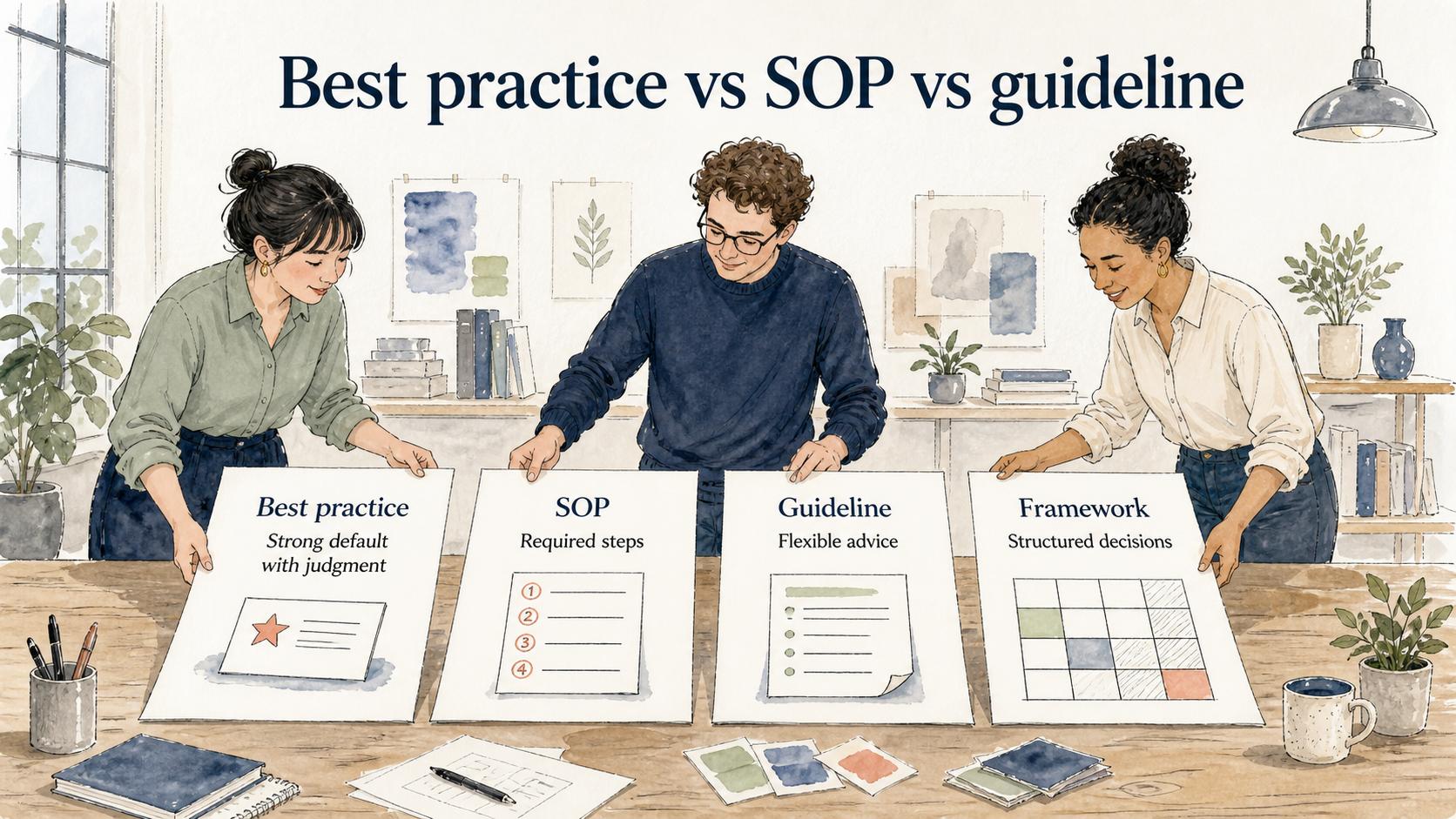
Best practice vs SOP vs guideline
Teams often use these terms interchangeably, but they do different jobs.
| Term | What it means | When to use it |
|---|---|---|
| Best practice | A preferred approach that usually works well in a defined context | When people need judgment and a strong default |
| SOP | A required step-by-step procedure | When consistency, compliance, or handoff reliability matters |
| Guideline | Flexible advice or principles | When teams need direction but not rigid steps |
| Framework | A structured way to think or decide | When the problem has multiple variables or tradeoffs |
A best practice can point to an SOP, but it should not pretend to be one. If every step must happen in a specific order, write a standard operating procedure. If the team needs a judgment rule, examples, and context, document it as a best practice.
Why best practices need context
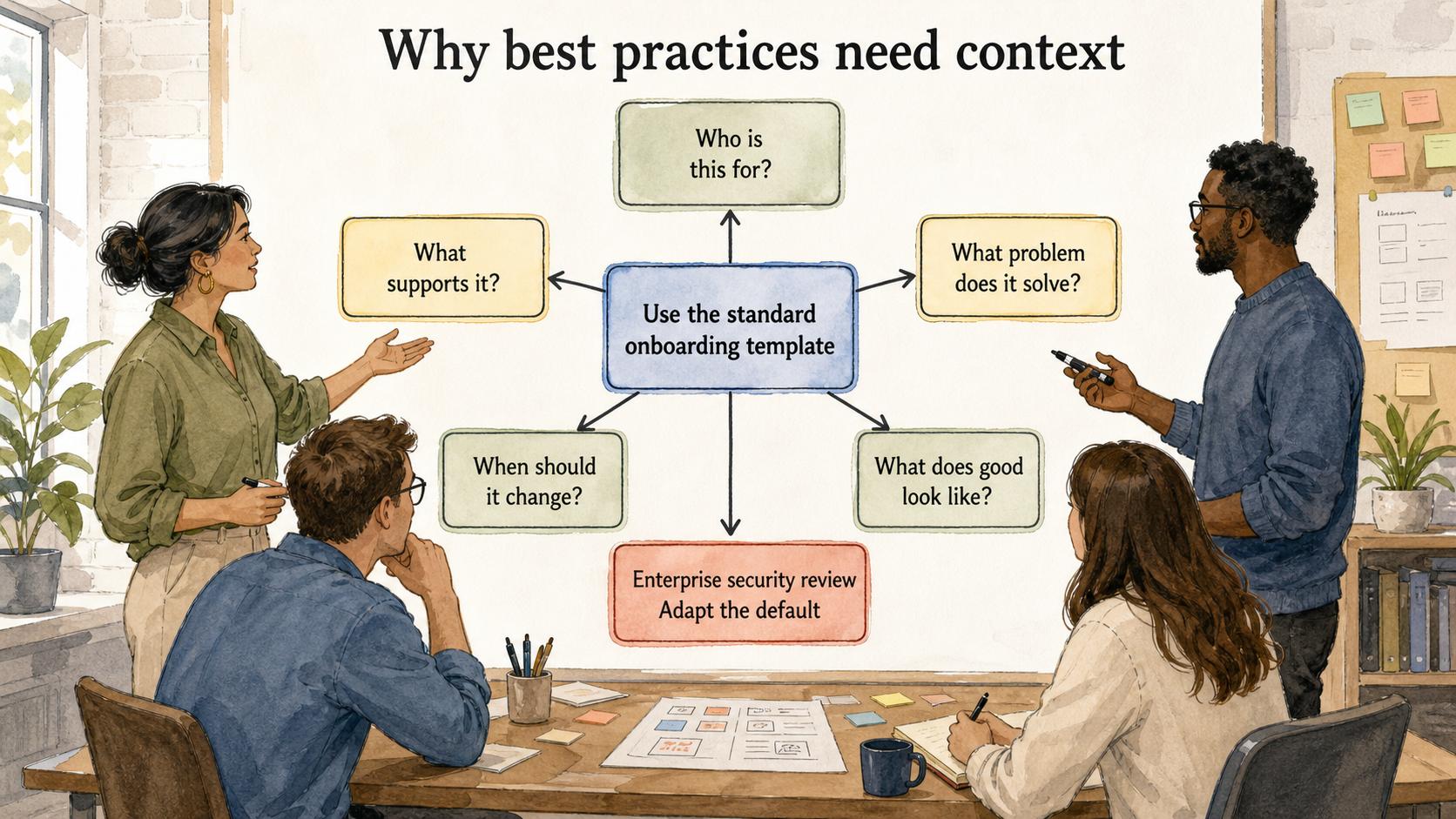
The phrase "best practice" can create false confidence. Something that works for one team, customer segment, tool, or risk level may fail somewhere else. Good documentation names the context instead of hiding it. AHRQ describes evidence-based practice as combining the best available knowledge with practitioner expertise and reassessment, which reinforces that context and judgment are part of using evidence well. 2
A strong best practice should answer:
- Who is this for?
- What problem does it solve?
- What evidence or experience supports it?
- When should someone adapt it or escalate?
- What does good execution look like?
The most useful part is often the exception. If the practice says, "Use the standard onboarding template," the real expertise may be, "Do not use it for enterprise customers with custom security reviews." That kind of caveat saves people from applying the default blindly.
Examples of best practices at work
In customer support, a best practice might be to summarize the customer's issue before giving instructions. That improves clarity and gives the customer a chance to correct the agent before time is wasted.
In operations, a best practice might be to document a process while the work is being performed instead of days later from memory. The hidden value is accuracy: the person captures the actual screens, decisions, and handoffs instead of reconstructing an idealized version.
In onboarding, a best practice might be to pair a written guide with a short video for tasks that are hard to understand from text alone. The tradeoff is maintenance. Video can help, but it gets stale quickly if the product changes, so the team needs an owner and review cadence. ISO 30401's knowledge-management standard emphasizes maintaining, reviewing, and improving knowledge-management systems, which supports ongoing ownership rather than one-time documentation. 3
These examples work because each practice is tied to a problem, a workflow, and a consequence.
How to document a best practice
Documenting a best practice should feel closer to explaining judgment than filling out a checklist. The entry should make a capable person faster and more consistent without removing their ability to think.
A practical structure is:
- Name the practice in plain language.
- Explain the situation where it applies.
- Describe the failure mode it prevents.
- Show one concrete example of good execution.
- Link to the SOP, checklist, template, or guide that helps someone apply it.
- Add an owner and review trigger.
Do not bury the judgment in a long list of generic instructions. If the entry mostly says "communicate clearly," "review regularly," or "follow up," it needs more context. What should someone communicate? What should they look for during review? What happens if they do not follow up?
Common mistakes
The first mistake is treating best practices as permanent. Work changes, tools change, customers change, and the advice needs to be reviewed. Stale guidance can be worse than missing guidance because people follow it with confidence.
The second mistake is skipping ownership. If everyone can add practices but no one owns review, the collection becomes a junk drawer of half-trusted advice.
The third mistake is confusing popularity with proof. A practice may be common because it is easy, familiar, or copied from another team. Before promoting it, ask what problem it solves and whether the team can point to a better outcome. WHO's guideline-development handbook similarly treats evidence review and transparent methods as central to trustworthy recommendations, which is a useful reminder that recommendations need a defensible basis. 4
How Trails helps
Trails helps teams capture workflows as they perform them, turn those workflows into polished step-by-step guides, and create AI-narrated video versions for training or sharing. That helps turn a best practice from advice into something people can actually repeat.
For example, if the best practice is "document the handoff before closing a support escalation," a Trails guide can show the exact fields, examples, and sequence the team expects. The best practice explains the judgment; the guide shows the work.
Best practice FAQ
Is a best practice the same as a rule?
No. A best practice is usually a recommended default. A rule or SOP is mandatory. If people are allowed to adapt the approach based on context, call it a best practice or guideline rather than a required procedure.
Who decides what counts as a best practice?
The decision should come from a mix of subject matter expertise, operational evidence, and review. A team lead, process owner, enablement owner, or documentation owner may approve it, but the practice should be grounded in real work.
How often should best practices be updated?
Update them whenever the underlying process, tool, risk, or customer expectation changes. For stable practices, set a review cadence so the team confirms the advice still matches how work is actually done.
Sources
- 1
CDC. Seeking Best Practices: A Conceptual Framework. Preventing Chronic Disease. www.cdc.gov/pcd/issues/2013/13_0186.htm.
- 2
AHRQ. Evidence-Based Practice. Agency for Healthcare Research and Quality. www.ahrq.gov/topics/evidence-based-practice.html.
- 3
ISO. ISO 30401:2018 Knowledge management systems. ISO. www.iso.org/standard/68683.html.
- 4
WHO. WHO handbook for guideline development. World Health Organization. www.who.int/publications/i/item/9789241548960.