
Glossary
SOP Scope
 ChatGPT
 Perplexity
 Gemini
 Claude
What is SOP scope?
SOP scope is the part of a standard operating procedure that defines where the procedure applies and where it does not. It tells the reader which process, role, team, location, system, product, or situation the SOP covers, plus the point where another procedure, owner, or escalation path takes over.1
Scope matters because a procedure can be accurate and still be used in the wrong situation. If the boundary is vague, employees have to guess whether the SOP applies to the work in front of them.
Why SOP scope matters
Scope protects the reader from starting with the wrong document. Before someone follows steps, they need to know whether those steps were written for their case.
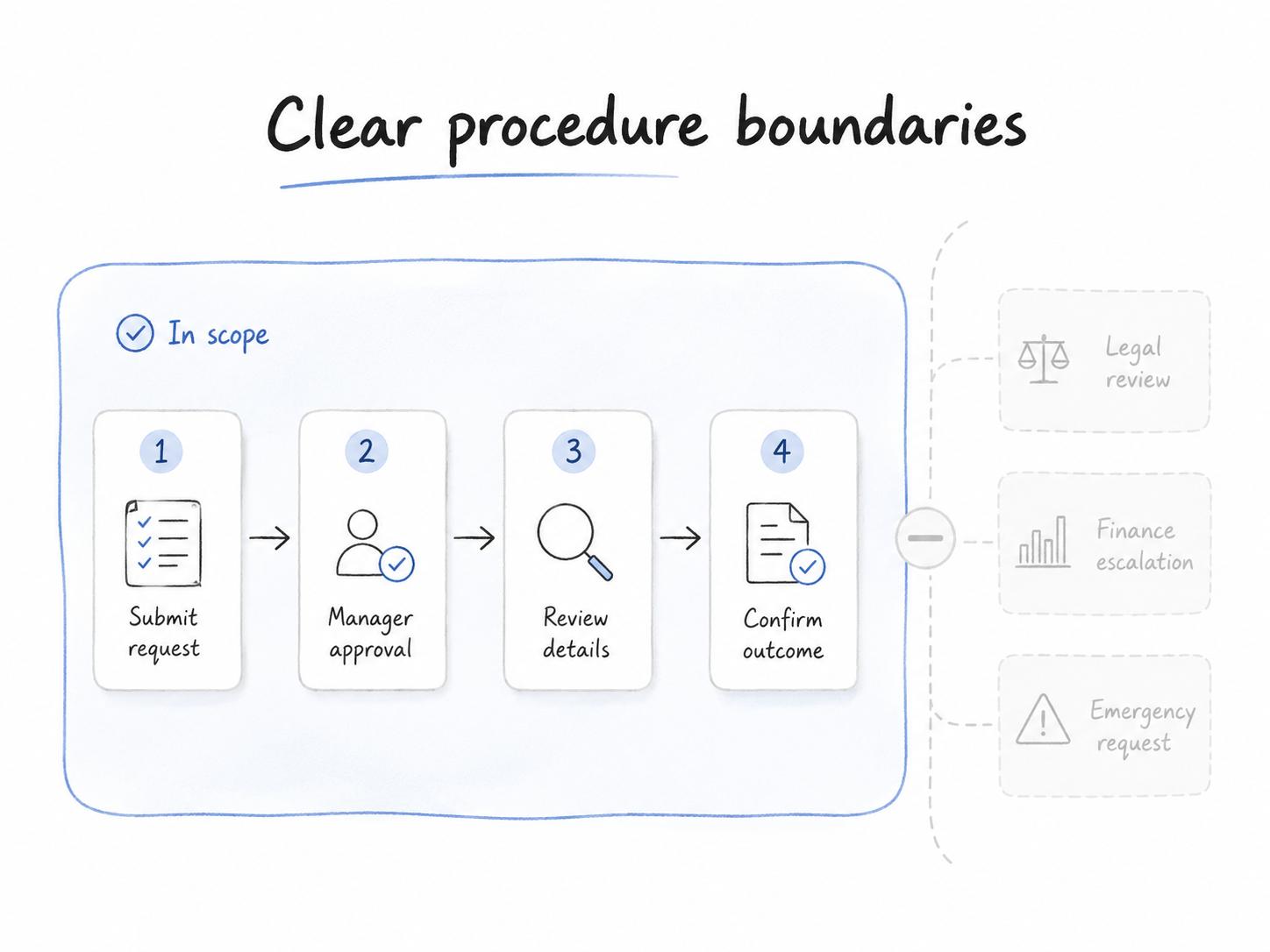
For example, a purchasing SOP might cover routine software purchases under a set dollar amount. It may exclude legal contracts, emergency purchases, capital equipment, vendor onboarding, and renewals that require finance approval. If the scope does not say that clearly, employees may use the SOP for work it was never meant to control.
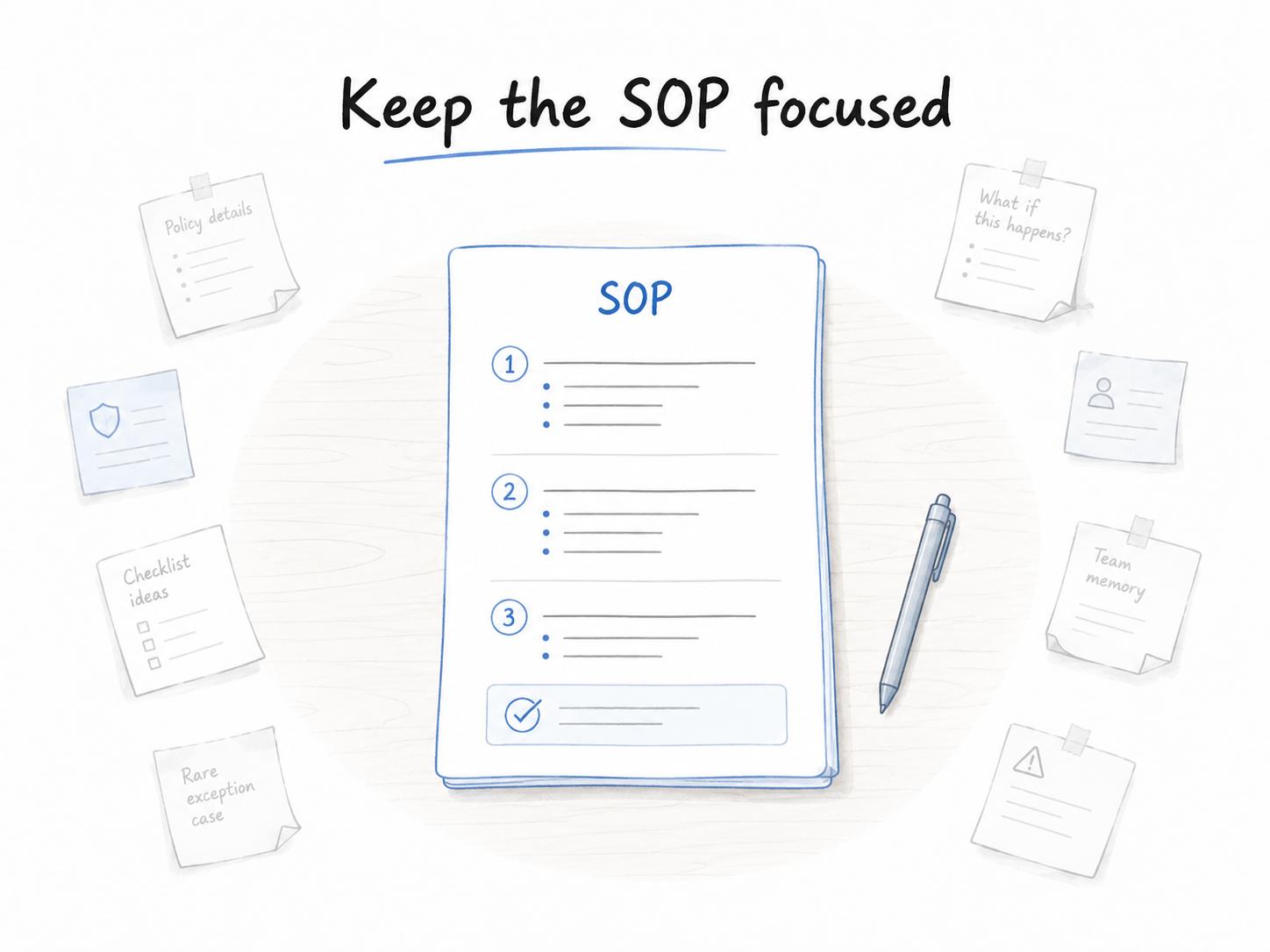
Scope also protects the SOP owner. A procedure with no boundary attracts every related edge case. Over time, it becomes part policy, part checklist, part exception log, and part team memory. That kind of SOP is hard to review and harder to trust.
What should an SOP scope include?
A useful scope statement answers five practical questions:
- What process or task does this SOP cover?
- Which roles, teams, locations, customers, systems, or business units does it apply to?
- What event starts the procedure?
- What outcome ends the procedure?
- What related work is explicitly excluded?
The start and end points are the details teams most often skip. "Refund processing" is too broad to guide a reader. "From receipt of a customer refund request through eligibility review, approval, payment processing, and customer notification" gives the procedure a usable boundary.
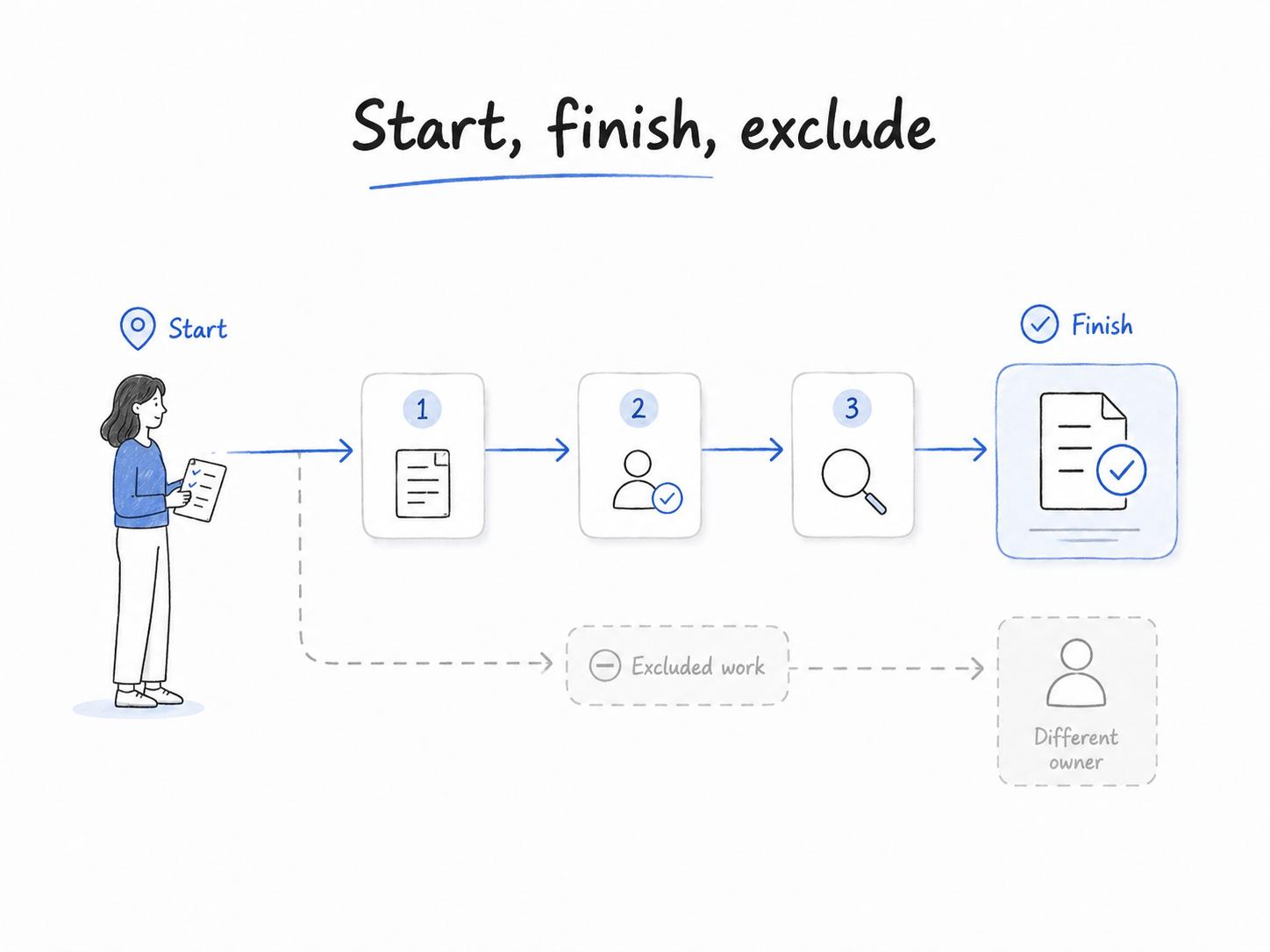
When the procedure changes by threshold, risk level, geography, tool, customer type, or approval path, include that in scope. ISO 9001 auditing guidance uses the same boundary logic for quality-management-system scope: define boundaries, applicability, and the products or services covered. Those details are how a reader decides whether the SOP is safe to use.2
SOP scope vs purpose vs procedure
Scope is easy to blur with the purpose or the procedure steps. Each section should do a different job.
| SOP element | Question it answers | Example |
|---|---|---|
| Purpose | Why does this SOP exist? | To handle customer refunds consistently and reduce approval confusion |
| Scope | When and where does this SOP apply? | Applies to standard refund requests under $500 for active subscription customers |
| Procedure | What does the reader do? | Review request, confirm eligibility, get approval, process refund, notify customer |
| Exceptions | What happens when the normal path does not apply? | Escalate suspected fraud, chargebacks, enterprise contract exceptions, or refunds above $500 |
Purpose explains the reason. Scope sets the boundary. Procedure explains the work. Exceptions tell the reader what to do when the boundary is crossed.
How to write a clear SOP scope statement
The best scope statements are short, specific, and testable. A reader should be able to compare the statement against a real case and decide whether to keep going.
## SOP Scope Statement Template

**Glossary term:** SOP Scope
**Source:** Trails Glossary — trails.so/glossary/sop-scope

---

### 01. Scope statement structure

"This SOP applies to [process or task] performed by [role or team] for [business unit, customer type, location, system, or product], beginning when [starting trigger] and ending when [final outcome]. It excludes [related work not covered], which is handled by [other SOP, owner, or escalation path]."

### 02. Example

"This SOP applies to standard customer refund requests handled by the Support team for active self-serve subscription customers, beginning when a refund request is received and ending when the refund decision is logged and communicated to the customer. It excludes chargebacks, suspected fraud, enterprise contract exceptions, and refunds above $500, which are handled by the Finance escalation process."
The most useful word in that template is excludes. Exclusions remove ambiguity before it becomes a mistake.
Common SOP scope mistakes
One mistake is writing the scope after the steps are already finished. By then, the SOP may have absorbed too much work. Write the scope early, then use it to decide which steps belong in the document.
Another mistake is using broad phrases like "all related activities." That sounds comprehensive, but it pushes judgment onto the reader. If the SOP applies only to one team, system, region, customer type, product line, approval threshold, or risk level, say so directly.
A third mistake is hiding handoffs. SOPs often fail at the edges: when Support sends something to Finance, when Operations waits on Legal, when a manager approves a deviation, or when one tool becomes the source of truth. FDA's CDER SOP guidance treats SOPs as one documentation form among alternatives, which is a useful reminder to define where one document stops and another control or owner takes over.3
Documentation takeaway
Define the scope before polishing the steps. The scope tells you what the procedure must cover, what it can safely leave out, and which related procedures should be linked instead of folded into one sprawling document.
A strong scope statement gives the reader a decision rule: use this SOP here, stop here, and switch paths when this no longer applies.
How Trails helps
Trails helps teams capture real workflows and turn them into polished step-by-step guides.
That makes SOP scope easier to see because the team can inspect where the work actually begins, where it ends, which handoffs occur, and which exceptions deserve separate documentation.
- Standard operating procedure
- SOP meaning in business
- SOP vs work instruction
- Work instruction
- Procedure vs process
- Process owner
Sources
- 1
U.S. Environmental Protection Agency. Guidance for Preparing Standard Operating Procedures. EPA. www.epa.gov/quality/guidance-preparing-standard-operating-procedures. Accessed July 6, 2026.
- 2
ISO 9001 Auditing Practices Group. Guidance on Scope and Applicability. International Organization for Standardization. committee.iso.org/files/live/sites/tc176/files/documents/ISO%209001%20Auditing%20Practices%20Group%20docs/Auditing%20to%20ISO%209001%202015/APG-Scope_and_Applicability_Ver2_2020-02.pdf. Accessed July 6, 2026.
- 3
U.S. Food and Drug Administration. Developing and Maintaining Standard Operating Procedures. FDA CDER. www.fda.gov/media/90280/download. Accessed July 6, 2026.