
Glossary
Meeting SOP
 ChatGPT
 Perplexity
 Gemini
 Claude
What is a meeting SOP?
A meeting SOP is a standard operating procedure that explains how a recurring meeting should be prepared, run, documented, and followed up.1 It sets the meeting's purpose, owner, participants, agenda process, decision rules, note-taking expectations, and action-item handoff.
Most meetings don't need that much structure. A meeting SOP is useful when a recurring meeting produces decisions, approvals, customer handoffs, incident reviews, work assignments, or other follow-up that has to survive beyond the conversation.
Why a meeting SOP matters
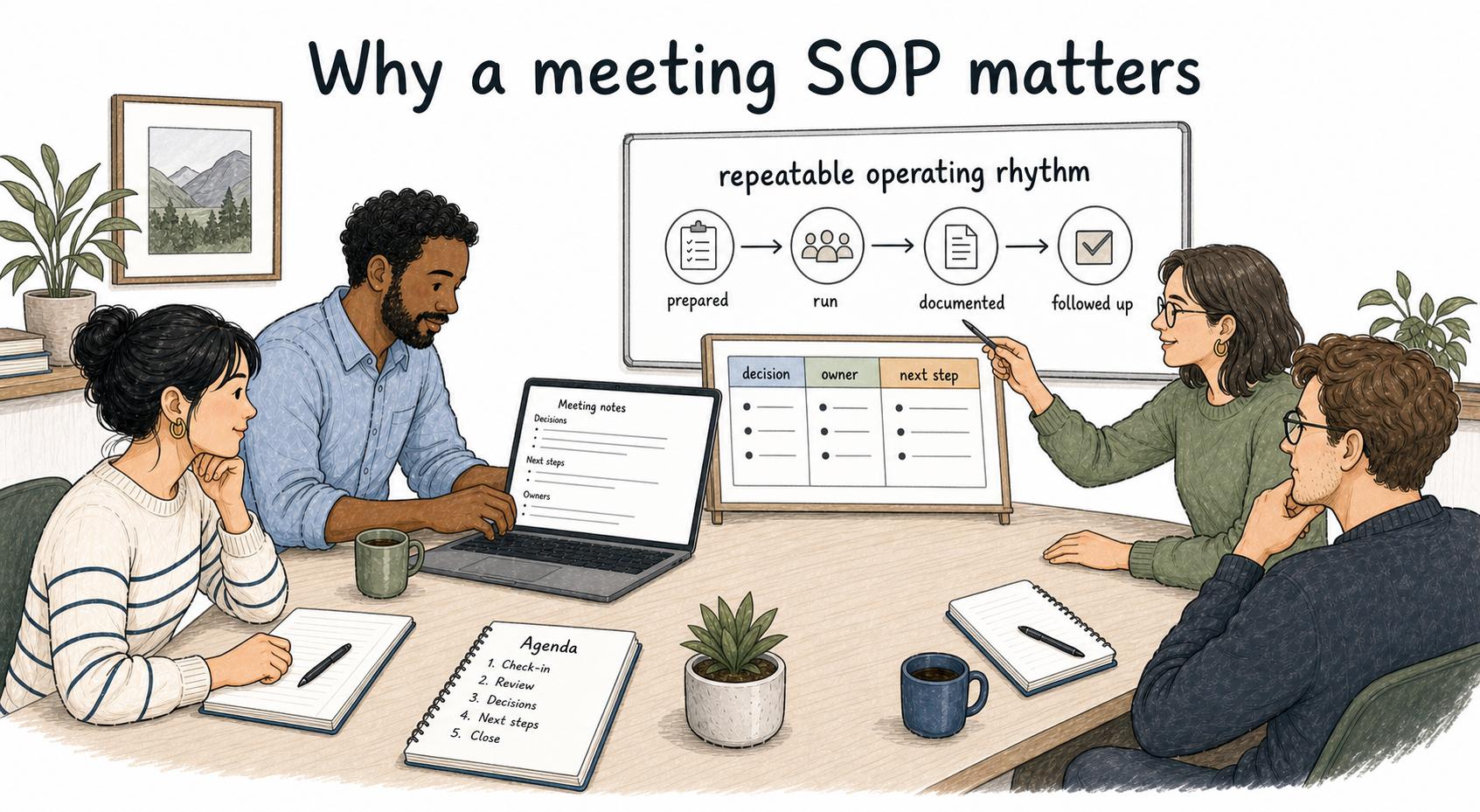
Recurring meetings often become undocumented processes.2 The calendar invite says when people show up, but it rarely says what good preparation looks like, who can make decisions, or where outcomes go after the call ends.
A meeting SOP turns the meeting into a repeatable operating rhythm. It gives a new manager, rotating facilitator, or backup owner enough structure to run the session without copying someone else's habits from memory.
The value isn't formality. It's preventing the familiar pattern where everyone leaves a meeting feeling aligned, then no one can find the decision, owner, or next step a week later.
When a meeting needs an SOP
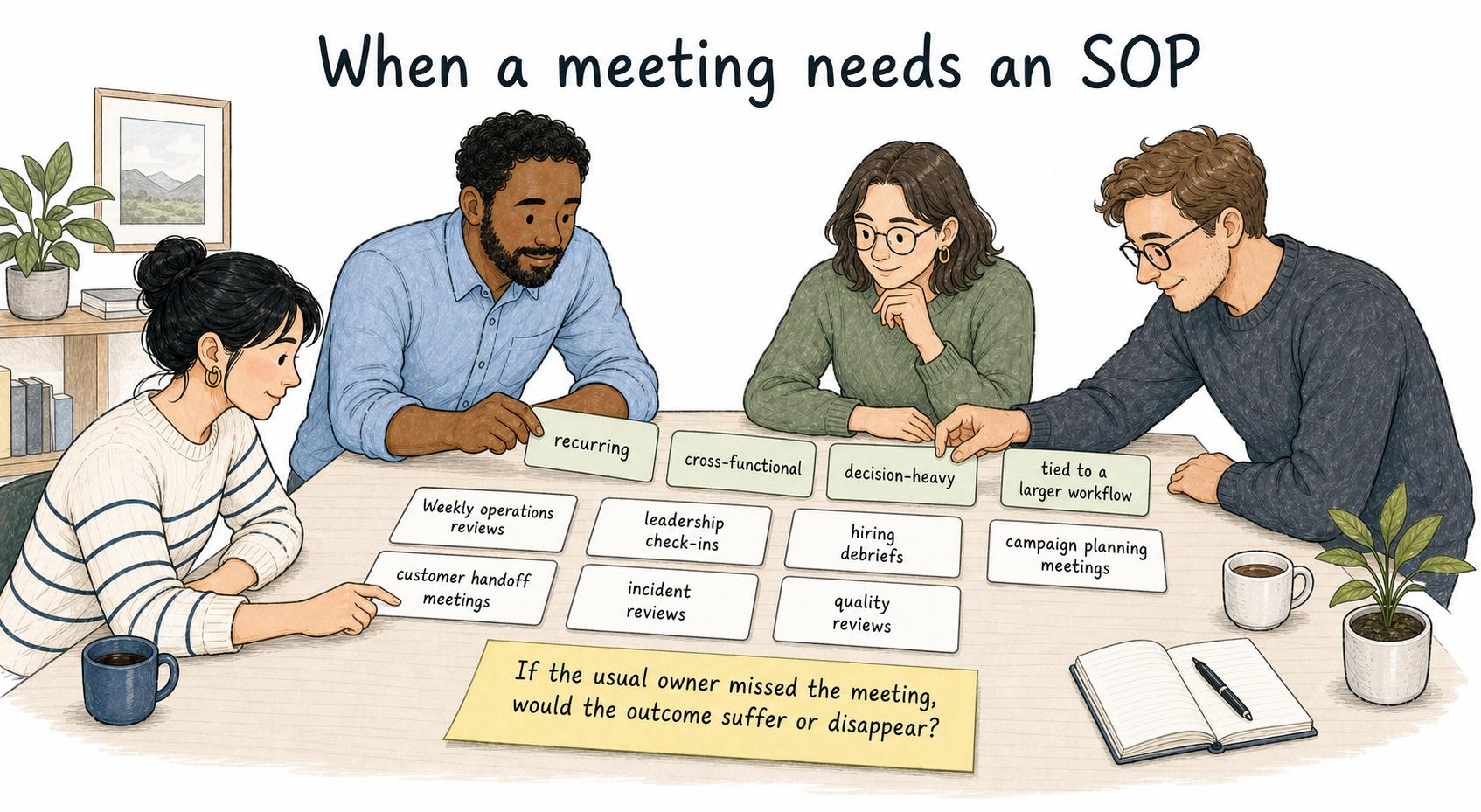
A meeting usually deserves an SOP when it is recurring, cross-functional, decision-heavy, or tied to a larger workflow. Weekly operations reviews, customer handoff meetings, leadership check-ins, incident reviews, hiring debriefs, quality reviews, and campaign planning meetings are common examples.
A casual one-on-one or temporary project sync usually doesn't need one. An agenda template is enough when the meeting has no durable handoff, recurring decision path, or shared record requirement.
Use a simple test: if the usual owner missed the meeting, would the outcome suffer or disappear? If yes, document the process. If no, keep the guidance lighter.
What to include in a meeting SOP
A practical meeting SOP should answer the questions that create inconsistency:
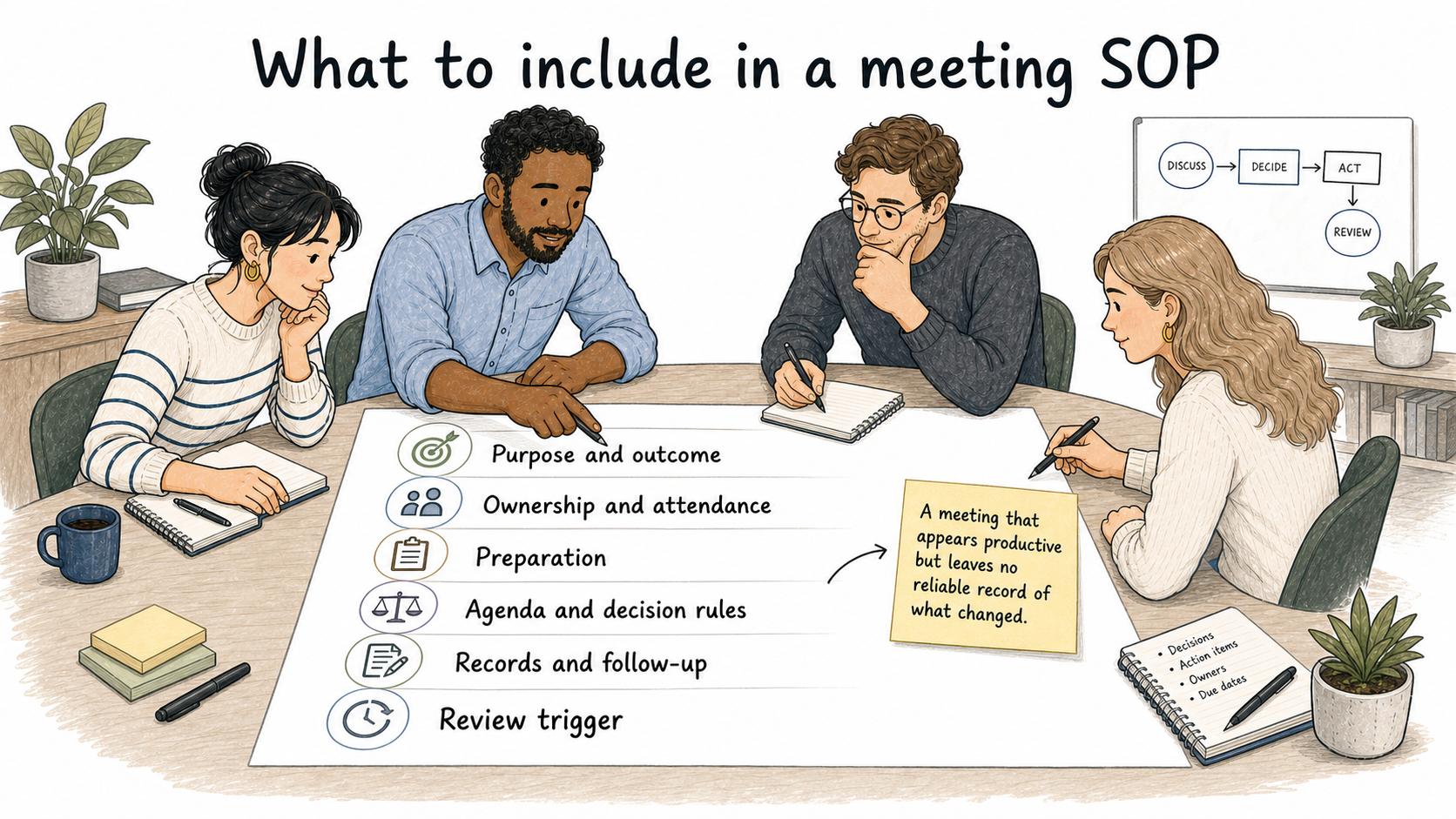
- Purpose and outcome: Why the meeting exists and what should be true when it ends.
- Ownership and attendance: Which role owns the meeting, who must attend, and who should join only for specific topics.
- Preparation: What needs to be updated, reviewed, or submitted before the meeting starts.
- Agenda and decision rules: Who manages the agenda, when it closes, and how decisions are made, deferred, escalated, or documented.
- Records and follow-up: Where decisions, risks, owners, due dates, and action items are captured.3
- Review trigger: When the team should change, shorten, or retire the meeting.
The hidden failure mode isn't a missing agenda. It's a meeting that appears productive but leaves no reliable record of what changed.
Meeting SOP vs agenda vs meeting notes
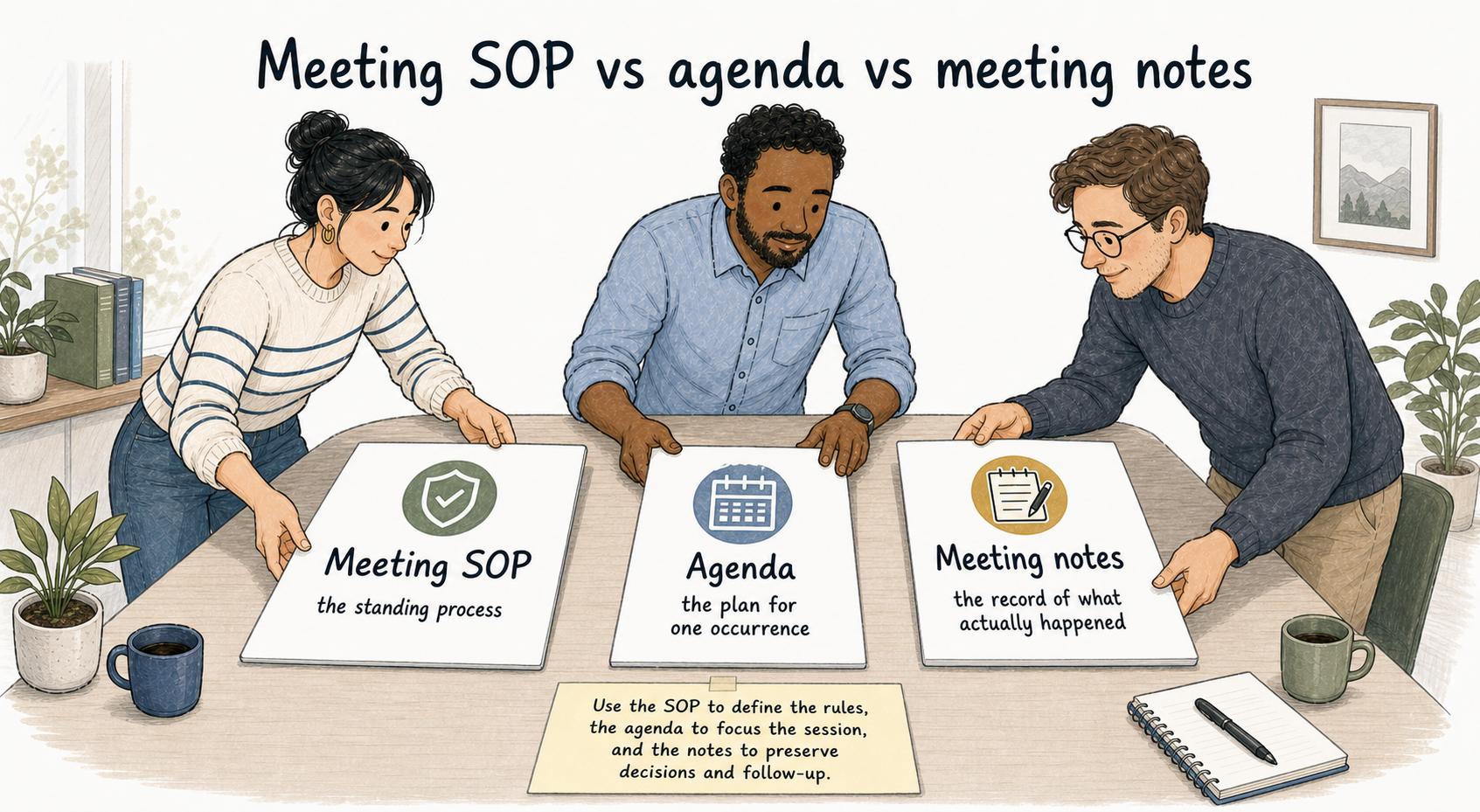
A meeting SOP is the standing process. An agenda is the plan for one occurrence of the meeting. Meeting notes are the record of what actually happened.
That distinction keeps each document useful. The SOP shouldn't list this week's topics. The agenda shouldn't re-explain the whole operating model. The notes shouldn't become the only place where the team learns how decisions are supposed to be made.
Use the SOP to define the rules, the agenda to focus the session, and the notes to preserve decisions and follow-up.4
AI-ready meeting SOP template
Use this prompt when you want a first draft that is specific enough to edit, not a generic meeting policy:
## Meeting SOP Template

**Glossary term:** Meeting SOP
**Source:** Trails Glossary — trails.so/glossary/meeting-sop

---

### 01. Create a meeting SOP

"Create a meeting SOP for [meeting name] used by [team or department].

Purpose: [why the meeting exists]
Cadence: [weekly, monthly, ad hoc, etc.]
Owner: [role responsible for the meeting]
Participants: [required and optional attendees]
Inputs: [reports, metrics, customer issues, project updates, or decisions needed]
Outputs: [decisions, action items, approvals, risks, notes, or next steps]

Include:
1. When the meeting happens and when it should be canceled.
2. What the owner and participants prepare before the meeting.
3. A simple agenda structure.
4. How decisions are recorded.
5. How action items get owners and due dates.
6. Where notes and records are stored.
7. How often the meeting should be reviewed for usefulness.

Keep the SOP practical, concise, and easy for a backup facilitator to follow."
After the draft exists, edit it against a real recent meeting. If the SOP can't explain what happened in practice, it's still too abstract.
Common mistakes
The most common mistake is documenting the meeting's schedule instead of its operating behavior. A useful SOP isn't a decorated calendar invite. It should make decisions, ownership, and follow-up harder to lose.
Another mistake is assigning the meeting to a person instead of a role. People change jobs, take leave, and switch teams. Role-based ownership makes the SOP more durable.
The third mistake is keeping notes in private documents. If decisions affect the team, the record needs to live somewhere the team can find later.
How Trails helps
Trails helps teams capture repeatable workflows as someone performs them and turn those workflows into polished step-by-step guides. For meetings, that can mean documenting how a team prepares the agenda, runs the session, captures decisions, and follows up on action items.
When the meeting is part of a broader operating process, Trails can help make the handoff clear enough for new managers, backup facilitators, and cross-functional partners to follow.
Sources
- 1
The Permanente Journal. Planning and Leading Effective Meetings. PubMed Central. pmc.ncbi.nlm.nih.gov/articles/PMC6743516/. Accessed July 24, 2026.
- 2
Harvard Business Review. Stop the Meeting Madness. Harvard Business Review. hbr.org/2017/07/stop-the-meeting-madness. Accessed July 24, 2026.
- 3
Atlassian. Meeting minutes template. Atlassian. www.atlassian.com/software/confluence/templates/meeting-notes. Accessed July 24, 2026.
- 4
UC Berkeley BPMO. Making the Most of Your Meetings: Agendas and Action Items. University of California, Berkeley. bpmoportal.berkeley.edu/making-most-your-meetings-agendas-and-action-items. Accessed July 24, 2026.