
Glossary
Knowledge Mapping
 ChatGPT
 Perplexity
 Gemini
 Claude
What is knowledge mapping?
Knowledge mapping shows where important knowledge lives, who holds it, how it moves, and where it is missing. It connects experts, systems, process steps, decisions, handoffs, and weak spots so a team can see the knowledge behind the work instead of treating it as a loose pile of documents. 1
For operations, support, onboarding, and knowledge management teams, a useful map changes priorities. It tells the team what to document next, who needs to be involved, and where too much operational risk still lives in one person's head.
Why knowledge mapping matters
Most teams do not lose knowledge all at once. They lose it through small fractures: a support workaround only one person knows, an onboarding step that changed but never made it into the handbook, or a process dependency hidden inside a spreadsheet no one owns.
Knowledge mapping exposes those weak spots before they become expensive. A good map can show that a critical workflow depends on one senior employee, that two teams maintain conflicting answers to the same question, or that the official documentation covers the policy but not the judgment people actually use. 2
Treat a knowledge map as a risk map for how the team gets work done. If it does not change what you document, train, or assign ownership to, it is probably too decorative.
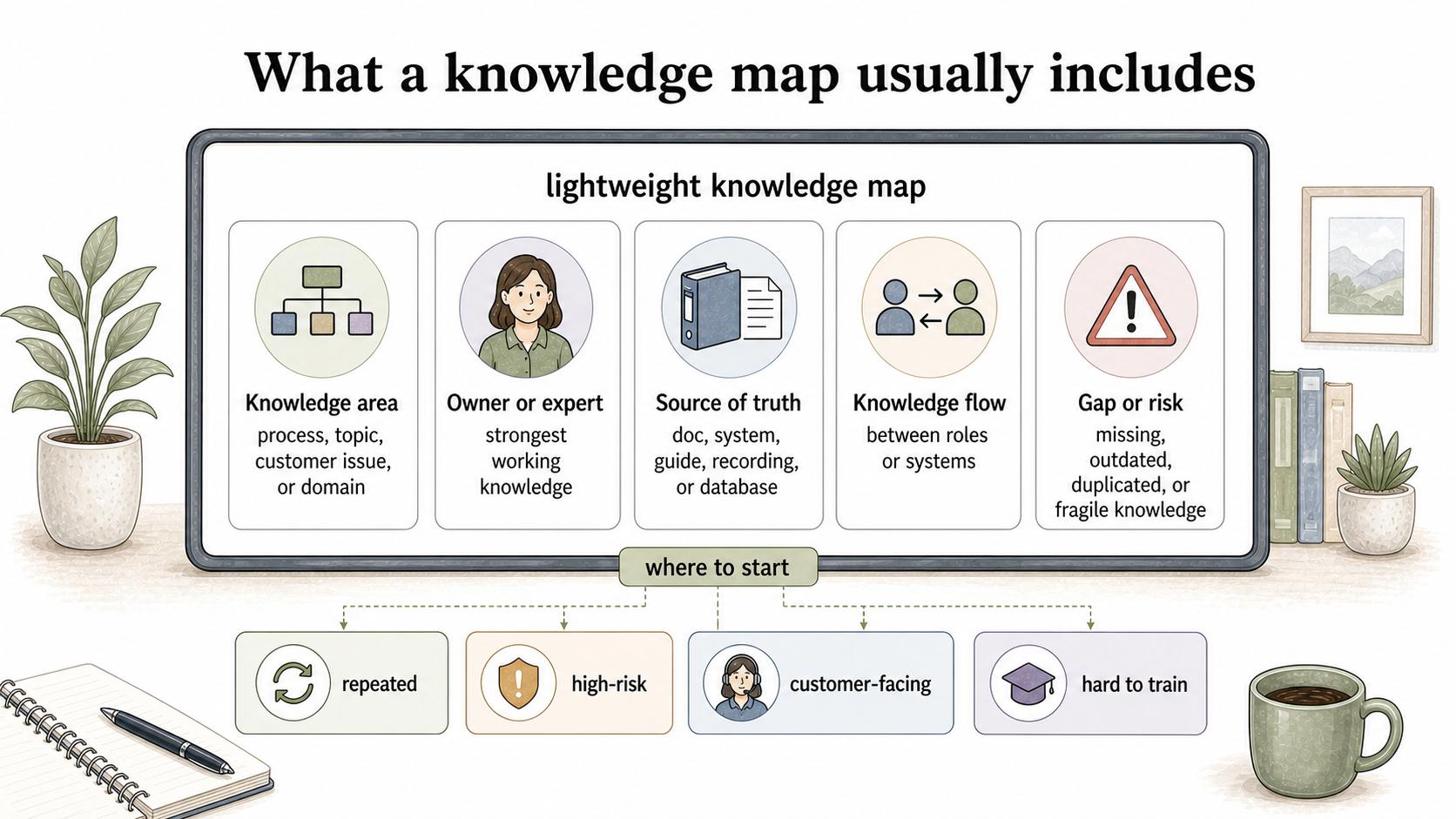
What a knowledge map usually includes
A knowledge map can be lightweight. It should capture enough structure to answer practical questions, not every file, channel, or decision the team has ever touched.
| Map element | What it shows | Why it matters |
|---|---|---|
| Knowledge area | The process, topic, customer issue, or domain being mapped | Keeps the map scoped enough to act on |
| Owner or expert | The person or team with the strongest working knowledge | Reveals dependency on specific people |
| Source of truth | The doc, system, guide, recording, or database people should use | Separates official knowledge from informal memory |
| Knowledge flow | How information moves between roles or systems | Shows where handoffs break down |
| Gap or risk | Missing, outdated, duplicated, or fragile knowledge | Turns the map into a prioritization tool |
The common mistake is waiting until the map feels complete. Start with work that is repeated, high-risk, customer-facing, or hard to train.
How knowledge mapping works in practice
A practical knowledge mapping exercise starts with a narrow operational question: What does a new support hire need to know to resolve billing issues? Or: What knowledge would we lose if our implementation lead left tomorrow?
From there, the team identifies the people, artifacts, and systems involved. The strongest signal usually comes from where people actually go for answers, not where the official process says they should go.
Next, the team marks the quality of each knowledge source. Is it current, trusted, accessible, and understandable without the expert nearby? Those questions turn vague knowledge concerns into concrete work. 3
Knowledge mapping vs process mapping
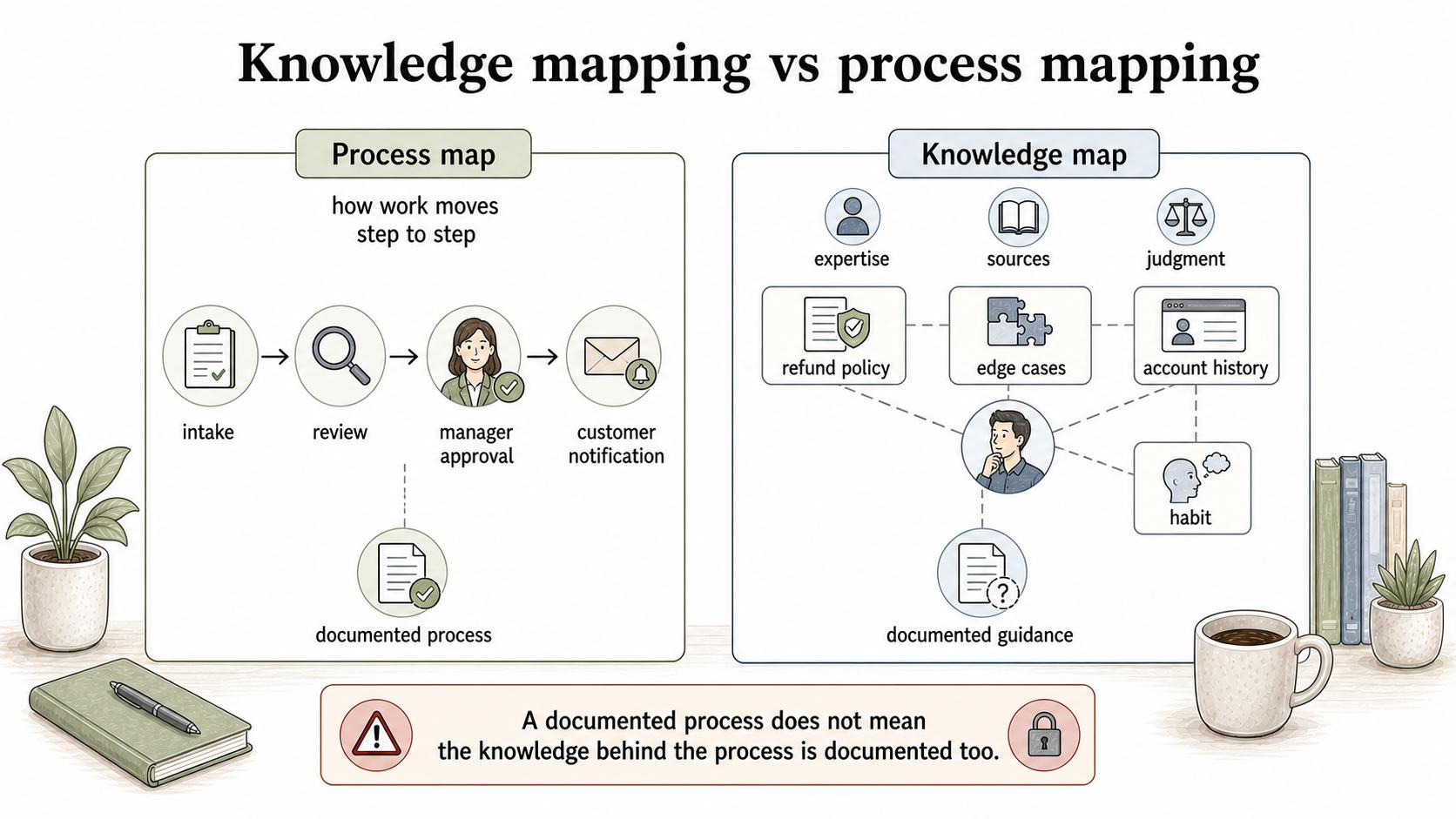
Knowledge mapping and process mapping overlap, but they diagnose different parts of the work. A process map shows how work moves from step to step. A knowledge map shows the expertise, sources, and judgment people need to run that sequence well. 4
For example, a process map for refund approvals might show intake, review, manager approval, and customer notification. A knowledge map would show where the refund policy lives, who understands edge cases, which system contains account history, and which decisions are still made from habit instead of documented guidance.
How to use knowledge mapping for documentation
Knowledge mapping is most valuable when it creates a shorter, sharper documentation backlog. Instead of asking what should we document, ask which knowledge risks are hurting onboarding, support quality, handoffs, or continuity.
Capture the expert workflow while the expert performs it, turn scattered answers into one source of truth, and document the judgment behind exceptions. The map should also name an owner for each high-risk knowledge area.
How Trails helps
Trails helps when a knowledge map points to a workflow that needs to be captured and shared. A team member can perform the workflow once, and Trails turns it into a polished step-by-step guide with an AI-narrated video version for training, onboarding, or repeated handoffs.
- Knowledge manager
- Knowledge management
- Knowledge management system
- Knowledge gap
Sources
- 1
APQC. Identify and Map Critical Knowledge. www.apqc.org/expertise/knowledge-management/knowledge-identification-mapping.
- 2
APQC. Why Knowledge Mapping Is Your KM Superpower. www.apqc.org/resources/blog/why-knowledge-mapping-your-km-superpower.
- 3
EU CAP Network. Knowledge mapping. eu-cap-network.ec.europa.eu/training/evaluation-learning-portal/knowledge-mapping_en.
- 4
NCCMT. Knowledge mapping to identify gaps in knowledge translation. www.nccmt.ca/knowledge-repositories/search/102.