
Glossary
Knowledge Bottleneck
 ChatGPT
 Perplexity
 Gemini
 Claude
What is a knowledge bottleneck?
A knowledge bottleneck happens when important information, expertise, or decision context is stuck with too few people or in too few places. Work slows because others have to wait for the person, document, or system that holds the answer. 1
A normal process delay is about flow. A knowledge bottleneck is about access to understanding: progress still depends on someone knowing how something works, why a decision was made, or what to do in an edge case.
Why knowledge bottlenecks matter
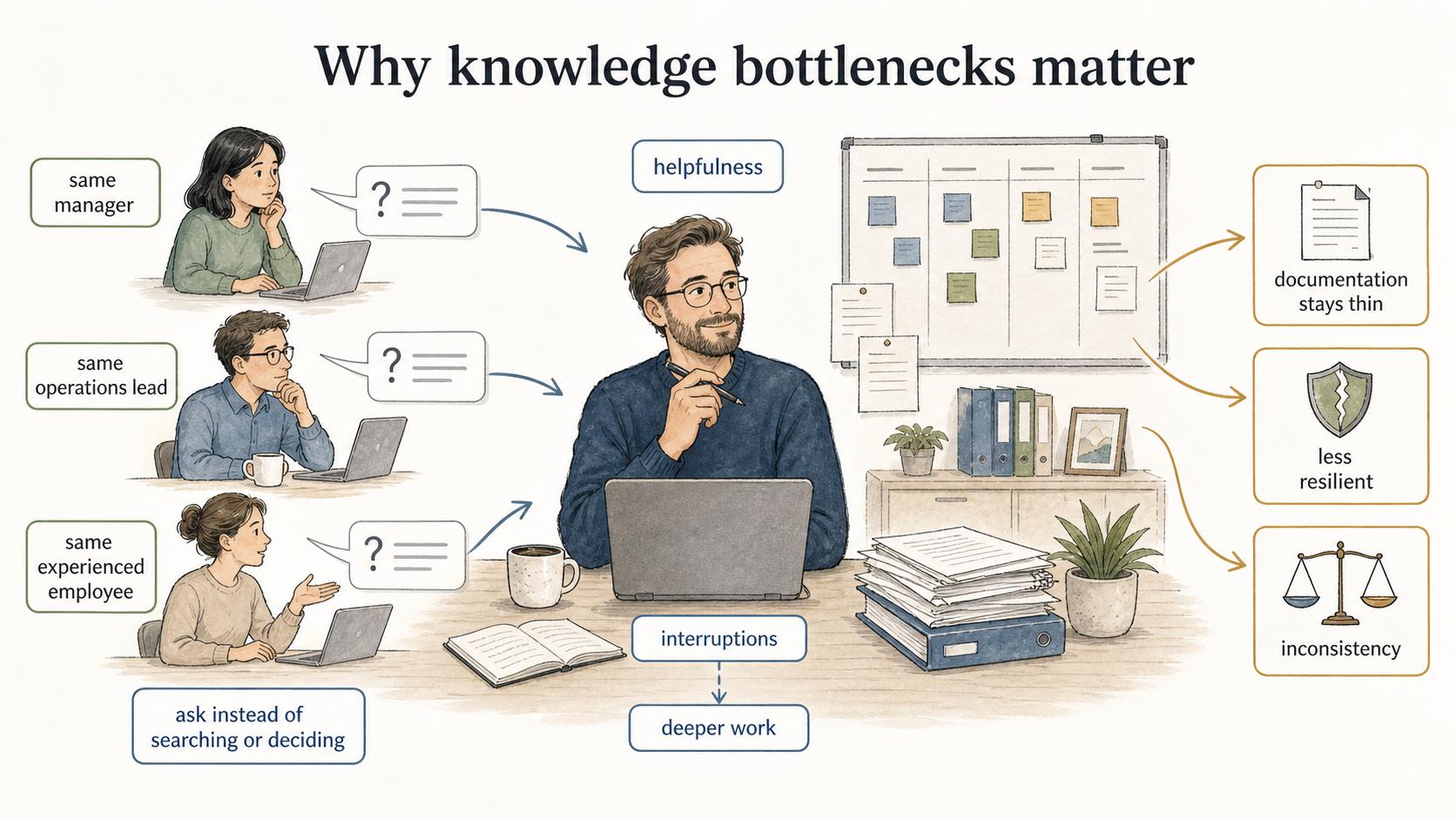
Knowledge bottlenecks often look like helpfulness. The same experienced employee answers every tricky customer question, the same manager remembers why the workflow changed, and the same operations lead knows which spreadsheet is safe to use. The work keeps moving, but one person absorbs the interruptions. 2
The expert gets pulled away from deeper work, newer teammates learn to ask instead of searching or deciding, and documentation stays thin because the answer feels available. If the expert is out, leaves, or gets too busy, the team discovers the process was less resilient than it looked. 3
How to recognize a knowledge bottleneck
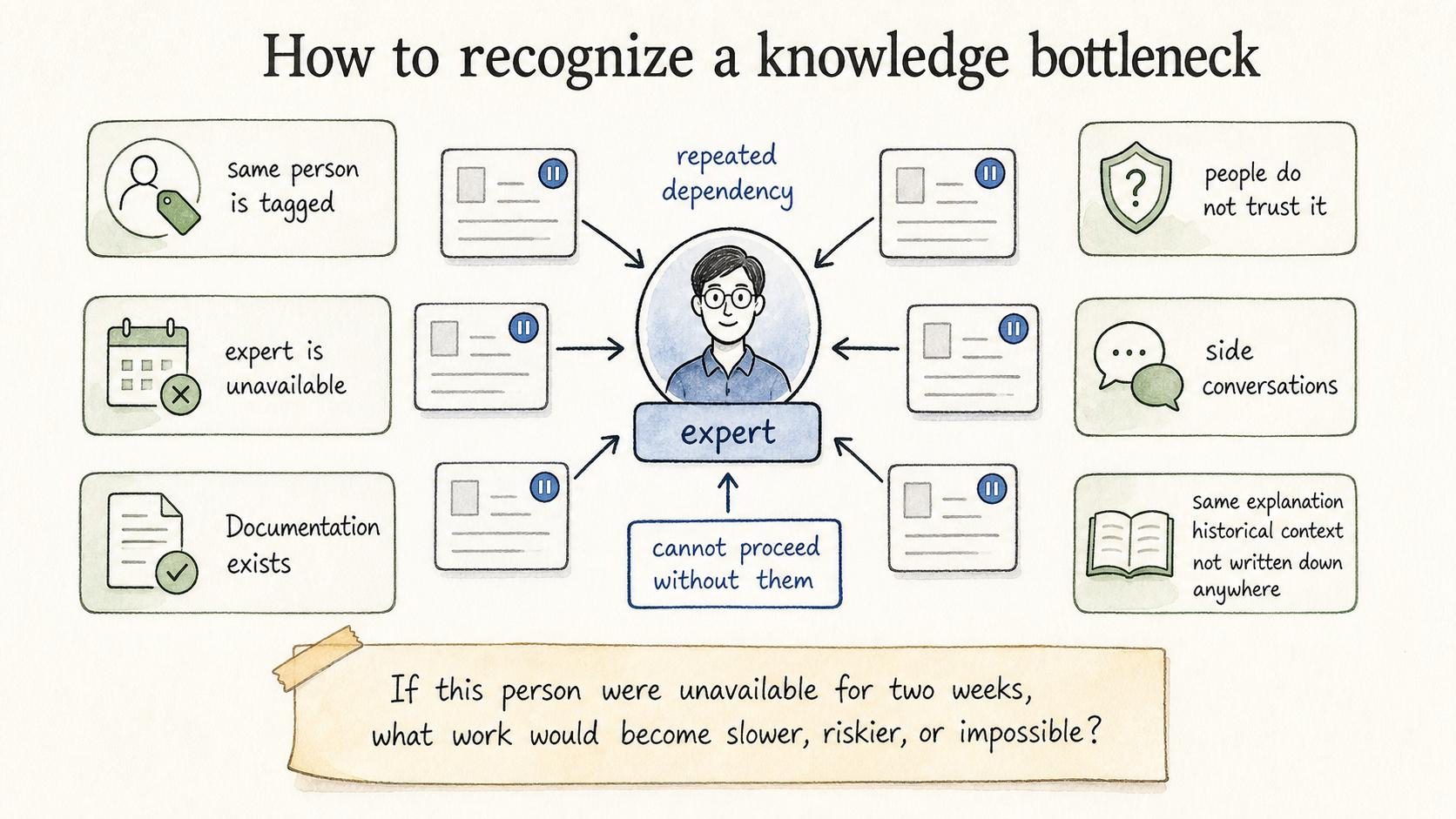
A knowledge bottleneck usually shows up as a repeated dependency. The clearest signal is not that someone is smart or experienced. It is that other people cannot proceed without them.
- The same person is tagged whenever a specific question appears.
- Work pauses when an expert is unavailable, even though the task itself is routine.
- Documentation exists, but people do not trust it enough to use it.
- New hires learn the real process through side conversations instead of official guides.
- Teams repeat the same explanation in meetings, Slack threads, or handoff notes.
- Decisions require historical context that is not written down anywhere.
Knowledge bottleneck vs. process bottleneck
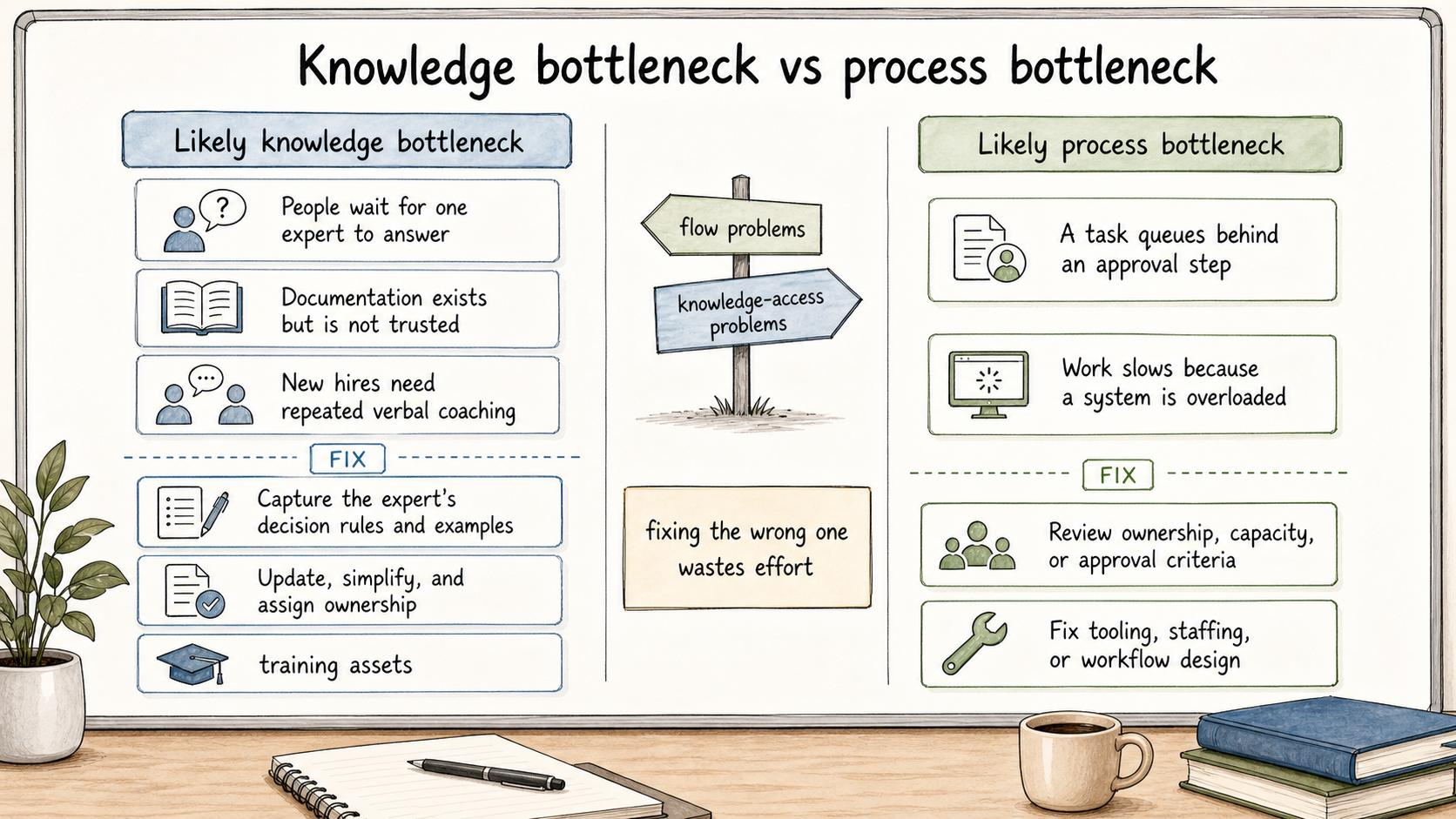
| Signal | Likely knowledge bottleneck | Likely process bottleneck | First useful fix |
|---|---|---|---|
| People wait for one expert to answer | Yes | Sometimes | Capture decision rules and examples |
| A task queues behind an approval step | Sometimes | Yes | Review ownership, capacity, or approval criteria |
| Documentation exists but is not trusted | Yes | Sometimes | Update, simplify, and assign ownership |
| Work slows because a system is overloaded | No | Yes | Fix tooling, staffing, or workflow design |
| New hires need repeated verbal coaching | Yes | Sometimes | Turn coaching moments into training assets |
Theory of Constraints guidance treats bottlenecks as limiting constraints in a system, which is useful when separating flow problems from knowledge-access problems. Adding more people will not help if everyone still needs the same expert to explain what good looks like. 4
How to reduce a knowledge bottleneck
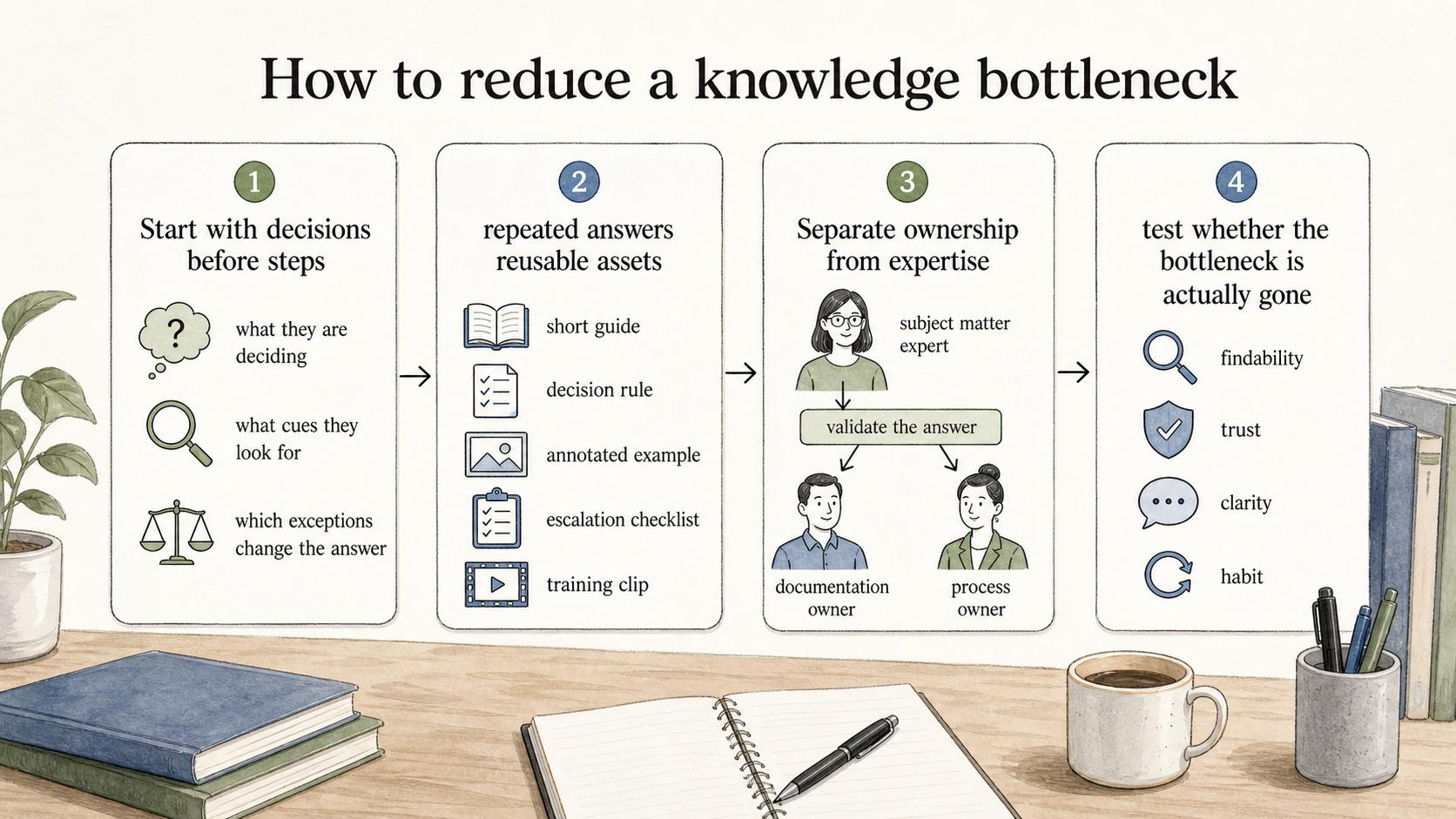
Start with decisions before steps. Ask what the expert is deciding, which cues they look for, and which exceptions change the answer. Turn repeated answers into reusable assets: a short guide, decision rule, annotated example, escalation checklist, or training clip.
Separate ownership from expertise. A subject matter expert may validate the answer, but they do not have to maintain every page forever. If people still ask the same person after a guide is published, the issue may be findability, trust, clarity, or habit.
Documentation takeaway
A knowledge bottleneck is often a documentation gap hidden inside a person-dependent routine. The goal is to capture enough repeatable judgment that other people can act safely without constant interruption.
Trails can help when the bottleneck is tied to a workflow: record an expert performing the process, turn it into a step-by-step guide, and create an AI-narrated video version for onboarding or reinforcement.
Sources
- 1
Bloomfire. A Guide to Knowledge Silos in the Workplace. bloomfire.com/blog/knowledge-silos-in-workplace/.
- 2
Mark, Gudith, and Klocke. The Cost of Interrupted Work. ics.uci.edu/~gmark/chi08-mark.pdf.
- 3
Workflawless. Key Person Risk Explained. workflawless.com/articles/business-process-management/key-person-risk-explained/.
- 4
TOC Institute. Theory of Constraints. www.tocinstitute.org/theory-of-constraints.html.