
Glossary
ISO 9001
 ChatGPT
 Perplexity
 Gemini
 Claude
What is ISO 9001?
ISO 9001 is the international standard for quality management systems. It gives an organization requirements for defining, running, checking, and improving the processes that affect product or service quality.
The standard is a framework for showing that the organization understands its context, controls important work, measures performance, manages risks and opportunities, and improves when the system exposes a weakness. ISO lists ISO 9001:2015 as the current published edition, with ISO/FDIS 9001 expected to replace it in September 2026. 12
Why ISO 9001 matters
Quality usually fails through ordinary operating gaps. A team promises one thing to customers, trains people another way, measures a third thing, and keeps the real process in someone's memory. ISO 9001 pushes those pieces into one managed system.
For a small business, the practical payoff is discipline before certification. The company has to define good work, show how people are trained, document quality-critical processes, and prove that leadership reviews whether the system is working. The certificate can add credibility, but the operating habit is what keeps ISO 9001 from becoming audit theater.
How ISO 9001 works
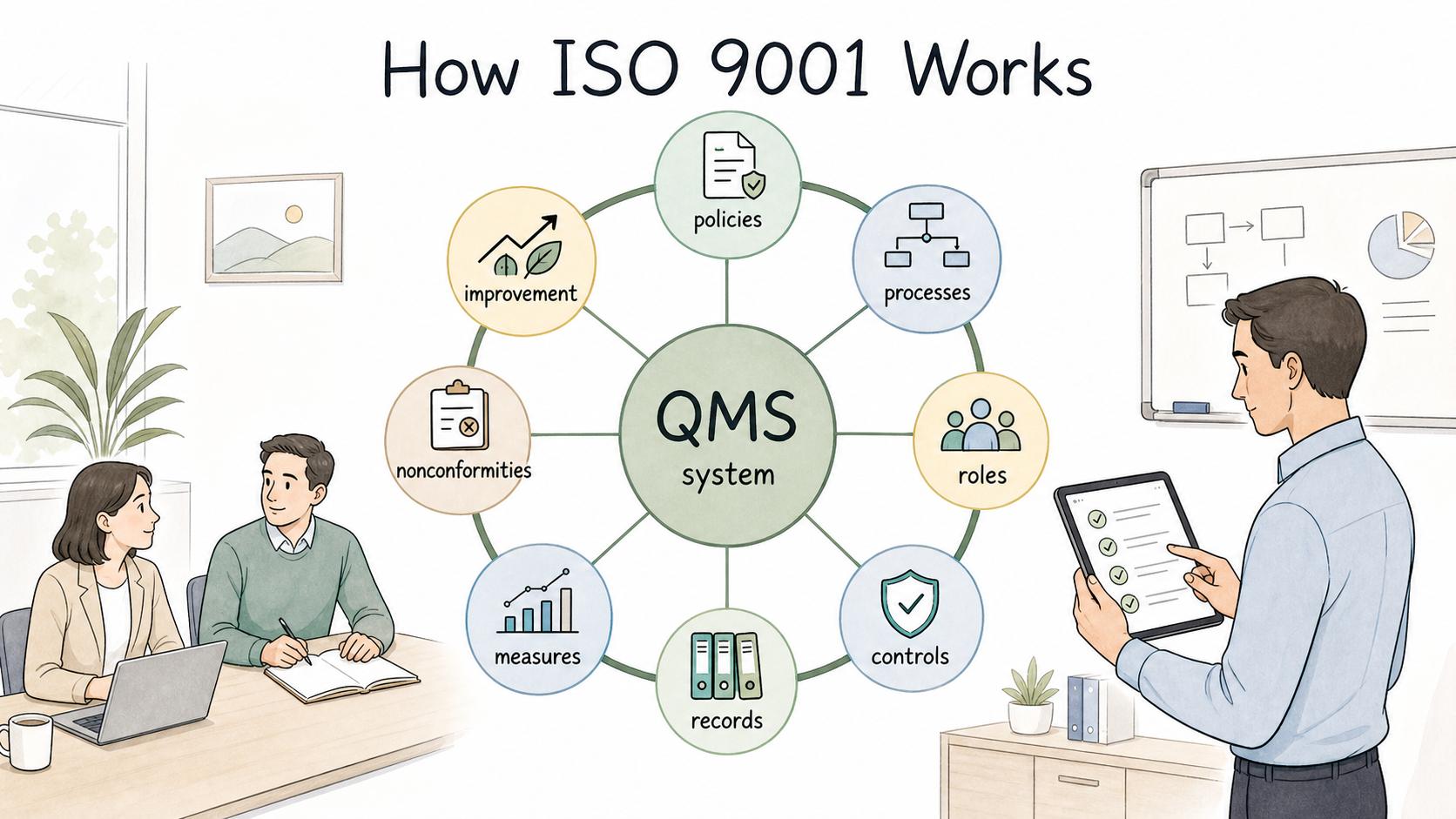
ISO 9001 is built around a quality management system, usually shortened to QMS. A QMS is the set of policies, processes, roles, controls, records, and improvement practices that help an organization deliver consistent outcomes. 3
In practice, ISO 9001 asks a company to answer a few hard operational questions:
- Which customer, legal, regulatory, and business requirements affect quality?
- Which processes need control because they shape the customer outcome?
- Who owns those processes, and what competence do they need?
- What documented information helps people do the work consistently?
- How does the organization measure performance, handle nonconformities, and improve?
The useful word is system. A training record without a defined process is weak evidence. A procedure without audit results is weak evidence. A dashboard without corrective action is weak evidence. ISO 9001 is strongest when those artifacts reinforce each other. 4
ISO 9001 vs everyday quality documentation
| Artifact | What it proves | Where teams often go wrong |
|---|---|---|
| Quality policy | Leadership has stated the quality direction | It sounds aspirational and never reaches daily work |
| Process map | The organization understands how work moves | It skips handoffs, exceptions, or outsourced steps |
| SOP or work instruction | People have a repeatable way to perform the task | It documents the ideal path instead of the actual workflow |
| Training record | People were prepared to follow the process | It proves attendance instead of competence |
| Audit finding | The system is being checked against reality | Findings are logged without corrective action |
| Corrective action | The organization learns from failures | The fix treats a symptom instead of the process cause |
Write ISO 9001 documentation for the people using it first. If the team can't follow the process during a normal workday, the documentation may survive a binder review while still failing operationally.
Common misconception: ISO 9001 is only a documentation project
A familiar failure mode is to treat ISO 9001 as paperwork: write policies, fill folders, schedule an audit, and hope the package is enough. That creates brittle compliance. The process exists on paper while employees still rely on side conversations, old screenshots, or tribal knowledge.
Stronger ISO 9001 work starts with the process as performed. Watch the work, capture the real steps, identify where quality decisions happen, and then write the minimum documentation needed to make that performance repeatable. The documentation should preserve judgment instead of burying it.
How to apply ISO 9001 in process documentation
- Document the decision points. Capture the criteria, examples, and escalation path.
- Tie critical steps to evidence: an approval, checklist, system timestamp, inspection result, or customer signoff.
- Keep ownership visible: put the owner, review cadence, and change trigger next to the process.
- Use exceptions as design input when employees routinely bypass the documented path.
How Trails helps
Trails helps teams create practical process documentation for a quality management system. A team member can capture a workflow while performing it, turn that capture into a polished step-by-step guide, and create an AI-narrated video version for training or sharing.
That matters for ISO 9001 because useful documentation is often closest to the work. Trails helps teams preserve the real sequence, handoffs, and decisions before they fade into memory, then maintain the guide as the process changes.
- Quality control
- Quality assurance
- Continuous improvement
- Process improvement
- Process documentation
- Standard operating procedure
- Quality management system
Sources
- 1
ISO. ISO 9001:2015 Quality management systems - Requirements. www.iso.org/standard/62085.html.
- 2
ISO. ISO/FDIS 9001 Quality management systems - Requirements. www.iso.org/standard/88464.html.
- 3
ISO. Introduction to quality management systems. www.iso.org/quality-management/what-is-qms.
- 4
ISO. Guidance on the process approach in ISO 9001:2015. www.iso.org/iso/iso9001_2015_process_approach.pdf.