
Glossary
Information Silos
 ChatGPT
 Perplexity
 Gemini
 Claude
What are information silos?
Information silos are pockets of knowledge, data, or context isolated inside a person, team, system, or department. The information exists somewhere in the organization, but the right people cannot easily find, understand, or trust it. McKinsey found that interaction workers spend a large share of the week looking for internal information or tracking down colleagues. 1
Silos often grow naturally as teams specialize and tools multiply. The problem starts when local efficiency creates organization-wide friction: duplicated work, inconsistent customer answers, slow handoffs, and decisions made with partial context. 2
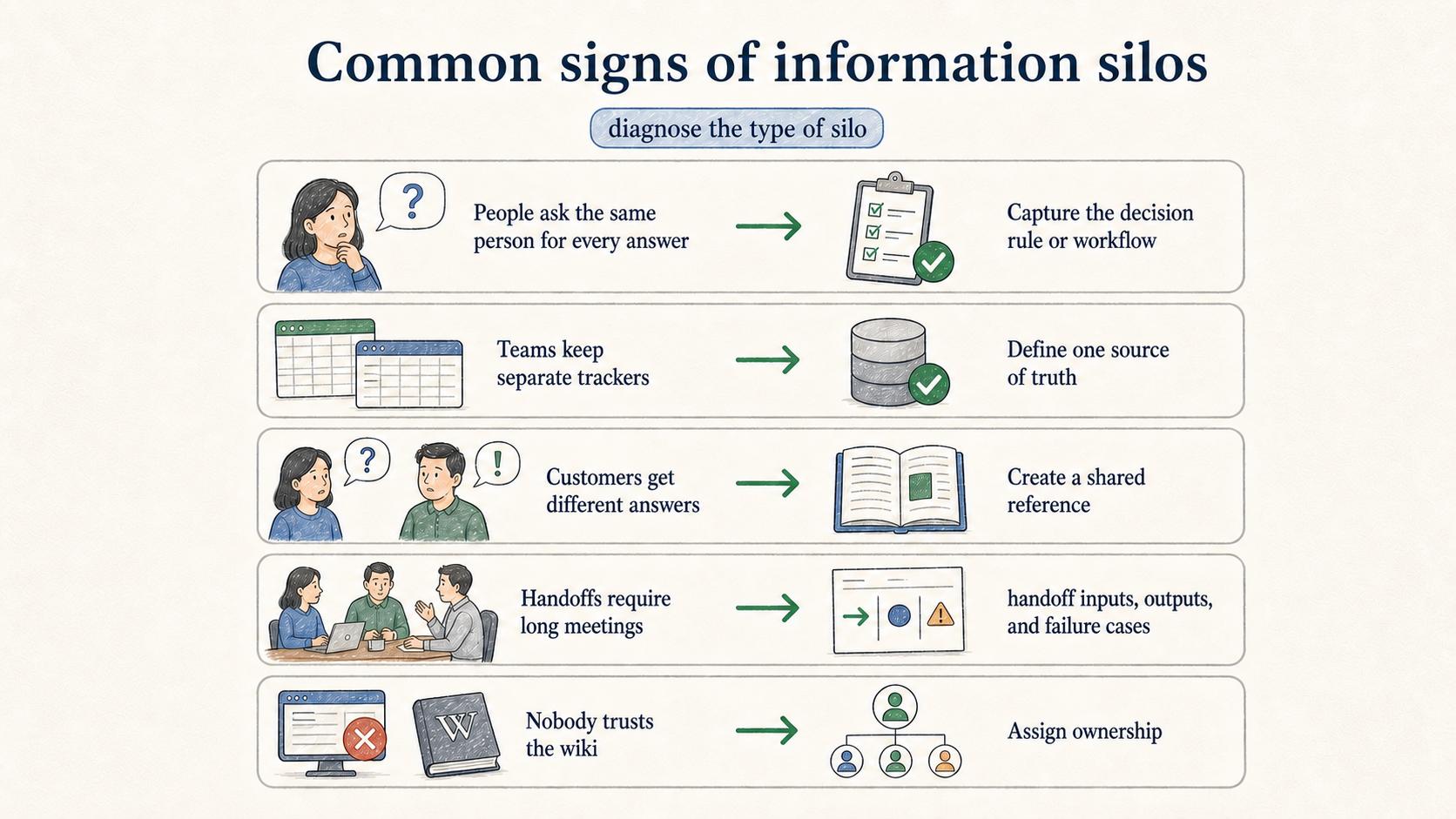
Common signs of information silos
| Symptom | What it usually means | Better first fix |
|---|---|---|
| People ask the same person for every answer | Knowledge is tied to an expert | Capture the decision rule or workflow |
| Separate trackers for the same work | Systems do not reflect shared ownership | Define one source of truth and each tool's role |
| Different customer answers | Context is not aligned | Create a shared reference and escalation path |
| Long handoffs | Context is not packaged for the next team | Document inputs, outputs, and failure cases |
| Nobody trusts the wiki | Content is stale, duplicated, or ownerless | Assign ownership and archive misleading pages |
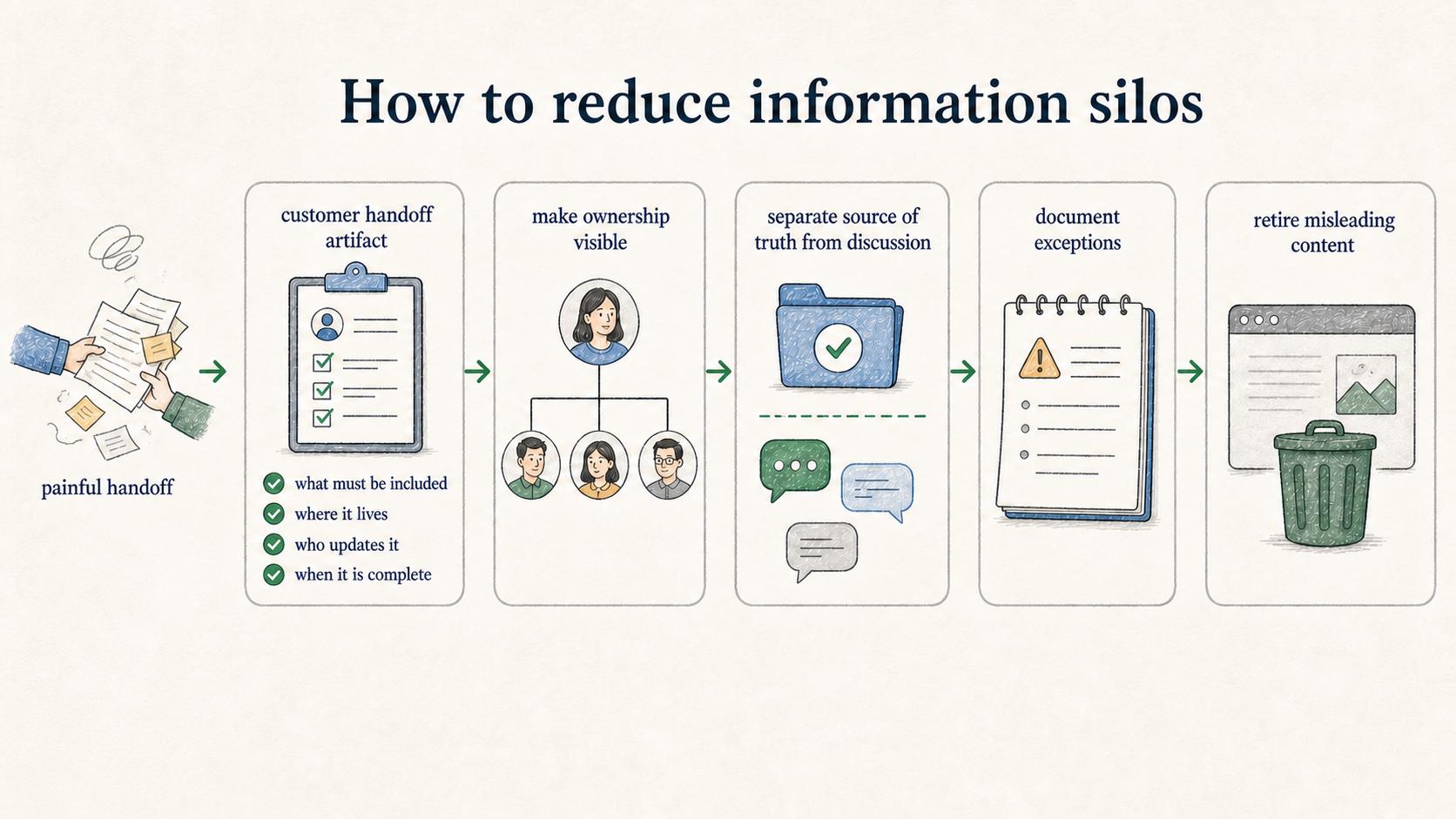
How to reduce information silos
Start with a painful handoff, not a company-wide cleanup. Define what must be included, where it lives, who updates it, and when it is complete.
Make ownership visible. Information becomes stale when everyone can edit it but nobody owns it. ISO's knowledge management systems standard reinforces that systems need to be maintained, reviewed, and improved over time. 3
Separate source of truth from discussion. When a decision changes work, move the result into the relevant process guide, SOP, knowledge base article, or customer record. NASA's lifecycle turns operating experience into recorded, shared, and applied practice. 4
Document exceptions carefully and retire misleading content rather than only creating more pages.
Documentation takeaway
Good documentation does not eliminate every silo. It reduces the silos that block repeatable work: cross-team processes, frequently repeated questions, recurring exceptions, and workflows where delay or inconsistency creates customer, compliance, or operational risk.
If information changes what another team does next, it needs to be findable outside the team that created it.
How Trails helps
Trails helps teams reduce silos around repeatable workflows by turning an expert's work into a step-by-step guide and AI-narrated video that can be shared across onboarding, support, operations, and customer-facing teams.
Sources
- 1
McKinsey Global Institute. The social economy. www.mckinsey.com/industries/technology-media-and-telecommunications/our-insights/the-social-economy.
- 2
OECD. Breaking Out of Policy Silos. www.oecd.org/en/publications/breaking-out-of-policy-silos_9789264094987-en.html.
- 3
ISO. ISO 30401:2018 knowledge management systems. www.iso.org/standard/68683.html.
- 4
NASA. Lessons learned lifecycle. www.nasa.gov/learning-resources/for-professionals/appel-lessons-learned/.