
Glossary
Healthcare SOP
 ChatGPT
 Perplexity
 Gemini
 Claude
What is a healthcare SOP?
A healthcare SOP is a standard operating procedure for a clinical, administrative, compliance, or patient-support workflow in a healthcare setting. It explains who does the work, when the procedure applies, which steps must be followed, what records are required, and which safety, privacy, or regulatory requirements shape the process.
The useful version is more than a policy rewritten as steps. A healthcare SOP has to be practical enough for staff to follow during a shift and controlled enough to protect patients, staff, and sensitive health information.
Why healthcare SOPs matter
Healthcare teams depend on repeatable work: intake, room turnover, medication handling, specimen collection, appointment scheduling, billing, referrals, incident reporting, infection control, privacy requests, and emergency response. When those workflows live only in training memory, every handoff adds risk: a missed step, an undocumented exception, a privacy mistake, or a variation no one sees until something breaks.
A healthcare SOP gives ordinary, repeatable work a controlled reference. It does not replace clinical judgment. It makes the routine parts of the process reliable so qualified staff can use their judgment where the situation actually calls for it.
That matters because healthcare SOPs often sit between operations and regulation. HIPAA-regulated organizations need documented security policies and procedures, safeguards for electronic protected health information, and workforce compliance around those safeguards.1 Infection prevention procedures should stay available, current, and aligned with evidence-based guidance.2 Emergency preparedness procedures may need to connect to planning, communication, policies, procedures, training, and testing requirements.3 A good SOP turns those obligations into task-level instructions instead of forcing staff to interpret a policy manual in the moment.
What a healthcare SOP should include
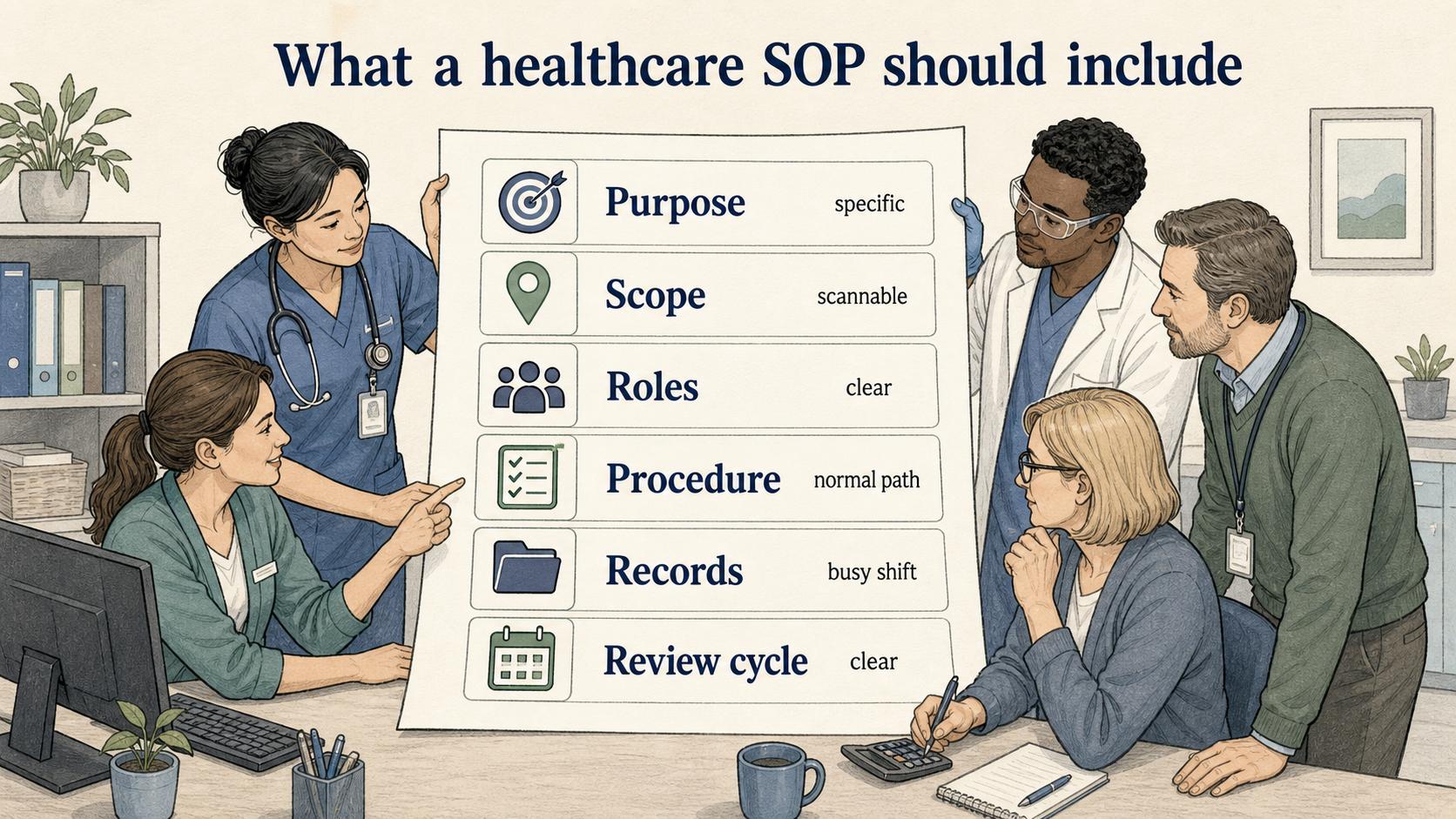
A strong healthcare SOP answers six questions without making the reader hunt:
| SOP element | What it should clarify | Common failure mode |
|---|---|---|
| Purpose | Why the procedure exists and what risk it controls | The SOP lists steps but never says what outcome matters |
| Scope | Which locations, roles, patients, systems, or situations it covers | Staff apply the SOP to edge cases it was never meant to handle |
| Roles | Who performs, reviews, approves, escalates, and documents the work | Everyone assumes someone else owns the handoff |
| Procedure | The step-by-step workflow, including checks and exceptions | Steps are technically correct but unusable during a busy shift |
| Records | What must be documented, where it lives, and how long it is retained | Work happens, but proof of the work cannot be found later |
| Review cycle | Who keeps the SOP current and what triggers an update | The SOP survives long after the workflow or requirement changes |
The common failure is writing for a reader with unlimited time and perfect context. A nurse, front-desk coordinator, lab tech, billing specialist, or practice manager usually needs the opposite: a procedure that is specific, scannable, and clear about what to do when the normal path does not apply.
Examples of healthcare SOPs
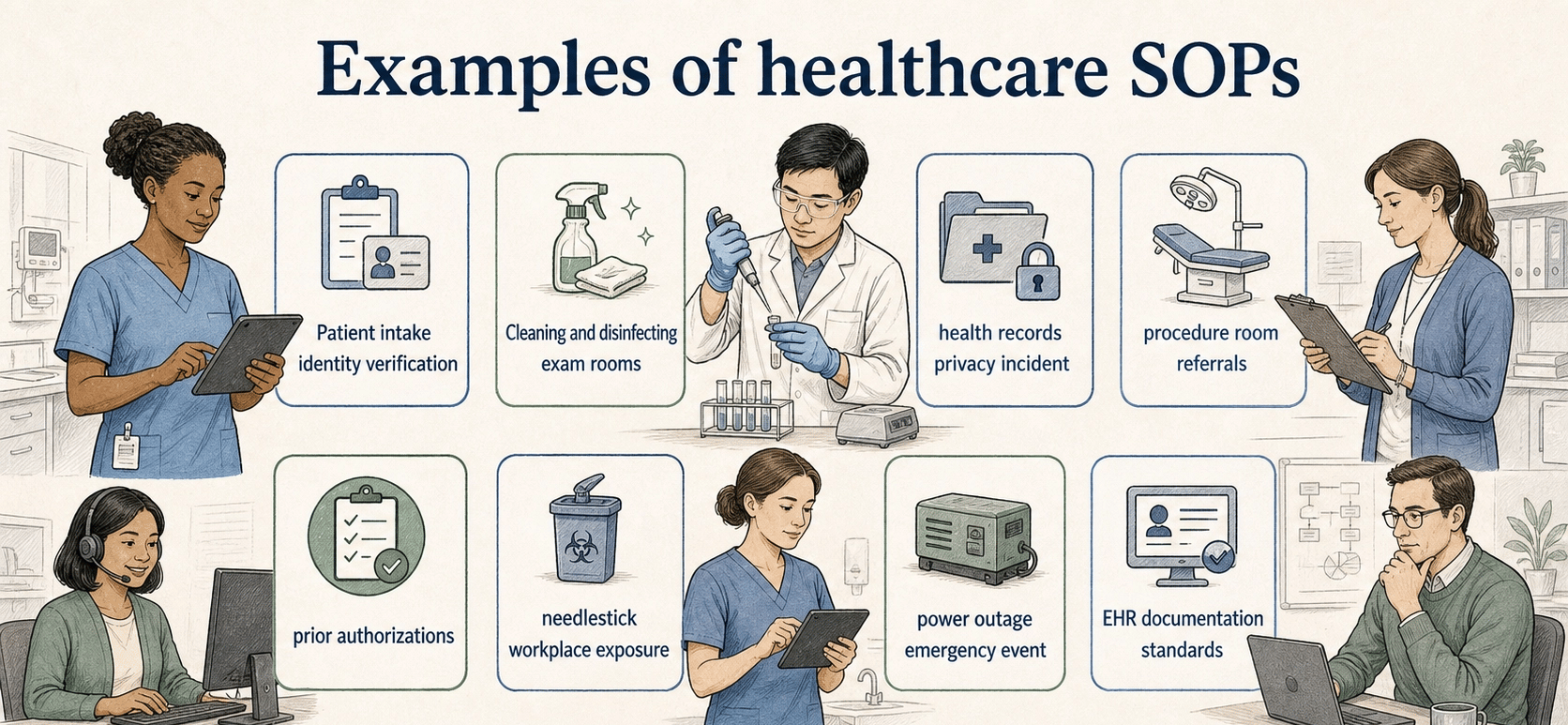
Healthcare SOPs can cover clinical, operational, and administrative work, such as:
- Patient intake and identity verification
- Cleaning and disinfecting exam rooms between visits
- Handling a patient request for access to health records
- Escalating a suspected privacy incident
- Preparing a procedure room
- Processing referrals and prior authorizations
- Reporting a needlestick or workplace exposure
- Communicating during a power outage or emergency event
- Training new staff on EHR documentation standards
The level of detail should match the risk. A supply-ordering SOP does not need the same control structure as a sterile processing SOP or a patient data access procedure. Good SOP systems make that distinction explicit instead of forcing every procedure into the same heavy template.
How to write a healthcare SOP people will use
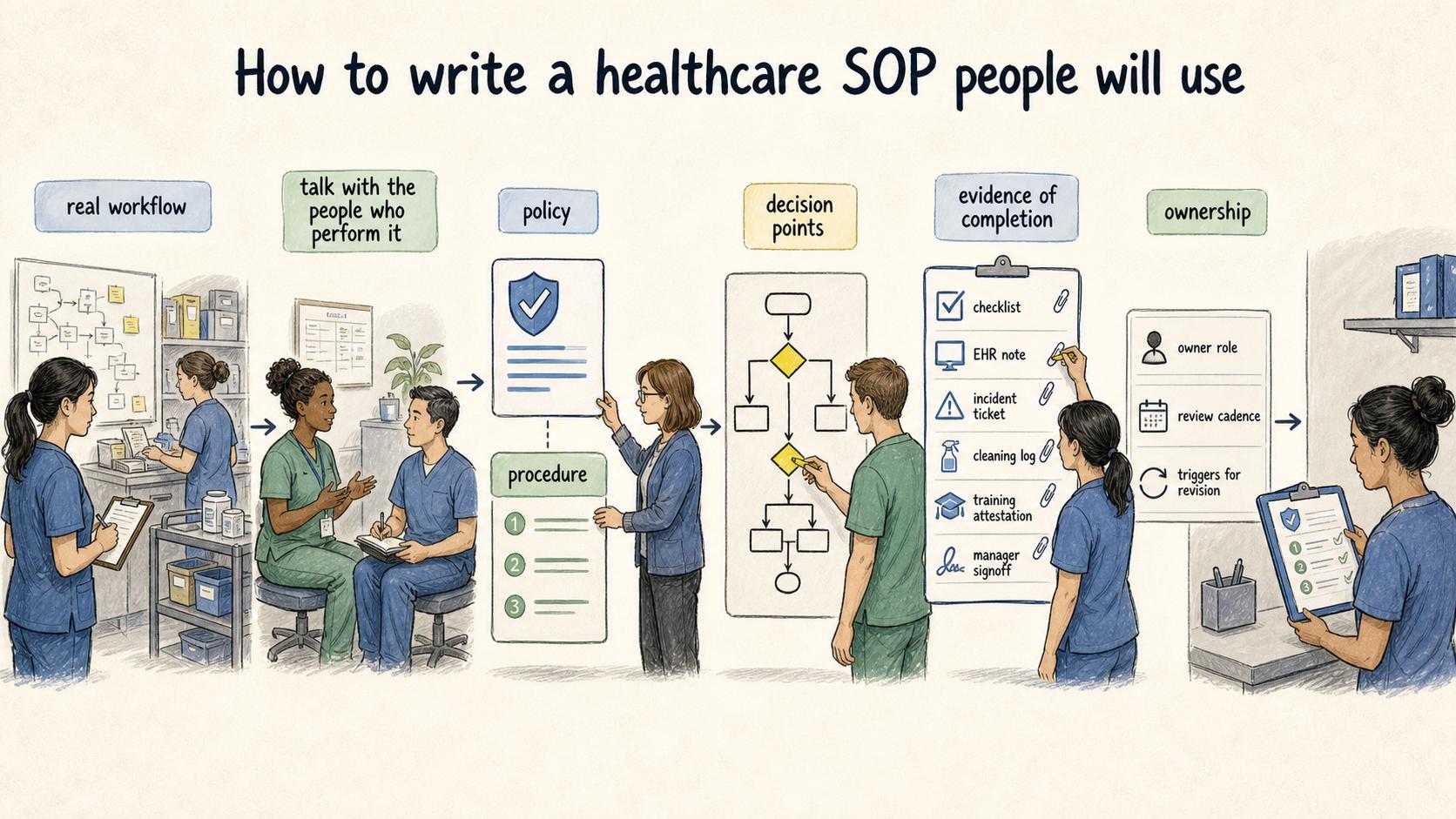
Start with the real workflow. Watch the work happen, talk with the people who perform it, and note the exceptions that come up repeatedly. If the SOP describes the official version of the process while staff follow a different version under pressure, the SOP will lose trust quickly.
Separate policy from procedure. A policy might state that protected health information must be handled according to privacy requirements. The SOP should explain what a scheduler, clinician, or support rep does when verifying identity, sending information, documenting a disclosure, or escalating uncertainty.
Make decision points visible. Healthcare work often turns on small judgments: when to escalate to a clinician, when to use standard precautions, when to pause and confirm patient identity, when to document an exception, or when to contact a privacy officer.
Build in evidence of completion. If the procedure requires a checklist, EHR note, incident ticket, cleaning log, training attestation, or manager signoff, say exactly where that artifact lives.
Assign ownership. Every healthcare SOP needs an owner role, a review cadence, and clear triggers for revision. New equipment, new software, updated guidance, incident findings, staffing changes, and regulatory updates can all make an old SOP misleading.
Healthcare SOP template
Use this as a starting point, then adapt it to the risk level of the process.
## Healthcare SOP Template

**Glossary term:** Healthcare SOP
**Source:** Trails Glossary — trails.so/glossary/healthcare-sop

---

### 01. Create a healthcare SOP

"Create a healthcare SOP for [process] used by [team/role] in [setting].

Include:
- Purpose: what risk, outcome, or patient/staff need this SOP supports
- Scope: when this SOP applies and when it does not
- Roles: who performs, approves, escalates, and documents the work
- Required materials or systems: forms, EHR screens, equipment, PPE, logs, or tools
- Procedure: step-by-step workflow with decision points and escalation paths
- Documentation: what record must be created, where it is stored, and who checks it
- Safety, privacy, or compliance considerations: requirements that shape the procedure
- Exceptions: what staff should do when the normal workflow cannot be followed
- Review owner and cadence: who maintains the SOP and what triggers an update

Use clear language for frontline staff. Flag any step that depends on local law, clinical policy, or compliance review."
Documentation takeaway
A healthcare SOP should reduce ambiguity without pretending every situation is routine. The best ones make the normal path easy to follow, the exception path visible, and the required documentation hard to miss. If the SOP is too vague, it will not control risk. If it is too dense, staff will not use it when the work is moving quickly.
How Trails helps
Trails helps teams capture a workflow as someone performs it, then turn that workflow into a polished step-by-step guide. For healthcare operations, that can make administrative and training workflows easier to document: intake, scheduling, referral handling, billing handoffs, and internal system procedures.
Trails can also create an AI-narrated video version for training or sharing, which helps new staff see the process instead of only reading about it.
FAQ
Is a healthcare SOP the same as a policy?
No. A policy sets the rule or standard. A healthcare SOP explains the procedure staff follow to carry out that rule in a specific workflow.
Who should approve a healthcare SOP?
Approval depends on the process. Clinical SOPs may need clinical leadership review. Privacy, security, billing, or emergency procedures may need compliance, legal, IT, or operations review. The SOP should name the approving role instead of leaving ownership informal.
How often should healthcare SOPs be reviewed?
Set a normal review cadence, then update sooner when the workflow, software, equipment, staffing model, guidance, or regulatory requirement changes. High-risk SOPs usually need tighter ownership than routine administrative procedures.
Sources
- 1
U.S. Department of Health & Human Services. Summary of the HIPAA Security Rule. HHS. www.hhs.gov/hipaa/for-professionals/security/laws-regulations/index.html. Accessed August 6, 2026.
- 2
Centers for Disease Control and Prevention. Core Infection Prevention and Control Practices. CDC. www.cdc.gov/infection-control/hcp/core-practices/index.html. Accessed August 6, 2026.
- 3
Centers for Medicare & Medicaid Services. Emergency Preparedness Rule. CMS. www.cms.gov/medicare/health-safety-standards/quality-safety-oversight-emergency-preparedness/emergency-preparedness-rule. Accessed August 6, 2026.