
Glossary
HIPAA Compliance
 ChatGPT
 Perplexity
 Gemini
 Claude
What is HIPAA compliance?
HIPAA compliance means meeting applicable Health Insurance Portability and Accountability Act requirements for protecting health information. In day-to-day operations, covered entities and business associates may need policies, safeguards, training, contracts, access controls, risk management, and breach-response procedures for protected health information (PHI).
This is a practical overview, not legal advice. Obligations depend on the organization, role, data, vendors, and current regulatory interpretation; teams should confirm policy decisions with qualified counsel or compliance leadership.
Who HIPAA compliance applies to
HIPAA Rules apply to covered entities and business associates. Covered entities include qualifying health care providers, health plans, and clearinghouses; business associates perform certain functions involving PHI for a covered entity. 1
Start process documentation with a data-flow map: where PHI enters, which systems store or transmit it, which roles access it, which vendors touch it, and what evidence shows access, training, review, and incident response occurred.
What HIPAA compliance includes operationally
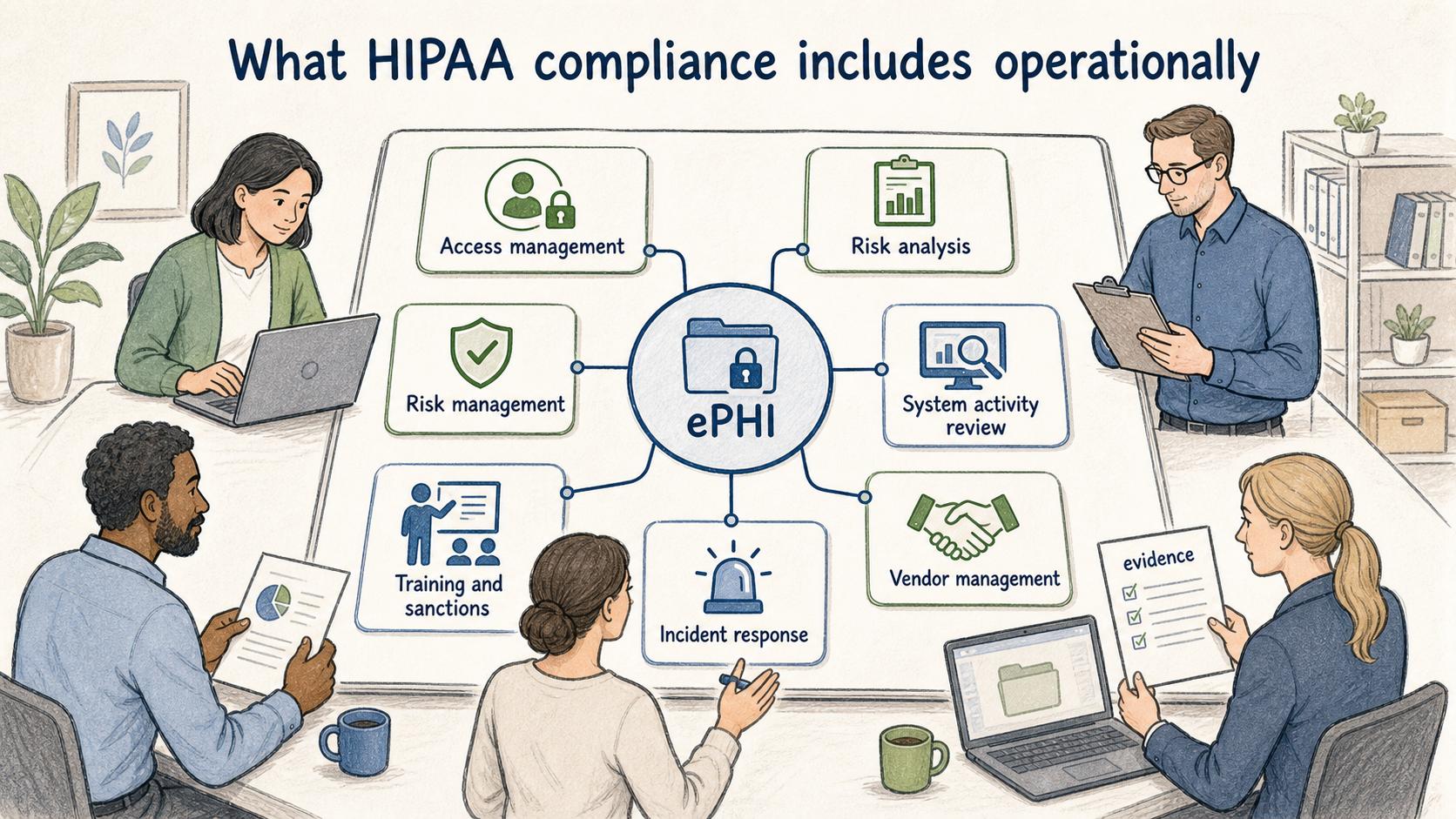
Compliance is broader than a privacy notice or training slide. The Security Rule requires protection of the confidentiality, integrity, and availability of ePHI, protection against anticipated threats and impermissible uses or disclosures, and workforce compliance. 2
- Access management: approve, change, review, and remove access.
- Risk management: identify ePHI risks and decide on reasonable safeguards.
- Training and system review: retain training evidence and review logs, reports, and incidents.
- Vendor management and incident response: document business associate responsibilities and escalate suspected events.
Common documentation gaps
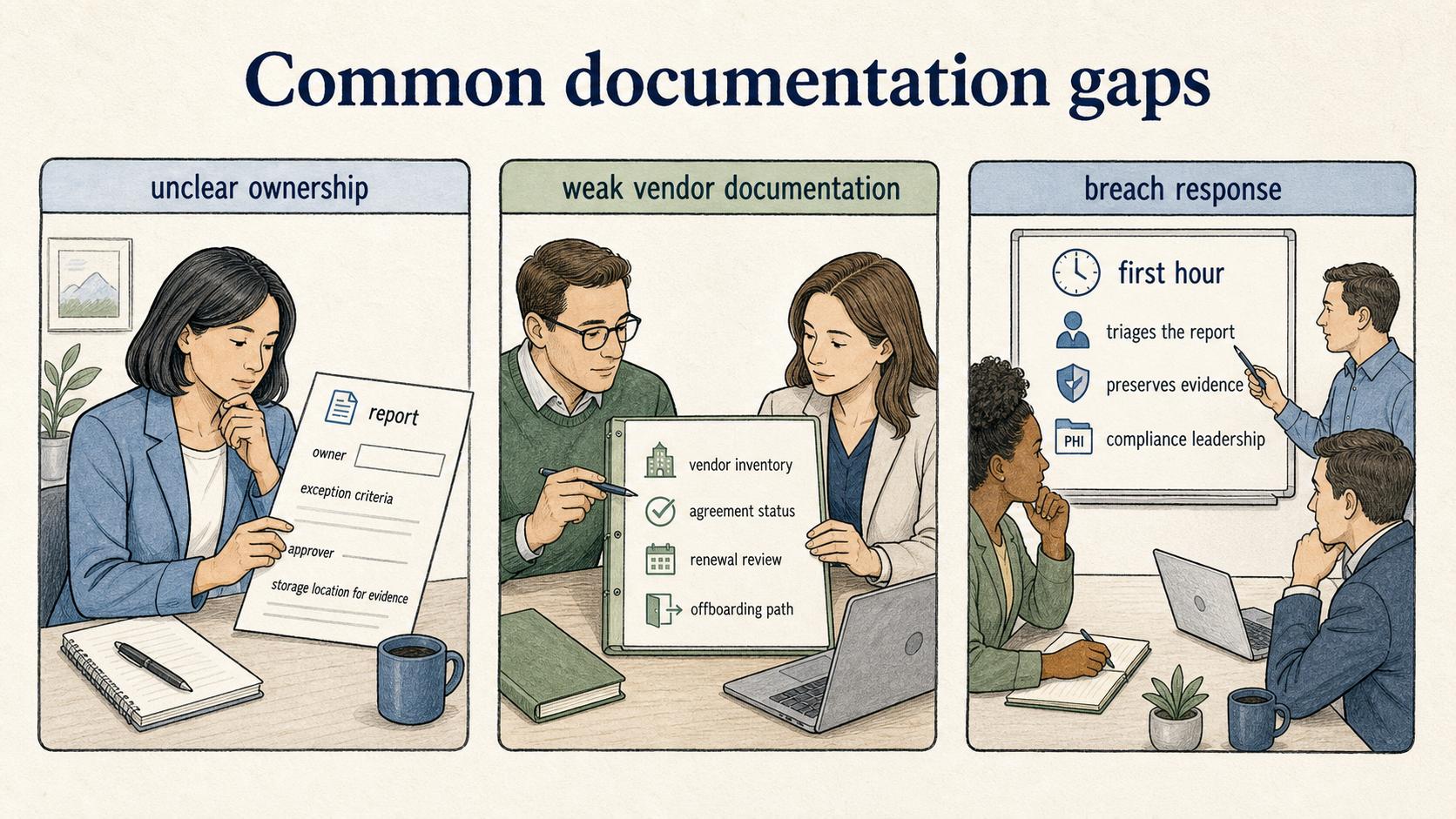
The most common gaps are unclear ownership, weak vendor documentation, and breach response treated as a legal memo instead of an operating procedure. A procedure needs an owner, report, exception criteria, approver, and evidence location. Written business-associate arrangements and breach notification duties also require clear operating ownership. 13
A practical HIPAA compliance documentation checklist
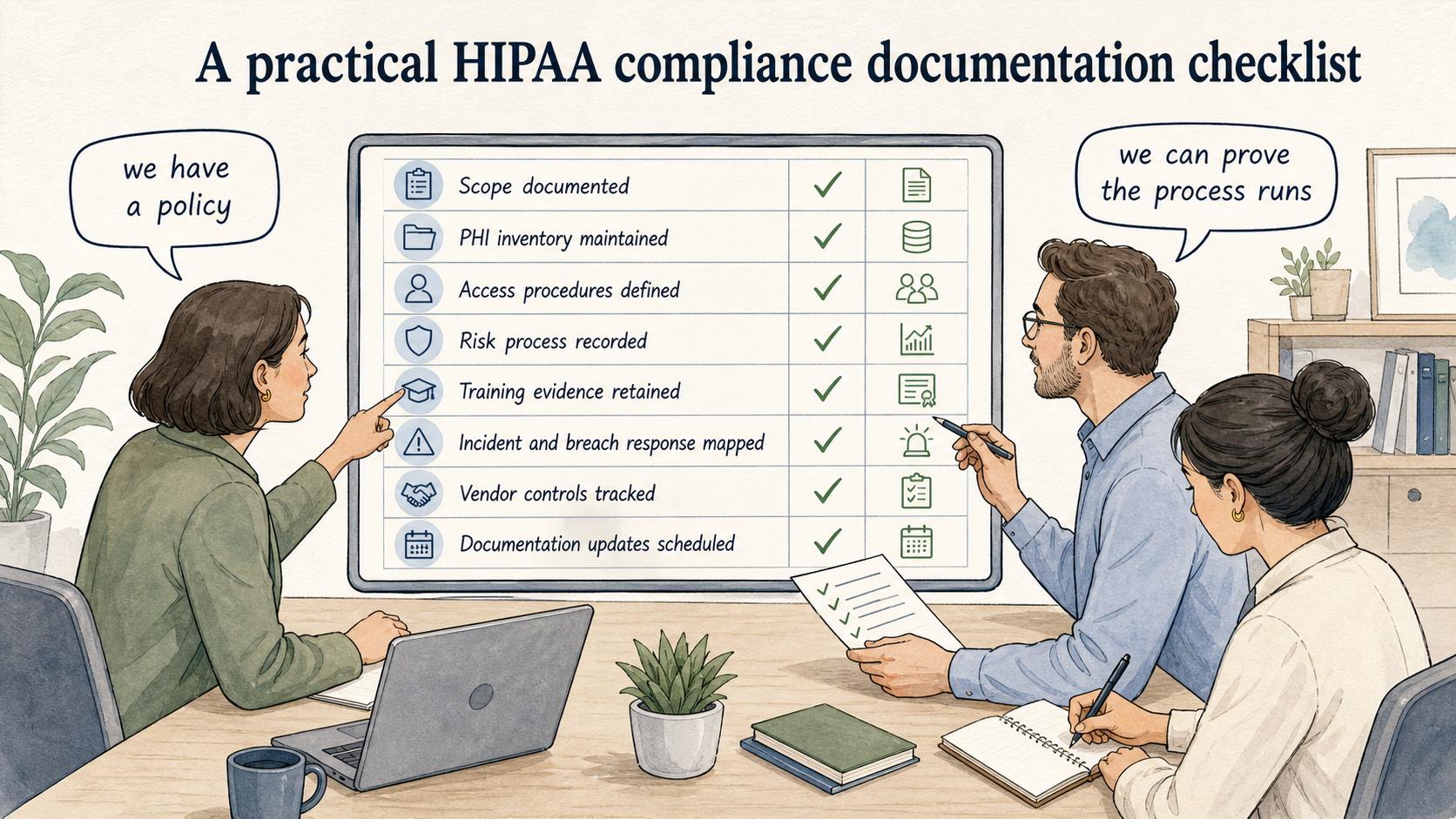
- Document covered-entity or business-associate scope for each relevant workflow.
- Maintain a PHI inventory for systems, vendors, forms, reports, and handoffs.
- Document access approval, changes, termination, and periodic review.
- Record risk analysis, mitigation decisions, residual-risk acceptance, and review dates.
- Retain role-specific training and completion evidence.
- Map incident and breach reporting, triage, escalation, documentation, and notification decision ownership.
- Track business associate agreements, vendor reviews, and offboarding.
- Review documentation when systems, vendors, regulations, or workflows change.
This separates “we have a policy” from “we can prove the process runs.”
AI-ready documentation prompt
Do not paste PHI, patient details, credentials, screenshots, logs, or sensitive system data into an AI tool unless the organization has approved that use and the required legal, security, and vendor controls are in place.
## HIPAA-Related SOP Outline

**Glossary term:** HIPAA Compliance
**Source:** Trails Glossary — trails.so/glossary/hipaa-compliance

---

### 01. Draft a HIPAA-related SOP outline

"Help draft a HIPAA-related SOP outline for [workflow] without PHI or sensitive details.

Context:
- Organization role: [covered entity, business associate, unsure]
- Workflow: [access review, incident intake, vendor review, training, records request]
- Systems: [generic names only]
- Roles: [privacy officer, security officer, manager, IT admin, vendor owner]
- Evidence: [log review, approval record, training record, ticket, agreement]

Create purpose and scope, trigger, responsibilities, steps, evidence to retain, escalation criteria, review cadence, and questions for legal/compliance review. Keep placeholders where legal interpretation is required."
Documentation takeaway
HIPAA compliance documentation should be specific, current, owned, and easy to prove. Review screenshots, recordings, examples, AI prompts, and training materials for PHI exposure before they are stored or shared.
- Compliance documentation
- Compliance SOP
- Audit trail
- Document control
- Healthcare SOP
Sources
- 1
HHS. Covered Entities and Business Associates. www.hhs.gov/hipaa/for-professionals/covered-entities/index.html.
- 2
eCFR. 45 CFR Part 164 Subpart C. www.ecfr.gov/current/title-45/subtitle-A/subchapter-C/part-164/subpart-C.
- 3
HHS. Breach Notification Rule. www.hhs.gov/hipaa/for-professionals/breach-notification/index.html.
- 4
NIST. SP 800-66 Rev. 2. csrc.nist.gov/pubs/sp/800/66/r2/final.