
Glossary
Incident Management SOP
 ChatGPT
 Perplexity
 Gemini
 Claude
What is an incident management SOP?
An incident management SOP is a standard operating procedure that explains how a team detects, classifies, escalates, communicates, resolves, and reviews incidents. It gives people a clear process to follow when something disrupts normal operations, customer experience, security, systems, or service delivery. NIST's current incident response guidance frames incident response around detecting, responding, recovering, and continuously improving from incidents. 1
Incidents are messy; the SOP's job is to make the response less improvised. Under pressure, people should not be inventing roles, severity levels, communication rules, or approval paths from memory. Google SRE warns that without a planned response, principled incident management can break down in real situations. 2
What an incident management SOP covers
An incident management SOP starts by defining what counts as an incident. For an IT team, that may include outages, degraded performance, data access issues, failed integrations, or security alerts. For an operations team, it may include safety issues, equipment failures, process breakdowns, customer-impacting delays, or compliance exceptions.
The SOP should explain how incidents move from detection to closure: intake, triage, severity assignment, ownership, escalation, communication, containment or workaround, resolution, documentation, and review. It should help a team act before everyone agrees on every fact.
Incident management SOP vs related documents
| Document | Purpose | When to use it |
|---|---|---|
| Incident management SOP | Defines the overall incident response process | When teams need consistent roles, escalation, communication, and closure steps |
| Runbook | Gives task-specific technical steps | When responders need exact commands, checks, or recovery actions |
| Incident response plan | Defines broader response strategy | When leadership, legal, security, or external communication may be involved |
| Service desk SOP | Standardizes support intake and ticket handling | When incidents begin as user or customer support issues |
| Change management SOP | Controls planned changes | When work must be reviewed before altering systems or processes |
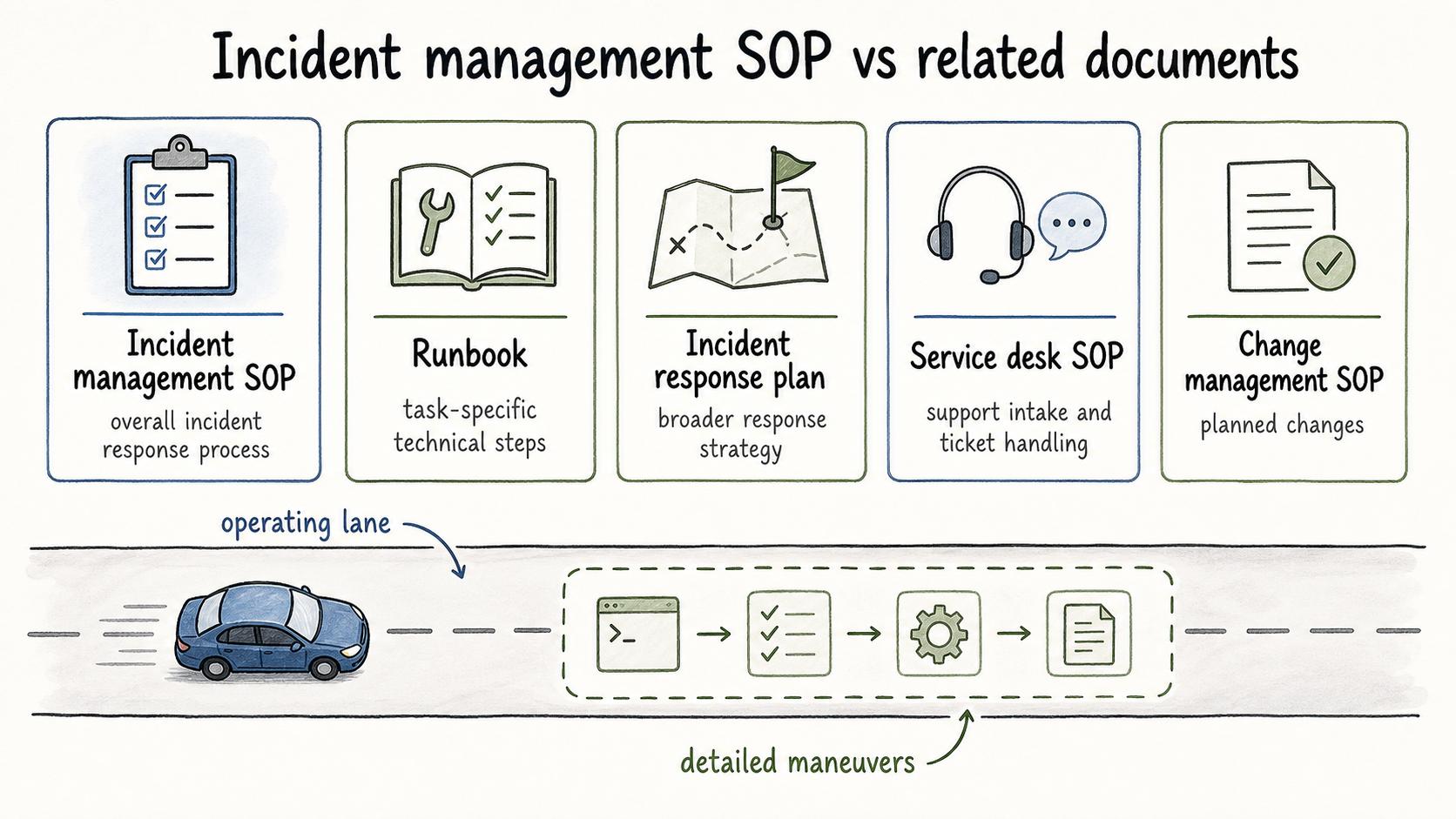
The SOP is the operating lane; runbooks are the detailed maneuvers inside that lane. If the SOP contains every technical recovery step, it becomes too long to use during an incident. If it does not link to runbooks, responders may know who is responsible but not what to do next.
What to include in an incident management SOP
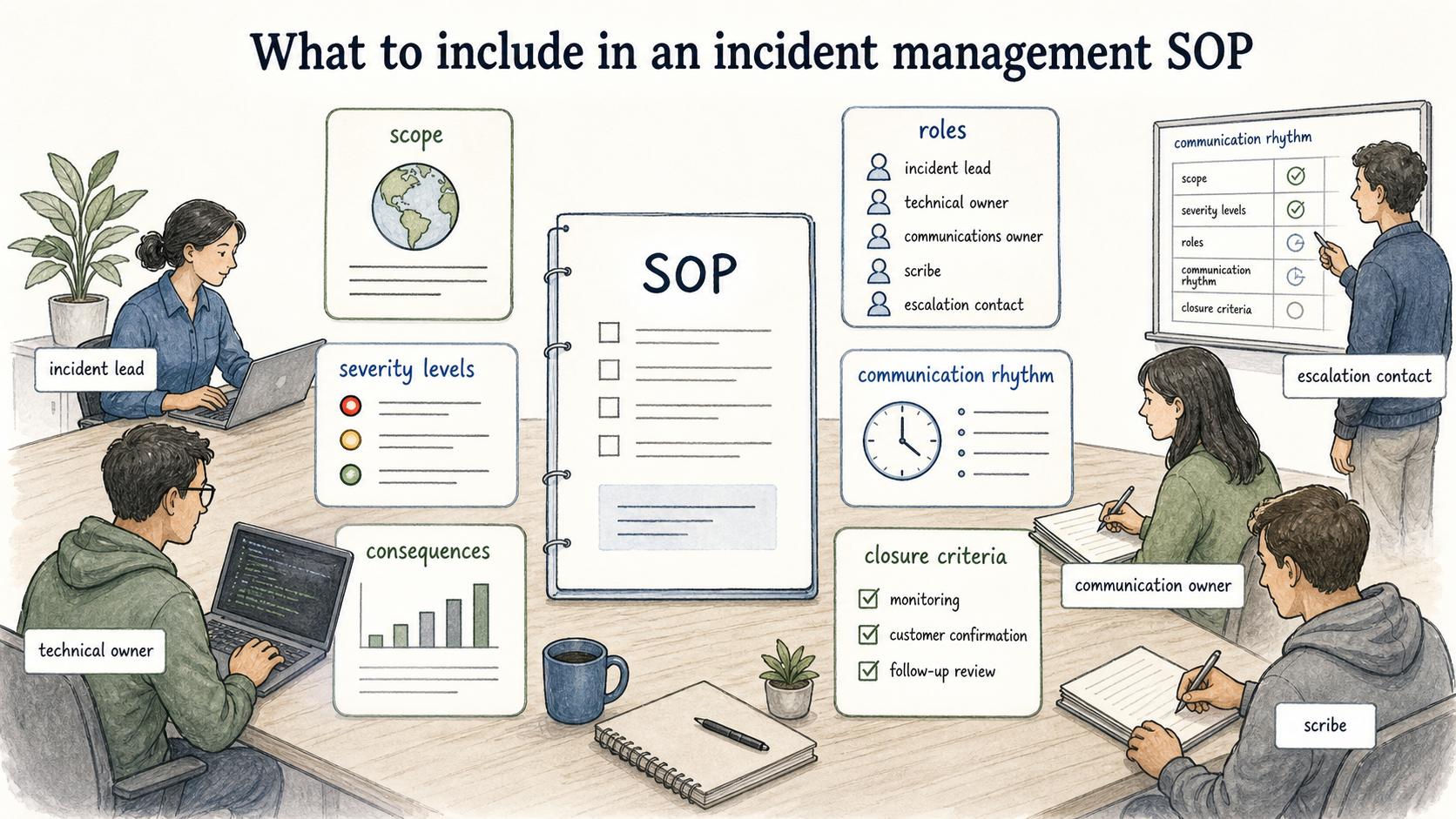
Start with scope: name the systems, teams, locations, incident types, or business processes the SOP covers. Define severity levels with consequences. A high-severity incident might require an incident lead, executive notification, customer communication, or a review within a fixed window; a low-severity incident might stay inside the owning team.
Assign roles before the incident: incident lead, technical owner, communications owner, scribe, escalation contact, and business approver. Google's guidance uses defined incident command, communications, and operations roles because responders need clear responsibilities and communication channels. 3
Create a communication rhythm and define closure criteria. An incident is not closed simply because the immediate symptom stopped; it may require monitoring, customer confirmation, records, follow-up tickets, or a review. Google's postmortem guidance treats the written record, root cause analysis, impact, and follow-up actions as part of learning from significant incidents. 4
Common mistakes
A common mistake is writing for calm readers instead of stressed responders. Long background sections, vague ownership, and buried escalation rules make the document harder to use at the moment it matters. Put critical decisions near the top.
Another mistake is treating severity as a label rather than a trigger. If Severity 1 does not clearly change who is notified, how often updates happen, or who can approve risky actions, it will be debated instead of used.
A third mistake is separating response from documentation. If responders keep notes in chat and never convert them into a timeline, decision log, or follow-up actions, the organization loses the knowledge needed to prevent repeats.
Simple incident management SOP template
## Incident Management SOP Template

**Glossary term:** Incident Management SOP
**Source:** Trails Glossary — trails.so/glossary/incident-management-sop

---

### 01. Create an incident management SOP

"Create an incident management SOP for [team/system/process].

Include:
1. Scope: covered incident types, exclusions, related runbooks or policies.
2. Severity levels and escalation triggers.
3. Roles: incident lead, technical or process owner, communications owner, scribe, and escalation contact.
4. Response workflow: detect and log, triage, assign severity, start the incident record, contain or apply a workaround, resolve and verify, communicate status, and document timeline and decisions.
5. Closure and review: closure criteria, required follow-up actions, review owner, and documentation updates.

Adapt roles and approvals for the team's risk, regulatory, and communication requirements."
How Trails helps
Trails can help teams document the repeatable parts of incident management, especially setup, triage, communication, and post-incident review workflows. A team member can perform the workflow once and turn it into a polished step-by-step guide or AI-narrated training video.
- Standard operating procedure
- Service desk SOP
- Runbook
- Root cause analysis
- IT SOP
- Change management SOP
- Document control
Sources
- 1
NIST. SP 800-61r3 Incident Response Recommendations. nvlpubs.nist.gov/nistpubs/specialpublications/nist.sp.800-61r3.pdf.
- 2
Google SRE. Managing Incidents. sre.google/sre-book/managing-incidents/.
- 3
Google SRE. Incident Management Guide. sre.google/resources/practices-and-processes/incident-management-guide/.
- 4
Google SRE. Postmortem Culture. sre.google/sre-book/postmortem-culture/.