
Glossary
EOS Integrator
 ChatGPT
 Perplexity
 Gemini
 Claude
What is an EOS Integrator?
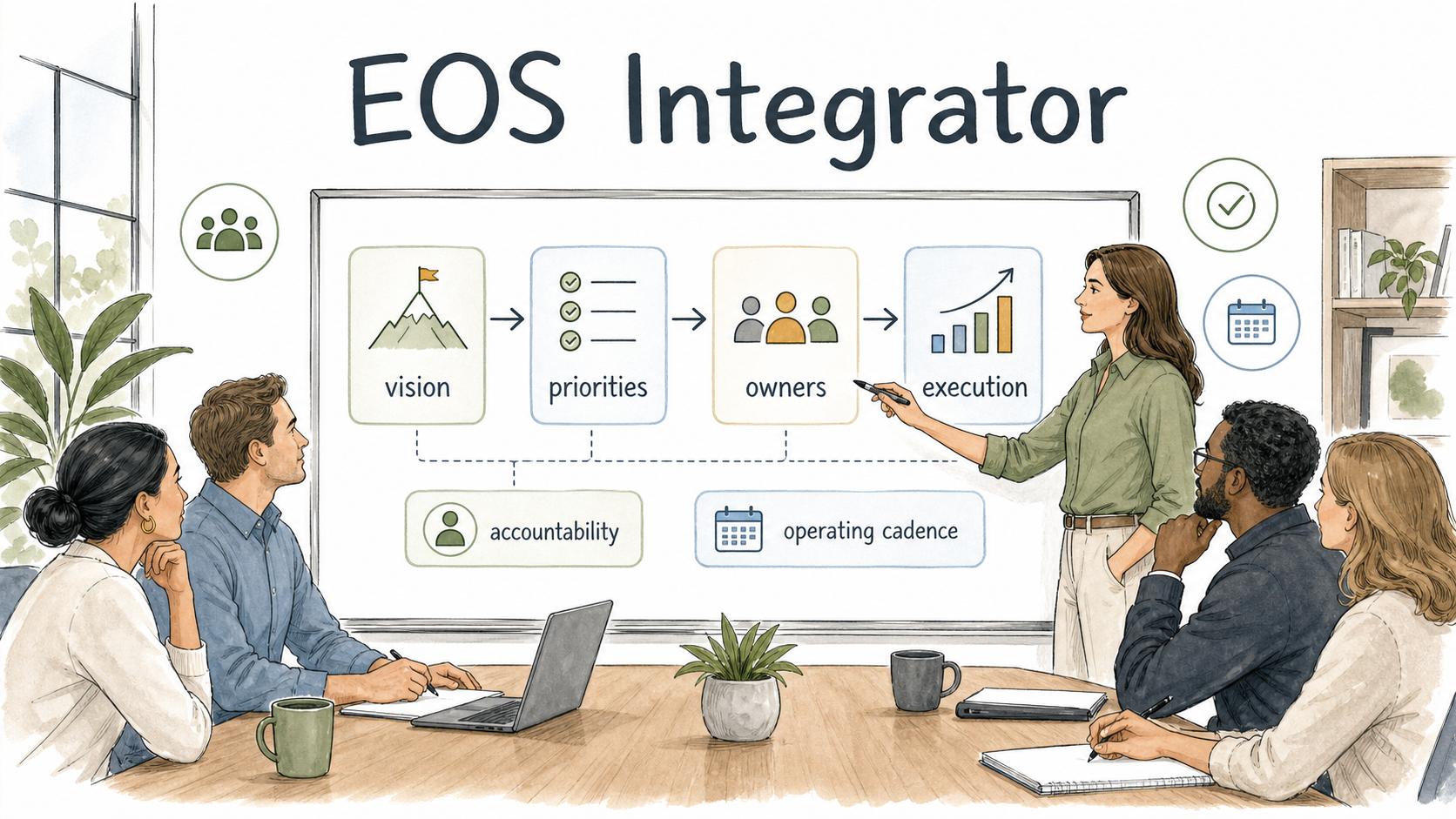
An EOS Integrator is the leadership role responsible for turning a company's vision into operating discipline inside the Entrepreneurial Operating System. EOS Worldwide describes the Integrator as the person who holds the organization together, executes the business plan, and holds the leadership team accountable. 1 In practice, the Integrator keeps major functions aligned, resolves cross-team tension, drives accountability, and makes sure priorities become real work.
This term uses EOS in the Entrepreneurial Operating System sense. An EOS Integrator is not a systems integrator, and the role is not automatically the same as a COO, although there can be overlap.
Why the EOS Integrator role matters
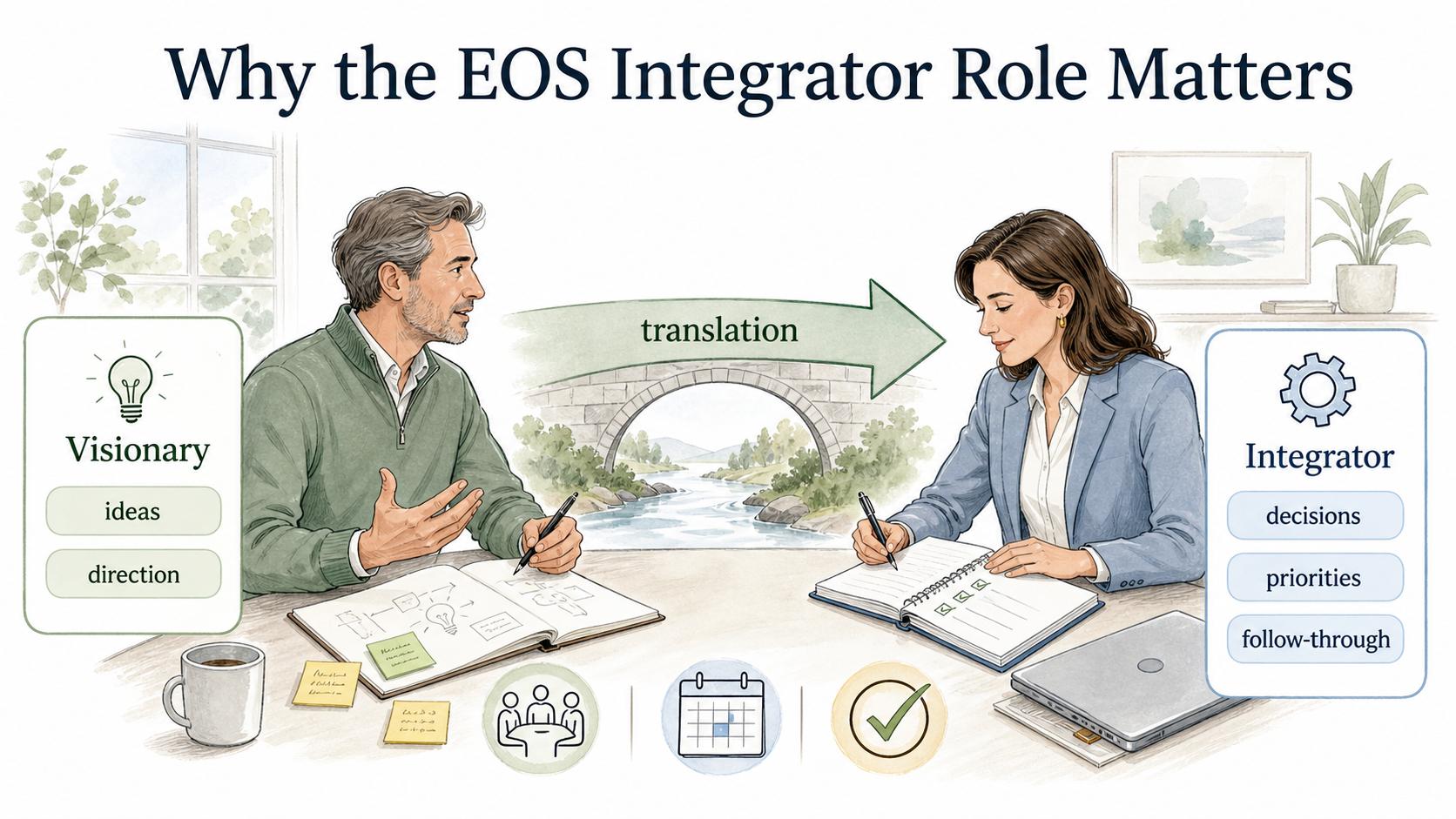
In EOS, growing companies often separate the Visionary role from the Integrator role. The Visionary tends to generate ideas, direction, relationships, and long-range energy. The Integrator turns that direction into decisions, priorities, meetings, accountability, and execution. EOS materials treat the Visionary/Integrator relationship as a core leadership pairing, not just two interchangeable titles. 2
That pairing helps when ideas outpace operating cadence. Departments may interpret priorities differently, leadership meetings may create discussion without decisions, and no one may be consistently deciding what gets done first. The Integrator creates operating clarity when the business is moving faster than its management habits.
The role is largely translation. An effective Integrator translates vision into Rocks, priorities into owner-level commitments, friction into decisions, and meetings into follow-through. Without that translation, a company can sound aligned in leadership meetings while behaving differently in sales, operations, finance, and customer success.
What an EOS Integrator does
An EOS Integrator usually operates across the leadership team rather than inside one narrow function. Responsibilities can include:
- Leading, managing, and holding the leadership team accountable
- Driving execution of the business plan and quarterly priorities
- Creating consistency across departments
- Resolving issues that cut across functions
- Keeping meetings focused on decisions and follow-through
- Protecting the operating cadence of the business
- Turning the Visionary's ideas into a practical sequence of work
The role is less about doing every job and more about making sure the right owners are doing the right work with enough clarity. That fits EOS's broader emphasis on leadership teams gaining alignment, traction, and healthier execution through practical tools. 3 The Integrator is often the person who asks, "Who owns this, by when, and what decision are we actually making?"
EOS Integrator vs related roles
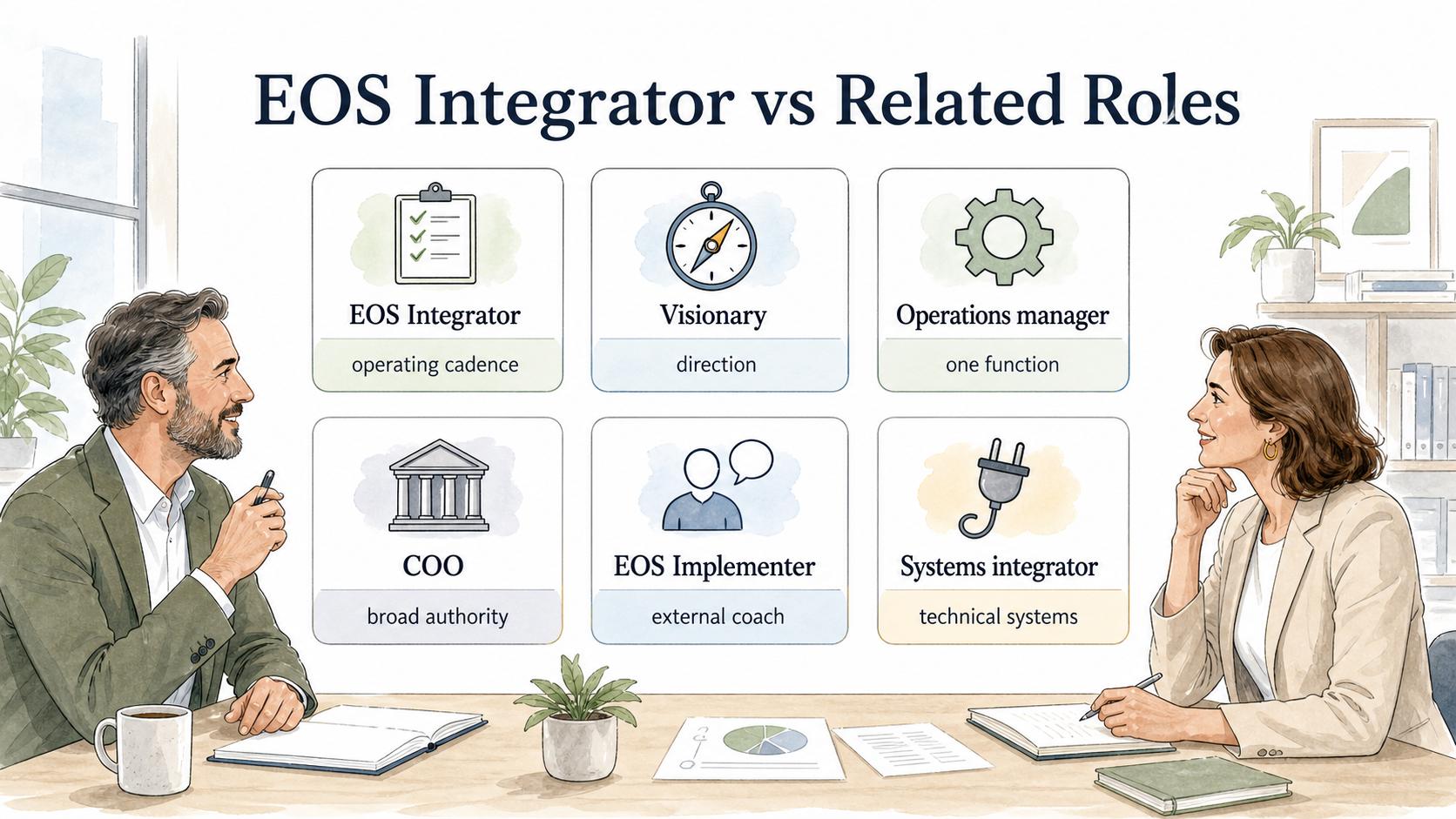
| Role | Primary focus | How it differs from an EOS Integrator |
|---|---|---|
| EOS Integrator | Aligning functions, executing the business plan, and holding leadership accountable | Specific EOS role that integrates the leadership team and operating cadence |
| Visionary | Ideas, market direction, relationships, culture, and long-term opportunity | Creates direction; the Integrator turns it into execution discipline |
| Operations manager | Day-to-day operational performance in one area or function | May be narrower than the full-company Integrator role |
| COO | Executive leadership over operations, often with broad authority | Can act as Integrator, but the title alone does not prove the EOS role is being performed |
| EOS Implementer | External teacher, facilitator, and coach for EOS adoption | Helps the company implement EOS; does not usually run the business day to day |
| Systems integrator | Connects technical systems, software, or infrastructure | A technical role, not the EOS leadership role |
This distinction matters because mislabeling the role creates poor expectations. A strong operations manager may not have the authority to challenge the whole leadership team. A technical systems integrator may have nothing to do with company operating rhythm. An EOS Implementer may help install the system while the company still needs an internal Integrator to run it.
Signs a company needs stronger integration
A company may need an Integrator, or a clearer Integrator function, when priorities keep changing without closure. Other signs include leadership meetings that generate discussion but not decisions, department heads who optimize locally at the expense of the company, and a Visionary whose ideas create energy but also overload.
Another signal is recurring confusion over ownership. If everyone agrees on the goal but nobody can say who owns the next action, the Integrator function is not strong enough yet.
The role becomes especially important when the company has enough complexity that informal coordination no longer works. Early teams can run on proximity and founder memory. Larger teams need a more explicit operating cadence.
How an Integrator uses documentation
An Integrator does not need documentation for its own sake. They need it because accountability breaks down when recurring work is trapped in memory, meetings, or one person's interpretation.
Useful documentation for an Integrator often includes leadership meeting agendas, quarterly priority trackers, process owner lists, escalation paths, role scorecards, issue-resolution notes, and repeatable SOPs. These artifacts make the operating system visible enough for leaders to inspect it, improve it, and teach it to new managers.
A practical rule: if the same operational confusion appears twice, it probably deserves a documented decision, process, or owner.
Documentation takeaway
For teams running on EOS, documentation should support traction instead of becoming a separate administrative hobby. The best artifacts help people know what matters this quarter, who owns each outcome, how repeatable work gets done, and where exceptions go.
Trails can support that work by capturing a workflow as someone performs it, turning it into a polished step-by-step guide, and creating an AI-narrated video version for training or sharing. That can be useful when an Integrator needs operating processes to be easier to create, teach, and maintain.
FAQ
Is an EOS Integrator the same as a COO?
Not always. A COO may perform the Integrator role, but EOS Integrator describes a specific leadership function: integrating the leadership team, resolving cross-functional tension, and driving execution within EOS.
Is an EOS Integrator an external consultant?
Usually no. The Integrator is an internal role running the business day to day. An EOS Implementer is the external coach or facilitator who helps the company learn and implement EOS.
What makes someone effective as an EOS Integrator?
The strongest Integrators create clarity, drive accountability, make decisions when tradeoffs are needed, and keep the leadership team focused on execution instead of endless discussion.
Sources
- 1
EOS Worldwide. What is an Integrator? Part II. www.eosworldwide.com/blog/46806-eos-integrator-part-ii.
- 2
EOS Worldwide. The Power of Roles. www.eosworldwide.com/s3e3-the-power-of-roles-slowing-down-to-speed-up-in-leadership-mark-odonnell-and-kelly-knight.
- 3
EOS Worldwide. What is EOS?. www.eosworldwide.com/what-is-eos.
- 4
Rocket Fuel University. EOS Implementer vs. Integrator vs. Visionary. rocketfueluniversity.com/integrator-resources/eos-implementer-vs-integrator-vs-visionary/.