
Glossary
EOS
 ChatGPT
 Perplexity
 Gemini
 Claude
What is EOS?
EOS stands for Entrepreneurial Operating System. In business, EOS is a specific operating system for leadership teams that want clearer priorities, stronger accountability, and a more disciplined way to run the company. EOS Worldwide describes it as a complete operating system for entrepreneurial businesses that helps leadership teams clarify vision, gain traction, and become healthier as a team. 1
This page uses EOS in the Entrepreneurial Operating System sense. It is a proper noun, not a generic abbreviation for any operating system, and it should not be confused with technical meanings like end of service or electro-optical system.
Why EOS matters
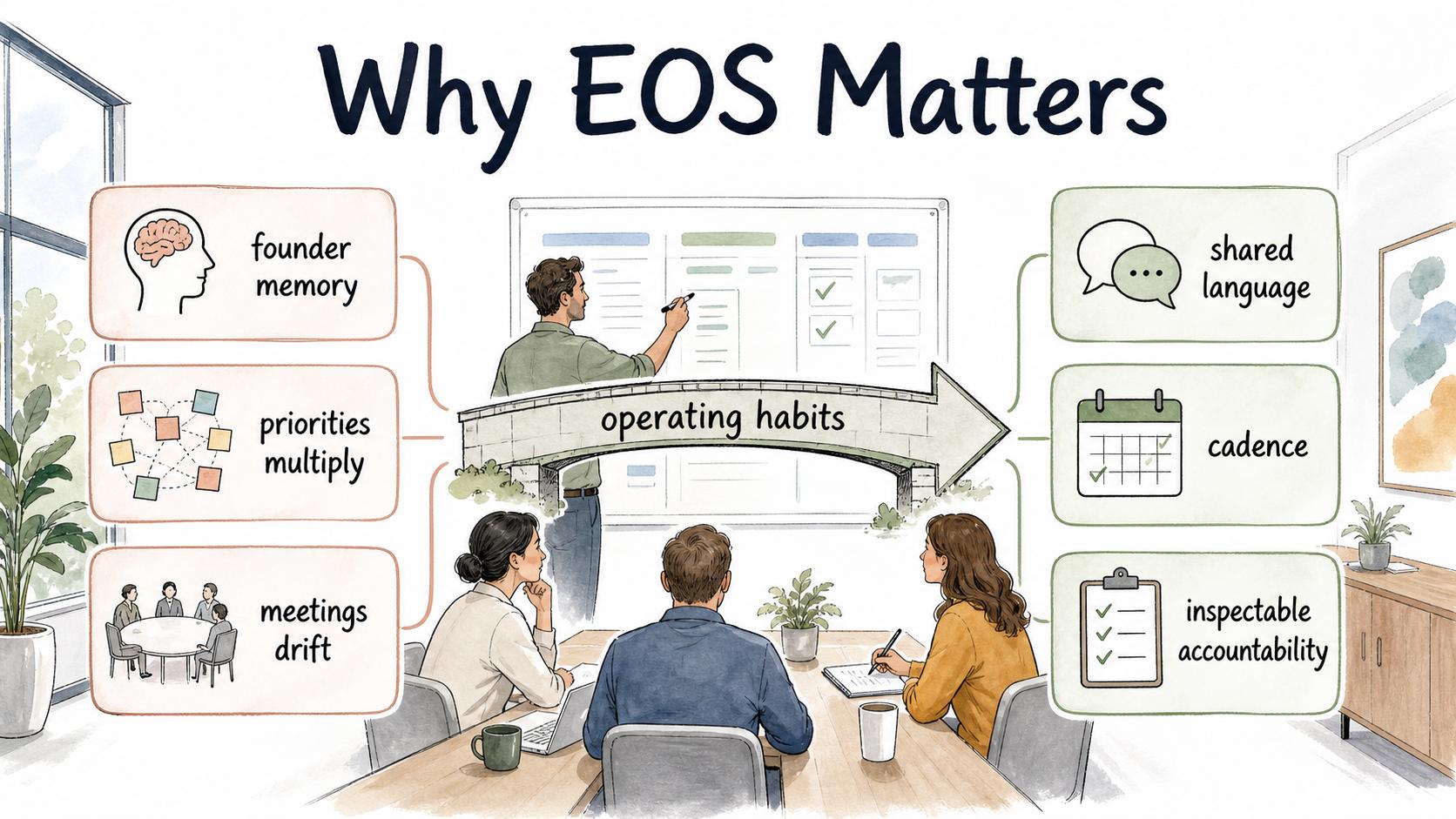
EOS matters because many growing companies outgrow founder memory before they build strong operating habits. Early on, a small team can coordinate through proximity, urgency, and constant conversation. As the company grows, those habits start to break. Priorities multiply, meetings drift, departments optimize for their own goals, and leaders disagree about what actually matters this quarter.
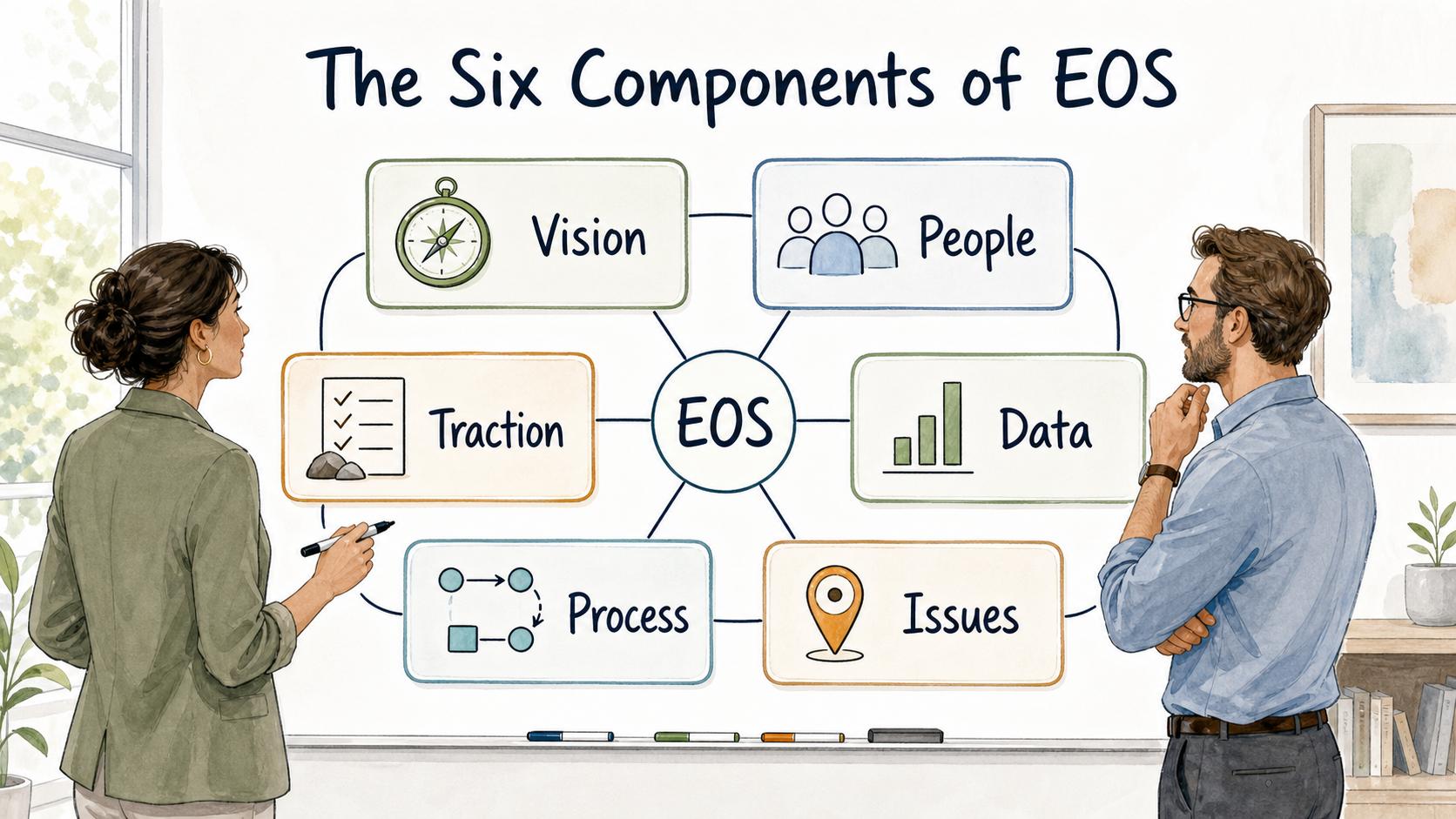
EOS gives the leadership team a shared language and cadence for running the business. It connects vision, people, data, issues, process, and traction so the company can move from broad ambition to specific execution. EOS's official model names those six areas as the key components every company must strengthen. 2
The practical value is inspectable accountability. When priorities, owners, numbers, issues, and meeting rhythms are explicit, the team has fewer places to hide confusion.
The six components of EOS
EOS is commonly explained through six key components. The names are simple, but each one points to a different kind of operating discipline.
| EOS component | What it focuses on | Practical question it helps answer |
|---|---|---|
| Vision | Shared direction and long-term clarity | Are we aligned on where the company is going? |
| People | Right people in the right roles | Do we have the right team and accountability structure? |
| Data | Objective measures of performance | What numbers tell us whether the business is healthy? |
| Issues | Surfacing and solving problems | Are we naming the real blockers and resolving them? |
| Process | Core processes that make the business repeatable | Have we documented and followed the way important work gets done? |
| Traction | Execution rhythm and short-term priorities | Are we completing the work we said mattered most? |
The components are connected. Weak process can create people problems. Poor data can hide issues. A strong vision without traction can still leave the team busy but unfocused.
How EOS works in practice
EOS works by giving leaders a recurring operating rhythm. Teams clarify vision, set quarterly priorities, define ownership, track metrics, identify issues, and use structured meetings to keep work moving.
The system asks leaders to make commitments visible: who owns the number, who owns the issue, who owns the process, and what will be done by the next meeting or quarter. That visibility is where many companies feel the biggest change.
A team can say it values accountability for years without changing much. EOS pushes the question into the calendar: what did we agree to, did it happen, and what is blocking the next step?
EOS vs a business operating system
A business operating system is a broad category: any repeatable management framework a company uses to run planning, execution, measurement, communication, and accountability. EOS is one specific business operating system.
That distinction matters because some readers search for EOS expecting a general concept. EOS has its own vocabulary, tools, roles, and meeting practices. A company may choose EOS, another framework, or a custom operating rhythm. The underlying problem is the same: turning strategy into repeatable management behavior.
The risk is adopting the vocabulary without the discipline. Calling a meeting a Level 10 meeting, naming quarterly priorities Rocks, or writing down a vision does not create traction by itself. The operating system works only if leaders use it consistently enough to change decisions and behavior.
When EOS is a good fit
EOS tends to fit companies that have moved beyond pure startup improvisation but are not yet operating with consistent management systems. EOS Worldwide says the system is designed for privately held entrepreneurial companies with roughly 10 to 250 employees, while emphasizing leadership-team openness and growth orientation over size alone. 3 Common signals include unclear priorities, recurring leadership-team friction, too many unresolved issues, inconsistent process ownership, and goals that do not translate into weekly behavior.
It can also help when a founder or Visionary has more ideas than the organization can absorb. EOS creates a way to filter, sequence, and execute without turning every new idea into an immediate company priority.
EOS is less useful if leaders want a label but not the operating discipline. The framework requires recurring meetings, visible metrics, issue-solving habits, and willingness to make ownership explicit. Teams that dislike those mechanics may adopt the words but keep the old habits.
Documentation takeaway
The Process component is where documentation becomes especially concrete. EOS's Process Component emphasizes documented core processes that are followed by all, not just written down and ignored. 4 A company cannot rely on repeatable processes if the work lives only in memory, private shortcuts, or one person's interpretation. Core workflows need enough documentation that people can learn them, inspect them, and improve them.
That does not mean every process needs a heavy manual. The most important recurring work should have a clear owner, known steps, visible exceptions, and a way to keep the guide current.
Trails can help with that part of EOS by capturing a workflow as someone performs it, turning it into a polished step-by-step guide, and creating an AI-narrated video version for training or sharing. For teams trying to strengthen the Process component, faster documentation can reduce the gap between how work is supposed to happen and how it actually happens.
FAQ
What does EOS stand for?
In this business context, EOS stands for Entrepreneurial Operating System. It is a specific business operating system, not a generic abbreviation.
Is EOS only for large companies?
No. EOS is commonly used by entrepreneurial companies that need more structure than informal coordination can provide. The key fit is operating complexity, not just headcount.
What is the difference between EOS and an EOS Integrator?
EOS is the operating system. The EOS Integrator is the leadership role that helps turn the company's vision and operating rhythm into execution across functions.
Does EOS replace process documentation?
No. EOS can make process documentation more important because the Process component depends on repeatable ways of working. Documentation is one way teams make those processes teachable and maintainable.
Sources
- 1
EOS Worldwide. EOS Worldwide FAQ. www.eosworldwide.com/faq.
- 2
EOS Worldwide. What is EOS?. www.eosworldwide.com/what-is-eos.
- 3
EOS Worldwide. What is EOS?. www.eosworldwide.com/what-is-eos.
- 4
EOS Worldwide. The Process Component. www.eosworldwide.com/process-component.