
Glossary
Emergency Response SOP
 ChatGPT
 Perplexity
 Gemini
 Claude
What is an emergency response SOP?
An emergency response SOP is a standard operating procedure for urgent incidents that threaten people, property, operations, data, or service continuity. It names the trigger, first actions, decision owner, escalation path, communications, and recovery checks so people don't have to invent the response while the incident is already moving.
A good SOP removes avoidable debate about roles, channels, and next steps when people have the least time to sort them out.
What an emergency response SOP should clarify
A useful emergency response SOP defines the operating rhythm of the response: how the incident is recognized, who takes control, what happens first, and how the team decides whether to escalate or stand down. For workplaces covered by OSHA emergency action plan requirements, 29 CFR 1910.38 gives a practical floor: reporting procedures, evacuation procedures, accountability after evacuation, rescue or medical duties, contact roles, alarm systems, training, and plan review. 1
The strongest SOPs are specific about the first few minutes. People may know the broad goal, such as evacuate, isolate a system, notify customers, or contact a manager, but still fail if the document does not say what happens first or who has authority when the normal owner is unavailable.
| SOP area | What it should answer |
|---|---|
| Trigger | What activates this SOP, and what is explicitly out of scope? |
| First responder | Who takes the first action before leadership joins? |
| Decision owner | Who can escalate, pause work, close a site, or contact outside support? |
| Communication path | Which channel is used, who is notified, and what template is used? |
| Safety or containment step | What reduces immediate risk before deeper analysis starts? |
| Recovery step | What must be true before normal operations resume? |
The hidden test is simple: if the person reading the SOP is nervous, tired, or alone on a shift, can they follow it without interpreting company folklore?
Where emergency response SOPs usually break
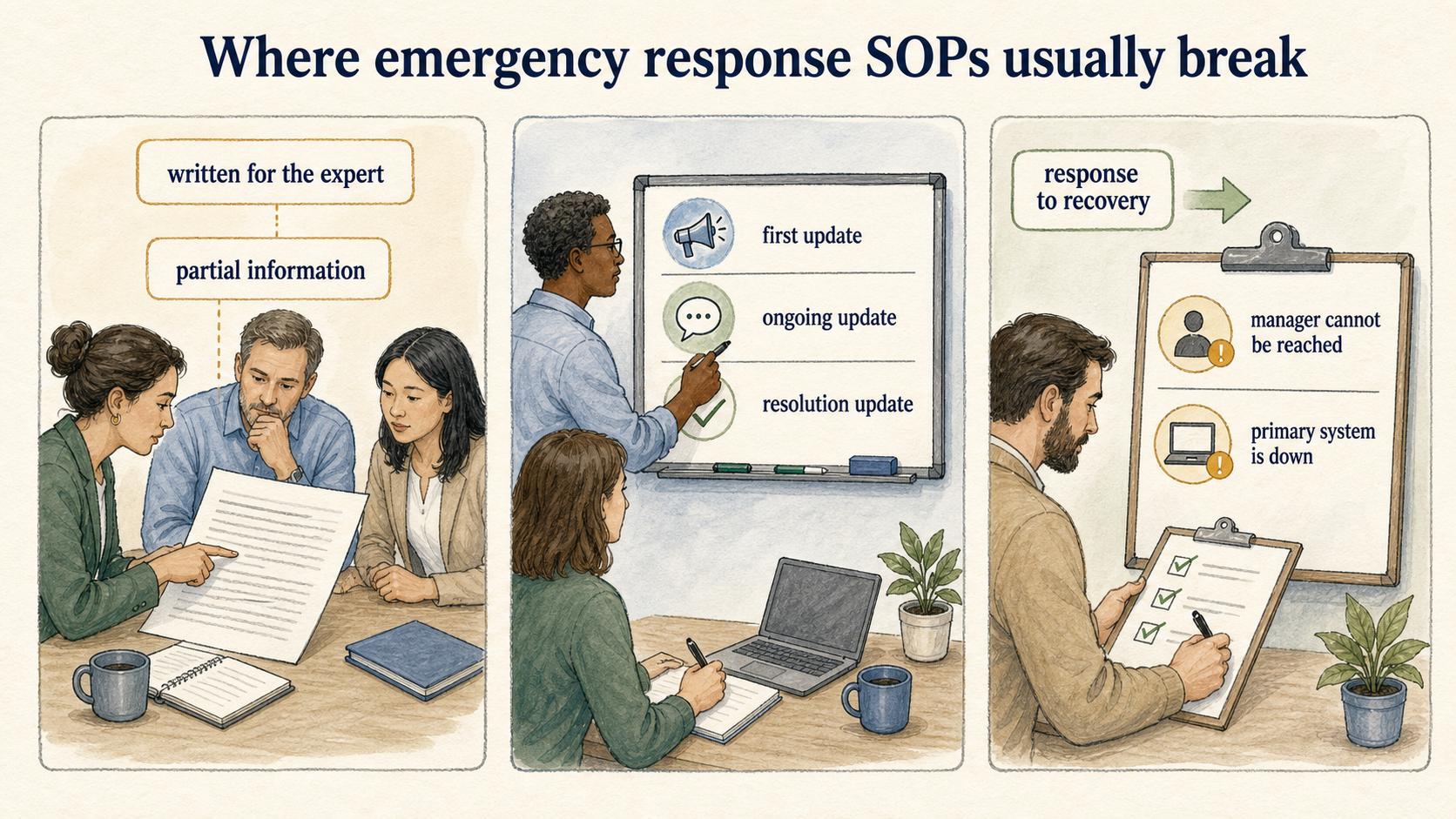
The common mistake is writing the SOP for the person who already understands the operation. That creates a document that looks complete during review but fails during an incident.
A better SOP assumes partial information. It tells the reader what to do if the manager cannot be reached, if the primary system is down, if the location lead is new, or if the incident is not severe enough to trigger a full response but is too important to ignore.
Communication is another common weak spot. In an emergency, silence creates duplicate work and bad assumptions. FEMA's Incident Command System guidance treats common terminology, accountability, integrated communications, and information management as core incident-management characteristics, so the SOP should say who posts the first update, where it goes, how often updates continue, and what must not be promised until facts are confirmed. 2
The last weak spot is the handoff from response to recovery. Teams often document the urgent action but not the cleanup: incident notes, customer follow-up, equipment checks, access restoration, root-cause review, or SOP revision. Ready Business separates response and recovery planning, which is a useful reminder to document the exit path from the incident. 3
Example of an emergency response SOP in practice
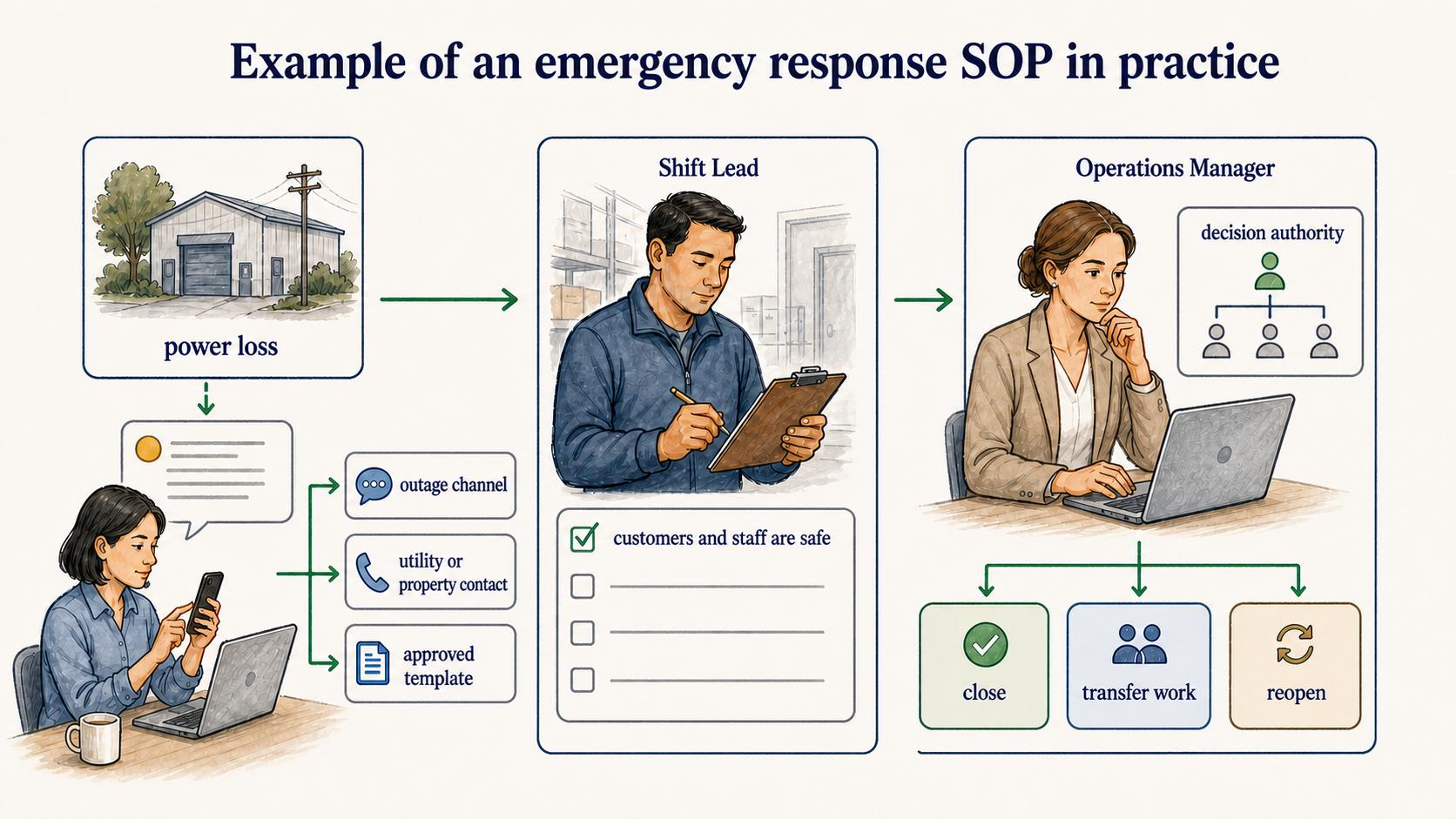
Imagine a multi-location service business loses power at one site during operating hours. A weak SOP says, "Notify management and follow emergency procedures." A usable SOP says the shift lead confirms whether customers and staff are safe, moves communication to the outage channel, calls the utility or property contact, posts a status update using the approved template, and waits for the operations manager to decide whether to close, transfer work, or reopen.
The useful detail is decision authority. The SOP gives the first responder enough room to stabilize the situation without pretending they own every downstream decision.
A practical emergency response SOP template
Use this AI-ready prompt to create a first draft, then have the people who actually handle the incident test it against realistic scenarios.
## Emergency Response SOP Template

**Glossary term:** Emergency Response SOP
**Source:** Trails Glossary — trails.so/glossary/emergency-response-sop

---

### 01. Create an emergency response SOP

"Create an emergency response SOP for [team/location/process].
The emergency scenario is: [scenario].
Include:
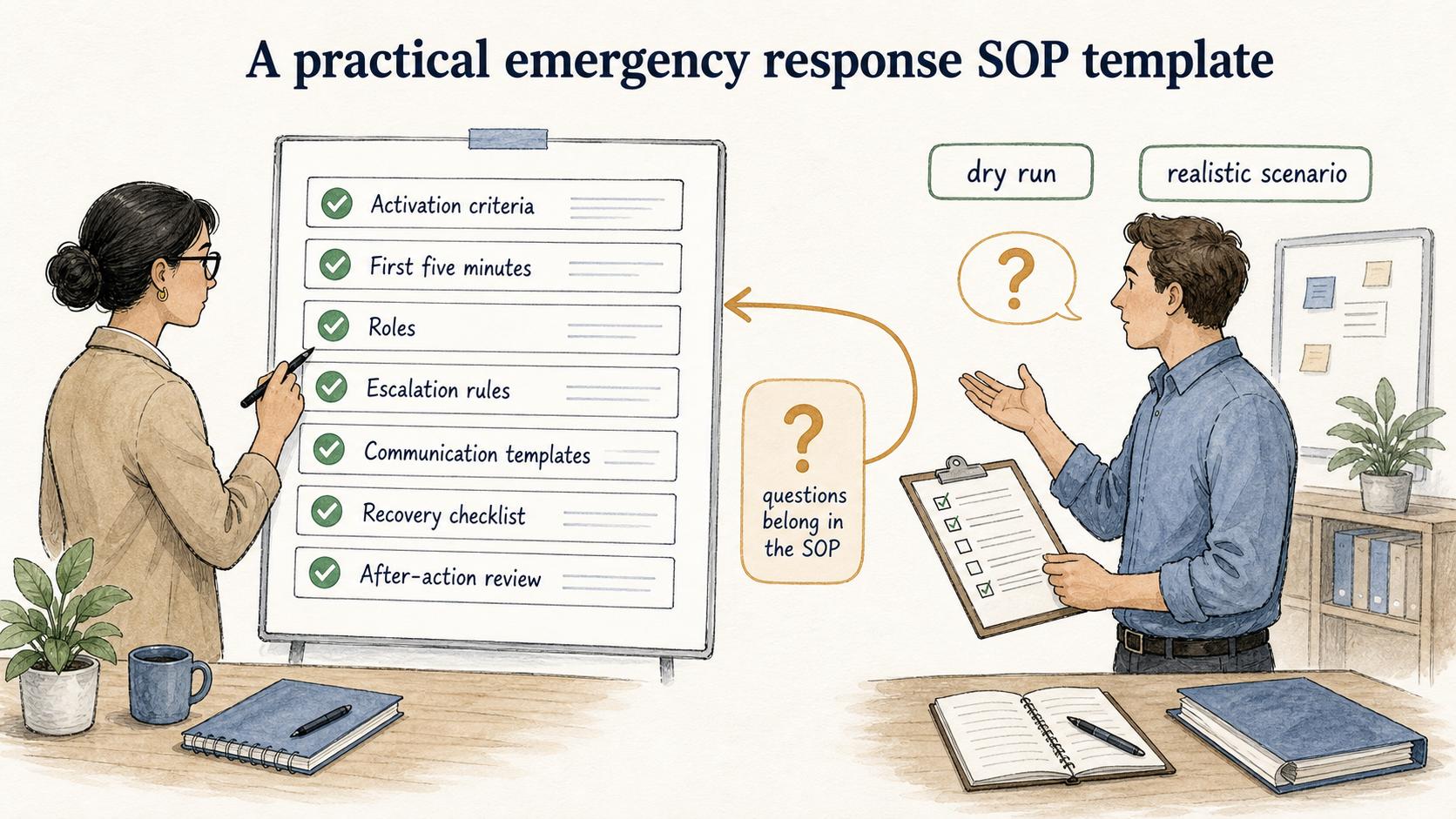
- Activation criteria: when this SOP should and should not be used
- First five minutes: exact actions in order
- Roles: first responder, decision owner, communications owner, backup owners
- Escalation rules: when to contact leadership, vendors, emergency services, customers, or internal teams
- Communication templates: first update, ongoing update, resolution update
- Recovery checklist: what must be confirmed before normal work resumes
- After-action review: what evidence, notes, and process changes should be captured
Write it for a trained employee who may be under pressure and may not have the usual manager available."
Do not treat the output as final. The best review is a dry run: hand the draft to someone who was not involved in writing it and ask them to walk through a realistic incident. Any question they ask out loud probably belongs in the SOP.
Documentation takeaway
An emergency response SOP preserves judgment under pressure. It should define the few decisions that matter most: when the SOP starts, who leads, how risk is contained, how updates move, and how the team exits the incident cleanly.
Keep the language plain. Replace vague commands like "notify stakeholders" with named roles and channels. Replace "as soon as possible" with a timing expectation. Replace "follow up" with the artifact that proves the follow-up happened.
How Trails helps
Trails helps teams turn real emergency-response practice into clearer SOPs. A manager or experienced operator can capture the workflow as they perform or rehearse it, then turn that capture into a polished step-by-step guide. For training, Trails can also create an AI-narrated video version so employees can review the response before they need it.
Sources
- 1
OSHA. 29 CFR 1910.38 emergency action plans. www.osha.gov/laws-regs/regulations/standardnumber/1910/1910.38.
- 2
FEMA. FEMA ICS Review Document. training.fema.gov/emiweb/is/icsresource/assets/ics%20review%20document.pdf.
- 3
Ready Business. Emergency plans. www.ready.gov/business/emergency-plans.