
Glossary
DevOps SOP
 ChatGPT
 Perplexity
 Gemini
 Claude
What is a DevOps SOP?
A DevOps SOP is a standard operating procedure for repeatable work across software delivery, infrastructure, reliability, and IT operations. It defines the trigger, owner, required checks, execution steps, evidence, and exception path for work that should not depend on one person's memory.
The useful version is not a transcript of terminal commands. It tells an engineer what must be true before work starts, what to verify while the work is happening, and when to stop because the normal path has become unsafe.
Why DevOps SOPs matter
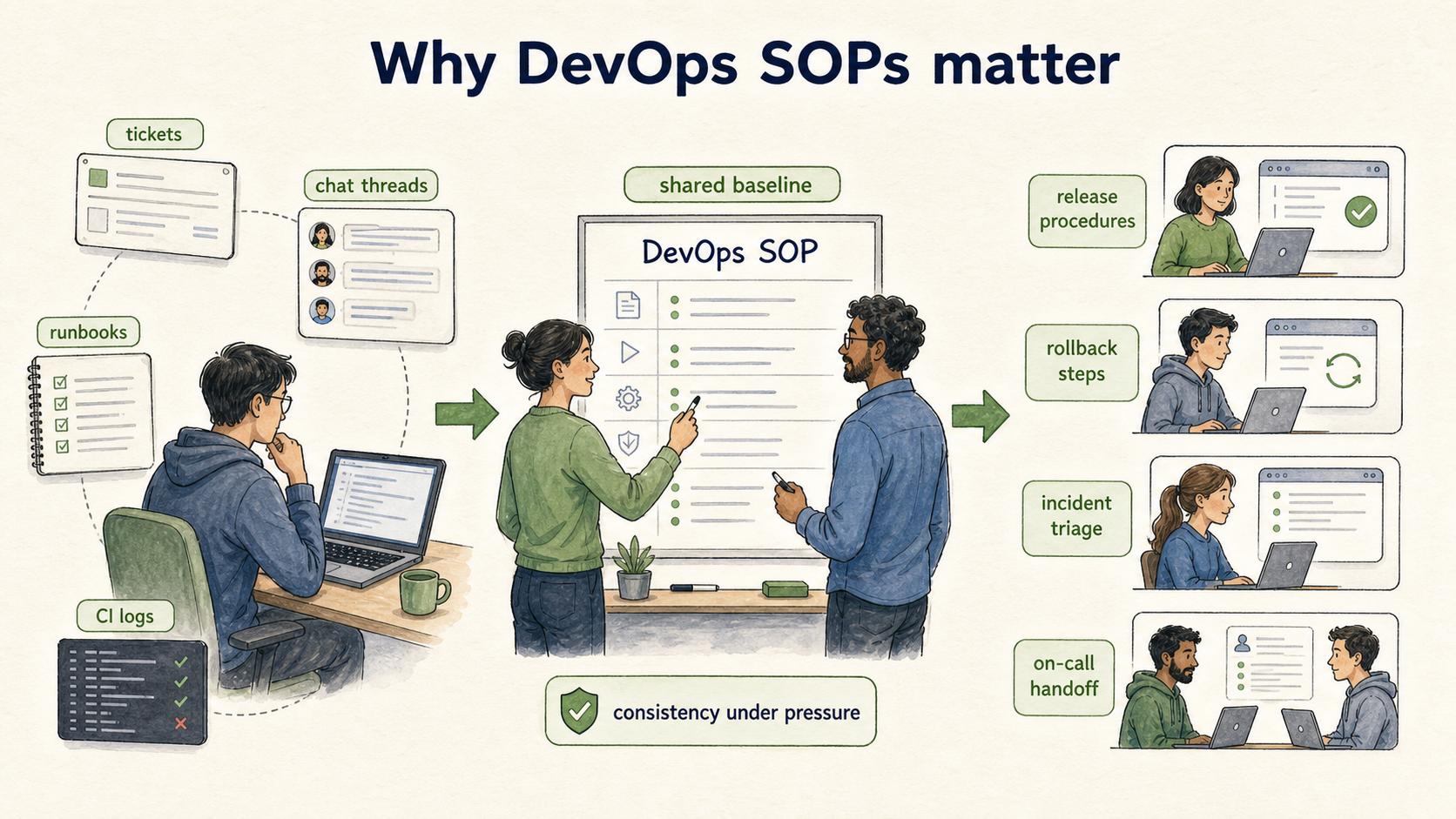
DevOps teams often move faster than their documentation. The real process ends up scattered across tickets, chat threads, runbooks, CI logs, and the person who handled the last incident. That works until someone is out, a release fails after hours, or a routine change touches a system nobody has deployed in months.
A DevOps SOP gives the team a shared baseline for work that carries operational risk: release procedures, rollback steps, access reviews, environment setup, database migration checks, incident triage, on-call handoff, and infrastructure provisioning.
The hidden value is consistency under pressure. During normal work, the SOP reduces rework and handoff friction. During urgent work, it helps people slow down the right decisions: whether to roll back, who approves a risky change, which logs to check first, and what proof is needed before calling an incident resolved. 1
What a DevOps SOP should include
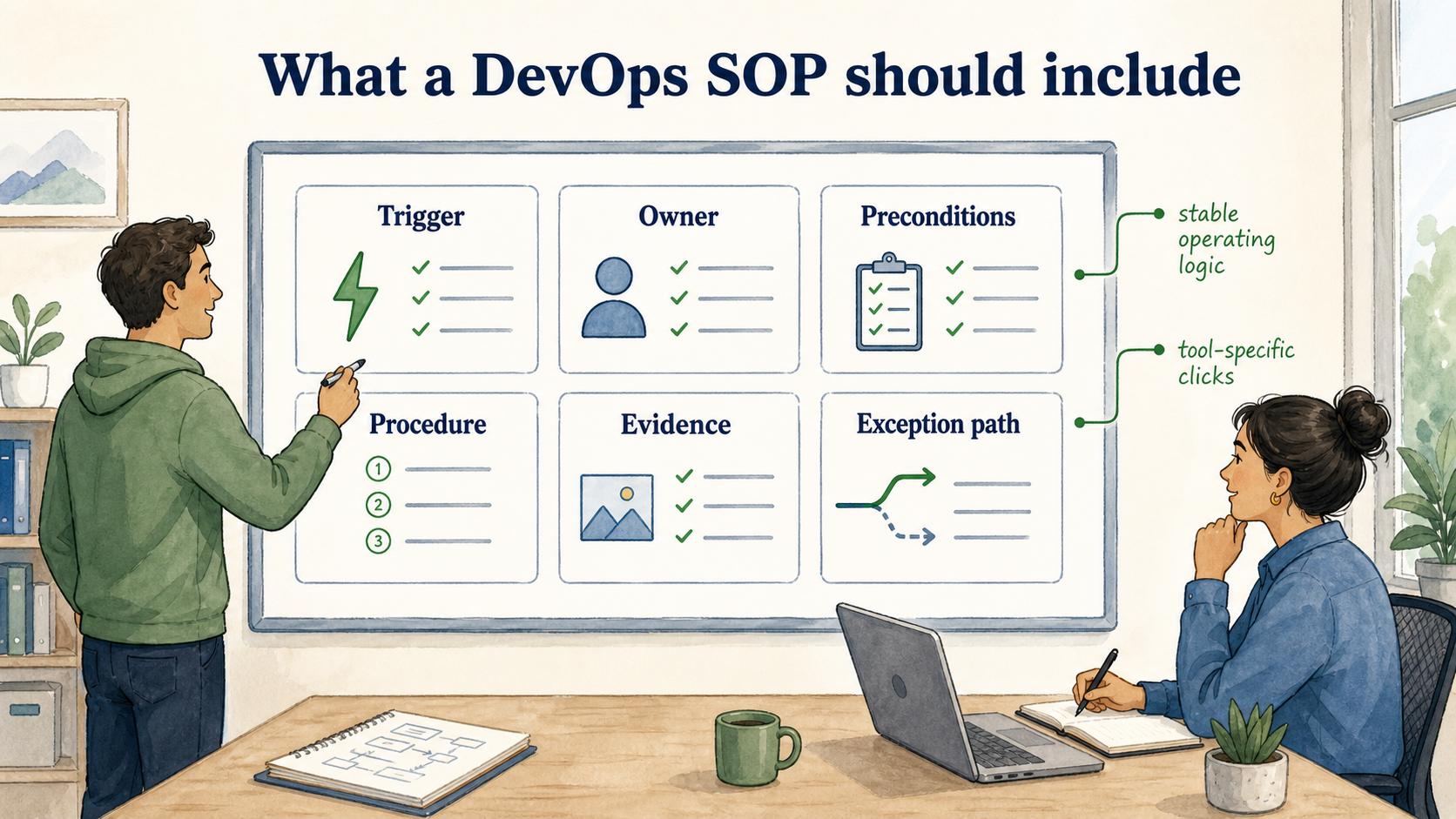
A DevOps SOP should be specific enough to run, but not so brittle that it breaks when a command, dashboard, or cloud screen changes. Separate the stable operating logic from the tool-specific clicks.
| SOP element | What it should answer | DevOps example |
|---|---|---|
| Trigger | When should this procedure be used? | A production deployment is scheduled, failed, or needs rollback |
| Owner | Who runs the procedure and who approves exceptions? | Release captain, on-call engineer, service owner |
| Preconditions | What must be true before work starts? | Tests passed, migration reviewed, monitoring dashboard open |
| Procedure | What steps happen in order? | Deploy, verify health checks, monitor error rates, notify stakeholders |
| Evidence | What proves the step worked? | Build ID, deployment link, logs, screenshots, metric snapshots |
| Exception path | What happens when the happy path fails? | Pause rollout, escalate, roll back, open incident channel |
The evidence column is the part teams most often skip. Without it, the SOP becomes a performance script instead of an operating control. Someone can say they checked monitoring, but the team cannot see what they checked or which threshold counted as healthy. 2
DevOps SOP examples
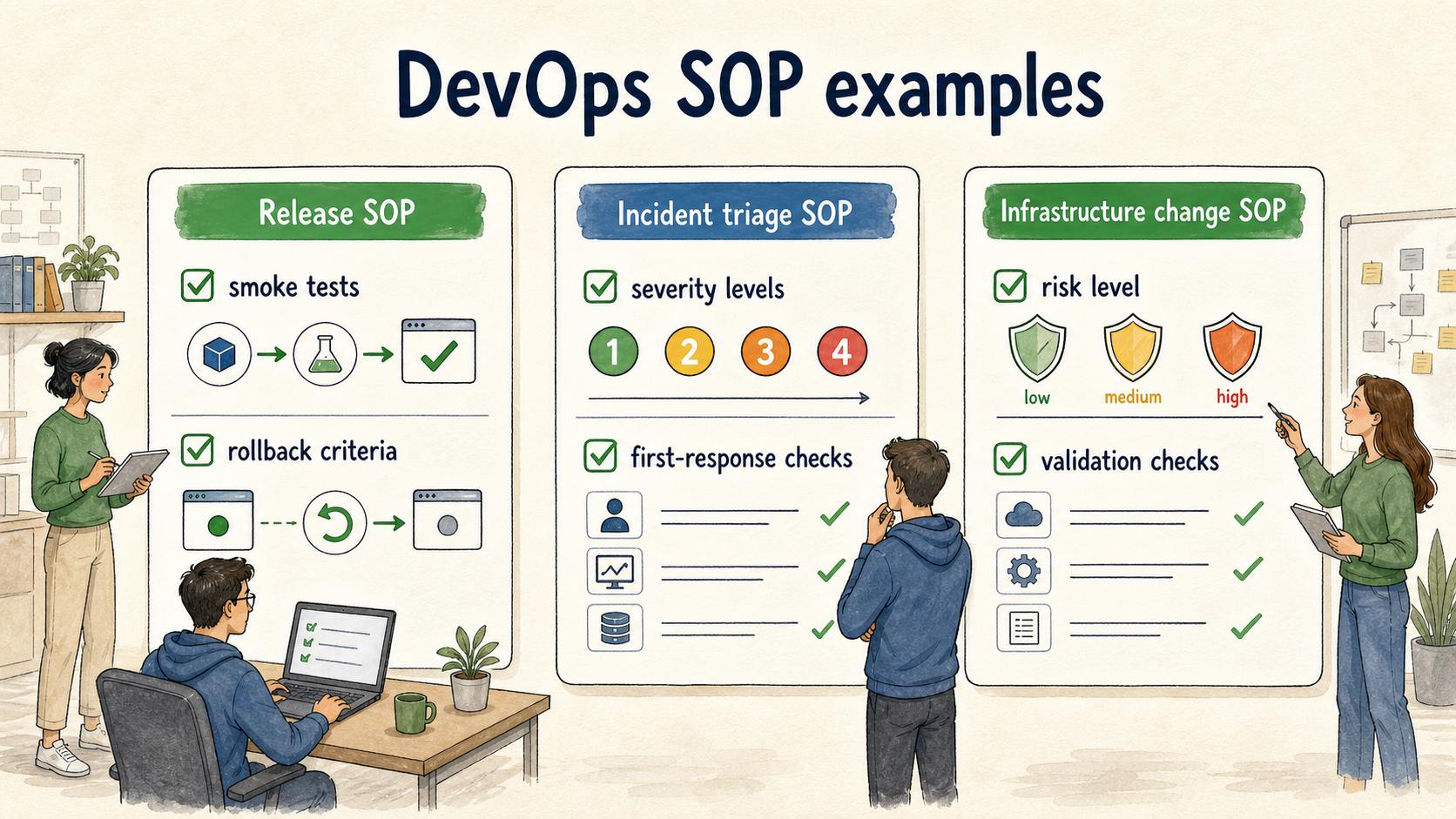
A release SOP might cover branch freeze rules, build verification, deployment windows, smoke tests, rollback criteria, and stakeholder communication. It should define a successful release, not just the button sequence for deploying code.
An incident triage SOP might define severity levels, alert intake, first-response checks, communication cadence, handoff rules, and post-incident notes. Its job is not to diagnose every possible failure. Its job is to make the first 10 minutes organized enough that diagnosis can happen. 3
An infrastructure change SOP might cover request review, risk level, backup requirements, approval rules, implementation steps, validation checks, and change log updates. The procedure should make it hard to skip the safeguards that only feel important after a failed change. 4
How to write a DevOps SOP that people will actually use
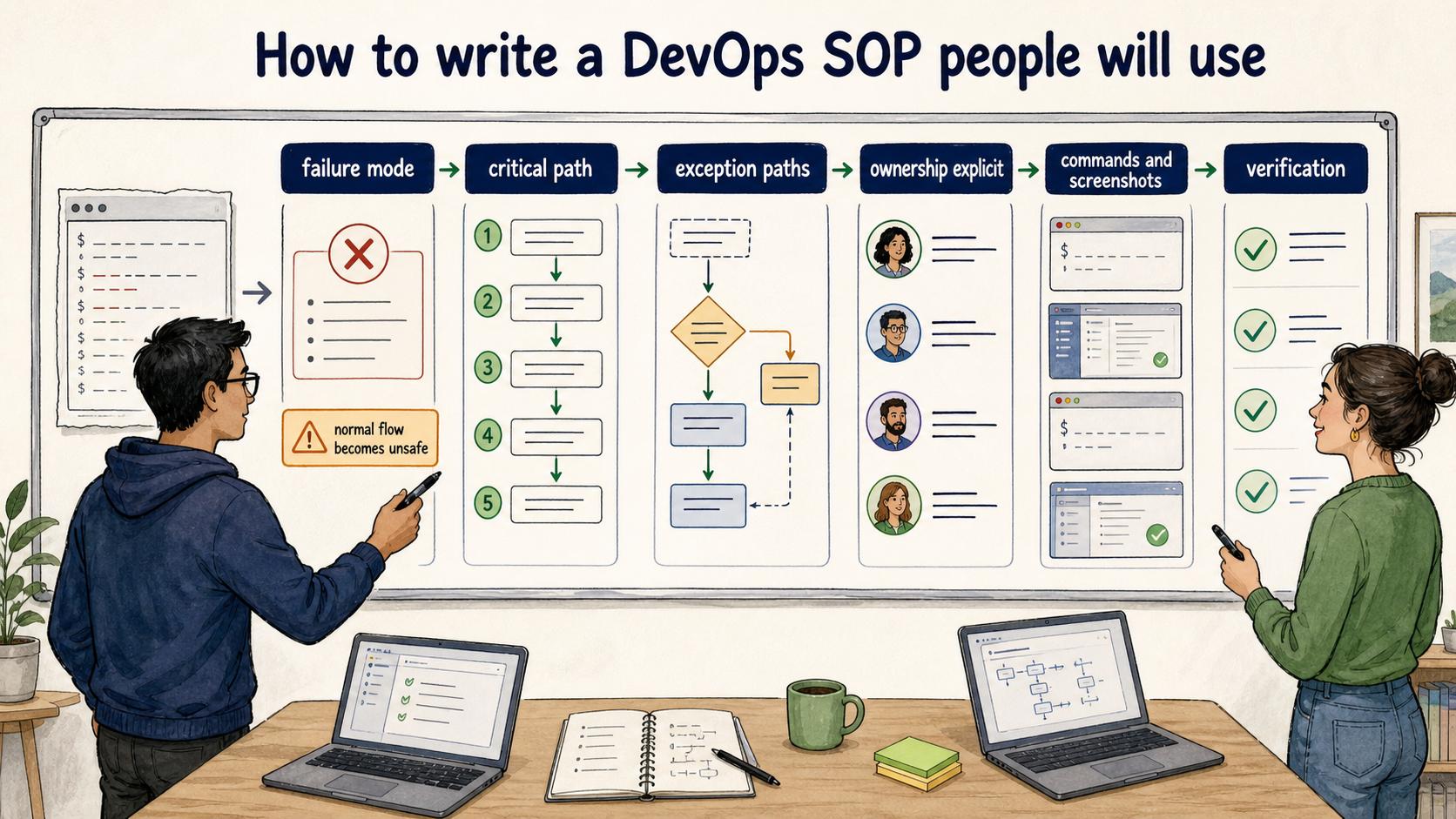
Start with the failure mode, not the tool. A procedure called "Deploy from GitHub Actions" may go stale when the team changes CI tooling. A procedure called "Production release and rollback" stays useful because the operating problem remains the same.
Write the critical path first. Put the normal flow in the main procedure, then add exception paths for the failures that change what someone should do: failed checks, elevated error rates, blocked approval, missing access, or rollback needed.
Make ownership explicit. If the SOP says "notify the team," it is incomplete. Say who notifies, where they notify, and what the message must contain. In technical operations, vague ownership creates duplicated effort during incidents and silent gaps during routine changes.
Keep commands and screenshots close to the workflow, but do not turn the SOP into a brittle UI transcript. Include exact commands when they matter. When the interface is likely to change, document the state the user needs to reach and the verification that proves it happened.
AI-ready DevOps SOP prompt
Use this prompt to create a first draft, then have a senior engineer or service owner review it before the SOP becomes official.
## DevOps SOP Template

**Glossary term:** DevOps SOP
**Source:** Trails Glossary — trails.so/glossary/devops-sop

---

### 01. Create a DevOps SOP

"Create a DevOps SOP for [process], used by [team] when [trigger]. Include: purpose, scope, owner, required access, prerequisites, step-by-step procedure, verification evidence, rollback or exception path, communication requirements, and review cadence. Optimize the SOP for someone competent but unfamiliar with this specific system. Call out assumptions, decisions that require human approval, and artifacts that should be captured after completion."
Common mistakes
The most common mistake is documenting only the happy path. DevOps work is full of partial failures: a deploy succeeds but error rates rise, a rollback works but leaves a migration in an awkward state, or an alert clears before the cause is understood. A usable SOP tells people what to do when the normal flow becomes unsafe.
Another mistake is hiding approvals in team culture instead of the document. If a production database change needs a second reviewer, write that into the SOP. If the on-call engineer can start a rollback without waiting for a manager, write that too.
Finally, do not let the SOP sit somewhere separate from the work. Link it from the runbook, ticket template, deployment checklist, or incident channel where the team will need it.
How Trails helps
Trails can capture a DevOps workflow as someone performs it, then turn that workflow into a polished step-by-step guide. For procedures that involve tools, dashboards, or repeated handoffs, that makes it easier to document the actual workflow instead of reconstructing it later from memory. Trails can also create an AI-narrated video version for training or sharing with teammates.
Sources
- 1
DORA. DORA software delivery performance metrics. DORA. dora.dev/guides/dora-metrics/.
- 2
Google Cloud. Google Cloud Four Keys measurement guide. Google Cloud. cloud.google.com/blog/products/devops-sre/using-the-four-keys-to-measure-your-devops-performance.
- 3
NIST. NIST SP 800-61 Rev. 3 incident response guidance. National Institute of Standards and Technology. nvlpubs.nist.gov/nistpubs/specialpublications/nist.sp.800-61r3.pdf.
- 4
NIST. NIST SP 800-128 security-focused configuration management. National Institute of Standards and Technology. csrc.nist.gov/pubs/sp/800/128/upd1/final.