
Glossary
Software Development SOP
 ChatGPT
 Perplexity
 Gemini
 Claude
What is a software development SOP?
A software development SOP is a standard operating procedure for a repeatable part of the software delivery process. It can cover workflows such as code review, release approval, QA handoff, environment setup, incident response, dependency updates, production deployment, or customer data access.
A good software development SOP standardizes the parts of engineering work where inconsistency creates quality, security, uptime, customer impact, or compliance risk.
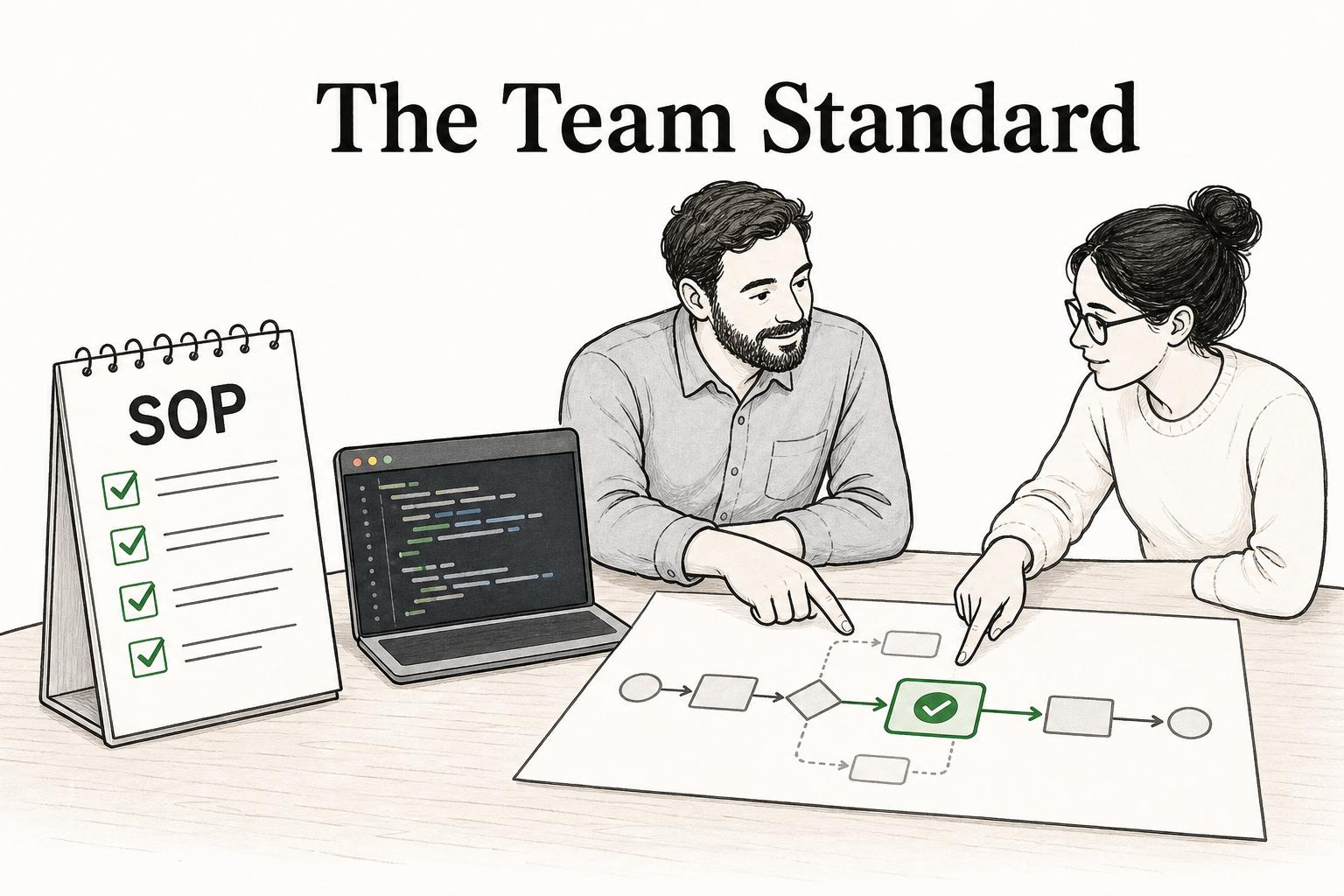
What a software development SOP should cover
A useful software development SOP documents the operating agreement around a workflow. It should not duplicate every ticket, pull request, architecture note, build script, or chat thread.
At minimum, it should clarify the purpose, scope, trigger, roles, required tools, procedure, review points, escalation path, definition of done, owner, and review cadence. The most valuable details are often the checks experienced engineers do automatically: which branch is safe, which tests must pass, which approval is required, what customer impact needs review, and which signal should be watched after release.
DORA's current software delivery metrics include change lead time, deployment frequency, failed deployment recovery time, change fail rate, and deployment rework rate. Those metrics are useful references when a release or operations SOP needs clear checks for speed, stability, and recovery.1
For example, a deployment SOP might define when a release can go out, who approves it, what checks must pass, how deployment is monitored, and what happens if error rates move in the wrong direction. Google's SRE release-engineering guidance emphasizes repeatable release processes and intentional, documented release steps. Exact commands may belong in a runbook or automation script. The SOP defines the team standard.2
When software teams need SOPs
Not every engineering task deserves an SOP. If a team documents every tiny preference, the process library becomes noise.
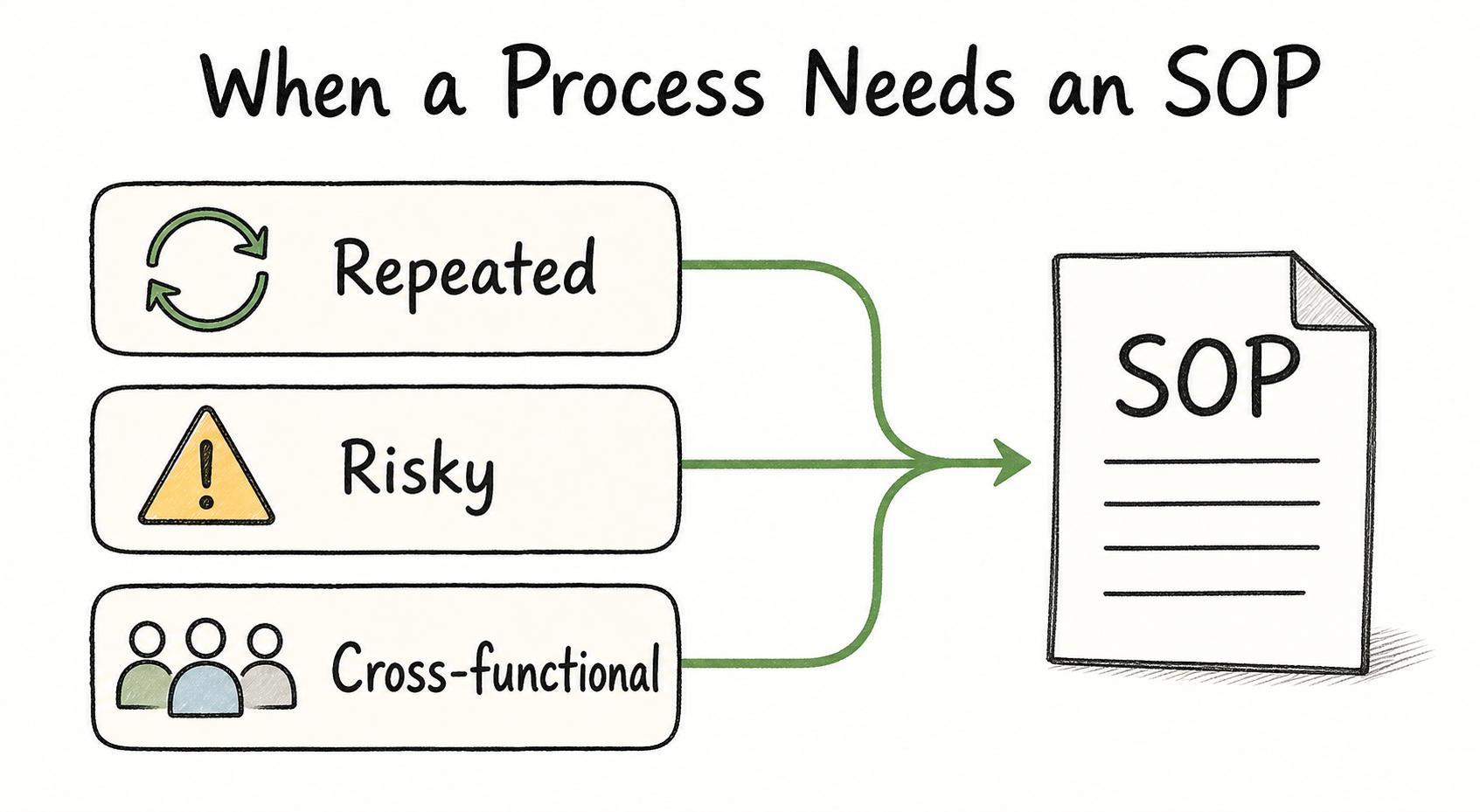
Software development SOPs are most useful when the workflow is repeated, cross-functional, risky, or easy to perform inconsistently. Good candidates include production deployments, emergency hotfixes, code review standards, security patch handling, incident triage, customer data access requests, QA release sign-off, feature flag changes, API deprecation, and new developer environment setup.
A practical test is: if doing the workflow incorrectly creates customer pain, security risk, downtime, compliance exposure, or expensive rework, it probably deserves a clear procedure. NIST's security-focused configuration management guide describes configuration change control as a documented process that controls changes from proposal through implementation and testing, with responsibilities and authorities clearly articulated.3
Software development SOP vs technical documentation
Software teams already use many documentation types. The SOP should not try to replace them.
| Format | Main purpose | Example |
|---|---|---|
| Software development SOP | Defines the approved workflow for repeatable engineering work | How to release a production change |
| Technical documentation | Explains how a system, API, architecture, or tool works | How the billing service calculates invoices |
| Runbook | Gives operational or troubleshooting actions | What to do when queue latency spikes |
| Checklist | Confirms required items before a handoff or decision | Pre-release QA checklist |
The boundary matters. A technical document may explain how the billing system works. A software development SOP explains what the team does when changing, reviewing, releasing, or supporting that system.
Secure development and SOPs
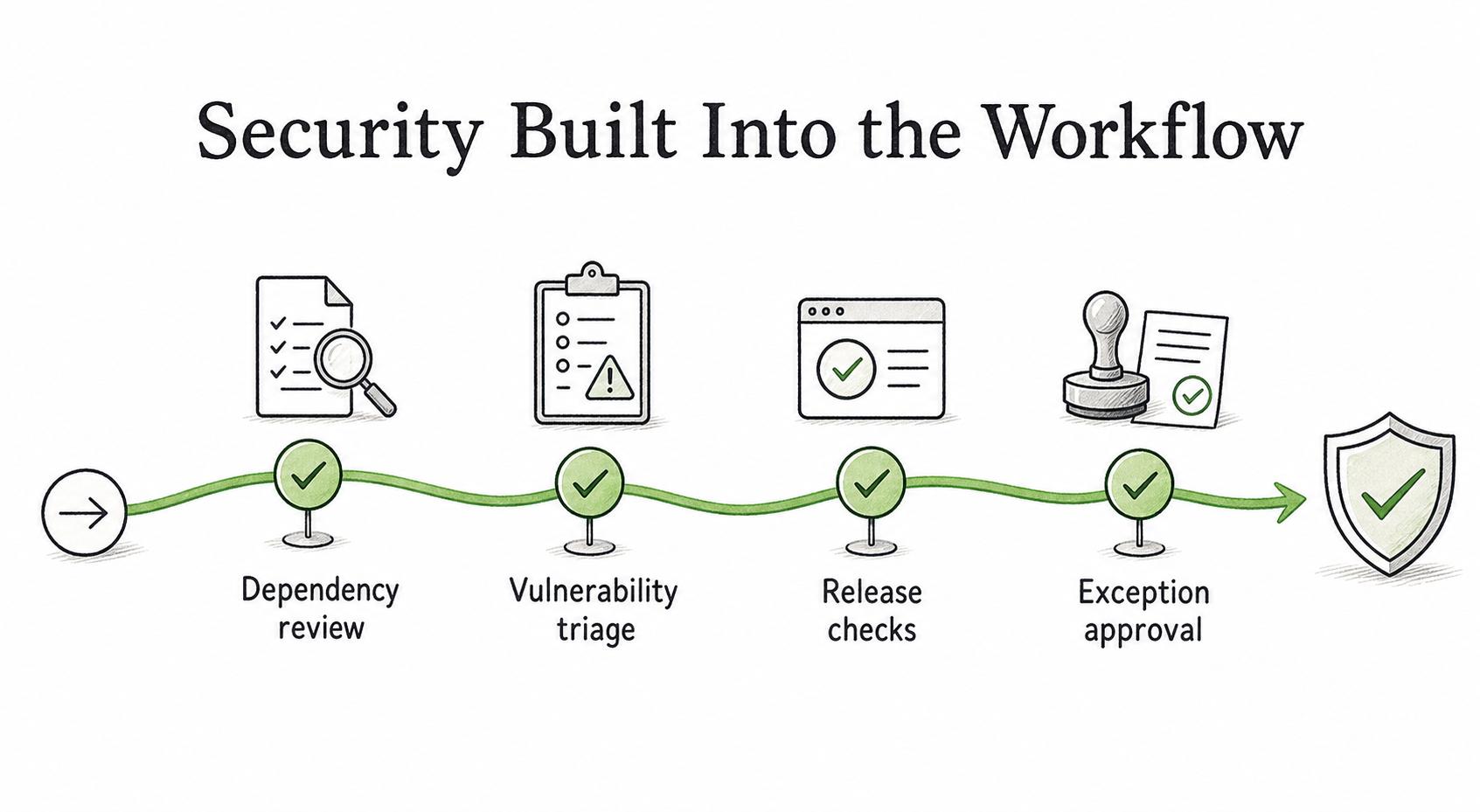
Security-sensitive development workflows deserve extra care. NIST SP 800-218, the Secure Software Development Framework, describes high-level secure software development practices that organizations can integrate into their software development life cycles. A local SOP can translate those broad practices into day-to-day behavior.4
For example, an engineering team might use SOPs to define who reviews dependencies, when threat modeling happens, how vulnerabilities are triaged, which checks must pass before release, and how security exceptions are approved.
The SOP should not pretend to be the entire security program. It should make the secure workflow concrete enough that engineers can follow it during normal work.
AI prompt for drafting a software development SOP
## Software Development SOP Drafting Prompt

**Glossary term:** Software Development SOP
**Source:** Trails Glossary — trails.so/glossary/software-development-sop

---

### 01. Draft a software development SOP

"Create a software development SOP for [workflow].

Team: [engineering team]
Workflow trigger: [what starts the procedure]
Systems involved: [repositories, environments, tools, services]
Risk if done incorrectly: [security, uptime, customer impact, compliance, data, cost]
Roles involved: [engineer, reviewer, QA, product, security, support, manager]

Include:
- Purpose and scope
- Prerequisites and access needed
- Step-by-step workflow
- Required reviews, checks, tests, or approvals
- Escalation and rollback path
- Definition of done
- Owner and review cadence
- Links to runbooks, dashboards, scripts, or technical docs that should stay separate"
Use the output as a draft, not as the standard. The workflow owner still needs to verify that the steps match the team's actual tools, risks, approvals, and release process.
Common mistakes
One mistake is writing the SOP from memory after the workflow is already over. Software delivery contains details that are easy to miss after the fact: the staging check, the monitoring window, the customer notice, the rollback owner, or the feature flag that must stay off until support is ready.
Another mistake is making the SOP too rigid. A good software SOP standardizes the normal path and makes exceptions visible. It should reduce avoidable variation without blocking engineering judgment when the situation is genuinely unusual.
A third mistake is leaving ownership unclear. Software systems change constantly. If nobody owns the SOP, it will drift behind the real workflow and lose credibility.
Documentation takeaway
A software development SOP is most valuable when it captures the process around engineering work: who does what, in what order, with which checks, and how exceptions are handled.
Keep architecture explanations in technical documentation, commands in runbooks, and task-level details in work instructions when that split makes the SOP easier to use.
How Trails helps
Trails helps teams capture workflows as someone performs them, turn the capture into a polished step-by-step guide, and create an AI-narrated video version for training or sharing.
That is useful for onboarding, internal tooling workflows, QA handoffs, release procedures, and support-facing engineering processes where screenshots and sequence matter.
Sources
- 1
DORA. DORA Metrics. DORA. dora.dev/guides/dora-metrics/. Accessed July 6, 2026.
- 2
Google Site Reliability Engineering. Release Engineering. Google. sre.google/sre-book/release-engineering/. Accessed July 6, 2026.
- 3
National Institute of Standards and Technology. SP 800-128: Guide for Security-Focused Configuration Management of Information Systems. NIST. nvlpubs.nist.gov/nistpubs/SpecialPublications/NIST.SP.800-128.pdf. Accessed July 6, 2026.
- 4
National Institute of Standards and Technology. SP 800-218: Secure Software Development Framework Version 1.1. NIST. csrc.nist.gov/pubs/sp/800/218/final. Accessed July 6, 2026.