
Glossary
Construction SOP
 ChatGPT
 Perplexity
 Gemini
 Claude
What is a construction SOP?
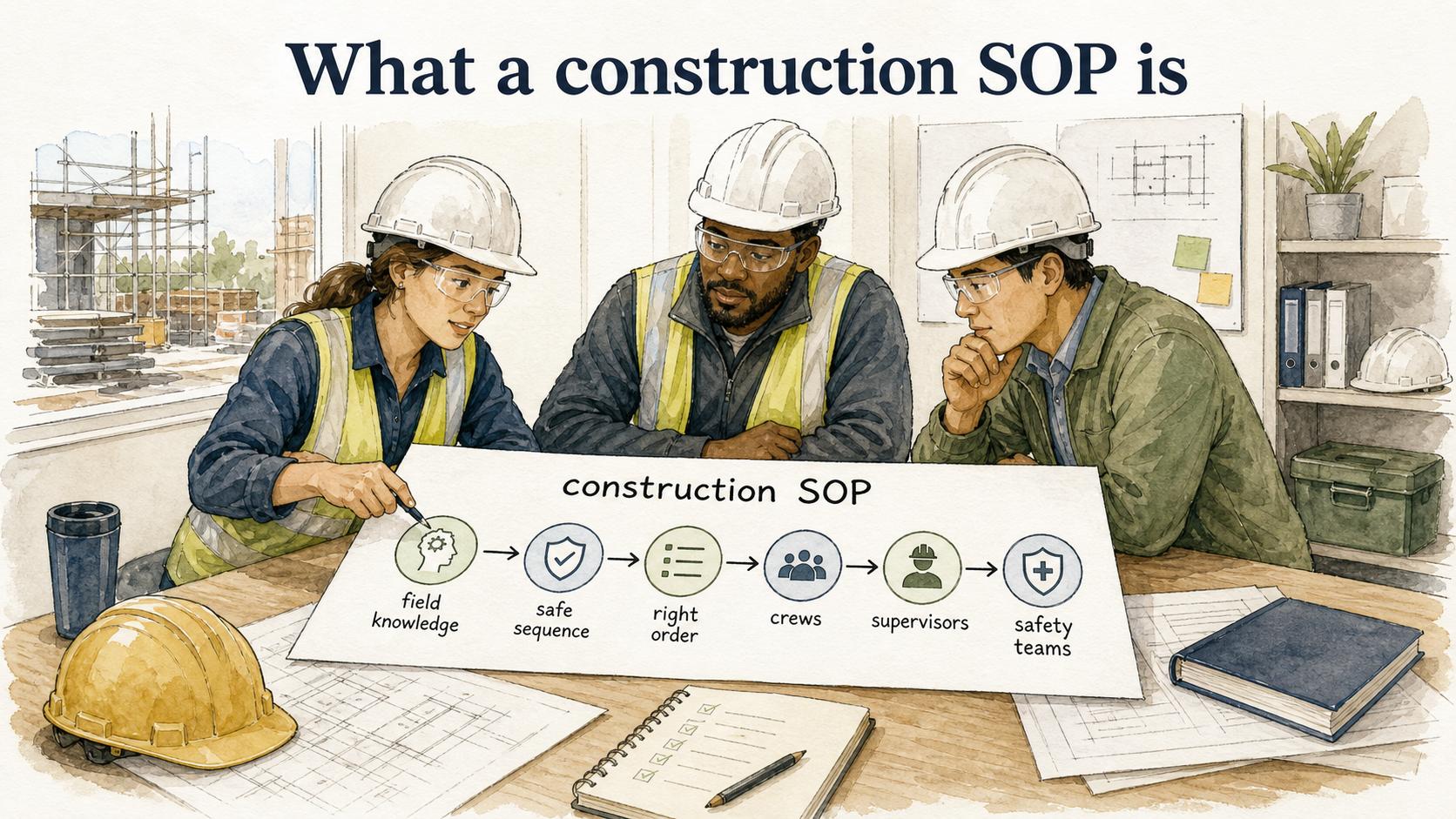
A construction SOP is a standard operating procedure for doing a construction task safely, consistently, and in the right order. It turns field knowledge into instructions crews, supervisors, subcontractors, and safety teams can use without relying on whoever happens to be on site that day.
The difference between a construction SOP and a generic office SOP is consequence. On a jobsite, a vague instruction doesn't just create rework. It can create safety exposure, schedule delays, failed inspections, damaged materials, or confusion between trades working in the same space.
Why construction SOPs matter
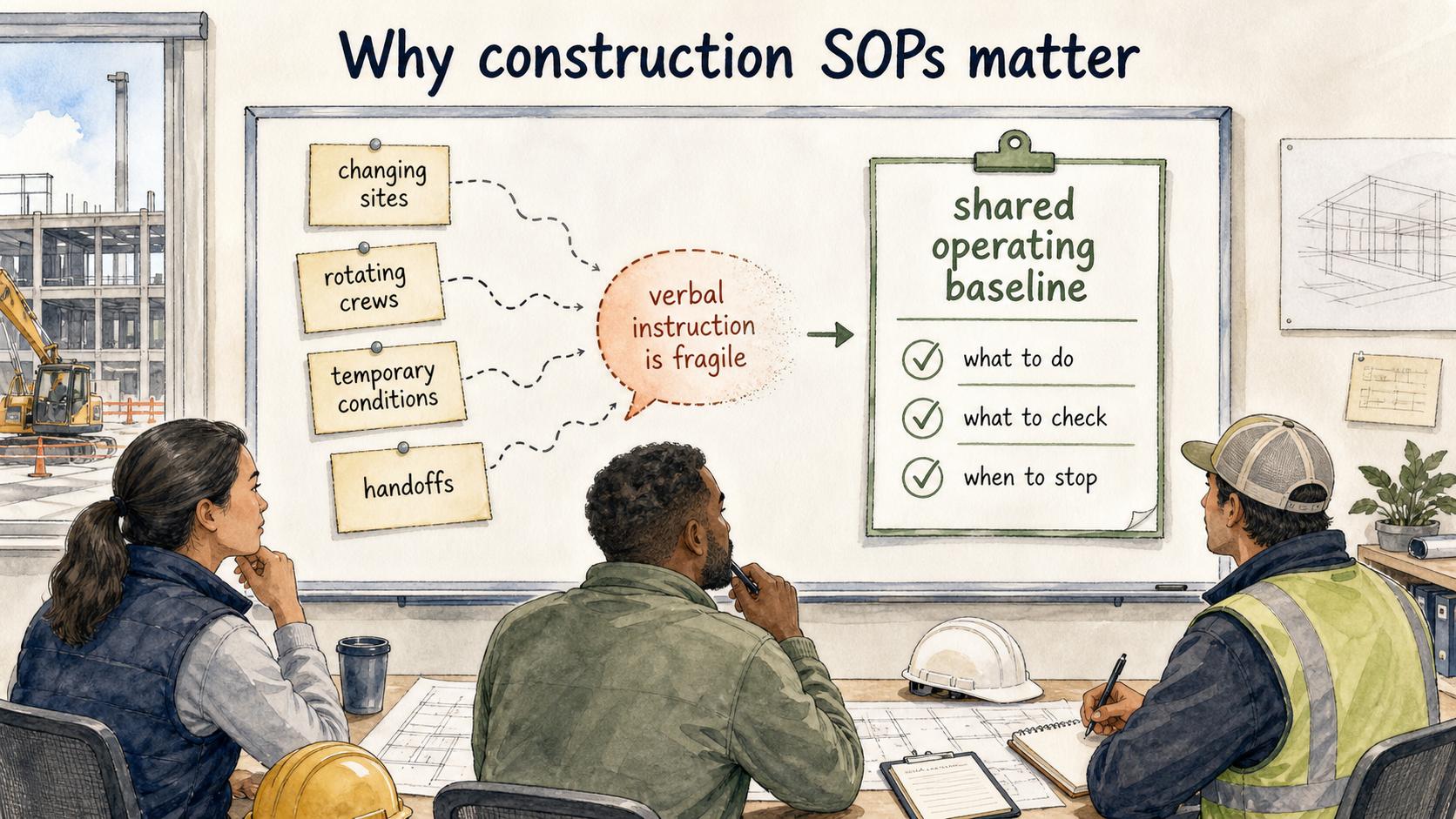
Construction work involves changing sites, rotating crews, temporary conditions, specialized equipment, and frequent handoffs between contractors. OSHA's construction safety program guidance treats coordination, worker participation, hazard identification, controls, training, and evaluation as connected parts of safer jobsite work. 1 That makes verbal instruction fragile. A foreman may know the right sequence for lockout, trench entry, scaffolding access, hot work, or concrete pour preparation, but the process becomes risky when that knowledge lives only in memory.
A good construction SOP gives the team a shared operating baseline. It doesn't replace safety training, competent-person judgment, manufacturer instructions, contracts, codes, or regulatory requirements. It gives workers and supervisors a practical way to carry those requirements into the work.
The strongest SOPs are useful when the work repeats often, the sequence matters, and mistakes are expensive or dangerous. If those are true, the SOP should be specific enough that a trained person can confirm what to do, what to check, and when to stop.
What a construction SOP should include
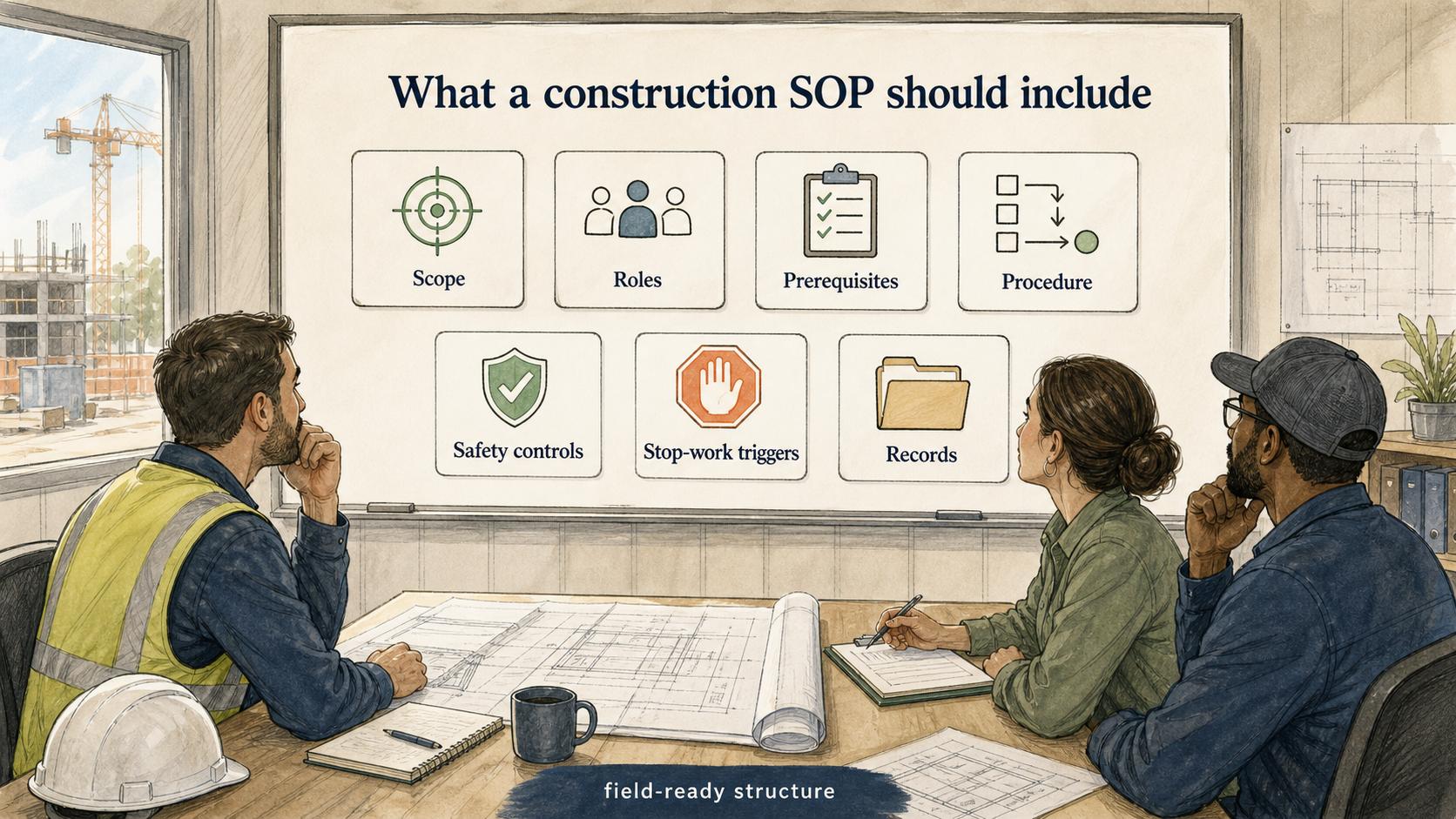
A construction SOP should be written for the person using it in the field, not for a binder on a shelf. That usually means short sections, direct language, and enough context to prevent bad judgment.
| SOP element | What it should answer | Common failure mode |
|---|---|---|
| Scope | Which task, site condition, crew, or phase does this apply to? | The SOP gets used outside its intended conditions. |
| Roles | Who performs, supervises, verifies, and escalates? | Everyone assumes someone else checked the risk. |
| Prerequisites | What permits, drawings, equipment, PPE, materials, or inspections are needed first? | Work starts before the site is ready. |
| Procedure | What happens first, next, and last? | Crews know the task but skip the critical sequence. |
| Safety controls | What hazards must be controlled before work continues? | Safety becomes a separate checklist instead of part of the work. |
| Stop-work triggers | What conditions require escalation or a pause? | Workers improvise when the jobsite changes. |
| Records | What photos, forms, signoffs, or logs prove completion? | The work is done, but the company can't show what happened. |
Stop-work triggers often carry the most value because they turn the SOP into a decision tool. For excavation, that means telling crews when to pause if protective systems are missing, water is accumulating, utilities are unmarked, or soil conditions differ from the plan. OSHA's excavation standard centers competent-person inspections and action when cave-ins, protective-system failures, hazardous atmospheres, or other hazardous conditions may be present. 2
Construction SOP example
For a scaffold inspection SOP, don't stop at “inspect scaffold before use.” OSHA's scaffold standard requires a competent person to inspect scaffolds and scaffold components for visible defects before each work shift and after events that could affect structural integrity. 3 A useful field SOP defines when inspection is required, who is qualified to inspect, which components must be checked, what tag or record is updated, and which defects remove the scaffold from service.
The SOP might include a short sequence:
- Confirm the scaffold type and intended use.
- Check access, guardrails, platforms, base plates, ties, planking, load limits, and visible damage.
- Verify site conditions, including ground support and nearby electrical hazards.
- Mark the scaffold status using the company's tagging system.
- Stop use and notify the supervisor if any required component is missing, damaged, unstable, or unclear.
That example works because it includes judgment points. It tells a trained worker what to look for and when the procedure no longer applies.
Construction SOP vs work instruction
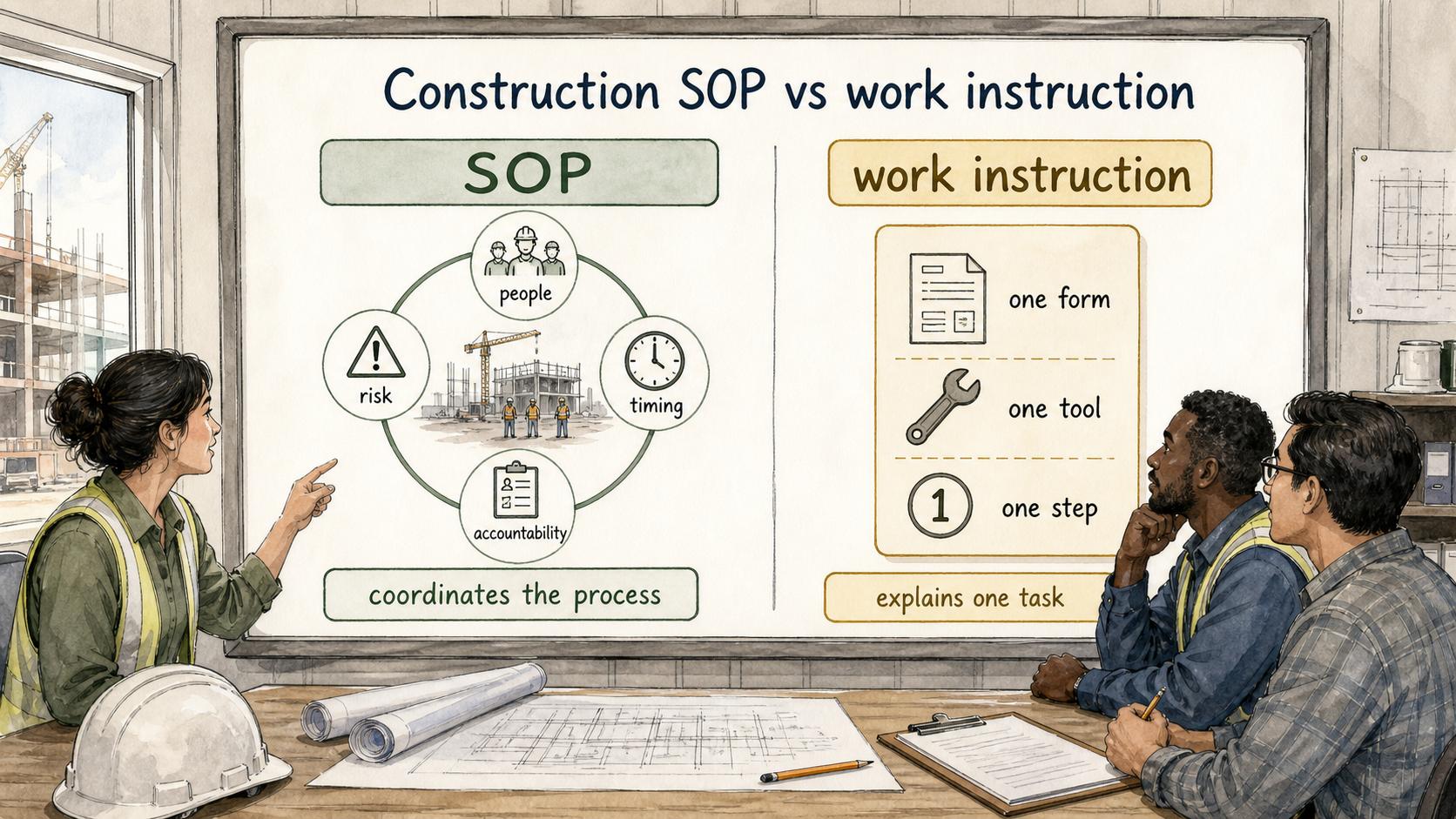
A construction SOP defines the standard way a repeatable jobsite process should run. A work instruction is narrower. The SOP might cover the company's process for ladder safety, confined space entry, equipment mobilization, or punch-list closeout. A work instruction might explain how to complete one inspection form, operate one tool, or document one step inside that larger process.
Use this practical rule: if the document coordinates people, risk, timing, and accountability, it's probably an SOP. If it explains one task inside that procedure, it's probably a work instruction.
How to write a construction SOP that crews will use
Start with the real workflow, not the policy language. Watch the task, interview the people who perform it, and ask where the process usually breaks. The best SOP often comes from the gap between the official sequence and what crews do when the jobsite is crowded, behind schedule, or missing information.
Write the SOP around decisions, not just actions. A procedure that says “prepare the area” hides the actual standard. A stronger version says which barricades, permits, drawings, inspections, weather checks, material staging, and supervisor approvals are required before work begins.
Keep the SOP maintainable. Construction procedures age quickly when equipment changes, subcontractors rotate, or a near miss exposes a weak control. Assign an owner, review the SOP after incidents or major process changes, and make the latest version easy to find from the jobsite. OSHA's program-evaluation guidance also emphasizes monitoring performance, verifying implementation, and evaluating the program for shortcomings and improvement opportunities. 4
Documentation takeaway
A construction SOP is valuable only if it reflects the work crews actually perform. Photos, screen recordings, field walkthroughs, and supervisor review can make the document more practical than a policy-only draft.
Trails can help teams capture a workflow as someone performs it, turn that workflow into a polished step-by-step guide, and create an AI-narrated video version for training or sharing. That's useful when construction teams need to document repeatable processes without turning every procedure into a writing project.
FAQ
Is a construction SOP the same as a safety plan?
No. A safety plan is broader and may cover site-wide responsibilities, hazards, emergency procedures, and compliance programs. A construction SOP explains how a specific repeatable task or process should be performed.
Who should write construction SOPs?
The owner should usually be the function responsible for the work, such as operations, safety, quality, or project management. The draft should be reviewed by the people who perform the task and by anyone responsible for safety or compliance requirements.
How detailed should a construction SOP be?
Detailed enough that a trained worker can follow the sequence, recognize required controls, and know when to stop. If the SOP needs dozens of tiny steps, split narrow tasks into work instructions instead of burying everything in one document.
Sources
- 1
OSHA. Recommended Practices for Safety and Health Programs in Construction. www.osha.gov/sites/default/files/publications/OSHA3886.pdf.
- 2
OSHA. 29 CFR 1926.651 excavation requirements. www.osha.gov/laws-regs/regulations/standardnumber/1926/1926.651.
- 3
OSHA. 29 CFR 1926.451 scaffold requirements. www.osha.gov/laws-regs/regulations/standardnumber/1926/1926.451.
- 4
OSHA. Safety management program evaluation guidance. www.osha.gov/safety-management/program-evaluation.