
Glossary
CMMI
 ChatGPT
 Perplexity
 Gemini
 Claude
What is CMMI?
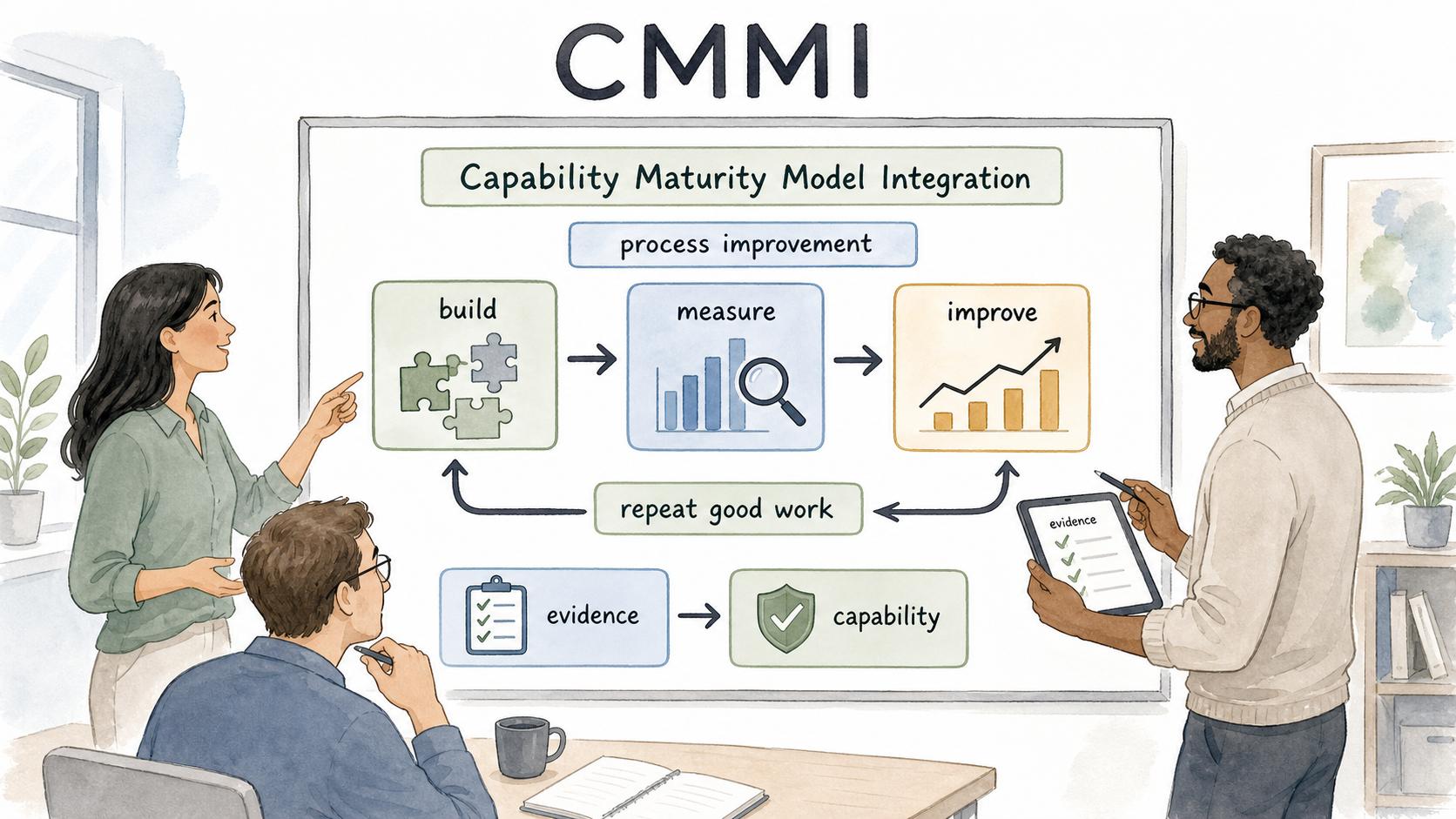
CMMI stands for Capability Maturity Model Integration. It is a process improvement model that helps organizations build, measure, and improve the capabilities that affect business performance.1
In plain English, CMMI asks whether your organization can repeat good work on purpose, or whether performance still depends on heroic individuals, local habits, and luck. The model gives teams a structured way to assess maturity, identify weak practices, and improve processes with evidence.
Why CMMI matters
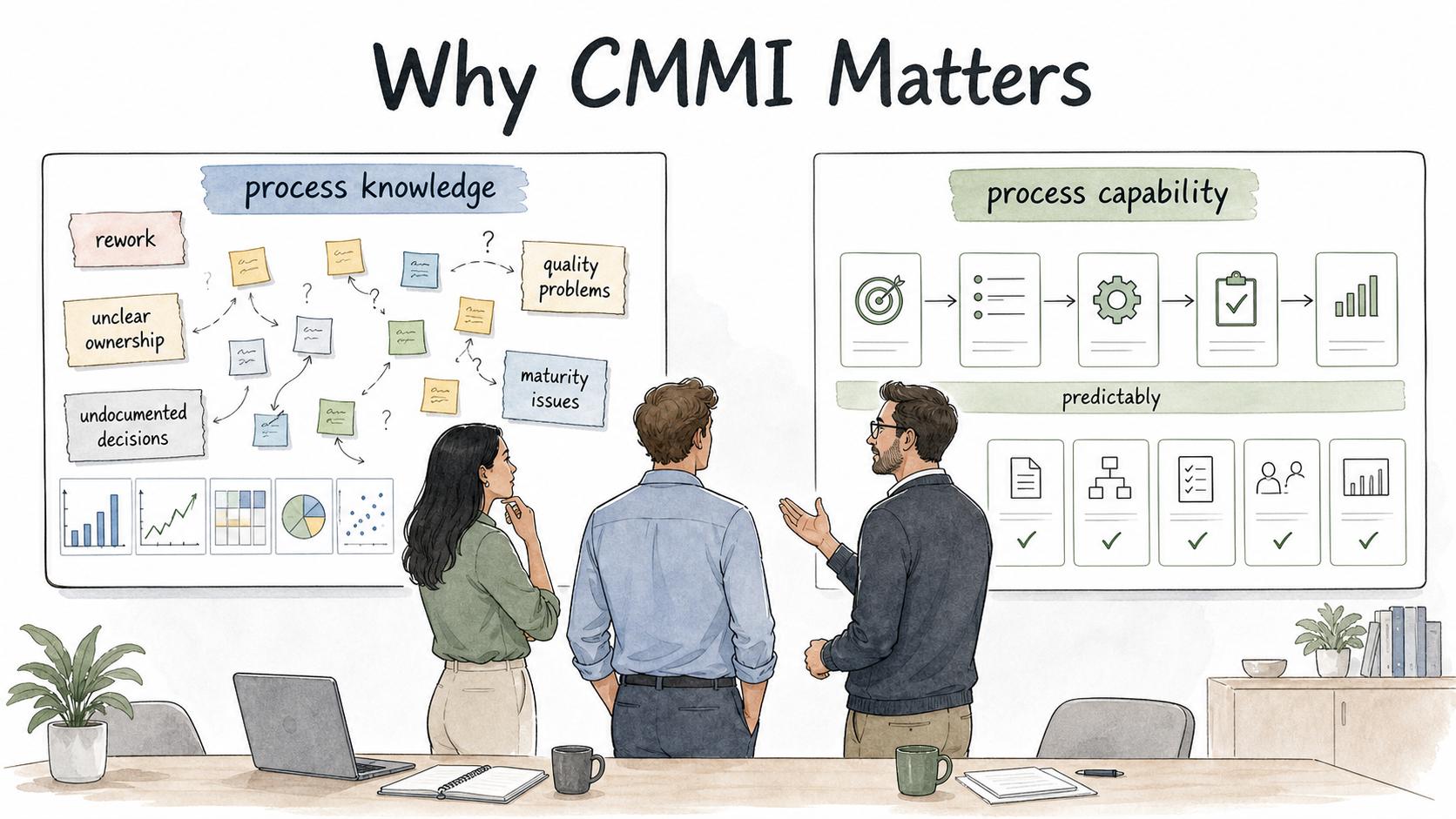
CMMI matters because many organizations confuse having a process with having a capable process. A document may exist. A team may know the routine. A manager may believe the work is under control. But if results vary by person, site, project, or customer, the organization has process knowledge without dependable process capability.
That distinction is the useful heart of CMMI. It helps leaders see whether the organization can perform important work predictably, improve it deliberately, and prove that improvement with evidence.
For software, services, regulated operations, product development, and complex delivery teams, inconsistency gets expensive. Missed handoffs create rework. Unclear ownership creates delays. Undocumented decisions create quality problems. CMMI frames those patterns as maturity issues, not isolated mistakes.
How CMMI works
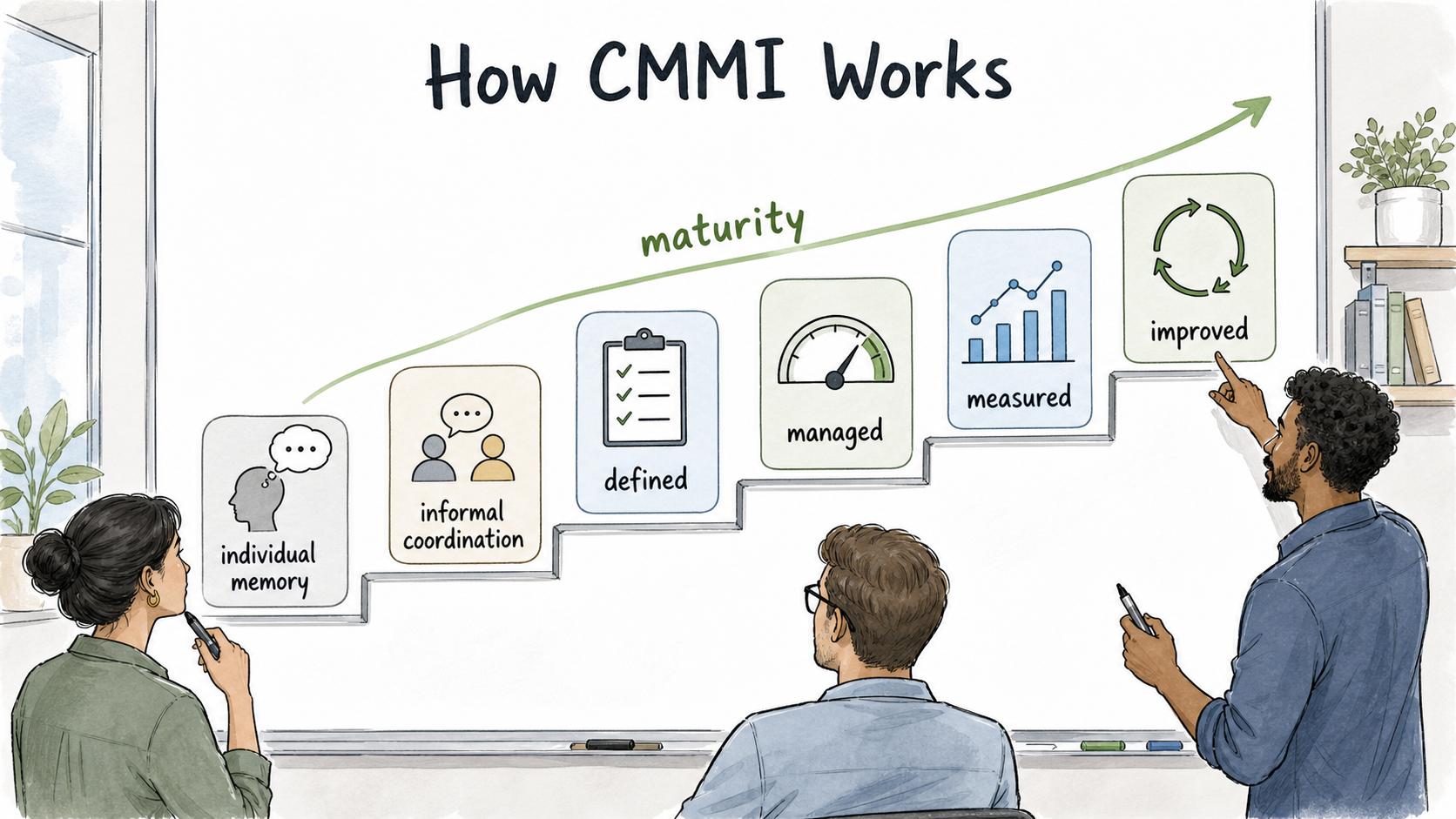
CMMI uses maturity to describe how well an organization's practices are defined, managed, measured, and improved. CMMI Institute describes maturity levels as a staged path for performance and process improvement, with each level adding rigor to the previous one.2 The useful question is what kind of capability the organization can actually rely on.
A low-maturity process often depends on individual memory and informal coordination. Work may still get done, but it's hard to predict, audit, train, or scale. A more mature process has clearer standards, active management, measurement, and improvement habits. People still exercise judgment, but the system no longer depends on everyone inventing their own version of the work.
The common mistake is treating maturity as bureaucracy. A mature process should be more explicit about the parts that matter: ownership, inputs, decision points, quality expectations, evidence, and feedback loops. In a healthy CMMI effort, unnecessary steps get removed instead of preserved because they look formal.
CMMI compared with common alternatives
CMMI is often mentioned alongside quality, governance, and improvement frameworks. They can work together, but they answer different questions.
| Framework or method | Main focus | Best use case |
|---|---|---|
| CMMI | Capability and maturity of organizational practices | Understanding how repeatable, managed, and improvable a process is |
| ISO 9001 | Quality management system requirements | Demonstrating a structured approach to quality management |
| COBIT | Governance and management of enterprise information and technology | Aligning IT decisions, controls, and outcomes with business goals |
| Continuous improvement | Ongoing refinement of work | Making small, repeated improvements to an active process |
| Process improvement | Diagnosing and improving a specific process | Fixing delays, defects, waste, or unclear ownership |
The practical difference is that CMMI looks at capability maturity. A team may run a process improvement project to fix a broken workflow, use ISO 9001 to structure quality management, and use CMMI to understand whether its core practices are consistently capable across the organization.
Where teams use CMMI
CMMI is useful when inconsistency creates real risk. The current CMMI product family includes models and appraisals for areas such as development, services, supplier management, data, people, safety, security, and virtual work, so the model applies beyond software teams.3 That can include software delivery, product development, supplier management, service operations, medical device work, cybersecurity programs, and other environments where process capability affects outcomes.
A good candidate process has three traits:
- The work repeats: The organization performs the process often enough that maturity matters.
- Variation is costly: Delays, defects, missed reviews, or unclear decisions create measurable pain.
- Evidence matters: Leaders, customers, auditors, or partners need proof that the process works.
A weak candidate is a one-time project or a creative activity where the main risk is standardizing too soon. CMMI can still inform the work, but applying a maturity model too aggressively can turn a flexible practice into a slow one.
The documentation CMMI actually needs
CMMI-related documentation should prove how the process works, not merely announce that a process exists. The most useful artifacts stay close to the work:
- Process descriptions that define scope, ownership, inputs, outputs, and decision points.
- Work instructions that explain how recurring tasks are performed.
- Measurement definitions so teams don't argue later about what a metric means.
- Evidence examples that show what good completion looks like.
- Improvement logs that connect lessons learned to actual process changes.
The failure mode is documentation theater. Process-maturity guidance is useful only when it leads to more predictable results and higher-quality products, not when teams create polished process files while the real work continues through side conversations and local shortcuts.4 If employees cannot follow the documented process during normal work, the document is evidence of a parallel process.
A practical CMMI readiness check
Before investing in a formal maturity push, ask five questions about one important process:
- Can a new qualified person perform the work from the documented process? If not, the process is still mostly tribal knowledge.
- Can the owner explain where judgment is required? Mature processes define decision points instead of pretending every situation is mechanical.
- Can the team show evidence of completion? If evidence is scattered, maturity will be hard to prove.
- Can performance be measured consistently? A metric that changes definition every month cannot guide improvement.
- Can recent lessons be traced to process changes? Continuous improvement should leave a visible trail.
This check does not replace a CMMI appraisal. It helps teams find the practical gaps that an appraisal or improvement program will eventually surface anyway.
How Trails helps
Trails helps teams turn real workflows into process documentation that can support maturity work. Instead of asking someone to reconstruct every step from memory, Trails captures a workflow as it is performed, turns it into a polished step-by-step guide, and can create an AI-narrated video version for training or sharing.
That matters for CMMI because process capability depends on repeatable practice. The better the team can capture, teach, and update the actual way work happens, the easier it is to move from informal habit to managed capability.
FAQ
Is CMMI only for software teams?
No. CMMI has roots in software and systems work, but the model is used more broadly for organizational capability and performance improvement. The important question is whether the process is repeatable, important, and worth improving deliberately.
Is CMMI the same as process documentation?
No. Documentation supports CMMI, but maturity also depends on capability, management, measurement, and improvement. Documentation is one way teams make those practices visible and repeatable.
Does higher maturity always mean more process?
Not necessarily. Higher maturity should mean better control, learning, and predictability. If a maturity effort adds steps that do not improve outcomes, the team may be optimizing for appearance instead of capability.
What should a team document first for CMMI?
Start with a process where variation is already causing pain. Document the real workflow, ownership, decision points, evidence, and measures. That gives the team something concrete to improve instead of debating maturity in the abstract.
- Process improvement
- Continuous improvement
- COBIT
- ISO 9001
- Software development SOP
- Process optimization
- Maturity model
- Capability assessment
Sources
- 1
CMMI Institute. CMMI overview. CMMI Institute. cmmiinstitute.com/cmmi/intro.
- 2
CMMI Institute. Maturity levels. CMMI Institute. cmmiinstitute.com/learning/appraisals/levels.
- 3
ISACA. CMMI Performance Solutions. ISACA. www.isaca.org/enterprise/cmmi-performance-solutions.
- 4
Microsoft. Background to CMMI. Microsoft Learn. learn.microsoft.com/en-us/azure/devops/boards/work-items/guidance/cmmi/guidance-background-to-cmmi?view=azure-devops.