
Glossary
COBIT
 ChatGPT
 Perplexity
 Gemini
 Claude
What is COBIT?
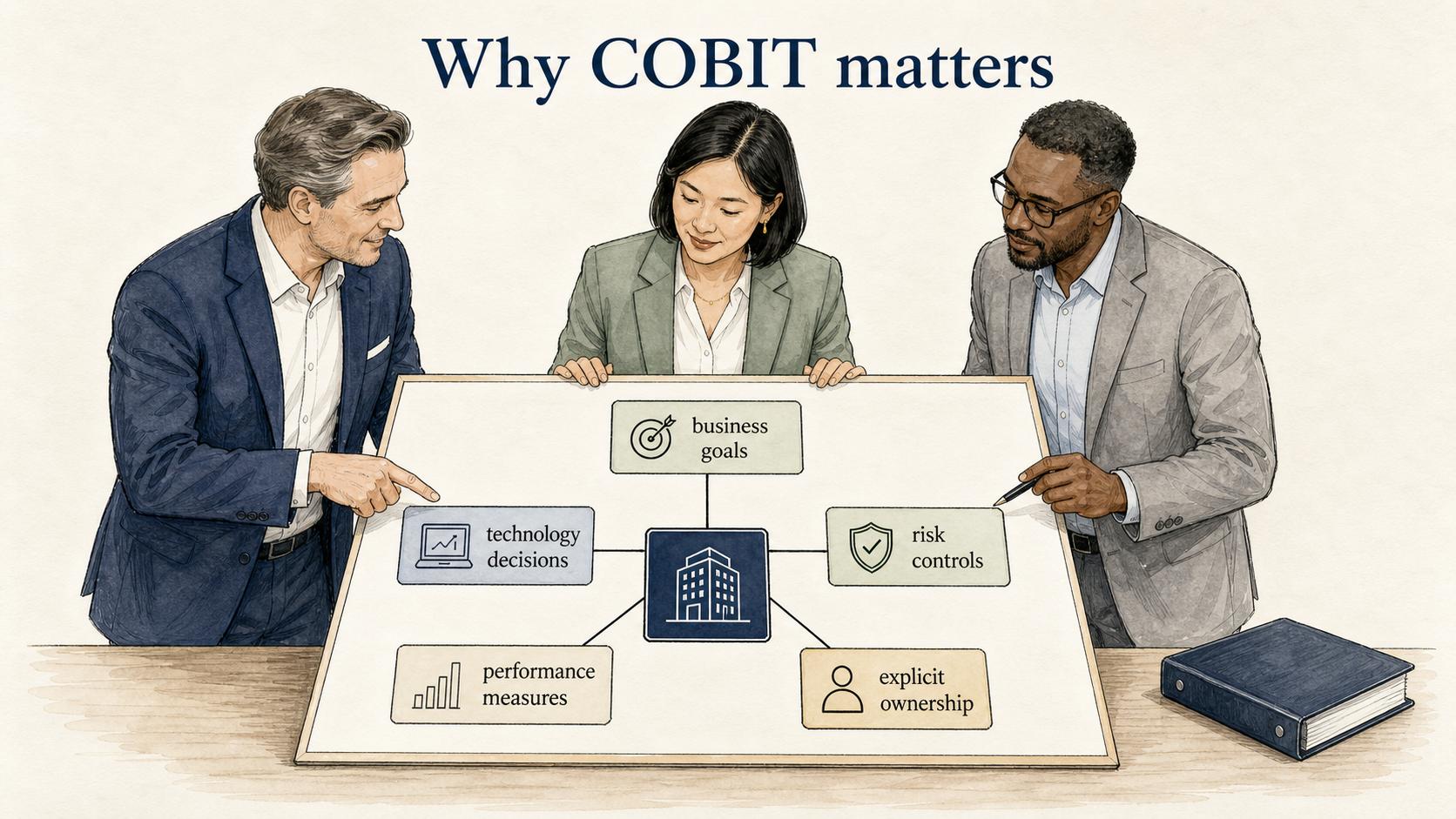
COBIT is a framework for governing and managing enterprise information and technology. Created by ISACA, it helps leaders connect IT decisions, risk controls, performance measures, and business goals so technology is managed as part of the business, not as a separate back-office function.1
The simplest way to understand COBIT: it gives an organization a management system for deciding whether technology is creating value, controlling risk, and supporting business priorities. Treat it as a structure for better governance questions, clearer decision rights, and visible evidence of how those decisions are working.
Why COBIT matters
COBIT matters when IT work has become too important to manage through tickets, projects, and informal judgment alone. A small team can rely on direct communication. A larger organization needs explicit ownership: who decides which systems matter most, how risk is evaluated, how controls are tested, and how leadership knows whether IT is helping or quietly creating drag.
COBIT gives executives, IT leaders, auditors, security teams, and process owners a shared language for enterprise governance of information and technology. Its value is practical: it connects strategy, controls, responsibilities, metrics, and improvement work so each department does not invent its own governance model.
The failure mode is paperwork. If a team maps COBIT objectives but never changes decisions, ownership, or operating habits, the framework becomes a binder. A useful implementation makes daily work easier to inspect: which decisions need governance, which processes need controls, which metrics matter, and which risks are being accepted on purpose.
How COBIT works
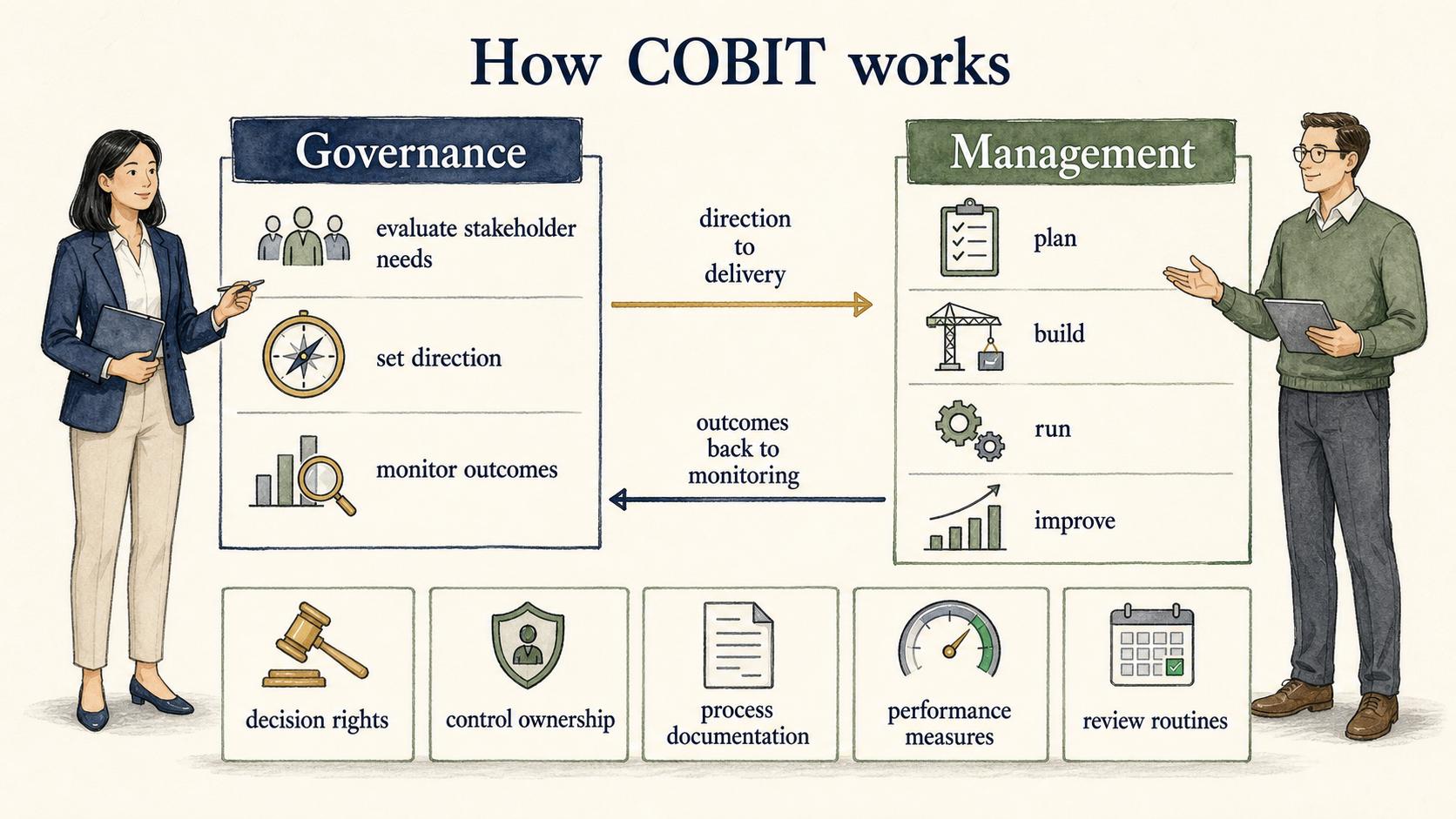
COBIT separates governance from management. Governance evaluates stakeholder needs, sets direction, and monitors outcomes. Management plans, builds, runs, and improves the activities that deliver those outcomes.2
That distinction prevents a common workaround: responding to governance gaps with more project management. Status meetings, dashboards, and ticket categories help only if the underlying decision rights are clear. COBIT pushes the harder question first: what should the enterprise require from information and technology, and who is accountable for seeing that it happens?
In practice, a COBIT-aligned program turns high-level objectives into operating artifacts such as:
- Decision rights for technology investment and risk acceptance
- Control ownership for security, access, change management, continuity, and vendors
- Process documentation that shows how governed work actually happens
- Performance measures that reveal whether the process is effective
- Review routines that make governance visible to leadership
COBIT 2019 also uses design factors to help organizations tailor a governance system to their context, which is why implementation should start from real enterprise priorities instead of a generic checklist.3 The breadth is useful, but it can tempt teams to document everything at once. A better starting point is one business-sensitive area, such as access management, incident response, vendor risk, or system change control. Use COBIT to define what good governance should look like, then prove the operating process can support it.
COBIT compared with related frameworks
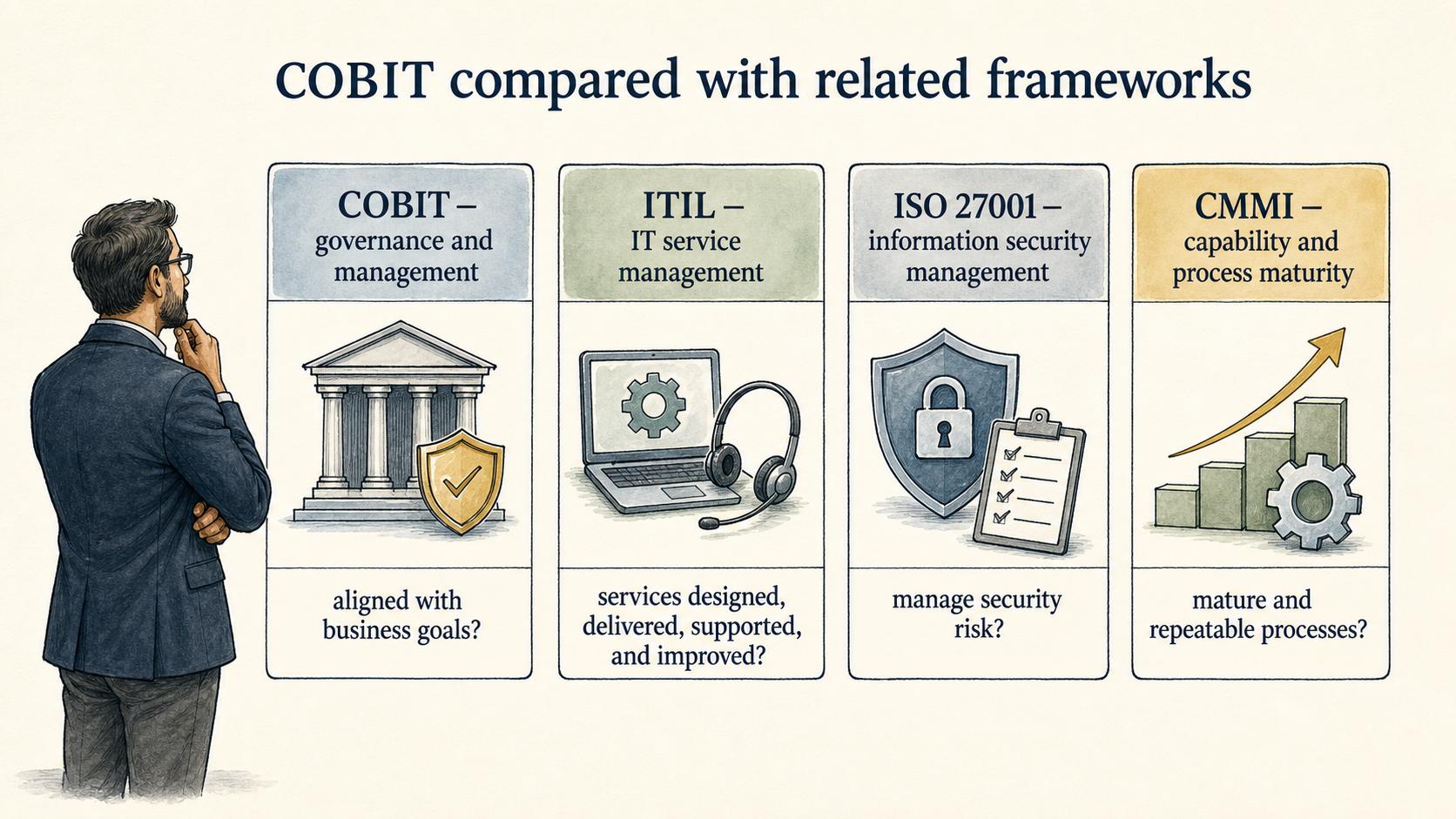
COBIT often sits beside other frameworks. The cleanest distinction is the job each framework is hired to do.
| Framework | Main purpose | Best question it helps answer |
|---|---|---|
| COBIT | Governance and management of enterprise information and technology | Are technology decisions, controls, and outcomes aligned with business goals? |
| ITIL | IT service management | How should IT services be designed, delivered, supported, and improved? |
| ISO 27001 | Information security management | How do we manage security risk through a formal ISMS? |
| CMMI | Capability and process maturity | How mature and repeatable are our processes? |
A company might use COBIT to define governance expectations, ITIL to structure service management, ISO 27001 to support security controls, and CMMI to evaluate process maturity. The frameworks overlap, but they work best when each one has a clear role.
Where documentation fits
COBIT depends on documentation because governance cannot run on memory. ISACA's governance objectives connect objectives to processes, practices, activities, and related information flows, so governed work needs artifacts that explain how the work is performed, who owns it, what evidence is retained, and how exceptions are handled.4
Useful documentation is usually the operating layer underneath the policy: step-by-step procedures, owner lists, review schedules, control evidence, escalation paths, and examples of acceptable exceptions. That material gives auditors and managers something concrete to inspect, and it helps employees do the work consistently.
Document the control where the work actually happens. If access reviews live in a spreadsheet, vendor approvals live in a procurement system, and change approvals live in a ticketing tool, the COBIT documentation should explain those real paths. Governance fails when the documented process describes an ideal workflow no one follows.
A practical COBIT documentation pattern
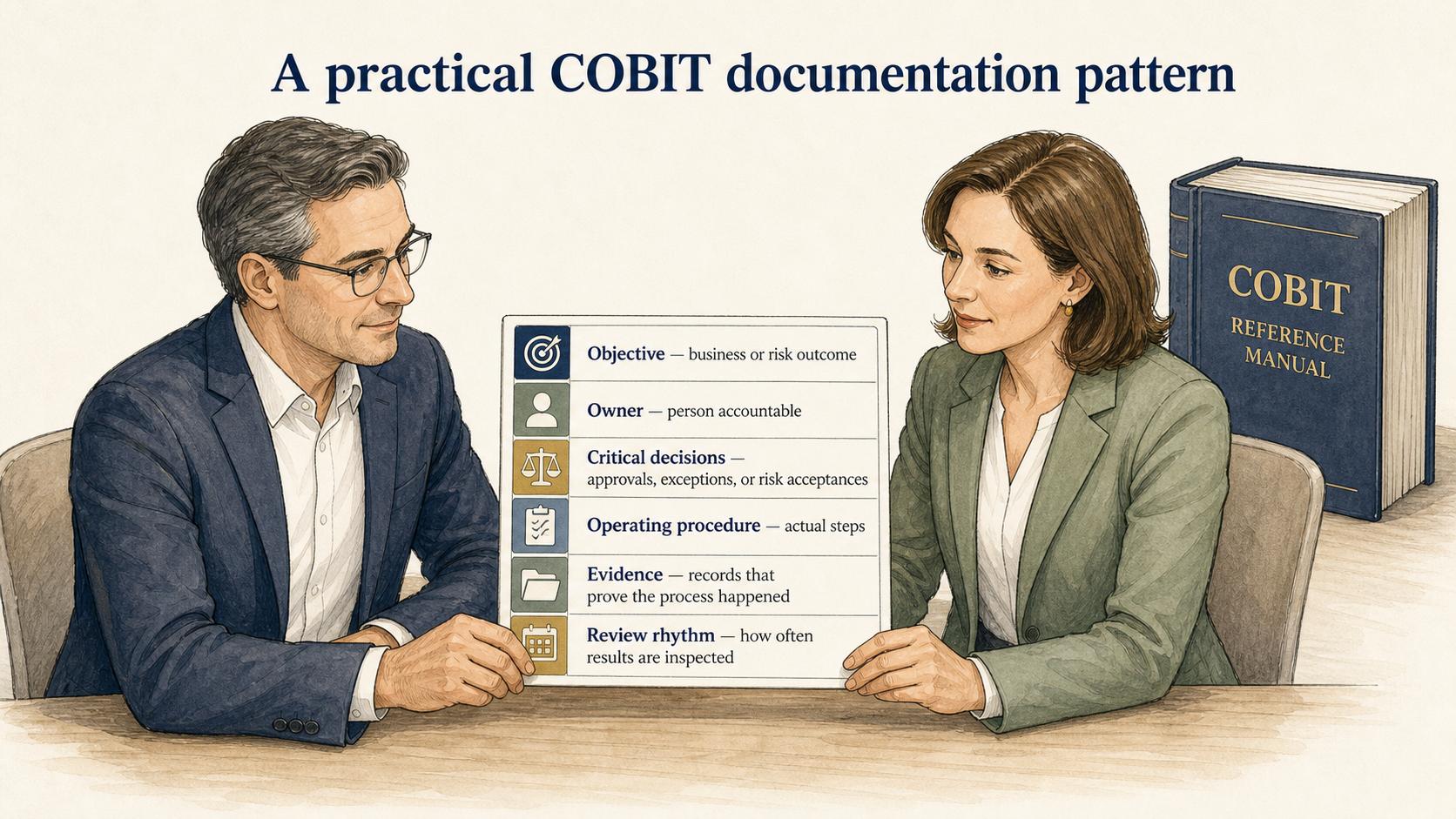
When applying COBIT to a process, create a short governance packet rather than a sprawling manual:
- Objective: What business or risk outcome this process supports.
- Owner: The person accountable for the process, not just the team that performs tasks.
- Critical decisions: Which approvals, exceptions, or risk acceptances require judgment.
- Operating procedure: The actual steps people follow to complete the work.
- Evidence: What records prove the process happened as expected.
- Review rhythm: How often leadership or control owners inspect results.
This packet turns COBIT into a working management habit. It also makes gaps easier to discuss. If a team cannot name the owner, evidence, or review rhythm, the issue is a specific operating weakness, not abstract governance maturity.
How Trails helps
Trails helps when a COBIT-related process needs to be documented from real work instead of reconstructed from interviews. A team member performs a workflow, Trails captures the steps, and the result becomes a polished step-by-step guide. Trails can also create an AI-narrated video version for training or review.
That is useful for governed processes like access reviews, change requests, incident handoffs, vendor checks, or recurring control evidence collection. The practical win is lighter maintenance: repeatable work is easier to capture, explain, and keep aligned with the process people actually follow.
FAQ
Is COBIT only for auditors?
No. Auditors use COBIT because it gives structure to controls and governance, but the framework is meant for enterprise governance and management of information and technology. IT leaders, security teams, risk owners, and executives can all use it.
Is COBIT a compliance standard?
COBIT is not a law or certification requirement by itself. It is a governance framework that can help organizations structure control, risk, and management practices that support compliance obligations.
Can small companies use COBIT?
Yes, but they should scale it down. A smaller company usually gets more value from applying COBIT principles to a few high-risk processes than from trying to implement every governance artifact at once.
What is the biggest COBIT implementation mistake?
The biggest mistake is mapping the framework without changing operating behavior. COBIT should clarify ownership, decisions, controls, evidence, and review routines. If it only creates documentation, it will not improve governance.
- CMMI
- ITIL
- ISO 27001
- IT documentation software
- Enterprise security
- SOP Meaning in Business
- IT governance
- Internal controls
Sources
- 1
ISACA. COBIT resources. ISACA. www.isaca.org/resources/cobit.
- 2
ISACA. COBIT 5 framework publications. ISACA. www.isaca.org/resources/cobit/cobit-5.
- 3
ISACA. Comparison of COBIT 2019 and COBIT 5. ISACA, 2020. www.isaca.org/resources/news-and-trends/industry-news/2020/cobit-2019-and-cobit-5-comparison.
- 4
ISACA. COBIT 2019 Framework: Governance and Management Objectives. ISACA. www.isaca.org/resources/cobit.