
Glossary
Chief Operations Officer
 ChatGPT
 Perplexity
 Gemini
 Claude
What is a chief operations officer?
A chief operations officer, often called a COO, is the executive responsible for making the company's operating system work. The COO turns strategy into execution by coordinating teams, processes, metrics, systems, and management routines across the business.
The COO role changes from company to company. HBR's classic treatment of the role describes it as highly situational rather than a fixed job description. 1 In one organization, the COO may run day-to-day operations across customer success, support, implementation, finance, people, and internal systems. In another, the COO may focus on scaling delivery, improving margins, enforcing operating cadence, or freeing the CEO to focus on strategy, fundraising, sales, or product vision.
What a chief operations officer does
A COO is usually accountable for operational execution, not the visible activity around execution. U.S. labor data describes chief executives as leaders who plan strategy, set policies, and coordinate organizational work so the organization meets its goals. 2 Many people can manage tasks, projects, or departments. The COO is responsible for whether the business can deliver its promises repeatedly as it grows.
Typical COO responsibilities include:
- translating company goals into operating priorities
- aligning department plans, capacity, and accountability
- improving cross-functional processes and handoffs
- managing operating metrics and leadership reviews
- clarifying ownership for recurring work
- removing bottlenecks that slow execution
- improving systems, documentation, and management routines
- supporting hiring, onboarding, and organizational design as the company scales
The COO's work is often quiet when it is going well. Meetings are shorter because decisions are clearer. Teams escalate earlier because ownership is understood. Processes improve before they break. New employees ramp faster because operating knowledge is captured instead of passed through one-off explanations.
COO vs operations manager vs process owner
The COO is not simply the most senior operations manager. The role sits at a different level of accountability; McKinsey notes that COOs are not expected to act as super site managers, but to delegate daily running of the operation while focusing on strategic COO-only work. 3
| Role | Primary accountability | Typical scope |
|---|---|---|
| Chief operations officer | Company-wide operating execution | Cross-functional priorities, operating cadence, leadership alignment, scale, and performance |
| Operations manager | Day-to-day operational performance | A department, function, site, queue, team, or workflow area |
| Process owner | Health of a specific process | Process design, quality, measurement, improvement, and documentation for one workflow |
| EOS integrator | Turning vision into operating discipline in EOS-led companies | Leadership team alignment, issue solving, scorecards, and execution rhythm |
| Chief knowledge officer | Organizational knowledge strategy | Knowledge capture, sharing, governance, and knowledge systems |
In smaller companies, one person may cover several of these responsibilities. That is normal. The problem starts when the accountabilities stay blurred as the company grows. If everyone assumes the COO owns every operational detail, teams stop owning their own processes. If every process owner operates independently, the company loses cross-functional coherence.
A strong COO designs the operating system without becoming the operating system.
When a company needs a COO
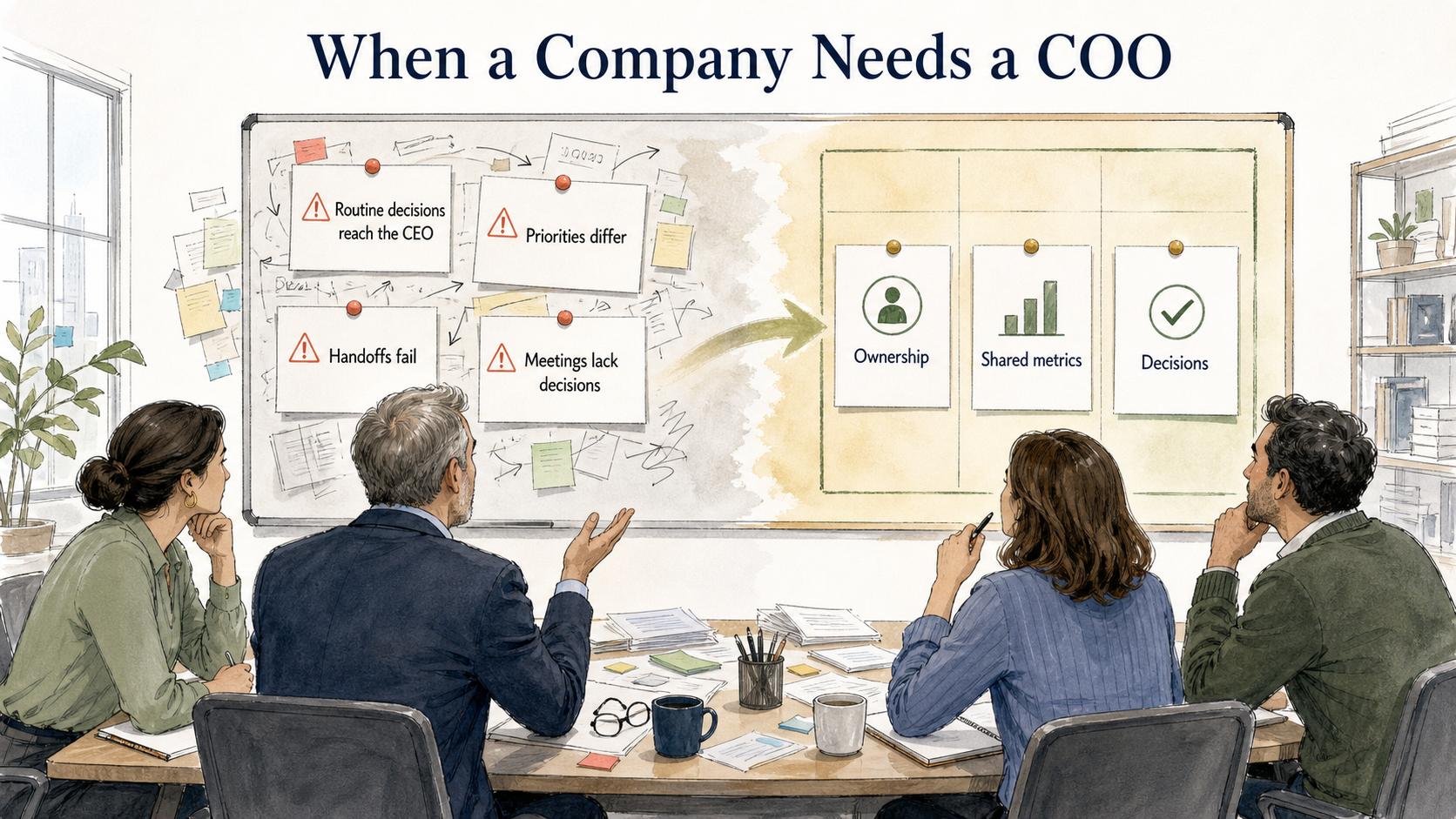
A company usually starts needing a COO when execution becomes too complex for the CEO and functional leaders to coordinate informally. The signal is not headcount alone. It is operating drag. McKinsey's COO agenda research frames successful COOs as balancing the operation with strategic outcomes, which is why the role becomes more useful when informal coordination can no longer carry the business. 4
Common signs include:
- the CEO is still the default decision-maker for routine execution issues
- teams interpret company priorities differently
- customer promises depend on individual heroics
- process problems repeat because no one owns the system
- leaders debate metrics because definitions are inconsistent
- onboarding depends on who happens to train the new hire
- meetings create updates but not decisions
- growth exposes handoff failures between teams
A COO is not a cure for an unclear strategy. If the company does not know what it is trying to become, adding an operations executive may only professionalize confusion. The COO is most effective when there is enough strategic direction to translate into operating choices.
The COO's documentation problem
COOs need clear process documentation, but they cannot let documentation become the work. The useful goal is a business that is easier to run, teach, inspect, and improve.
COO-level documentation usually includes:
- Operating cadence: Leadership meetings, review cycles, planning rhythm, and decision forums.
- Process ownership map: Who owns each recurring workflow and what success looks like.
- Metrics definitions: How the business calculates and reviews the numbers it uses to make decisions.
- Department playbooks: The repeatable practices each function uses to deliver consistent results.
- Escalation paths: How risks, blockers, customer issues, and exceptions move through the company.
- Change logs: What changed in a process, why it changed, and who needs to be retrained.
The failure mode is centralizing all documentation under the COO. That may feel controlled, but it does not scale. The COO should define standards, make ownership visible, and ensure important workflows are maintained. The people closest to the work should still own the accuracy of their processes.
What makes a COO effective
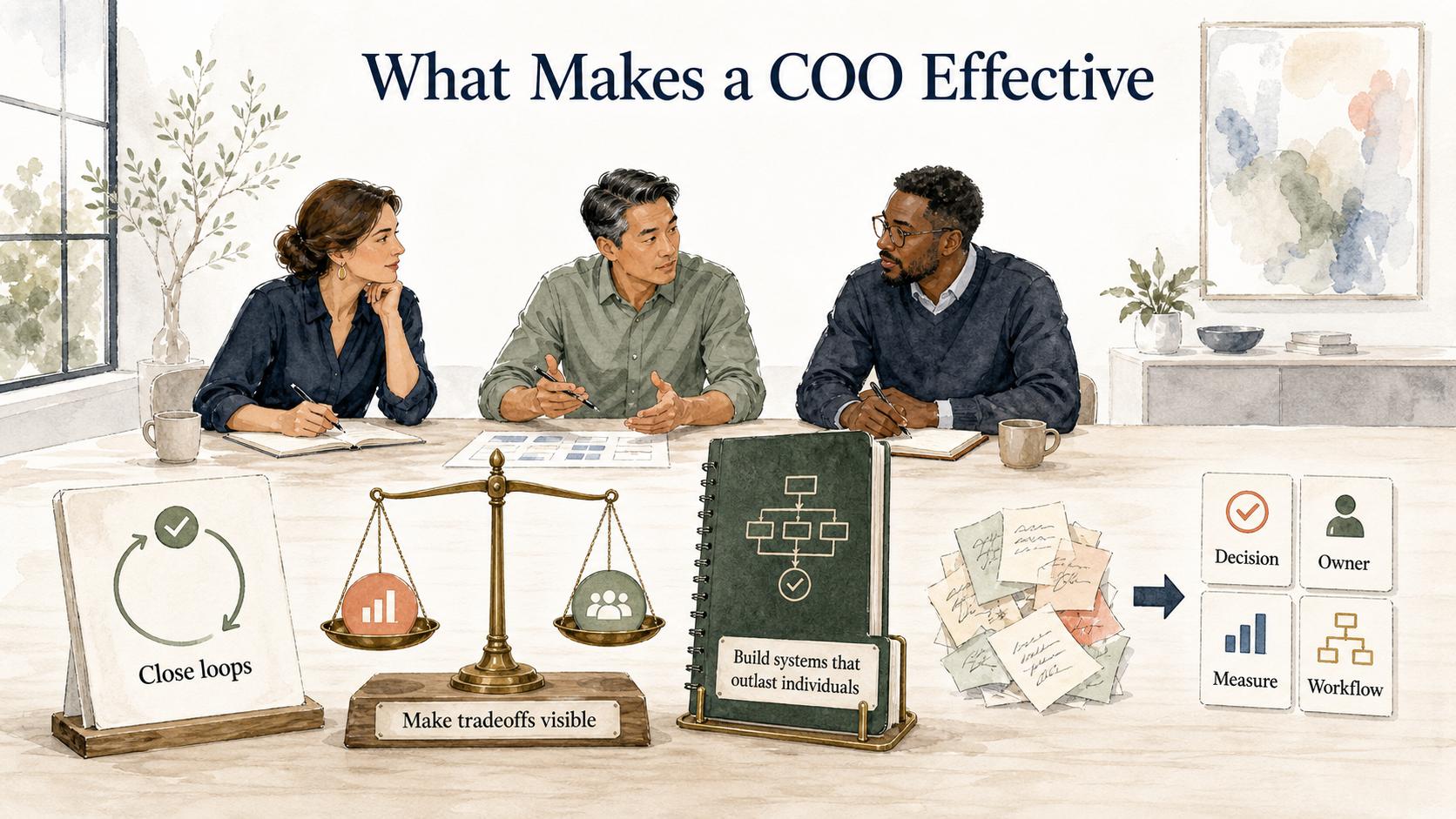
An effective COO creates operating pressure without turning every problem into a meeting. The business knows what matters, what is late, who owns the next decision, and where the system is weak. Ambiguity gets converted into a decision, owner, measure, or documented workflow.
Three habits matter more than elaborate frameworks:
- They close loops. If a leadership meeting identifies a problem, the COO makes sure it becomes an owner, action, deadline, or explicit decision not to act.
- They make tradeoffs visible. Faster delivery, higher quality, lower cost, and happier teams are all desirable. A COO forces the business to choose when those goals conflict.
- They build systems that outlast individuals. When the same issue depends on the same person every time, the COO sees a process or knowledge problem, not just a staffing dependency.
The best COOs do not remove judgment from the business. They create enough structure that judgment can be applied where it matters.
How Trails helps
Trails helps teams capture repeatable work as it happens and turn it into polished step-by-step guides. For a COO, that is useful because operating discipline depends on whether teams can explain, teach, and improve their recurring workflows.
A COO might use Trails to help department leaders document onboarding processes, customer handoffs, support escalations, finance routines, internal tool workflows, or recurring operating procedures. Trails can also create AI-narrated video versions, which can make training and rollout easier when a process changes.
The value is reducing the gap between how leaders think work happens and how work actually happens.
FAQ
Is a COO the same as a CEO?
No. The CEO is usually accountable for overall company direction, strategy, board or investor relationships, and final executive leadership. The COO is typically focused on execution, operating systems, cross-functional alignment, and day-to-day business performance.
Does every company need a COO?
No. Some companies distribute operations leadership across strong functional executives. A COO becomes more useful when cross-functional execution is complex enough that informal coordination slows the business down.
What teams report to a COO?
It depends on the company. Operations, customer success, support, implementation, people operations, finance, business operations, revenue operations, or internal systems may report to the COO. The reporting chart should follow the operating problem the company needs the COO to solve.
What should a new COO document first?
Start with operating cadence, ownership, metrics definitions, and the most fragile cross-functional workflows. Those areas usually reveal where the business is relying on memory, personality, or heroic coordination instead of a repeatable operating system.
Sources
- 1
Harvard Business Review. Second in Command: The Misunderstood Role of the Chief Operating Officer. Harvard Business Review, 2006. hbr.org/2006/05/second-in-command-the-misunderstood-role-of-the-chief-operating-officer.
- 2
U.S. Bureau of Labor Statistics. Top Executives. Occupational Outlook Handbook. www.bls.gov/ooh/management/top-executives.htm.
- 3
McKinsey & Company. The COO agenda: organization and talent. McKinsey Operations Blog. www.mckinsey.com/capabilities/operations/our-insights/operations-blog/the-coo-agenda-organization-and-talent.
- 4
McKinsey & Company. The COO agenda: personal operating model. McKinsey Operations Blog. www.mckinsey.com/capabilities/operations/our-insights/operations-blog/the-coo-agenda-personal-operating-model.