
Glossary
Chief Knowledge Officer
 ChatGPT
 Perplexity
 Gemini
 Claude
What is a chief knowledge officer?
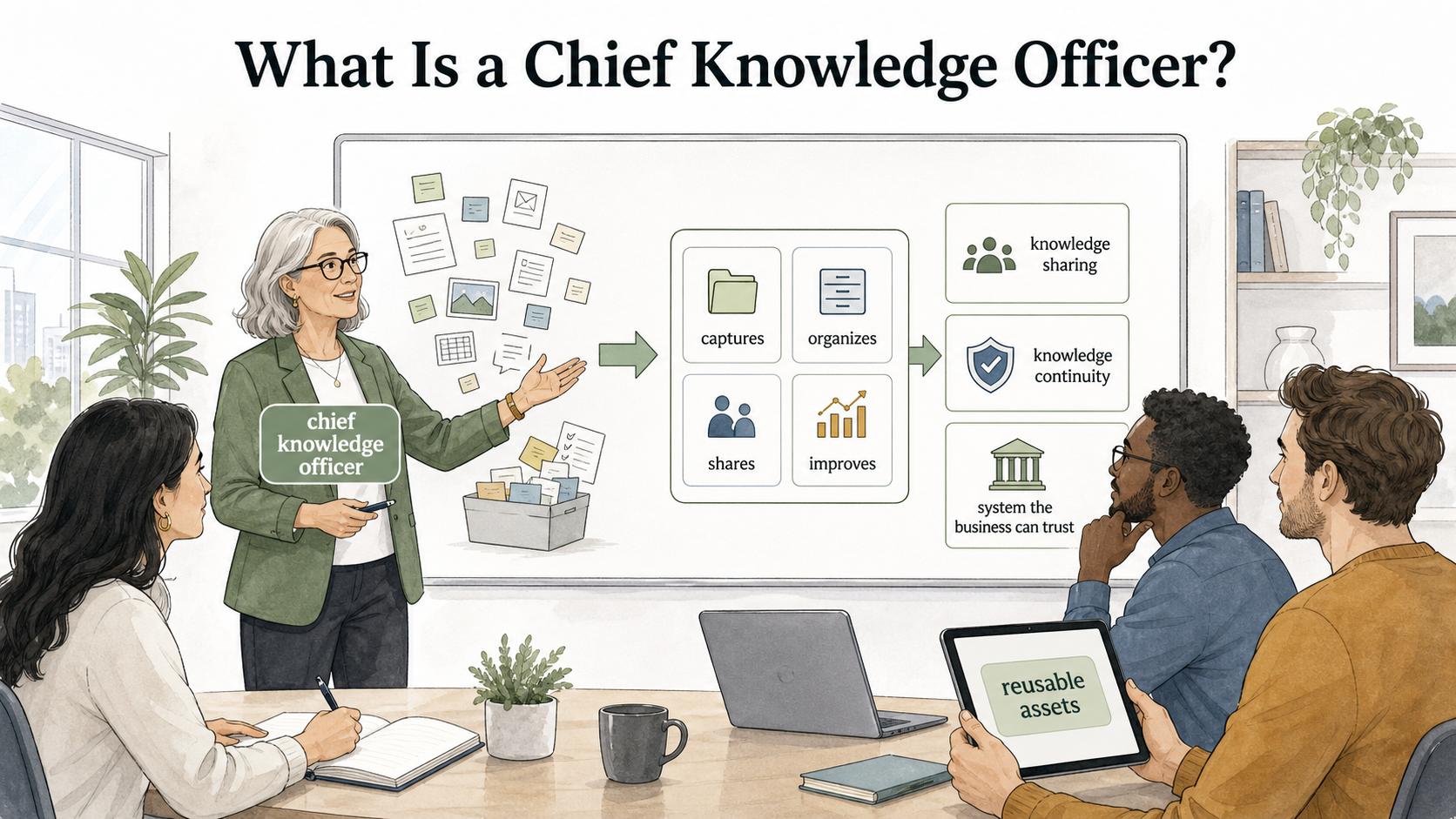
A chief knowledge officer is an executive or senior leader responsible for how an organization captures, organizes, shares, and improves its knowledge. NASA describes its Chief Knowledge Officer as responsible for standards and capabilities that support knowledge sharing, workforce development, and knowledge continuity across programs and centers. 1
The role turns knowledge management from scattered effort into operating discipline. A CKO decides what knowledge matters, where it should live, who owns it, and how teams turn daily learning into reusable assets. Public-sector knowledge-management research treats governance, organizational learning, and knowledge sharing as core parts of the discipline, not just repository maintenance. 2
The job is not simply owning a wiki. Many people can write docs, record processes, and answer internal questions. The chief knowledge officer makes those efforts add up to a system the business can trust.
What a chief knowledge officer owns
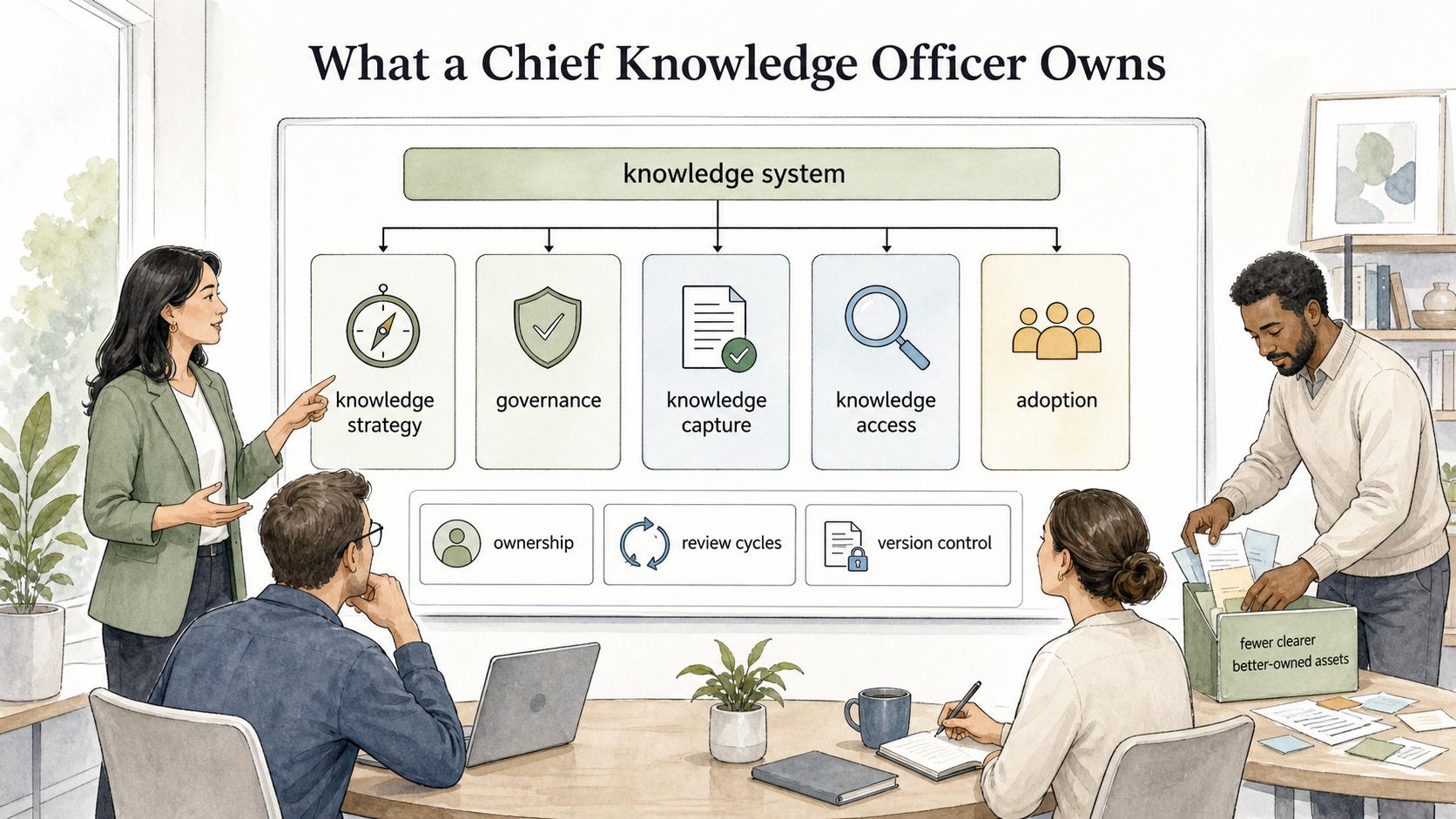
The role is easiest to understand as accountability for the knowledge system, not authorship of every article. A CKO usually owns a few high-leverage responsibilities:
- Knowledge strategy: deciding which assets matter most, such as support playbooks, implementation methods, sales enablement material, product operating knowledge, or compliance procedures.
- Governance: setting rules for ownership, review cycles, publishing standards, permissions, archiving, and version control.
- Knowledge capture: making expert work reusable before it disappears into meetings, chat threads, or individual memory.
- Knowledge access: helping employees find the right answer through search, taxonomy, internal links, onboarding paths, and role-based collections.
- Adoption: checking whether people use the knowledge base, follow the documented process, and improve the material when reality changes.
The hidden work is prioritization. Weak knowledge programs reward volume: more pages, more folders, more documentation requests. A strong CKO pushes for fewer, clearer, better-owned assets that remove repeated questions and reduce operational drag.
When a company needs a chief knowledge officer
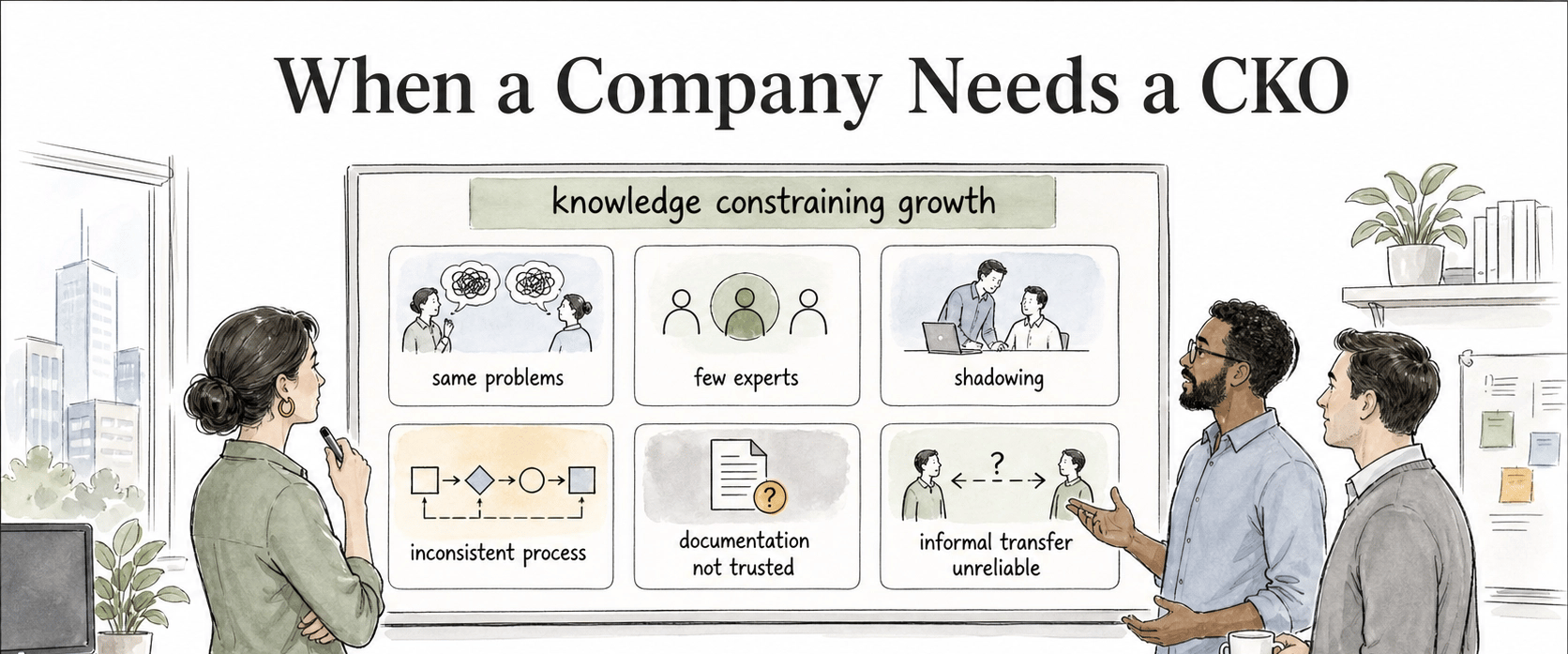
Most small teams don't need a dedicated CKO. They need clear ownership, a practical knowledge base, and steady documentation habits. The executive role becomes useful when knowledge starts constraining growth.
Common signals include:
- Teams keep re-solving the same problems because prior decisions are hard to find.
- Customer-facing teams depend on a few experts for routine answers.
- Onboarding relies on shadowing instead of durable materials.
- Processes vary by location, team, or manager when the work should be consistent.
- Internal documentation exists, but employees don't trust it enough to follow it.
- Mergers, scaling, compliance work, or distributed teams make informal knowledge transfer unreliable.
The role is especially useful where tacit knowledge has high business value: consulting, customer success, support, healthcare operations, implementation services, manufacturing, education, and complex B2B software teams. Research on tacit and explicit knowledge sharing describes knowledge sharing as the social process that helps individual knowledge become organizational capability. 3
Chief knowledge officer vs knowledge manager
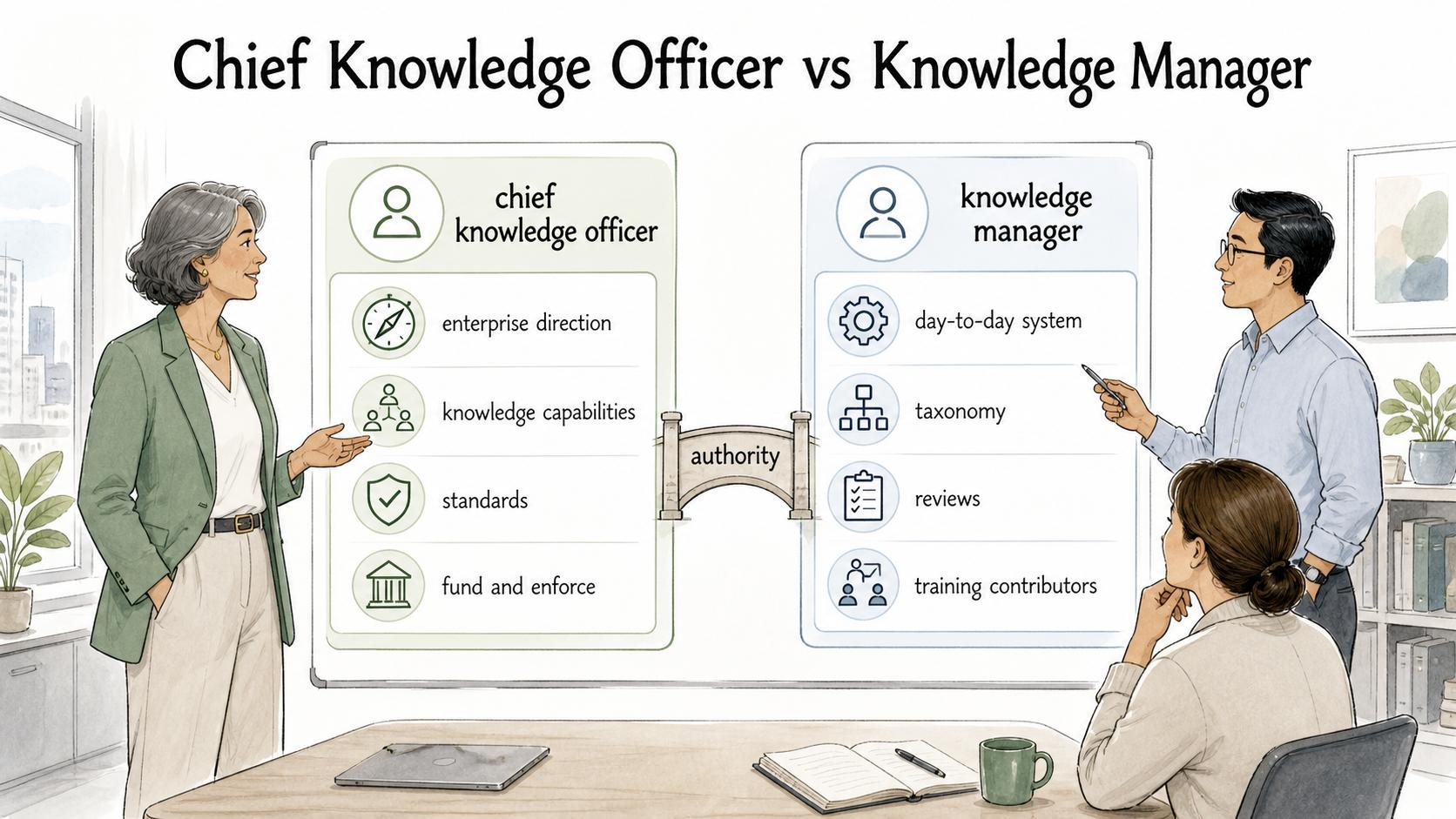
A knowledge manager usually runs the day-to-day system: maintaining articles, improving taxonomy, coordinating reviews, training contributors, and helping teams publish usable content. A chief knowledge officer sets the enterprise direction: what knowledge capabilities the business needs, which standards matter, and how leadership will fund and enforce the system.
The practical difference is authority. If the person can change incentives, assign ownership across departments, and make knowledge quality part of the operating cadence, they are acting closer to a chief knowledge officer. If they mostly maintain the repository after other teams create content, they are acting closer to a knowledge manager.
The mistake is hiring the title without giving the role leverage. Knowledge work fails when the owner can recommend standards but can't get teams to follow them.
A practical CKO charter template
Use this prompt when defining the role or preparing a knowledge strategy discussion:
## Chief knowledge officer charter

**Glossary term:** Chief Knowledge Officer
**Source:** Trails Glossary — trails.so/glossary/chief-knowledge-officer

---

### 01. Charter

"Create a chief knowledge officer charter for [company/team].

Context:
- Business model: [brief description]
- Teams affected: [teams]
- Highest-risk knowledge gaps: [examples]
- Current systems: [wiki, LMS, help center, docs, shared drives]
- Current pain: [repeated questions, slow onboarding, inconsistent process, compliance risk]

Draft:
1. The knowledge outcomes this role owns
2. The knowledge assets this role is accountable for
3. The standards teams must follow
4. The decision rights the role needs
5. The operating cadence for reviews and improvements
6. The measures that show knowledge is becoming easier to find, trust, and use

Keep the charter practical and avoid broad innovation language unless it changes a real workflow."
The prompt forces the role to name authority, artifacts, and cadence. That matters because knowledge leadership can become abstract: everyone agrees knowledge is important, but no one changes how work is captured or maintained.
Documentation takeaway
A chief knowledge officer succeeds when documentation becomes part of how work is done, not a cleanup project after work is finished. The best knowledge programs capture decisions, processes, examples, and exceptions close to the moment they happen, then refine them into assets other people can trust.
For process-heavy teams, that means pairing knowledge strategy with lightweight capture habits. Trails can help by capturing a workflow as someone performs it, turning it into a polished step-by-step guide, and creating an AI-narrated video version for training or sharing. That gives knowledge leaders a faster path from expert behavior to reusable process documentation.
FAQ
Is a chief knowledge officer the same as a chief learning officer?
No. A chief learning officer usually focuses on employee development, training programs, and learning strategy. A chief knowledge officer focuses on organizational knowledge: how expertise, decisions, processes, and reusable know-how are captured and made usable across the business.
Does every company need a CKO?
No. Many companies need a strong knowledge manager, documentation owner, or operations leader before they need an executive-level role. A CKO makes sense when knowledge quality affects scale, risk, customer experience, or cross-functional execution.
What should a new chief knowledge officer fix first?
Start with the highest-friction knowledge flow, not the biggest repository. A focused win might be support escalation knowledge, implementation playbooks, onboarding-critical procedures, or decision records. Fixing one painful flow builds more credibility than launching a broad knowledge transformation.
Sources
- 1
NASA. Knowledge Management. NASA. www.nasa.gov/learning-resources/for-professionals/appel-knowledge-management/.
- 2
PubMed Central. Systematic review on knowledge management in the public sector. PubMed Central, 2023. pmc.ncbi.nlm.nih.gov/articles/PMC10696008/.
- 3
ERIC. Organizational conditions associated with sharing tacit and explicit knowledge. Education Resources Information Center. files.eric.ed.gov/fulltext/EJ1446327.pdf.