
Glossary
Hospitality SOP
 ChatGPT
 Perplexity
 Gemini
 Claude
What is a hospitality SOP?
A hospitality SOP is a standard operating procedure for repeatable guest-service work in a hotel, restaurant, resort, venue, or food-service operation. It gives employees the steps, decision rules, and proof points for moments such as room turnover, check-in, table setup, complaint escalation, food-safety checks, and shift handoffs. 1
A useful hospitality SOP is not a brand-standard paragraph. It tells an employee what to do when the lobby is backed up, a room fails inspection, a guest is angry, or the normal checklist cannot be finished on schedule.
Why hospitality SOPs matter
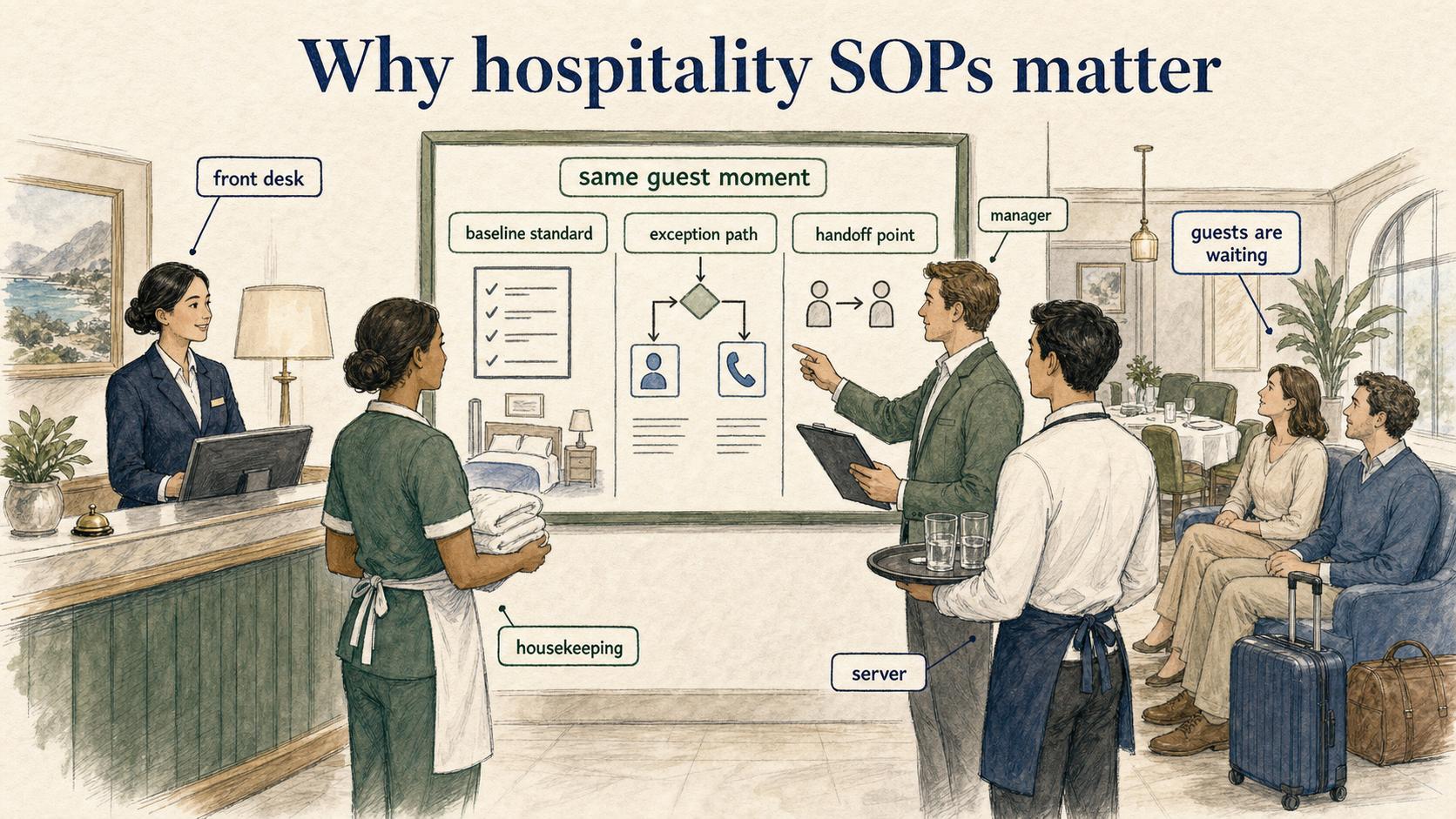
Hospitality teams are judged by how consistently different shifts handle the same guest moment. 2 SOPs reduce variation, but weak SOPs describe perfect service and leave employees to improvise when the shift gets messy.
- The baseline standard: what good looks like before the guest sees the result.
- The exception path: what changes when the room, table, order, payment, or safety check cannot follow the normal flow.
- The handoff point: when a supervisor, engineering lead, kitchen lead, or general manager takes over.
What a hospitality SOP should include
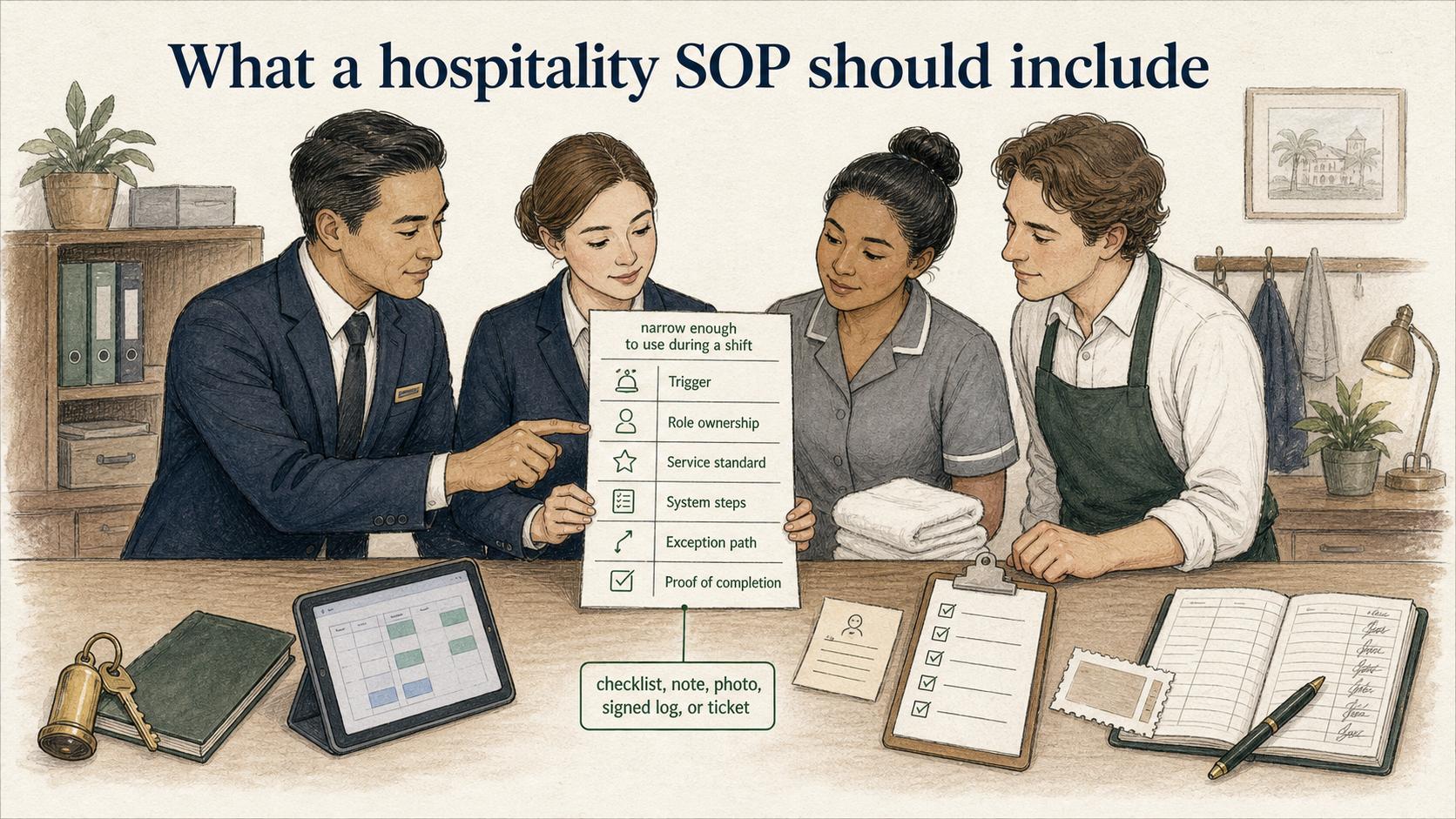
Keep each procedure narrow enough to use during a shift. Instead of one giant front-desk SOP, split the work into late check-in, payment issue, room move, lost item, service recovery, and end-of-shift cash reconciliation procedures.
- Trigger: the exact event that starts the SOP.
- Role ownership: who performs steps, approves exceptions, and receives a handoff.
- Service standard: the response time, tone, inspection criteria, or follow-up the guest should experience.
- System steps and proof: the screens, forms, logs, checklist, note, photo, or ticket that show the work happened.
- Exception path: what to do when the normal process cannot be completed.
Proof of completion matters because hospitality work crosses shifts. If the evening team cannot see what the morning team did, the SOP has not closed the loop. 3
Example: guest complaint escalation SOP
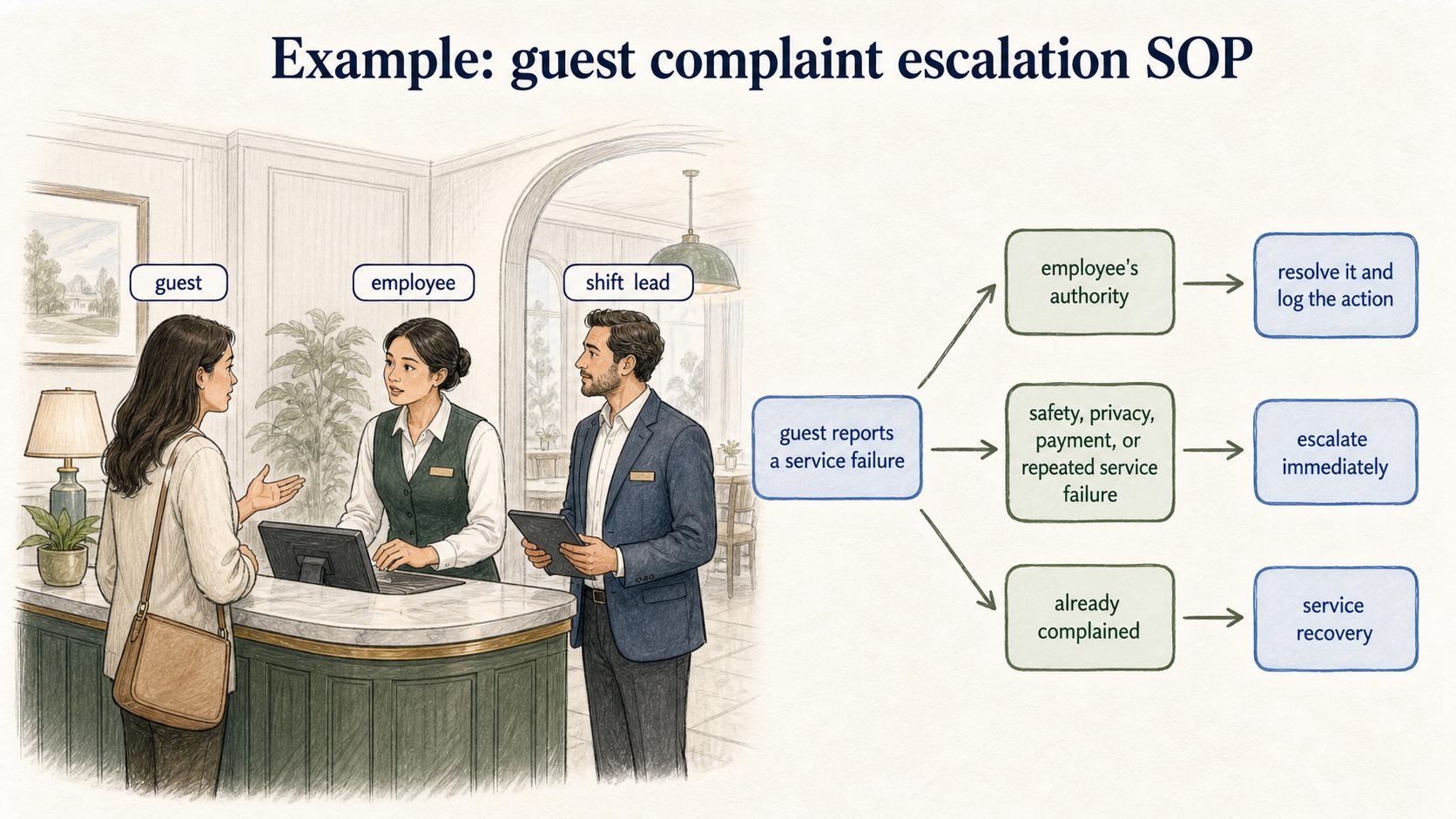
A guest complaint escalation SOP can start when a guest reports a service failure that the first employee cannot resolve immediately. The employee records the guest and issue, logs the category, offers the approved first response, and notifies the shift lead when the fix requires a room move, refund, comp, maintenance dispatch, or manager decision.
- Resolve and log issues within the employee's authority.
- Escalate immediately if the issue affects safety, privacy, payment, or a repeated service failure.
- Treat a repeat complaint as service recovery, not a routine request.
Common mistakes
Common mistakes include writing for managers instead of shift employees, using policy language where procedure language is needed, and leaving judgment out of the SOP. A good SOP says where judgment is allowed, where approval is required, and which situations should never be improvised.
AI-ready hospitality SOP template
## Hospitality SOP Template

**Glossary term:** Hospitality SOP
**Source:** Trails Glossary — trails.so/glossary/hospitality-sop

---

### 01. Create a hospitality SOP

"Create a hospitality SOP for [team or role] covering [workflow].

Context:
- Business type: [hotel, restaurant, resort, venue, or other]
- Guest-facing standard: [response time, quality standard, tone, or brand expectation]
- Systems used: [PMS, POS, ticketing tool, checklist app, shared log]
- Normal trigger: [event that starts the procedure]
- Known exceptions: [rush period, unavailable room, payment issue, safety issue, VIP guest]

Write the SOP with purpose and scope, trigger, roles and approval points, step-by-step procedure, exception path, required documentation, proof of completion, and review owner. Use practical shift language, not policy language."
How Trails helps
Trails captures an actual workflow as someone performs it, turns it into a polished step-by-step guide, and can create an AI-narrated video for training. That is useful for hospitality procedures with software steps, visual checks, or handoffs between roles.
- Checklist
- Hiring SOP
- Compliance SOP
- Customer service SOP
- Emergency response SOP
Sources
- 1
FDA. Food Code 2022. www.fda.gov/food/fda-food-code/food-code-2022.
- 2
Cornell Hospitality Report. Online Reviews. sha.cornell.edu/wp-content/uploads/sites/4/2019/03/rohit-verma-online-reviews.pdf.
- 3
Cal/OSHA. Restaurant Employees Workplace Safety & Health Guide. www.dir.ca.gov/dosh/dosh_publications/Rsg.pdf.
- 4
Auburn University. Hotel Complaint Management. etd.auburn.edu/handle/10415/11.