
Glossary
Audit SOP
 ChatGPT
 Perplexity
 Gemini
 Claude
What is an audit SOP?
An audit SOP is a standard operating procedure that explains how a team prepares for, performs, documents, and follows up on an audit. It turns audit work into a repeatable process instead of a scramble for evidence, screenshots, approvals, and owner updates. 1
Audit SOPs can support internal audits, customer audits, vendor reviews, quality checks, security reviews, finance controls, and operational process audits. The subject changes, but the job is consistent: define who does what, what evidence is required, how findings are recorded, and how follow-up work gets closed. 2
Why an audit SOP matters
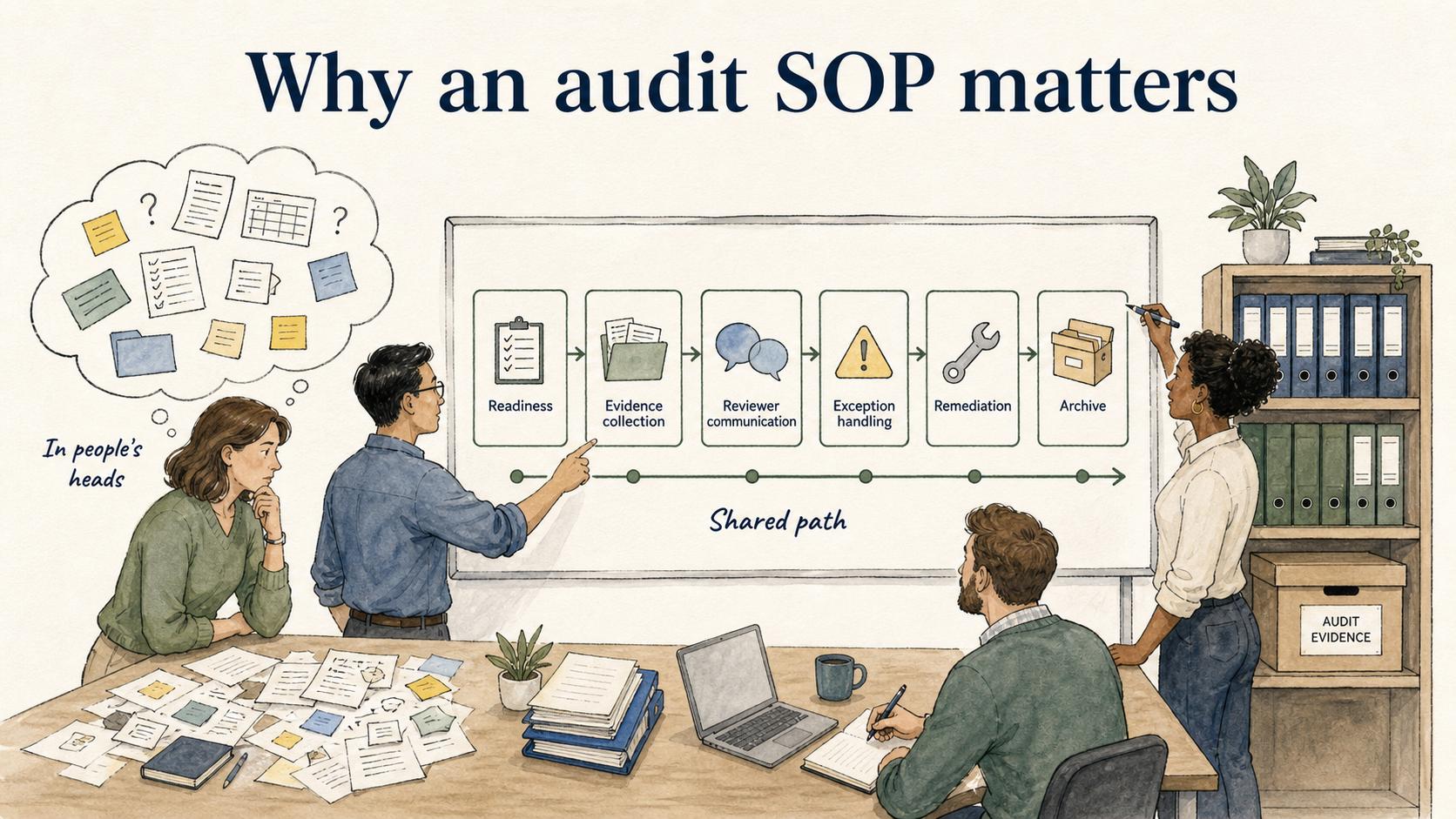
An audit gets fragile when the process only lives in people's heads. The team may know where evidence is stored, which spreadsheet has the latest status, and who usually answers auditor questions. When that person is unavailable, the process slows down fast.
An audit SOP reduces that dependency. It gives the team a shared path for readiness, evidence collection, reviewer communication, exception handling, remediation, and archiving. It also prevents quiet drift across audit cycles, where each review is handled a little differently because nobody wrote down the working method.
Its value starts before the audit. If the SOP names the required evidence and where it must live, teams can capture proof during normal work instead of rebuilding it under deadline pressure.
What an audit SOP should include
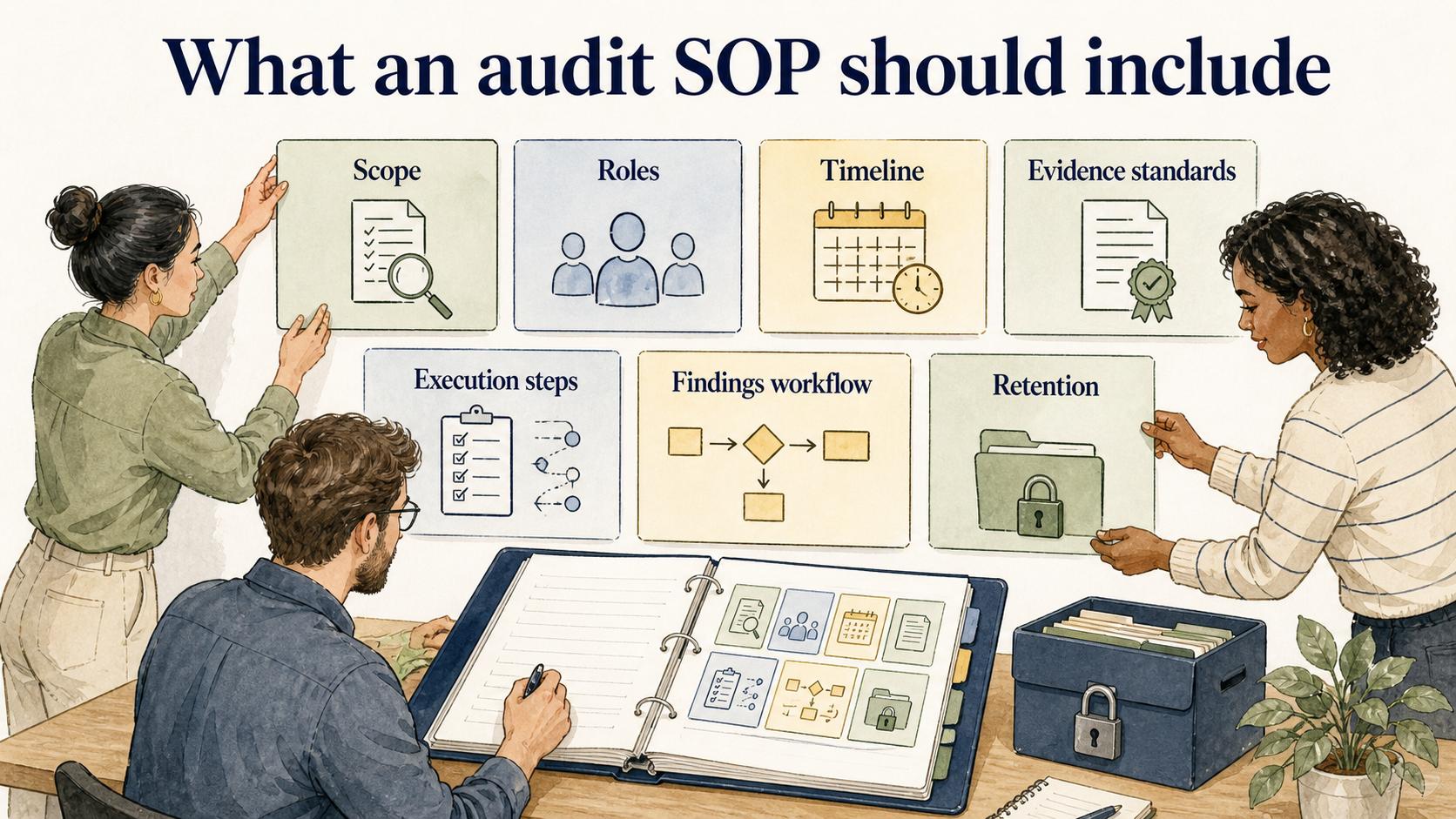
A useful audit SOP should be specific enough for someone to run the process and flexible enough to handle reasonable exceptions.
| SOP section | What it should clarify | Common miss |
|---|---|---|
| Scope | Which audit, process, location, team, or control set the SOP covers | A broad title like "audit process" with no boundary |
| Roles | Who owns preparation, evidence, review, responses, and approvals | Everyone is "responsible," so nobody is actually accountable |
| Timeline | When preparation starts and which milestones matter | The SOP only describes audit day, not the weeks before it |
| Evidence standards | What counts as acceptable evidence and where it is stored | Screenshots and exports exist, but source systems are unclear |
| Execution steps | How requests are received, tracked, answered, and reviewed | The steps assume the same person handles every request |
| Findings workflow | How findings are logged, prioritized, assigned, and closed | Findings are discussed but never converted into trackable work |
| Retention | How long records are kept and who owns the archive [3] | Evidence is deleted, moved, or locked behind the wrong permissions |
The best audit SOPs include decision rules, not just task names. For example: "If evidence contains customer data, upload it to the secure audit folder and link the folder item in the tracker. Do not send it directly in email." That kind of instruction makes the SOP usable during a real review.
Audit SOP vs audit checklist
An audit checklist lists what to review or gather. An audit SOP explains how the audit work should happen.
A checklist might say, "Collect user access reports." The SOP should say who exports them, which system is authoritative, how the file is named, where it is stored, who reviews it, and what happens if the report shows an exception.
Many teams need both: the SOP as the operating guide, and the checklist as the task-level companion inside the process.
Common audit SOP mistakes
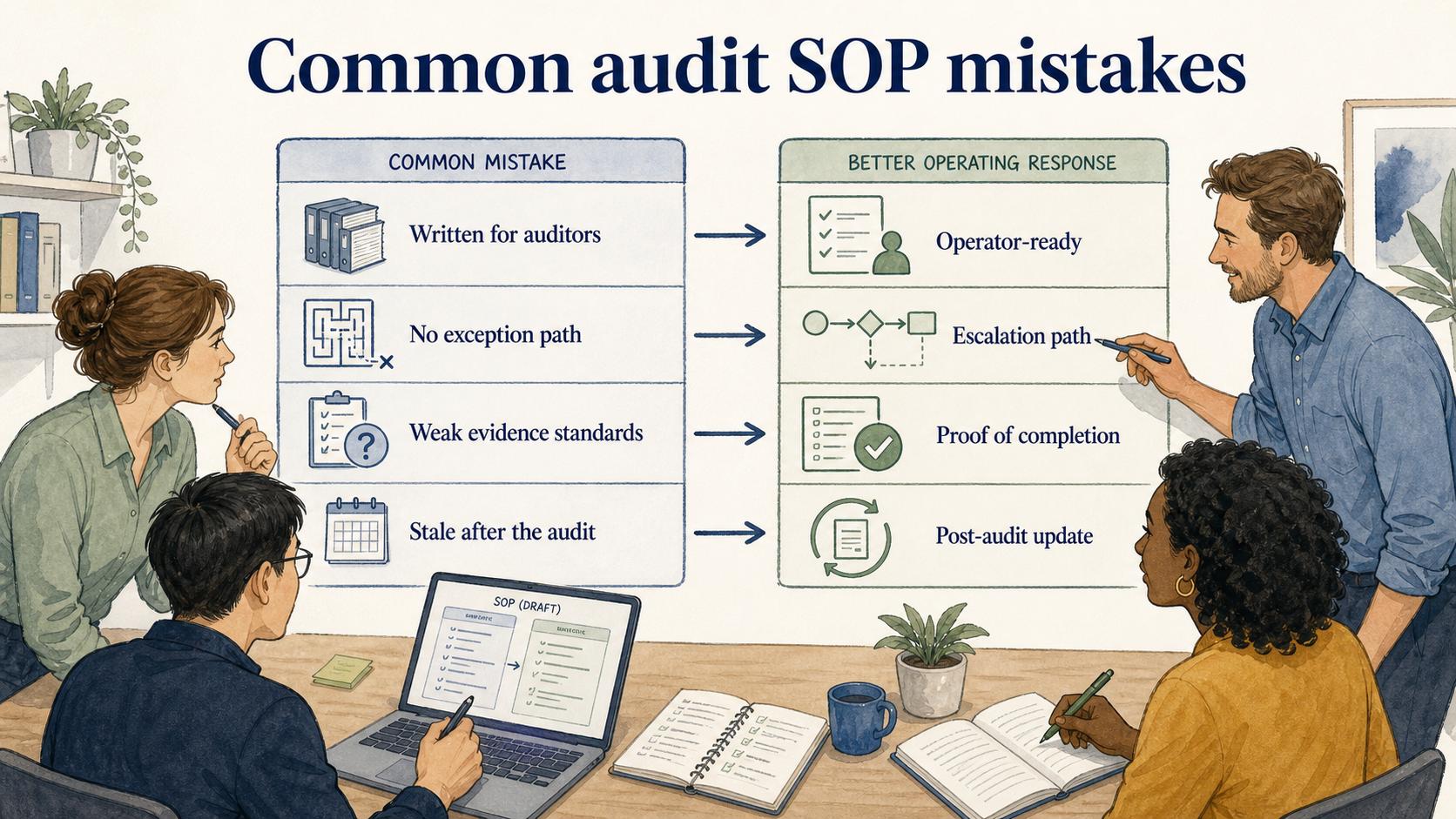
Writing the SOP for auditors instead of operators. The document should satisfy audit needs, but the primary reader is the person doing the work. If the SOP is full of abstract compliance language and light on handoffs, it won't help during a live review.
Skipping exception handling. Audit work rarely follows a clean path. Evidence may be missing, a control may have failed, an owner may disagree with a finding, or a request may fall outside scope. A strong SOP names the escalation path before the team is under pressure.
Treating evidence collection as admin work. Evidence is the backbone of the audit. The SOP should clarify what proves completion, not just tell people to "collect documentation." Weak evidence standards create rework and undermine confidence in the review.
Letting the SOP go stale after the audit ends. The best time to improve an audit SOP is immediately after an audit, when the pain is still visible. Capture what was confusing, which evidence took too long to find, and which findings exposed process gaps.
How to create a practical audit SOP
Start with one real audit cycle instead of trying to design a universal procedure. Map the phases: preparation, evidence collection, request handling, review meetings, findings, remediation, and archive. Then identify the handoffs where work stalls or evidence gets lost.
For each phase, write the instruction around a clear artifact. Preparation produces an audit calendar or tracker. Evidence collection produces source-linked records. Findings produce assigned remediation items. 4 Closure produces an archive and lessons learned. When every phase has an artifact, the SOP becomes easier to follow and easier to audit.
A strong final test is simple: could a new owner run the next audit from this document without asking who usually does what? If not, the missing details are usually roles, evidence standards, naming conventions, or exception paths.
How Trails helps
Trails can help teams document the repeatable parts of an audit SOP by capturing the workflow as someone performs it. That captured process can become a polished step-by-step guide, and Trails can create an AI-narrated video version for training or sharing. This is especially useful for evidence collection, tracker updates, system exports, and other audit tasks that need to be performed consistently.
FAQ
Is an audit SOP required for every audit?
Not always. Small, low-risk reviews may only need a checklist or tracker. An SOP becomes more useful when the audit repeats, involves multiple teams, requires evidence, or has consequences if the process is inconsistent.
Who owns an audit SOP?
Ownership depends on the audit type. Compliance, security, finance, operations, quality, or department leads may own the SOP. The important part is that one role is accountable for keeping it current.
What is the difference between an audit SOP and an audit plan?
An audit plan usually describes the scope, timing, and objectives for a specific audit. An audit SOP describes the repeatable procedure the team uses to handle audit work across cycles.
How often should an audit SOP be reviewed?
Review it after each audit cycle or whenever the underlying process, system, owner, or evidence requirement changes. The post-audit review is especially useful because it captures the friction people just experienced.
Sources
- 1
ISO. ISO 19011:2026 guidelines for auditing management systems. ISO, 2026. www.iso.org/standard/19011.
- 2
U.S. Government Accountability Office. GAO Government Auditing Standards 2024 Revision. U.S. Government Accountability Office, 2024. www.gao.gov/assets/d24106786.pdf.
- 3
U.S. National Archives and Records Administration. NARA General Records Schedules guidance. U.S. National Archives and Records Administration. www.archives.gov/records-mgmt/grs.
- 4
Institute of Internal Auditors. IIA 2024 Global Internal Audit Standards. Institute of Internal Auditors, 2024. www.theiia.org/en/standards/2024-standards/global-internal-audit-standards/.