
Glossary
Clinical SOP
 ChatGPT
 Perplexity
 Gemini
 Claude
What is a clinical SOP?
A clinical SOP is a standard operating procedure for a clinical setting, clinical research activity, or health-related workflow. It explains how recurring work should be performed so people can act consistently, protect patients or participants, and follow applicable protocols, regulations, institutional policies, and quality expectations.1
Clinical SOPs are common in clinical trials, research sites, laboratories, pharmacies, hospitals, and other care or research environments. The term sounds administrative, but the stakes are operational: vague instructions can affect safety, data quality, privacy, audit readiness, and how staff handle exceptions.
Why clinical SOPs matter
Clinical work often combines human judgment, regulated requirements, time pressure, and sensitive information. That combination makes informal process knowledge risky, especially in clinical trials where GCP guidance emphasizes participant rights, safety, well-being, and reliable data.2 If every coordinator, nurse, investigator, technician, or manager handles the same situation differently, the organization can end up with inconsistent care, unreliable data, missed documentation, or avoidable compliance findings.
A clinical SOP gives teams a shared operating method. It does not replace professional judgment, the study protocol, or local clinical leadership. It narrows the routine parts of the work so staff can focus judgment where it belongs: eligibility questions, adverse events, participant communication, escalation, protocol deviations, or unusual clinical facts.
The best clinical SOPs are specific at the moment of work. A useful SOP tells someone when the procedure applies, who is responsible, what steps to follow, what records to create, what needs review, and what to do when reality does not match the expected path.
Where clinical SOPs are used
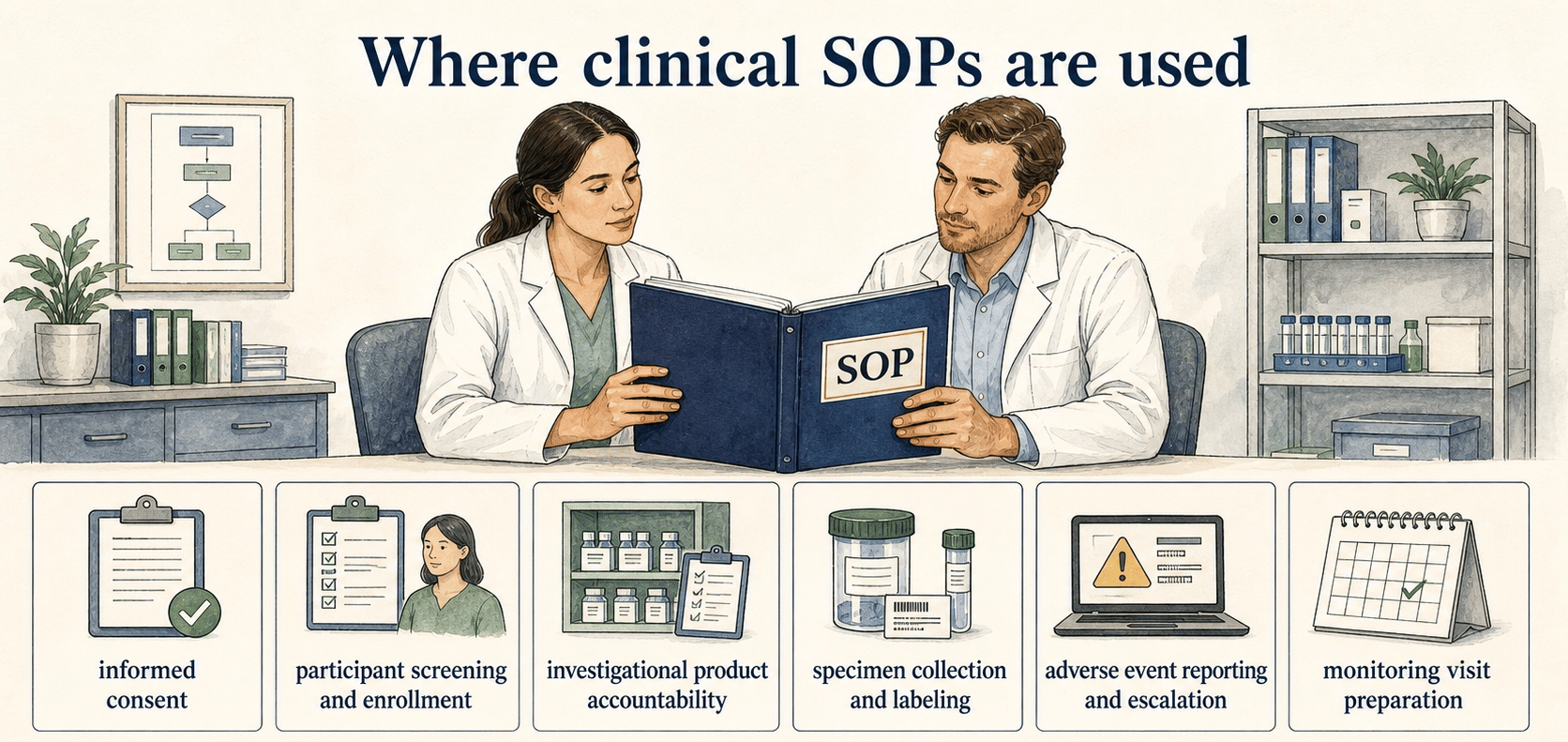
Clinical SOPs are strongest when the work is repeatable and consequence-heavy. Common examples include:
- Informed consent process documentation
- Study startup and regulatory binder maintenance
- Participant screening and enrollment workflows
- Investigational product accountability
- Specimen collection, labeling, handling, and shipment
- Source documentation and case report form completion
- Adverse event reporting and escalation
- Monitoring visit preparation, follow-up, and data query resolution
- Equipment calibration or clinical lab procedures
The scope matters. A clinical trial SOP should say whether it applies to all studies, a specific department, one sponsor program, one site, or one study protocol. For example, U.S. FDA investigator regulations require adequate and accurate case histories and record retention, so scope and evidence rules cannot be left vague.3 A hospital SOP should also distinguish clinical practice, administrative workflow, and research obligations. Blurring those boundaries is how teams end up with procedures that sound authoritative but do not match the work.
Clinical SOP vs protocol vs work instruction
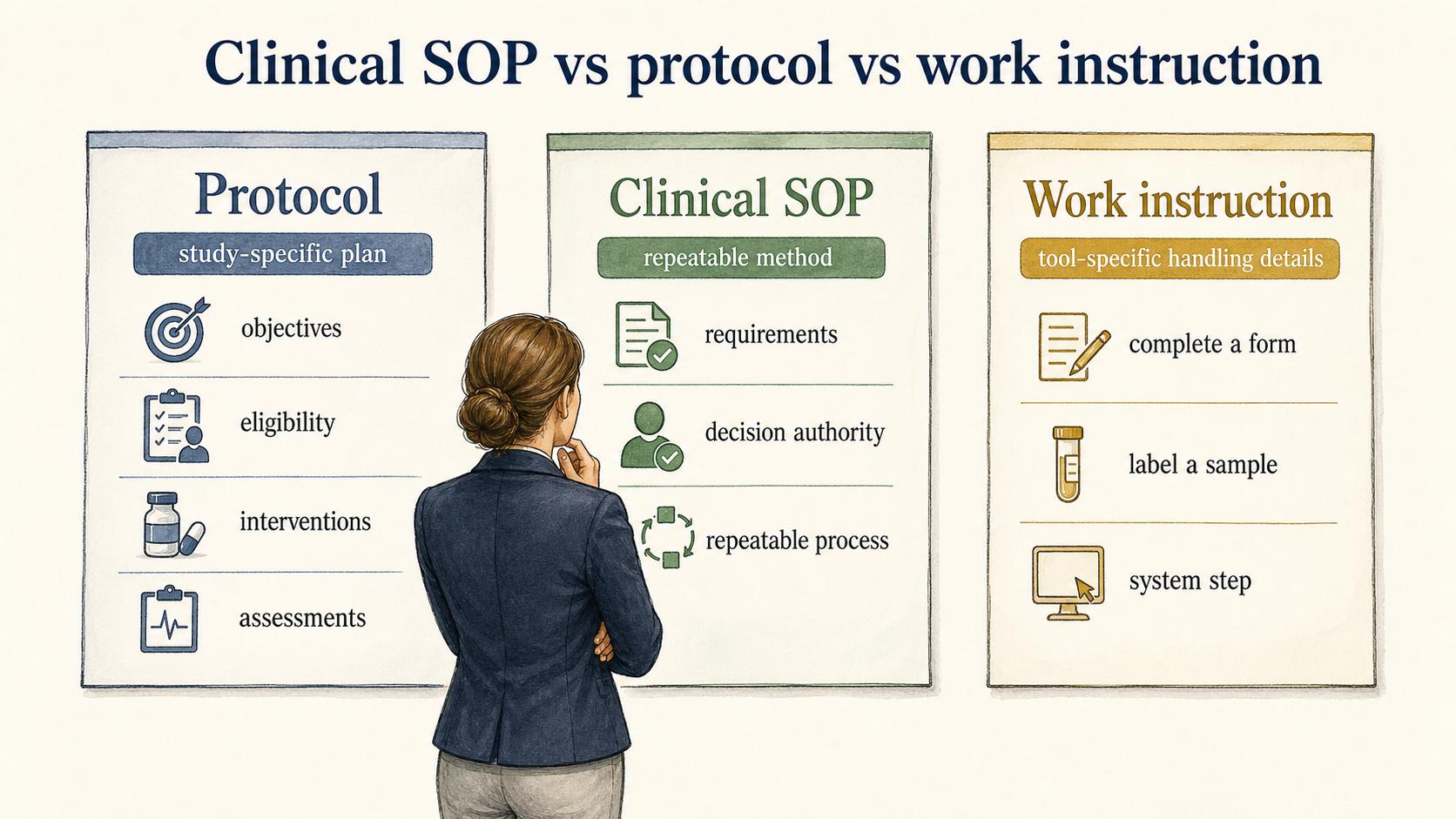
A clinical SOP is different from a study protocol. The protocol defines the study-specific plan: objectives, design, eligibility, interventions, assessments, and analysis. The SOP defines the organization's repeatable method for carrying out a type of activity.
A work instruction is usually narrower than an SOP. It may explain how to complete a form, use a device, label a sample, upload a file, or perform a specific system step. In clinical environments, the protocol, SOP, and work instruction need to agree without duplicating each other.
A practical rule: put requirements and decision authority in the protocol or governing policy, put repeatable process in the SOP, and put tool-specific handling details in the work instruction. When electronic systems are involved, FDA guidance points to controls that support trustworthy, reliable electronic records.4 If a protocol changes, the SOP should change only when the underlying operating method changes. If a system interface changes, the work instruction may change while the SOP remains stable.
What a clinical SOP should include
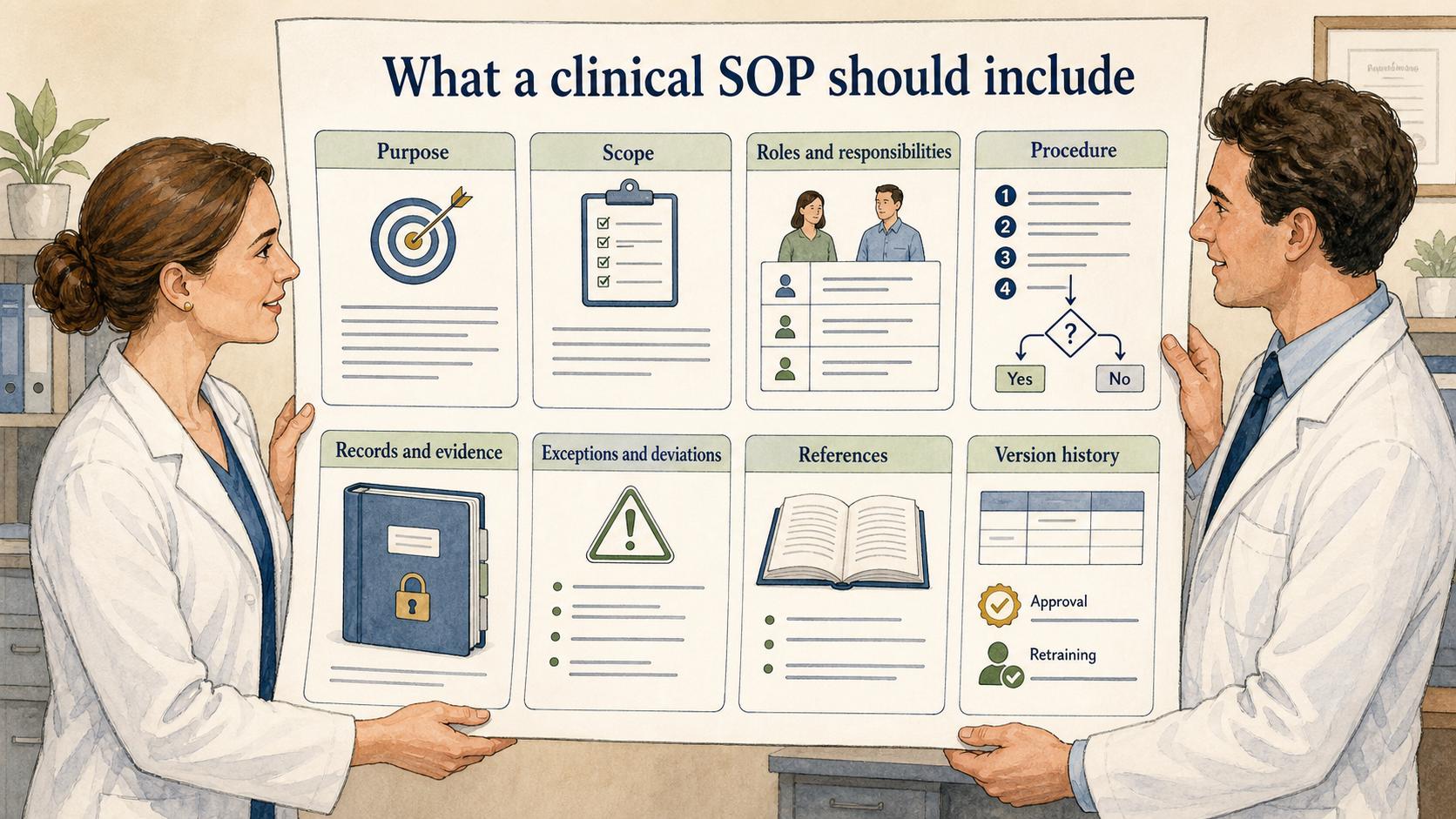
A strong clinical SOP should help someone perform the work and help a reviewer understand why the work was performed that way. It usually needs these elements:
- Purpose: The risk, quality objective, patient or participant protection, or compliance need the SOP supports.
- Scope: The teams, studies, sites, systems, and situations covered, plus clear exclusions.
- Roles and responsibilities: Who performs, reviews, approves, escalates, and documents the activity.
- Procedure: The ordered steps, including decision points and required checks.
- Records and evidence: What must be documented, where it is stored, and how long it is retained according to the organization's rules.
- Exceptions and deviations: How staff should handle urgent issues, protocol deviations, missed steps, or unclear scenarios.
- References: Related protocols, policies, regulations, forms, templates, or training material.
- Version history: What changed, who approved it, and when staff need retraining.
The failure mode is writing the SOP for the auditor instead of the user. Audit readiness matters, but an SOP that frontline staff cannot follow creates the risk it is supposed to control. Good clinical SOPs are reviewable and usable.
AI-ready clinical SOP starter prompt
Use this prompt to create a first working draft, then have the appropriate clinical, quality, regulatory, privacy, and legal reviewers adapt it to the organization's actual obligations.
## Clinical SOP Starter Prompt

**Glossary term:** Clinical SOP
**Source:** Trails Glossary — trails.so/glossary/clinical-sop

---

### 01. Draft a clinical SOP

"Draft a clinical SOP for [workflow] used by [team/role] in [clinical setting, research site, lab, or study type].

Include:
- Purpose: what patient, participant, data quality, safety, or compliance risk this SOP controls
- Scope: where it applies, where it does not apply, and any study/site limitations
- Roles: who performs, reviews, approves, escalates, and documents the work
- Procedure: the ordered steps, with decision points and required checks
- Required records: what evidence is created, where it is stored, and who reviews it
- Exceptions: what staff should do for urgent issues, missing information, deviations, or unclear cases
- Training: who must be trained and when retraining is required
- References: protocol, policy, GCP, IRB/ethics, privacy, or institutional references to verify
- Version history: owner, approver, effective date, and change summary

Keep the procedure usable during real work. Flag any point where local policy, sponsor requirements, regulatory requirements, or clinical leadership review is required."
The prompt is only a drafting aid. Clinical SOPs should not be finalized by AI alone. The final version needs knowledgeable review because the correct procedure depends on the setting, study, applicable regulations, institutional policies, sponsor requirements, and patient or participant risk.
Common mistakes
The first mistake is copying a generic SOP without adapting it to the actual clinical workflow. Templates can help, but clinical teams need local clarity: the forms they use, systems they touch, roles they have, and escalation paths they follow.
The second mistake is hiding judgment calls. If staff need to decide whether an event is reportable, whether a missing signature requires escalation, or whether a specimen can still be used, the SOP should name the decision owner and reference the governing requirement. It should not pretend the answer is automatic.
The third mistake is letting SOPs drift after systems or protocols change. A clinical SOP that describes the old process creates false confidence. Tie SOP review to protocol amendments, system changes, audit findings, and training updates.
How Trails helps
Trails can help teams capture repeatable clinical-adjacent workflows as someone performs them, then turn the workflow into a polished step-by-step guide. That can be useful for training coordinators, documenting administrative study workflows, preparing for monitoring visits, or keeping internal procedures easier to maintain.
For clinical environments, review is the important caveat. Trails can make process documentation faster to create and update, and it can generate an AI-narrated video version for training or sharing, but the final SOP still needs the right clinical, quality, regulatory, privacy, and institutional review before use.
FAQ
Is a clinical SOP legally required?
It depends on the setting, activity, jurisdiction, sponsor, and applicable regulatory requirements. Clinical SOPs often support compliance and Good Clinical Practice expectations, but the specific requirement should be verified against the relevant regulations, protocol, sponsor requirements, IRB or ethics requirements, and institutional policies.
Who should approve a clinical SOP?
Approval usually depends on the workflow. Clinical operations, quality, regulatory, privacy, principal investigator, department leadership, or sponsor representatives may need to review or approve. The SOP should name the approval path rather than leaving ownership implied.
How often should clinical SOPs be reviewed?
Organizations commonly set a periodic review cycle, but event-based review is just as important. Review the SOP when regulations, protocols, systems, forms, staffing models, audit findings, or recurring deviations show that the current process no longer matches reality.
Can AI write clinical SOPs?
AI can help create a structured first draft, identify missing sections, or simplify wording. It should not be the final authority for clinical SOPs. The final procedure needs human review by people accountable for clinical quality, participant protection, data integrity, and compliance.
- Healthcare SOP
- Compliance SOP
- SOP vs Work Instruction
- SOP Meaning in Business
- HIPAA Compliance
- Training Documentation
- Good Clinical Practice
- Source documentation
Sources
- 1
FDA. E6(R3) Good Clinical Practice guidance. U.S. Food and Drug Administration. www.fda.gov/regulatory-information/search-fda-guidance-documents/e6r3-good-clinical-practice-gcp.
- 2
EMA. ICH E6 Good Clinical Practice guideline. European Medicines Agency. www.ema.europa.eu/en/ich-e6-good-clinical-practice-scientific-guideline.
- 3
U.S. Government. 21 CFR 312.62 investigator recordkeeping and record retention. Electronic Code of Federal Regulations. www.ecfr.gov/current/title-21/chapter-I/subchapter-D/part-312/subpart-D/section-312.62.
- 4
FDA. Electronic systems, electronic records, and electronic signatures guidance. U.S. Food and Drug Administration. www.fda.gov/media/166215/download.