
Glossary
SOP Meaning in Business
 ChatGPT
 Perplexity
 Gemini
 Claude
What SOP means in everyday business language
In business, SOP means standard operating procedure. An SOP is a written guide that explains the approved way to perform a repeatable business process, task, or workflow.
The plain-English version is: This is how we do this here. A useful SOP turns work that lives in someone's memory, inbox, or chat history into a shared standard that other people can follow.
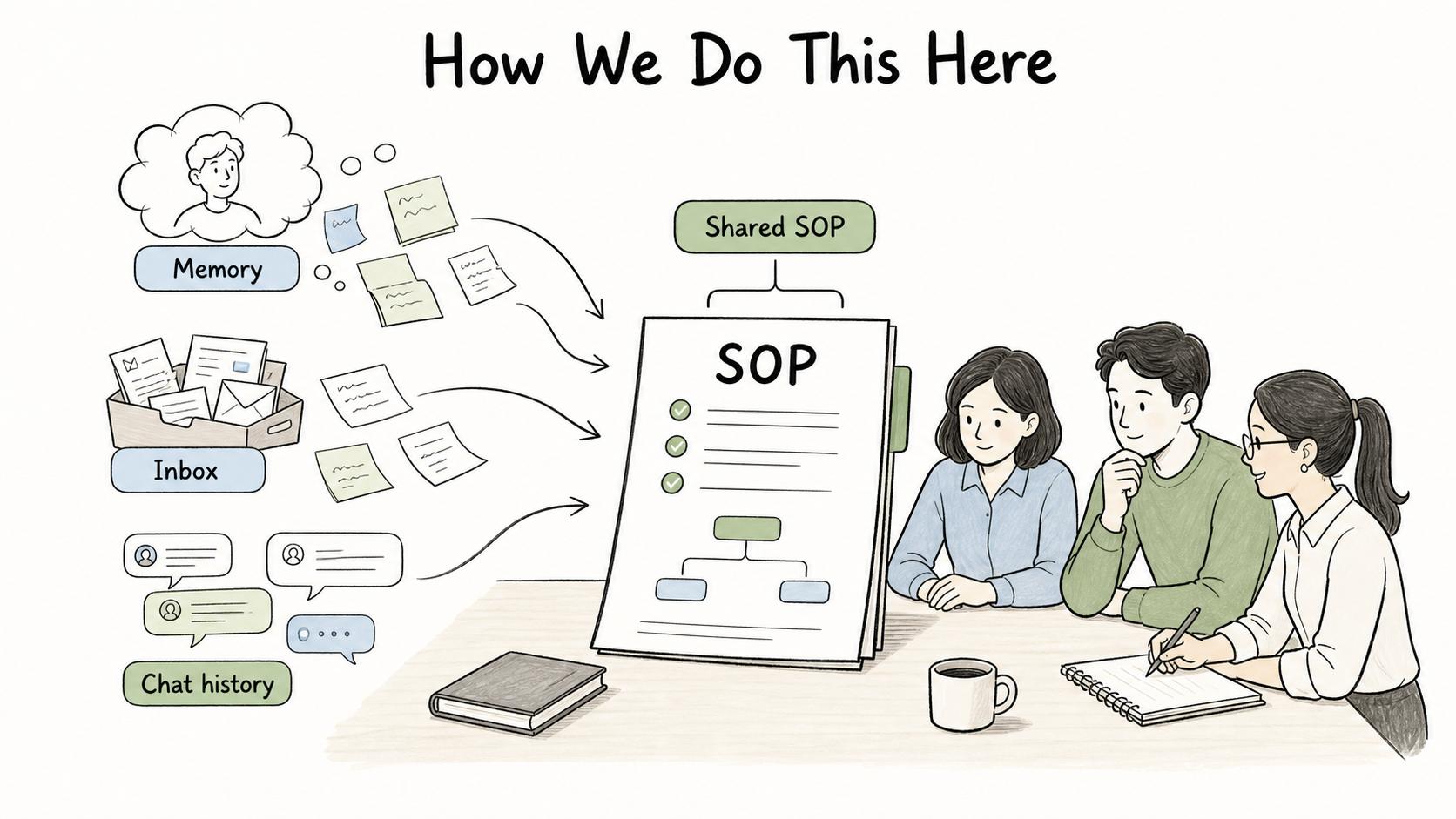
A business SOP explains how a team should complete recurring work. It may cover a small task, like processing a refund, or a broader process, like onboarding a new employee. The point is consistency: the work should not depend entirely on who is available, who remembers the shortcut, or who trained the last person.1
SOPs are common in operations, finance, HR, customer support, sales, IT, compliance, manufacturing, healthcare, agencies, and small businesses. The format can be simple. A one-page procedure with clear steps, roles, and exceptions may be more useful than a polished manual nobody reads.
The key is that an SOP documents the standard the business wants followed, not merely a description of what people sometimes do.
Why SOPs matter in business
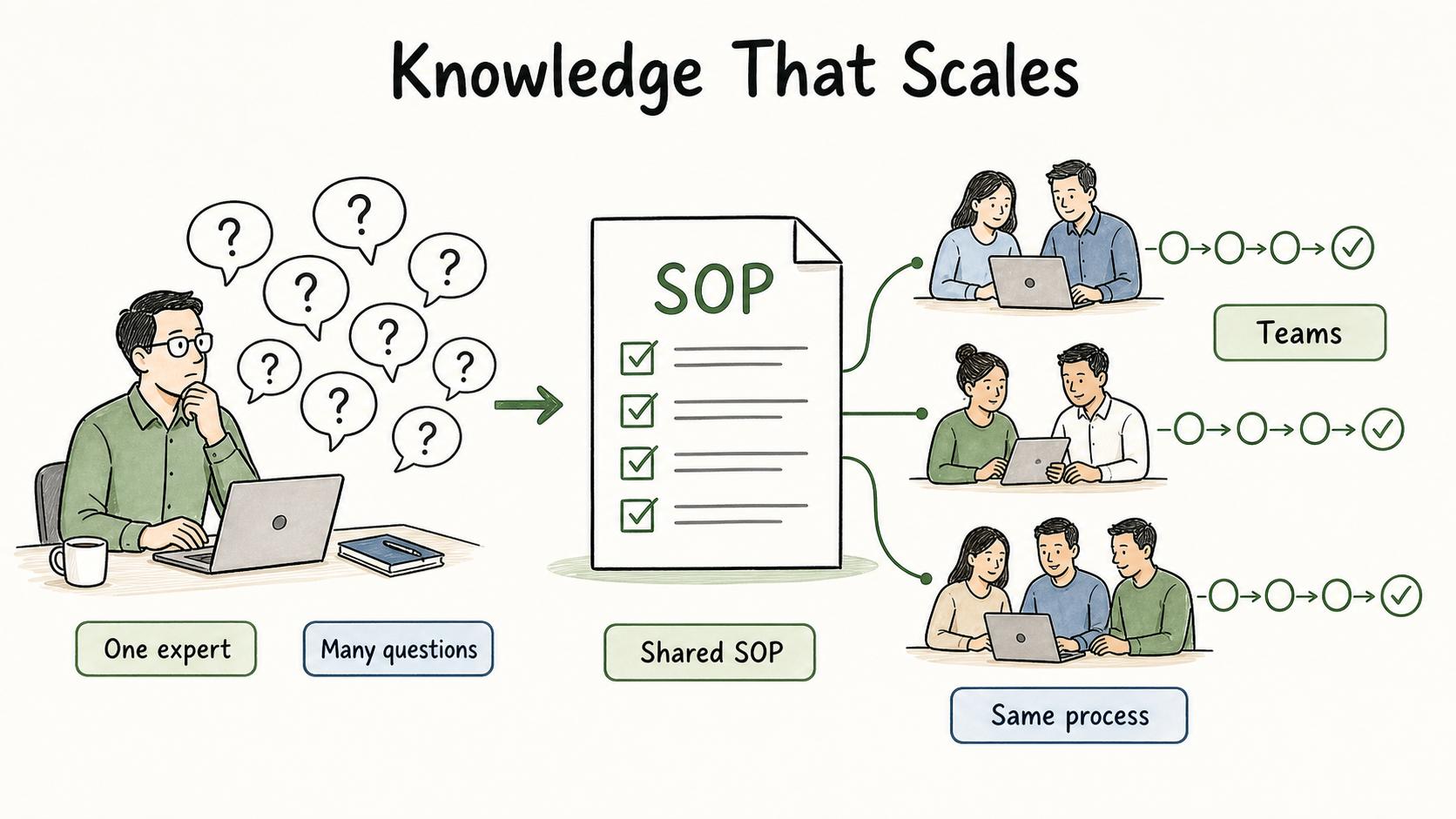
SOPs become more important as a business grows because informal knowledge stops scaling. In a very small team, one experienced person can answer every question. As teams add locations, shifts, departments, contractors, or remote employees, that model breaks down.
Clear SOPs help businesses train new employees, reduce avoidable mistakes, keep customer-facing work consistent, preserve knowledge when people leave, clarify handoffs, and support audits or compliance reviews. Well-written SOPs can improve communication, reduce training time, and improve work consistency.2
The value is the shared standard behind the document. A stale SOP that nobody follows is paperwork. A living SOP that matches real work can become a practical training, quality, and management tool.
Business SOP examples
Different teams use SOPs for different recurring workflows.
| Team | SOP example | What it standardizes |
|---|---|---|
| Finance | Accounts payable approval SOP | How invoices are reviewed, approved, and paid |
| HR | New hire onboarding SOP | How a new employee is prepared before and after their start date |
| Support | Refund request SOP | How agents evaluate, approve, and process refunds |
| Sales | Lead handoff SOP | How qualified leads move from one role or stage to another |
| Operations | Daily opening SOP | How a location, shift, or workspace is prepared for work |
| IT | Access request SOP | How employees request, approve, and receive system access |
The details change by team, but the pattern is the same: the business wants repeatable work to happen in a trusted way.
What a business SOP usually includes
A business SOP should be practical enough for someone to use while doing the work. It does not need to sound legalistic. It needs to remove ambiguity.
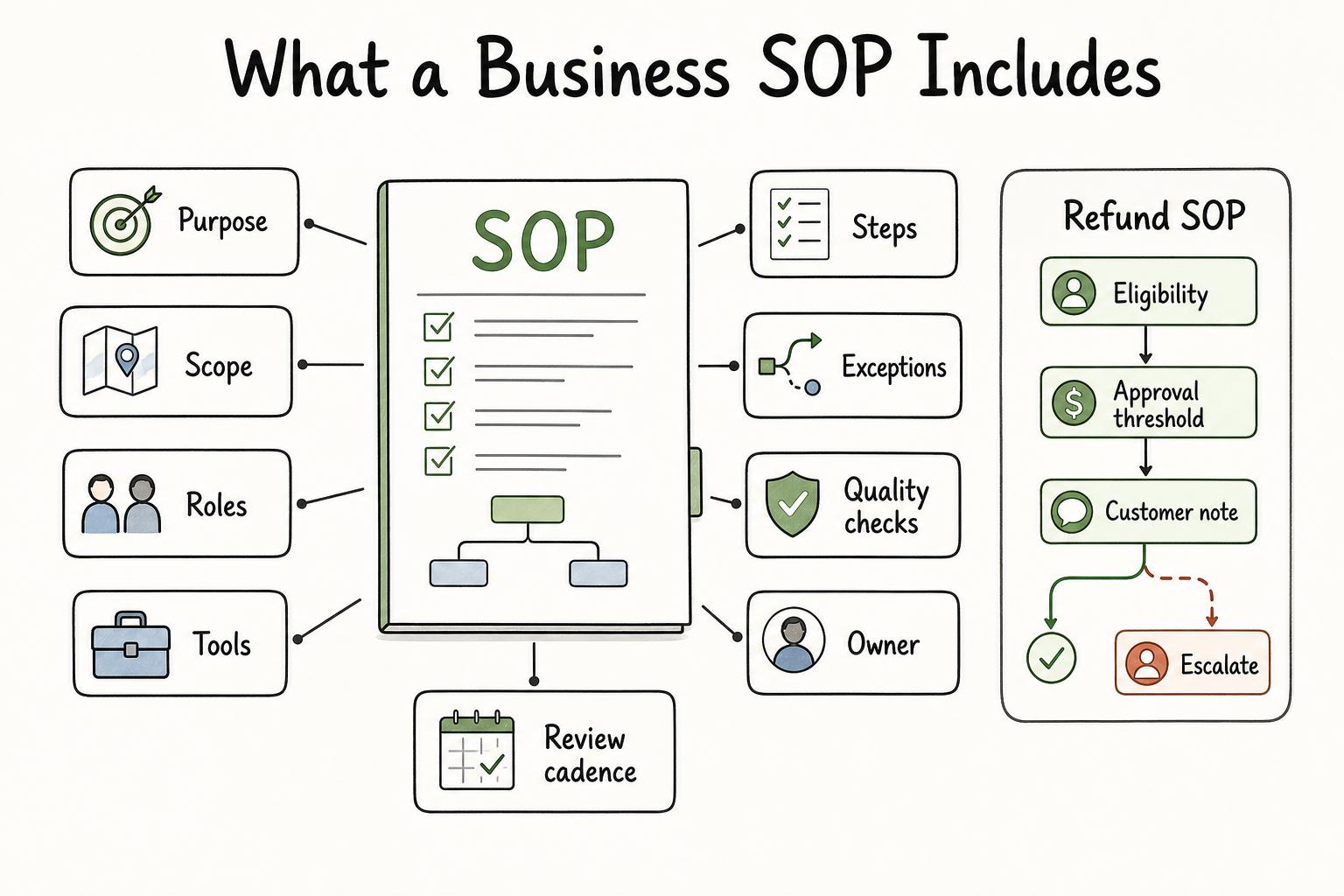
Most SOPs include a purpose, scope, roles, required tools or systems, procedure steps, exceptions, quality checks, owner, and review cadence. ISO guidance on documented information emphasizes that organizations should determine the amount of documentation needed to support effective planning, operation, and control of processes.3 The most useful SOPs also explain what should happen when the normal path does not apply.
For example, a refund SOP should not only say how to issue the refund. It should explain eligibility, approval thresholds, required notes, customer communication, and when to escalate.
SOP vs policy vs process
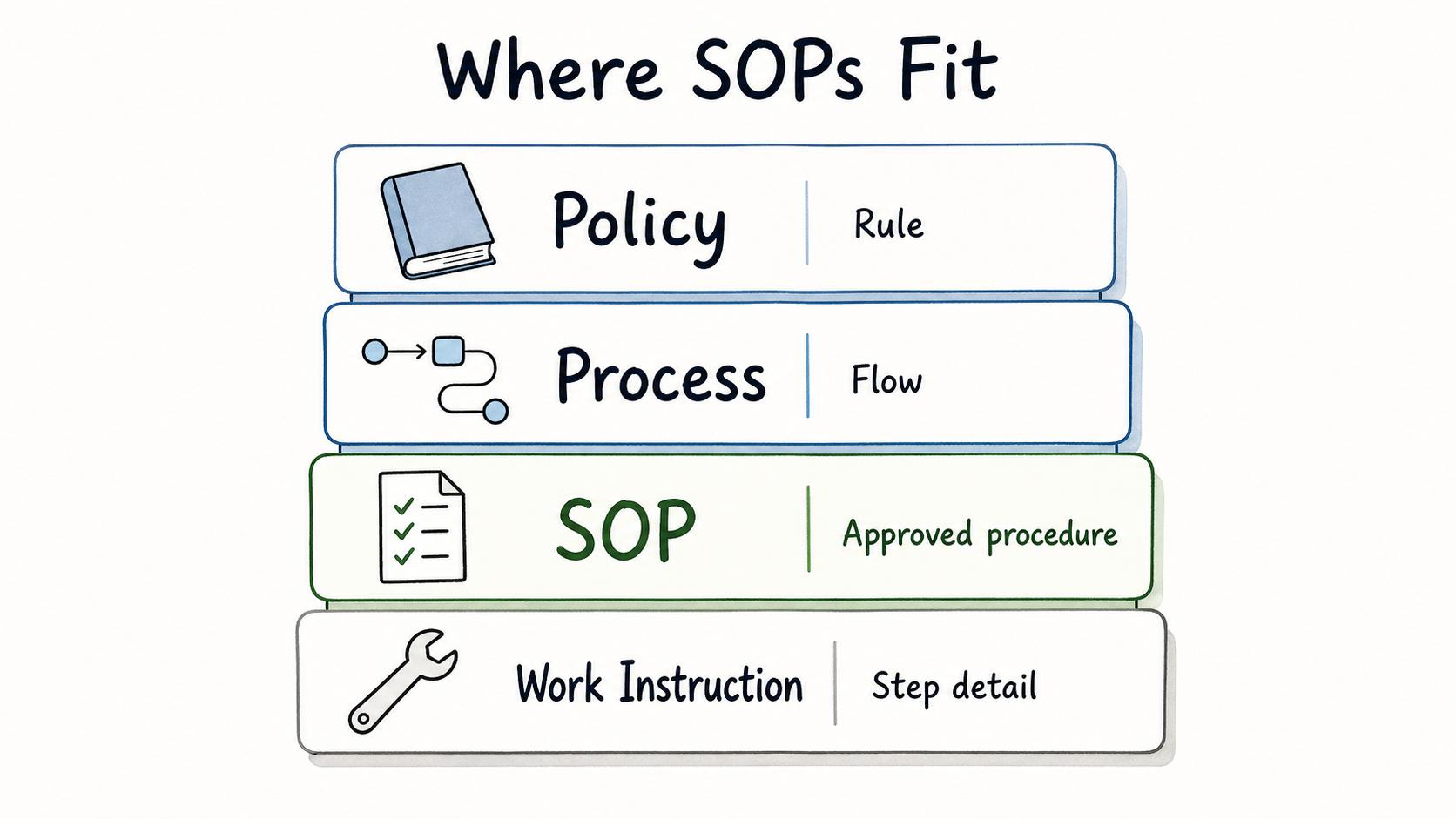
SOPs often sit between high-level rules and task-level instructions.
- Policy: explains the rule or standard.
- Process: explains the broader flow of work.
- SOP: explains the approved procedure for completing that work.
- Work instruction: gives exact task-level detail for one action.
For example, a refund policy might say that refunds above $500 require manager approval. The refund process explains how a request moves from support to finance to customer notification. The SOP explains the approved refund approval and processing procedure. A work instruction explains the exact payment-system steps.
This distinction keeps documents from becoming overloaded. The SOP should be detailed enough to guide the workflow, but not so detailed that every tool click makes it hard to maintain.
When a business process needs an SOP
Create an SOP when the work is repeated, teachable, important to quality, performed by more than one person, or risky when done incorrectly. That risk may be financial, operational, customer-facing, safety-related, compliance-related, or simply expensive rework.
COSO's internal-control framework connects controls with objectives related to operations, reporting, and compliance.4 For everyday teams, that means SOPs are most useful when a process needs a visible standard, not just tribal knowledge.
Do not rush to create an SOP when the work is one-off, highly creative, still changing every day, or better handled by a short checklist. If the process is still being designed, start with a lightweight draft. Once the team agrees on the standard, turn it into an SOP with an owner and review cadence.
How Trails helps
Trails helps teams create SOPs from real work. A teammate can perform the workflow, capture the steps, turn them into a polished guide, and create an AI-narrated video version for training or sharing.
That is useful for business SOPs because many procedures hide in routine work: the screen someone opens, the field they check, the exception they remember, or the handoff they make without thinking.
- Standard operating procedure
- SOP scope
- SOP training
- SOP software
- SOP vs work instruction
- Policy vs procedure
- Business process
Sources
- 1
U.S. Environmental Protection Agency. Guidance for Preparing Standard Operating Procedures. EPA. www.epa.gov/sites/default/files/2015-06/documents/g6-final.pdf. Accessed July 6, 2026.
- 2
Penn State Extension. Standard Operating Procedures: A Writing Guide. Penn State Extension. extension.psu.edu/standard-operating-procedures-a-writing-guide. Accessed July 6, 2026.
- 3
International Organization for Standardization. Guidance on the requirements for documented information of ISO 9001:2015. ISO. www.iso.org/iso/documented_information.pdf. Accessed July 6, 2026.
- 4
COSO. Internal Control - Integrated Framework. Committee of Sponsoring Organizations of the Treadway Commission. www.coso.org/guidance-on-ic. Accessed July 6, 2026.