
Glossary
30-60-90 Day Plan
 ChatGPT
 Perplexity
 Gemini
 Claude
30-60-90 day plan overview
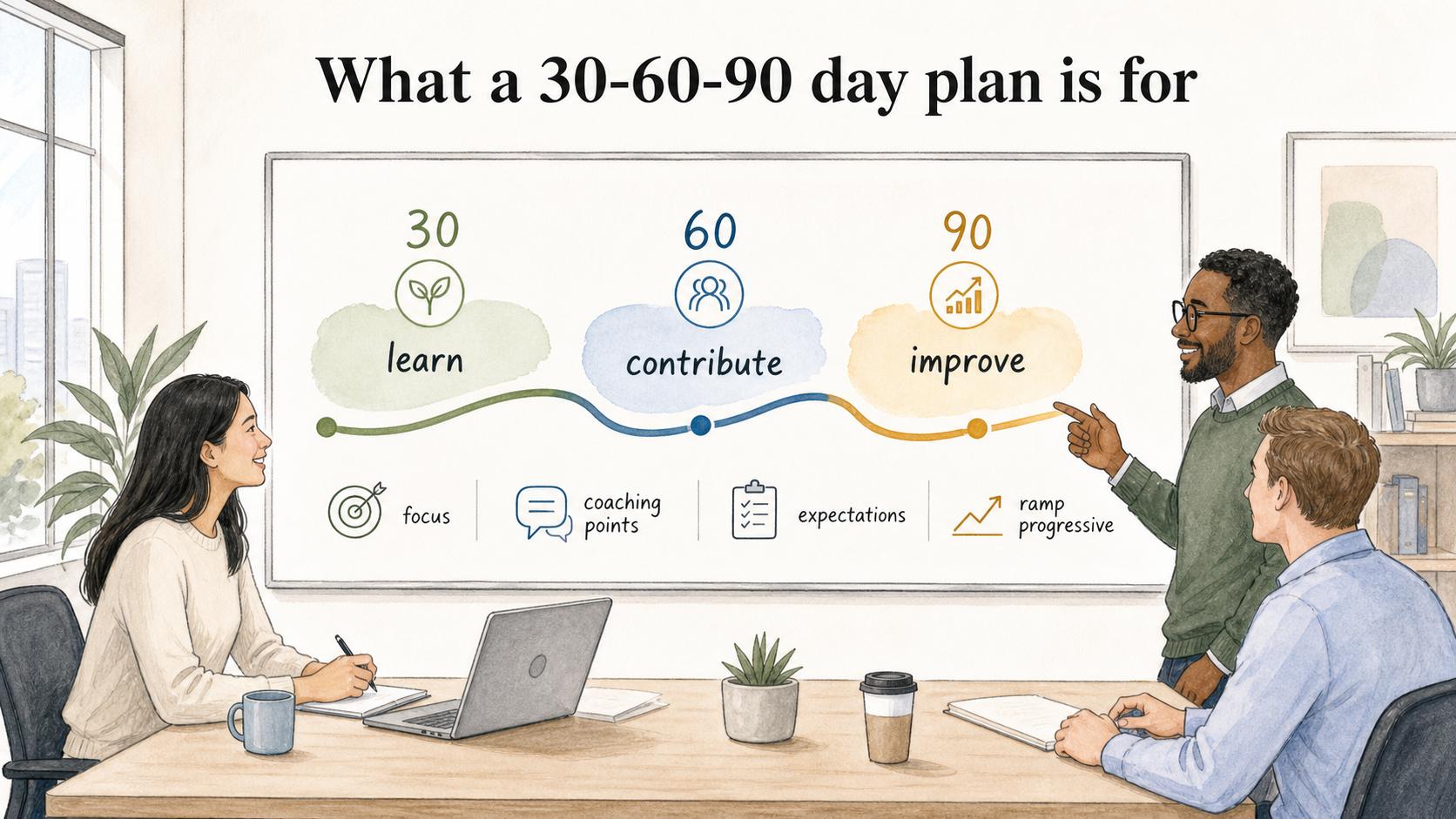
A 30-60-90 day plan divides a person's first three months in a role, project, or transition into three phases: learn, contribute, and improve. It clarifies what the person should understand, accomplish, and demonstrate by the end of each 30-day period.
The plan is most common in new-hire onboarding, manager transitions, sales roles, and leadership changes. SHRM's onboarding guide notes that onboarding can extend across months and should integrate new employees into the organization's structure, culture, mission, and work. 1 The calendar gives the plan shape; the real value is making expectations visible before everyone quietly develops a different definition of "ramped."
What a 30-60-90 day plan is for
A 30-60-90 day plan gives a new or transitioning employee a shared map for the first three months. It helps the employee focus, gives the manager concrete coaching points, and keeps the team from relying on vague expectations like "get up to speed."
The best plans answer three questions:
- What should this person learn first?
- What should they own or contribute next?
- What should they improve, lead, or decide by the end of the first 90 days?
That sequence matters. Some onboarding plans ask people to produce before they understand customers, systems, team norms, or decision rights. Others keep people in passive learning mode too long. A strong 30-60-90 day plan makes the ramp progressive. Recent newcomer-socialization research points to role clarity, task mastery, social acceptance, and fit as important adjustment outcomes during onboarding. 2
What each phase usually includes
| Phase | Main focus | Useful outcomes |
|---|---|---|
| First 30 days | Learn the role, team, customers, tools, expectations, and current work | Completed onboarding tasks, key relationships mapped, core workflows observed, early questions captured |
| Days 31-60 | Contribute to recurring work with support and start owning small deliverables | First independent tasks completed, feedback loops established, process gaps identified, confidence building |
| Days 61-90 | Own meaningful outcomes, improve a workflow, and make better decisions with less supervision | Clear ownership, measurable contribution, documented lessons, plan for the next quarter |
Adapt the structure to the role. HBS career guidance similarly recommends laying out the first 90 days in three 30-day increments, identifying stakeholders, quantifying outputs, and scheduling check-ins to manage expectations. 3 A sales rep may need pipeline creation and discovery-call milestones. A support hire may need ticket-quality benchmarks. A manager may need listening tour themes, team health observations, and operating rhythm changes.
How to write a useful 30-60-90 day plan
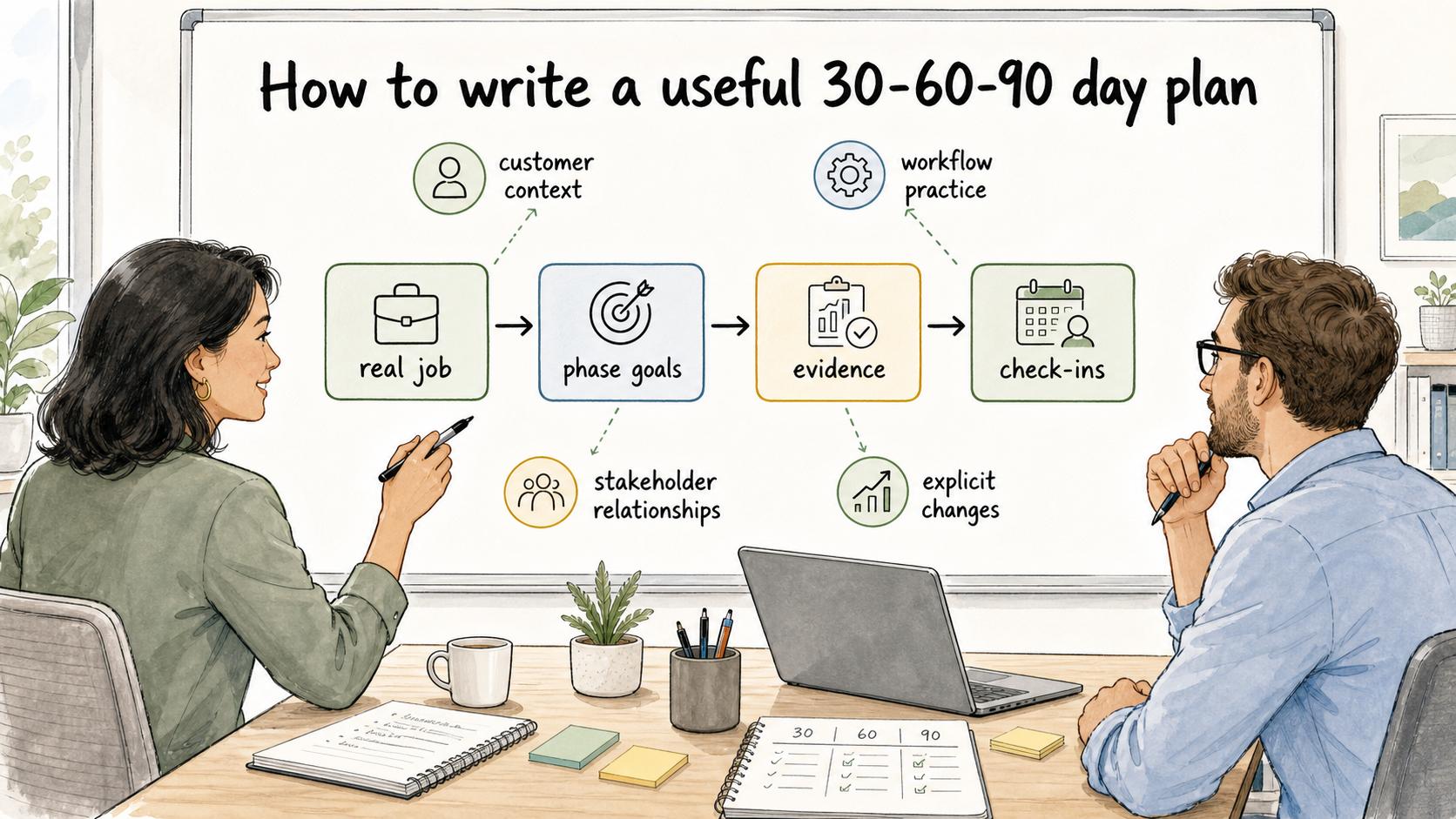
Start with the role's real job, not a generic onboarding checklist. The plan should connect to the work the person will actually do. If the role depends on customer conversations, include customer context. If it depends on internal systems, include workflow practice. If it depends on cross-functional trust, include stakeholder relationships.
Then define evidence for each phase. "Understand the product" is not a milestone. Better evidence might be: can explain the top customer use cases, shadowed three implementation calls, completed a product walkthrough, and documented five open questions. Evidence turns vague ramping into observable progress, which fits goal-setting research showing that specific goals outperform vague instructions to do one's best. 4
Keep the plan flexible without making it mushy. A 30-60-90 day plan should change when the role, team priorities, or business context changes, but every change should be explicit. If the first 30 days are consumed by urgent customer escalations, the manager and employee should reset expectations instead of pretending the original plan still applies.
30-60-90 day plan examples
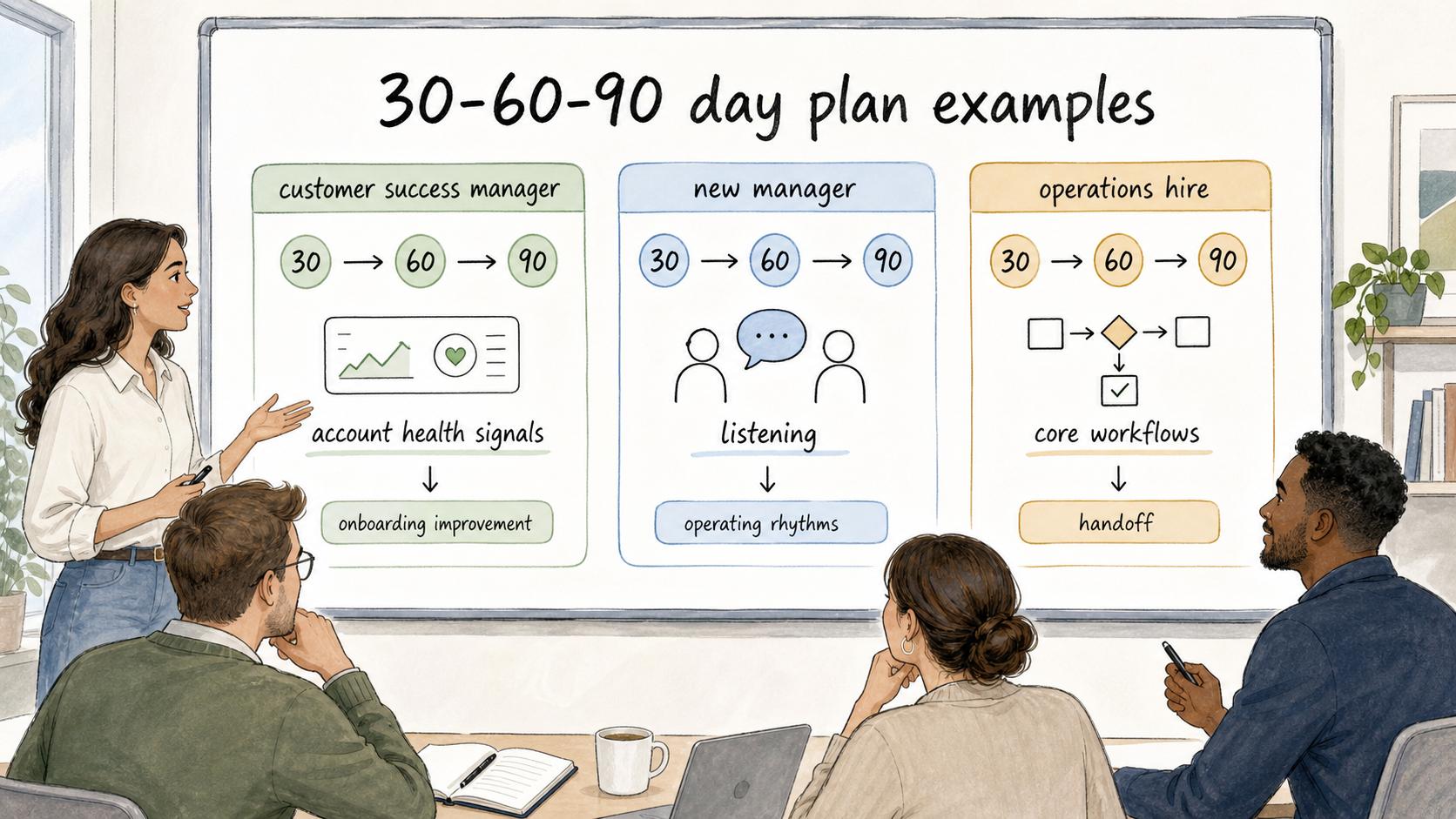
For a customer success manager, the first 30 days might focus on learning customer segments, renewal process, product workflows, and account health signals. Days 31-60 might include owning a small book of accounts with manager review. Days 61-90 might include identifying one onboarding improvement and presenting a plan to reduce repeated customer confusion.
For a new manager, the first 30 days might focus on listening, understanding team responsibilities, reviewing metrics, and mapping stakeholder expectations. Days 31-60 might include clarifying operating rhythms and coaching patterns. Days 61-90 might include making one or two deliberate changes to team process, not rewriting everything at once.
For an operations hire, the plan might start with observing core workflows, then move into running repeatable processes, then end with documenting a bottleneck or improving a handoff.
Common mistakes
One mistake is making the plan a list of activities instead of outcomes. "Attend meetings" and "review docs" may be necessary, but they don't prove readiness. The plan should say what the person can do or explain after those activities.
Another mistake is overloading the first 30 days. New hires need enough context to avoid learning the wrong lessons. If the first month is packed with deliverables, they may optimize for looking busy instead of understanding how the team works.
A third mistake is writing the plan once and never revisiting it. The plan should be a coaching tool. Managers should use it in check-ins to ask what is clear, what is blocked, what expectations changed, and which workflows need better documentation.
Documentation takeaway
A 30-60-90 day plan works better when it links to the actual guides, SOPs, checklists, and examples the person needs. Otherwise the plan says "learn billing process" or "master onboarding workflow" without giving the employee the path to do it. Treat the plan as an index into the role's working knowledge, not just a standalone schedule.
How Trails helps
Trails can help teams turn key onboarding workflows into step-by-step guides and AI-narrated videos. That makes a 30-60-90 day plan more useful because each milestone can point to concrete process documentation instead of relying on shadowing, scattered notes, or repeated manager explanations.
FAQ
Who should create a 30-60-90 day plan?
The manager should usually create the first version, then refine it with the employee so expectations, milestones, and support needs are clear.
Is a 30-60-90 day plan only for new hires?
No. It can also help with promotions, role changes, new managers, internal transfers, and project leadership transitions.
What should happen after the first 90 days?
The plan should turn into a normal operating rhythm: role goals, recurring check-ins, development priorities, and process improvements for the next quarter.
Sources
- 1
SHRM. Complete Employee Onboarding Guide. www.shrm.org/topics-tools/topics/onboarding.
- 2
Bauer et al.. New Horizons for Newcomer Organizational Socialization. pure.ul.ie/en/publications/new-horizons-for-newcomer-organizational-socialization-a-review-m/.
- 3
Harvard Business School Alumni. Tackle the First 90 Days of Your Next Role. www.alumni.hbs.edu/careers/blog/post/tackle-the-first-90-days-of-your-next-role-a-5-step-process-for-success-on-the-job.
- 4
Locke and Latham. Building a Practically Useful Theory of Goal Setting and Task Motivation. pubmed.ncbi.nlm.nih.gov/12237980/.