
Glossary
GDPR compliance
 ChatGPT
 Perplexity
 Gemini
 Claude
What is GDPR compliance?
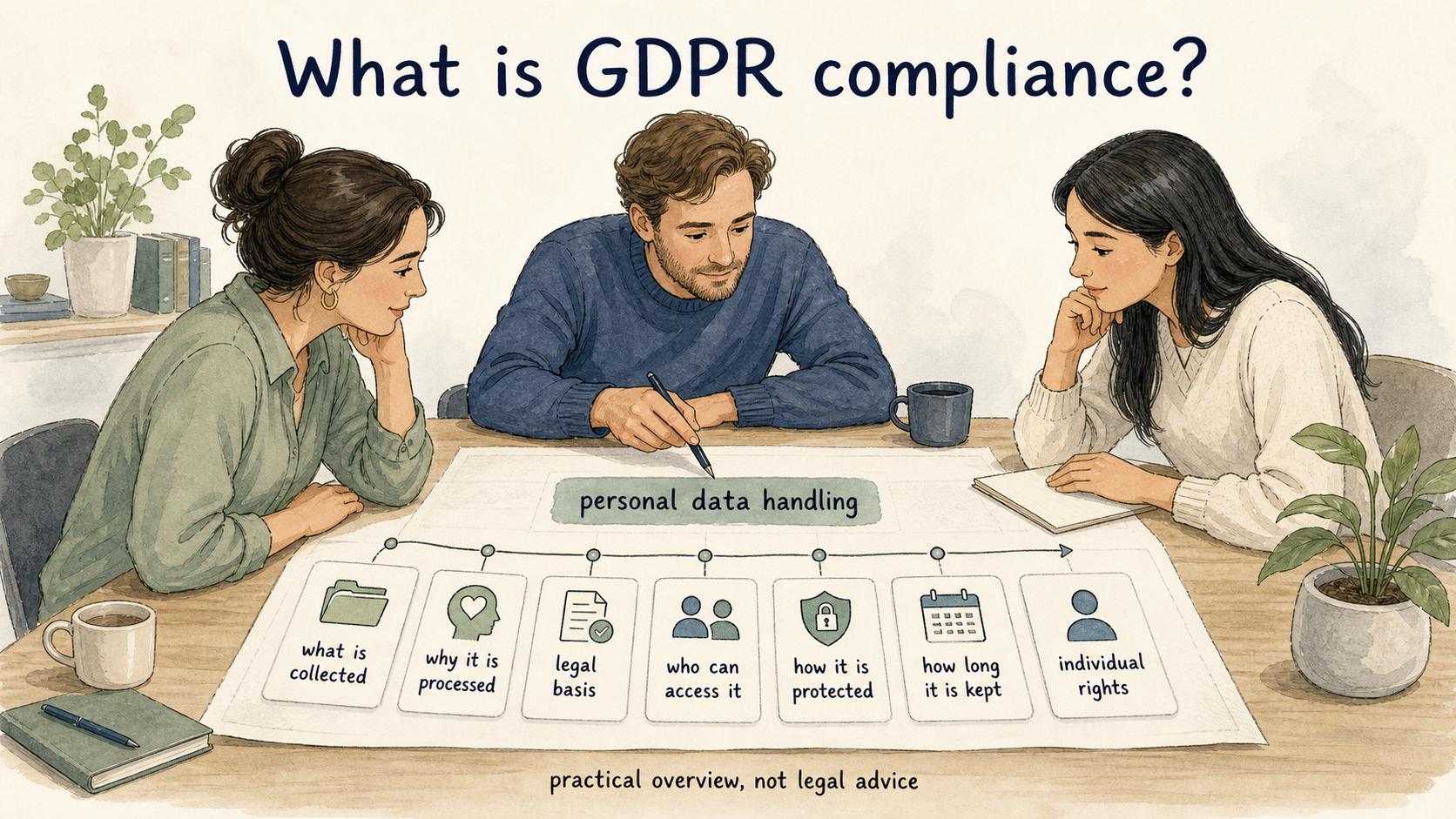
GDPR compliance means an organization can show how it handles personal data under the EU General Data Protection Regulation: what it collects, why it is processed, which legal basis applies, who can access it, how it is protected, retained, and handled when people exercise their rights. 1
This is a practical overview, not legal advice. Actual obligations depend on the organization, processing activity, role, location, data types, vendors, and applicable member-state rules.
Why GDPR compliance matters
The GDPR creates obligations for how personal data is collected, used, shared, secured, retained, and deleted. It can apply to organizations outside the EU when activities relate to offering goods or services to people in the EU or monitoring their behavior. 2
The hard part is that GDPR compliance touches ordinary workflows: marketing forms, CRM enrichment, support tickets, analytics, HR records, vendor onboarding, security access, deletion requests, training records, and incident response. Accountability means being able to explain and prove the process.
What GDPR compliance usually involves
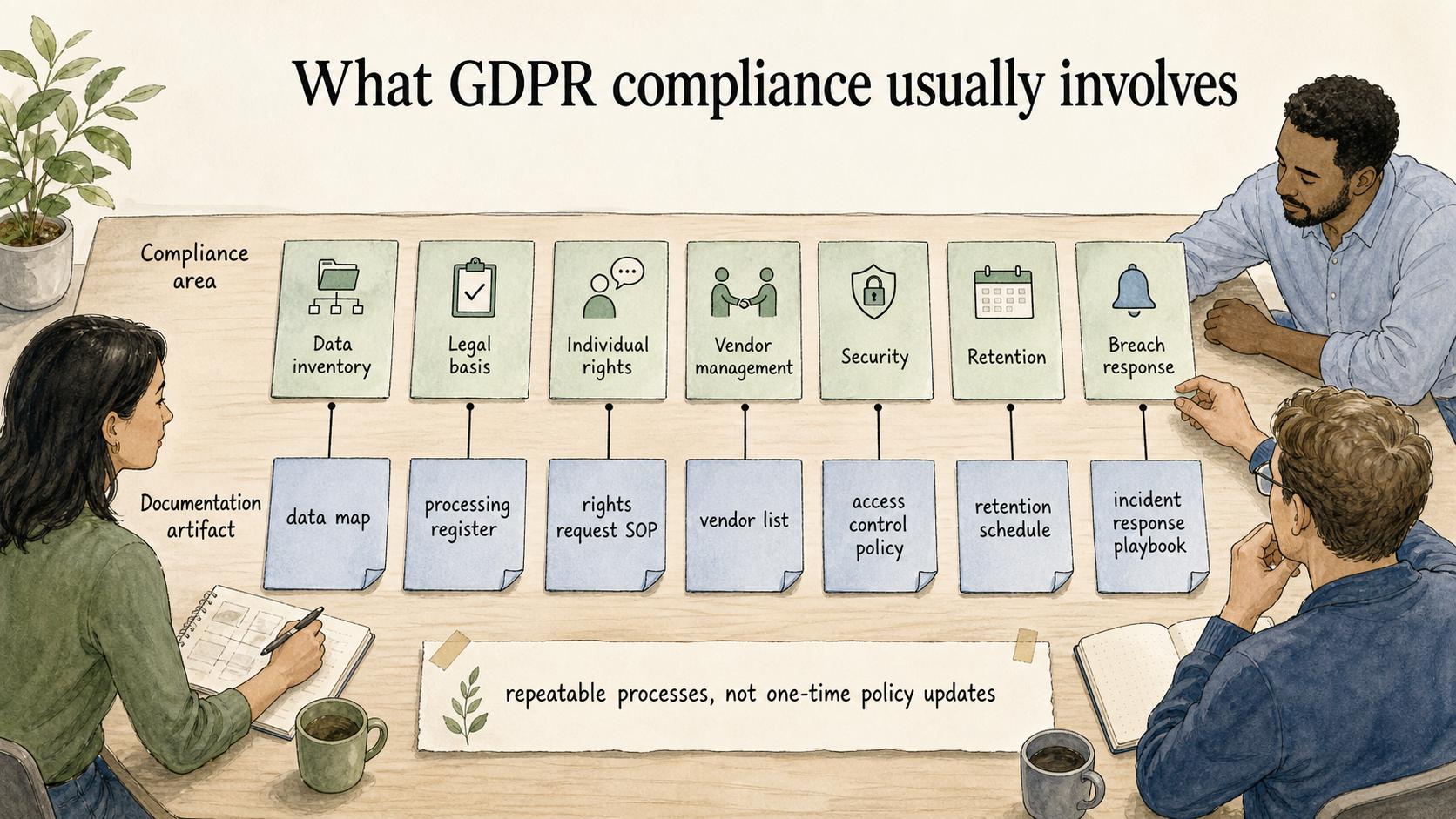
Compliance work varies by organization, but most teams need to make several areas operational rather than theoretical.
| Compliance area | Practical question | Documentation artifact |
|---|---|---|
| Data inventory | What data do we collect and where does it move? | Data map or record of processing activities |
| Legal basis | Why are we allowed to process it? | Processing register or approval notes |
| Individual rights | How are access, correction, deletion, restriction, or objection requests handled? | Rights request SOP and templates |
| Vendor management | Which processors handle data? | Vendor list, terms, and risk notes |
| Security and retention | How is data protected and how long is it kept? | Access policy, retention schedule, and deletion workflow |
| Breach response | Who evaluates a suspected breach? | Incident-response playbook |
Controllers, processors, and why roles matter
A controller determines the purposes and means of processing personal data; a processor handles data on behalf of a controller. 3
Controllers must facilitate data-subject rights requests, while processors assist; processors also have direct obligations around instructions, records, security, contracts, and breach notification where required. 4
Answer the role question per workflow. A SaaS company may be a processor for customer-uploaded data and a controller for its marketing, billing, hiring, and analytics data.
Common GDPR compliance mistakes
- Treating GDPR as a legal-document project instead of operational workflows.
- Not knowing where data lives, including spreadsheets, recordings, attachments, exports, AI prompts, and training materials.
- Relying on access controls without periodic review as permissions and vendors change.
- Forgetting evidence of decisions, requests, approvals, security reviews, and deletion actions.
GDPR compliance workflow template
Use this prompt to turn GDPR compliance from a vague obligation into a mapped process.
## GDPR compliance workflow

**Glossary term:** GDPR compliance
**Source:** Trails Glossary — trails.so/glossary/gdpr-compliance

---

### 01. Prompt

"Create a GDPR compliance workflow for [processing activity] at [organization/team]. Include processing purpose; data categories and data subjects; controller, processor, or both; legal basis to confirm with the privacy owner; systems and vendors; access-review controls; retention and deletion; rights requests; incident response; and accountability evidence. Flag every item that needs legal, privacy, security, or data-protection-officer review."
Documentation takeaway
GDPR compliance becomes easier to manage when each privacy obligation has a documented workflow behind it. The documentation should be practical enough for the people handling a deletion request, vendor change, exposed spreadsheet, screenshot, or suspected breach—not only written for auditors.
How Trails helps
Trails can help document repeatable GDPR operations, including access requests, permission reviews, privacy-safe screenshots, and support training.
FAQ
Does GDPR apply only to companies based in the EU?
No. It can also matter for organizations outside the EU when processing relates to offering goods or services to people in the EU or monitoring their behavior. Seek qualified legal or privacy advice for the exact application.
Is GDPR compliance the same as having a privacy policy?
No. It also depends on lawful processing, records, security, vendor controls, rights workflows, retention, incident handling, and accountability.
Sources
- 1
EUR-Lex. Regulation (EU) 2016/679. eur-lex.europa.eu/legal-content/EN/TXT/HTML/?uri=CELEX%3A02016R0679-20160504.
- 2
European Commission. Rules for business and organisations. commission.europa.eu/law/law-topic/data-protection/rules-business-and-organisations_en.
- 3
European Commission. What is a data controller or processor?. commission.europa.eu/law/law-topic/data-protection/rules-business-and-organisations/obligations/controllerprocessor/what-data-controller-or-data-processor_en.
- 4
EDPB. Respect individuals' rights. www.edpb.europa.eu/sme-data-protection-guide/respect-individuals-rights_en.