
Glossary
Enterprise Security
 ChatGPT
 Perplexity
 Gemini
 Claude
What is enterprise security?
Enterprise security is the organization-wide practice of protecting a company's systems, data, users, vendors, and business processes from security risks. It connects governance, access control, risk management, monitoring, incident response, employee behavior, and documentation into one operating model.
A useful enterprise security program makes four things explicit: what needs protection, who can access it, how exceptions are approved, and how the organization proves its controls are working.
Why enterprise security matters
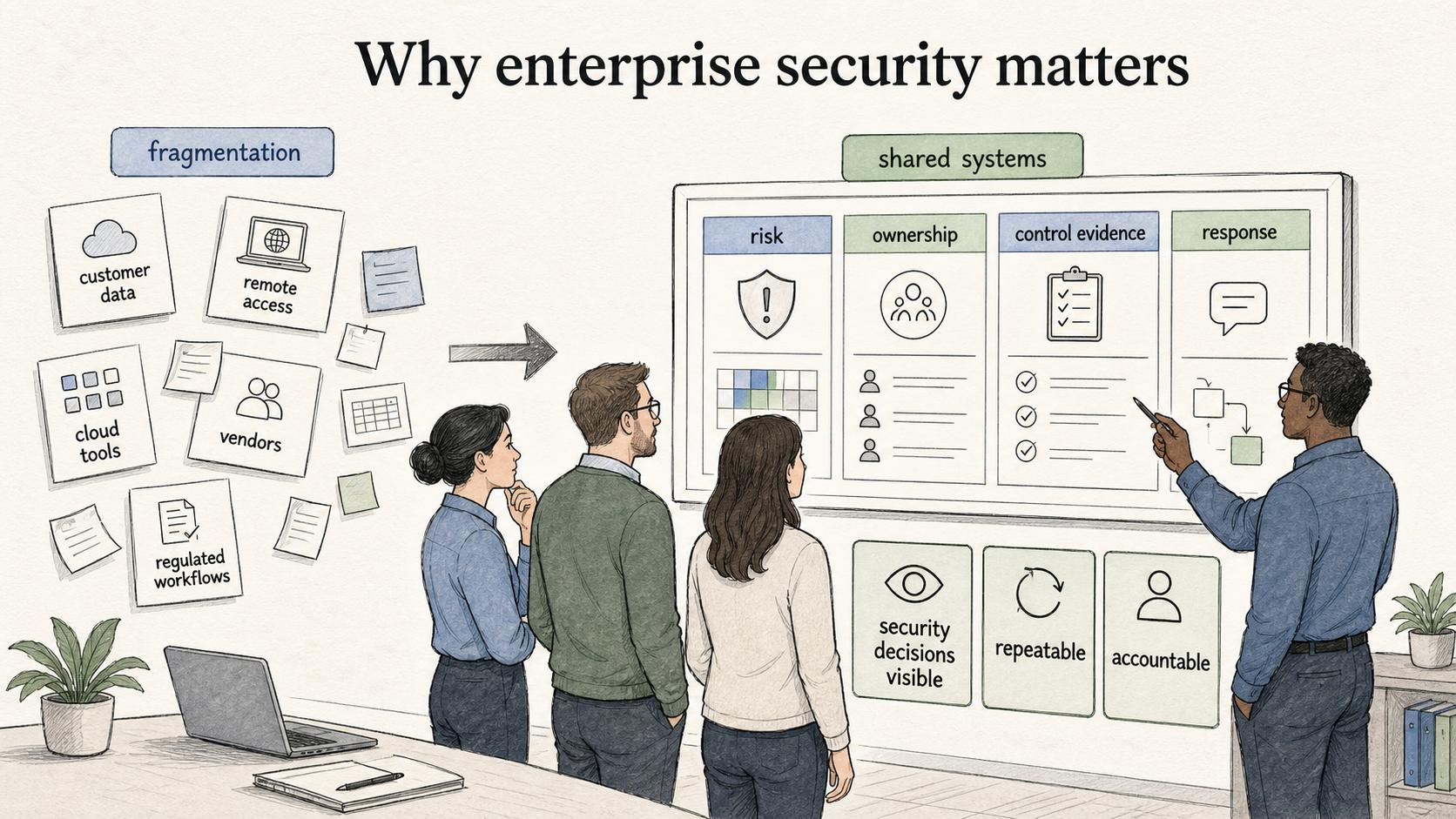
Enterprise security becomes important as soon as a business depends on shared systems, customer data, remote access, cloud tools, vendors, or regulated workflows. IBM's 2025 Cost of a Data Breach report put the global average breach cost at $4.4 million, a reminder that security failures quickly become business problems. 1 They affect sales, customer trust, compliance reviews, employee productivity, and recovery time.
The common failure mode is fragmentation. Identity rules live in one tool, device standards in another, vendor reviews in a spreadsheet, and incident response knowledge in the head of one senior engineer. Each piece may be reasonable on its own, but the whole system is hard to inspect. Enterprise security closes that gap by making security decisions visible, repeatable, and accountable.
Frameworks can provide useful structure. The NIST Cybersecurity Framework 2.0 organizes cybersecurity outcomes around Govern, Identify, Protect, Detect, Respond, and Recover. 2 ISO/IEC 27001 describes requirements for an information security management system. 3 A company doesn't need to turn every framework into bureaucracy, but it does need a clear operating rhythm for risk, ownership, control evidence, and response.
What enterprise security covers
Enterprise security usually spans several connected areas:
| Area | What it protects | What often breaks in practice |
|---|---|---|
| Identity and access | Accounts, permissions, authentication, privileged roles | People keep access after role changes or exceptions become permanent |
| Data protection | Customer data, internal records, intellectual property | Sensitive data is copied into tools with weak ownership or unclear retention |
| Endpoint and device security | Laptops, phones, browsers, managed devices | Device posture is assumed instead of verified before access is granted |
| Application and cloud security | SaaS apps, internal tools, production systems | Admin settings drift and nobody owns periodic review |
| Vendor and third-party risk | Tools, contractors, partners, integrations | Procurement approves a tool before security and data-flow questions are answered |
| Incident response | Detection, escalation, investigation, recovery | Teams know who to call, but not what to do first or how to preserve evidence |
Use the table to inspect the handoffs. Enterprise security usually fails where ownership crosses teams: IT to HR, procurement to security, support to legal, or engineering to operations.
Enterprise security vs cybersecurity
Cybersecurity focuses on protecting digital systems and data from threats. Enterprise security is the broader operating model that decides how cybersecurity is governed, adopted, and maintained across the business.
Multi-factor authentication is a cybersecurity control. Enterprise security sets the rules around it: which systems require MFA, who can approve an exception, when that exception expires, how access is reviewed after a role change, and what evidence is kept for audits or customer security questionnaires.
That distinction matters because many teams buy controls before they clarify behavior. A new tool can reduce risk, but it can't decide who owns vendor review, what counts as sensitive data, or when an incident becomes a legal or customer communication issue. Those decisions need documented policy and repeatable workflows.
How to make enterprise security operational
Strong enterprise security shows up in a few visible habits.
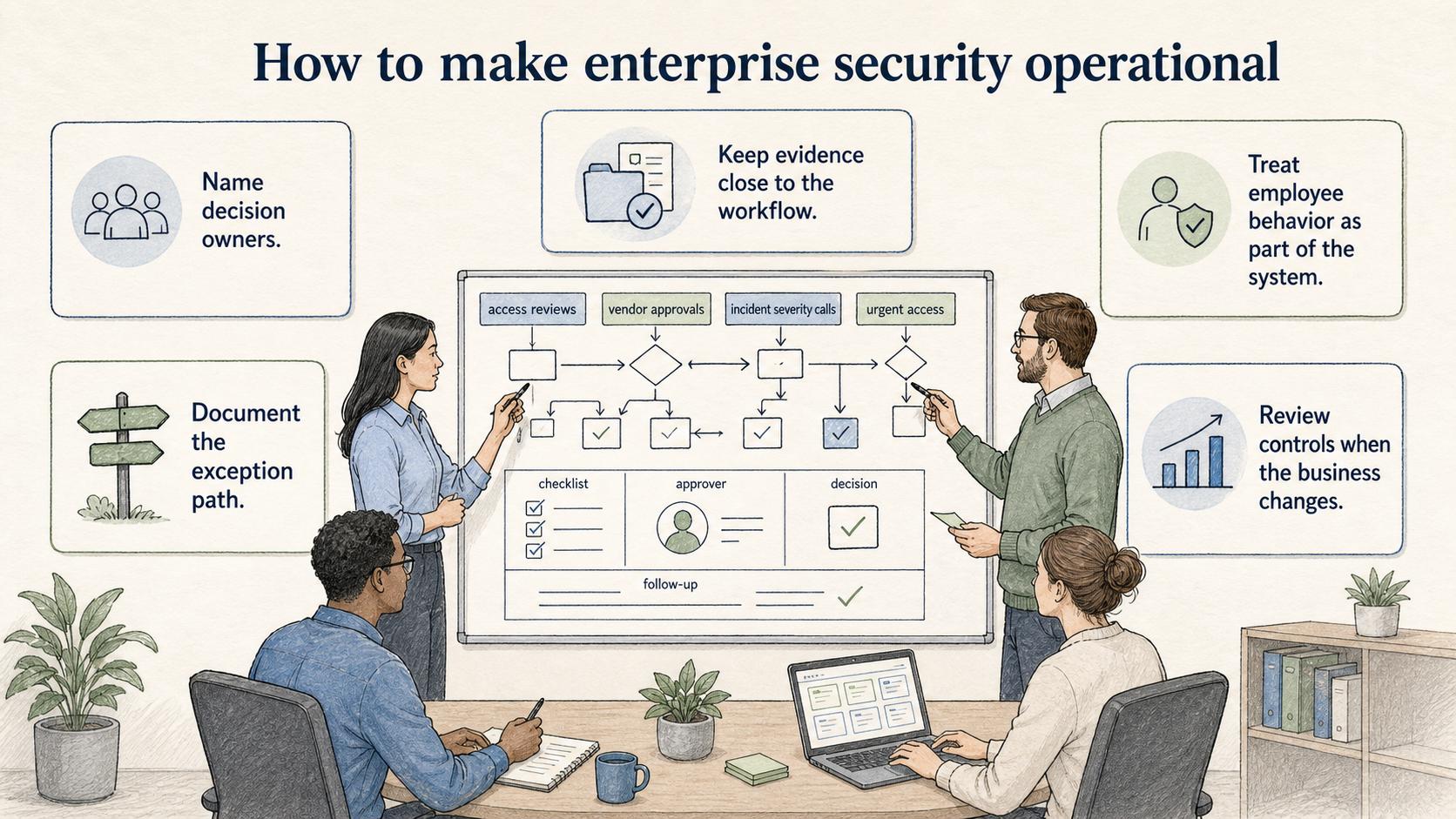
Name decision owners. A system owner can answer technical questions. A decision owner can approve risk, reject an exception, and explain the tradeoff later. Access reviews, vendor approvals, and incident severity calls all need decision owners.
Document the exception path. Most security programs look clean until someone needs urgent access, a contractor starts midweek, or a customer asks for a tool that hasn't been reviewed. Exceptions aren't automatically bad. Undocumented exceptions are hidden policy.
Keep evidence close to the workflow. If access reviews happen in one system and evidence is assembled manually three months later, the process will feel performative. Capture the checklist, approver, decision, and follow-up while the work happens.
Treat employee behavior as part of the system. Phishing training, password rules, device handling, and data sharing norms are the daily interface between policy and reality. Verizon's 2026 DBIR describes breaches involving the human element, software vulnerabilities, stolen credentials, and ransomware, which puts behavior, identity, and systems in the same operating model. 4 If the secure path is slower or unclear, people will route around it.
Review controls when the business changes. New markets, remote teams, contractors, acquisitions, AI tools, and new customer data all change the security picture. A control that worked for a 20-person company may be too informal for a 200-person company with enterprise customers.
Documentation takeaway
Enterprise security depends on documentation that is specific enough to guide action and short enough to use under pressure. The most useful artifacts are usually an access review procedure, vendor security intake checklist, incident escalation playbook, data handling guide, and role-change offboarding checklist.
The hidden test is whether a new manager, support lead, or IT admin could follow the workflow without guessing the unwritten parts. If they can't, the organization doesn't have a repeatable security process. It has experienced people compensating for missing documentation.
How Trails helps
Trails helps teams document the repeatable workflows behind enterprise security, such as access reviews, vendor intake, account provisioning, offboarding, and incident handoffs. A team can capture the workflow as someone performs it, turn it into a polished step-by-step guide, and create an AI-narrated video version for training or handoff. That keeps security procedures easier to explain, reuse, and maintain as tools or ownership change.
Sources
- 1
IBM. Cost of a Data Breach Report 2025. www.ibm.com/reports/data-breach.
- 2
NIST. NIST Cybersecurity Framework 2.0. nvlpubs.nist.gov/nistpubs/CSWP/NIST.CSWP.29.pdf.
- 3
ISO. ISO/IEC 27001 overview. www.iso.org/standard/27001.
- 4
Verizon. Verizon Data Breach Investigations Report 2026. www.verizon.com/business/resources/reports/dbir/.